
- Catalogs
- Portescap S.A.
- Motors to Optimize Home and Ambulatory Pumps


- Company
- Products
- Catalogs
- News & Trends
- Exhibitions
Motors to Optimize Home and Ambulatory Pumps

Motors to Optimize Home and Ambulatory Pumps
Healthcare providers are increasingly using home and ambulatory infusion pumps to reduce costs and improve patient quality of life by allowing treatment outside of hospital settings. These pumps are small, battery-powered, and provide mobility, enabling patients to continue therapy at home or on-the-go.
Design Challenges
Mobility: Traditional hospital pumps are stationary and use large hybrid stepper motors. In contrast, home and ambulatory pumps require compact, efficient motors like Coreless DC brushed motors to enhance mobility and reduce size and weight.
Patient Comfort: Home environments demand quieter pumps. Selecting appropriate motor and gearhead technology, such as spur gearheads and materials like plastic or ceramic, can reduce noise.
Cost Pressure: Motors are often the most expensive component. Cost-effective solutions include integrating components, using value-add features, and engaging with motor designers early in development.
Optimizing Mini Motors
Designers face challenges in optimizing home infusion pumps, particularly in motor selection, noise, and feedback. A linear peristaltic pump mechanism is used as an example to illustrate these challenges.
Specifications: Key specifications include a max flow rate of 1,200 mL/hr, feedback resolution of 100 pulses/mL, and a maximum noise level of 40 dB.
Motor Selection: A DC coreless gearmotor is preferred for its efficiency, compactness, and simplicity. A 16mm DC Brushed motor with a 27:1 gearhead meets the requirements.
Noise: Noise levels depend on motor and pump mounting and insulation. Testing during design is crucial.
Feedback: Feedback can be achieved with a 10-line system or a single line encoder, with enclosed magnetic encoders preferred for dust protection.
Conclusion
Design choices are interdependent, and early consideration of motor details is crucial. Collaboration with experienced motor suppliers can enhance pump performance.
Catalog excerpts
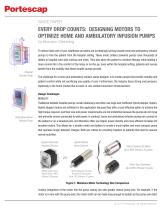
WHITE PAPER EVERY DROP COUNTS: DESIGNING MOTORS TO OPTIMIZE HOME AND AMBULATORY INFUSION PUMPS by Brandon Steinberg To reduce total cost of care, healthcare providers are increasingly turning toward home and ambulatory infusion pumps to free the patient from the hospital setting. These small, battery powered pumps save thousands of dollars in hospital room and nursing care costs. They also allow the patient to continue therapy while leading a more normal life in the comfort of the home or on-the-go. Even within the hospital setting, patients and nurses benefit from the mobility that these smaller pumps provide. Hospital Infusion Pump The challenge for a home and ambulatory infusion pump designer is to create pumps that provide mobility and patient comfort while not sacrificing any quality of care. Furthermore, the industry faces strong cost pressure, especially in the home market due to lower or non-existent insurance reimbursement. Design Challenges MOBILITY Traditional bedside hospital pumps remain stationary and often use large and inefficient hybrid stepper motors. Hybrid stepper motors are sufficient in this application because they offer a cost-effective option to achieve the high torque required, and their size and power requirements are not prohibitive because the pumps do not move Ambulatory/Home Infusion Pump and primarily remain connected to wall power. In contrast, home and ambulatory infusion pumps are carried on the patient or on a wheeled pole, and therefore often use higher power density and more efficient Coreless DC brushed motors. This allows for a smaller motor and battery to create a much lighter and more compact pump that operates longer between charges. Both are critical for providing freedom to patients that want to resume normal activities. Typical Stationary Hospital Solution Typical Mobile Home Solution vs. NEMA Single Stack Hybrid Motor ~40% Efficient, 108 grams 16mm Coreless DC Motor Up to 90% Efficient, 23 grams 16mm Diameter Coreless Brushed DC Gearmotor Up to 72% Efficient, 31 grams 16mm Spur Gearhead Up to 80% Efficient, 8 grams Figure 1: Miniature Motor Technology Size Comparison Custom integration of the motor into the pump casing can also greatly reduce pump size. For example, if the motor is in-line with the pump axle, the motor shaft can be made long enough to double as the pump axle itself, © 2017 Portescap. All rights reserved.
Open the catalog to page 1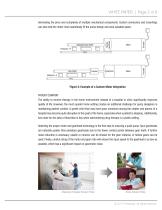
WHITE PAPER | Page 2 of 6 eliminating the price and complexity of multiple mechanical components. Custom connectors and mountings Integrated Cam Shaft Followers Shorter Gearhead can also help the motor more seamlessly fit the pump design and save valuable space. Figure 2: Example of a Custom Motor Integration PATIENT COMFORT The ability to receive therapy in the home environment instead of a hospital or clinic significantly improves quality of life. However, the much quieter home setting creates an additional challenge for pump designers in maintaining patient comfort. A gentle whirl that may...
Open the catalog to page 2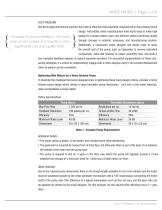
WHITE PAPER | Page 3 of 6 COST PRESSURE Due to the high performance required, the motor is often the most expensive component of a home infusion pump design. Fortunately, motor manufacturers have found ways to make high quality DC Coreless motors more cost effective without sacrificing quality The ability to receive therapy in the home environment instead of a hospital or clinic significantly improves quality of life. through changes in material, processes, and manufacturing location. Additionally, a resourceful motor designer can devise ways to lower the overall cost of the pump, such as integration...
Open the catalog to page 3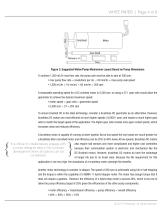
WHITE PAPER | Page 4 of 6 Figure 3: Suggested Motor/Pump Mechanism Layout Based on Pump Dimensions To achieve 1,200 mL/hr max flow rate, the pump axle must be able to spin at 200 rpm: max pump flow rate × revolutions per mL ÷ 60 min/hr = max pump axle speed 1,200 mL/hr × 10 rev/mL ÷ 60 min/hr = 200 rpm A reasonable operating speed for a DC coreless motor is 5,500 rpm, so using a 27:1 gear ratio would allow the gearmotor to achieve the desired maximum speed: motor speed ÷ gear ratio = gearmotor speed To ensure brushed DC is the ideal technology, consider a brushless DC gearmotor as an alternative....
Open the catalog to page 4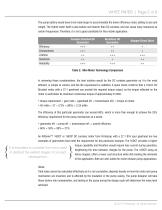
WHITE PAPER | Page 5 of 6 The pump battery would have to be made larger to accommodate the lower efficiency motor, adding to size and weight. The hybrid motor itself is also bulkier and heavier than DC coreless, and can cause noisy resonance at certain frequencies. Therefore, it is not a good candidate for this mobile application. Efficiency Compactness Lifetime Quietness Reliability Coreless Brushed DC Gearmotor +++ +++ ++ ++ +++ Stepper Direct Drive + + +++ ++ ++ Table 2: Mini Motor Technology Comparison In reviewing these considerations, the best solution would be the DC coreless gearmotor...
Open the catalog to page 5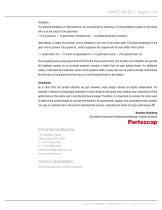
WHITE PAPER | Page 6 of 6 Feedback: The required feedback of 100 pulses/mL can be achieved by including a 10-line feedback system on the pump axle or at the output of the gearhead: 100 pulses/mL ÷ 10 gearmotor revolutions/mL = 10 pulses/gearmotor revolution Alternatively, a single line encoder can be installed on the rear of the motor shaft. This takes advantage of the gear ratio to achieve 150 pulses/mL, which surpasses the requirement for even better flow control: 1 pulse/motor rev × 27 motor rev/gearhead rev × 10 gearhead rev/mL = 270 pulses/motor rev The unsealed pump case means that...
Open the catalog to page 6All Portescap S.A. catalogs and technical brochures
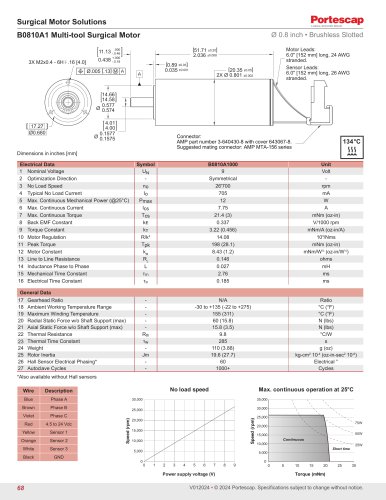 specifications_b0810a1
1 Page
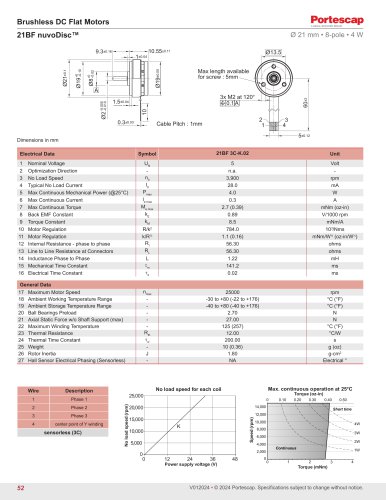 specifications_21bf
1 Page
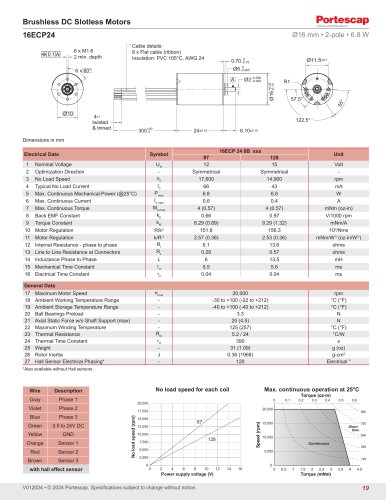 specifications_16ecp24
1 Page
Archived catalogs
 Portescap Medical Brochure
20 Pages
 Industrial Power Tools
8 Pages
 22ECT 35 - 48
2 Pages
 SMS ENCODER
1 Page
 35ecs
35ecs4 Pages
 White Paper Tattoo Machines
5 Pages
 Portescap Product Catalog
214 Pages
 BRUSH DC motor
12 Pages
 BRUSHLESS DC MOTORS
7 Pages
 CANSTACK stepper motors
7 Pages
 TurboDisc™ Stepper Motors
8 Pages
 B16C-0-24
1 Page
 16ECP24
1 Page
 Ultra EC Brushless Motors
8 Pages
 16ECP Ultra EC
2 Pages
 Miniature Motors
16 Pages


- Electromotor
- Synchronous motor
- Actuator
- Multipole motor
- Electric gearmotor
- Angular encoder
- Linear actuator
- Asynchronous motor
- Planetary gearbox
- Electric actuator
- Coaxial gearhead
- EC motor
- Incremental encoder
- Electromotor for industrial applications
- Three-phase motor
- Precision gearhead
- 24 V motor
- Compact gearhead
- Incremental rotary encoder