
- Catalogs
- Polat Group Redüktör
- PH/PB SERIES


- Products
- Catalogs
- News & Trends
- Exhibitions
PH/PB SERIES

PH/PB SERIES
The document outlines the specifications of PGR gear units, emphasizing their large surface area and non-contact labyrinth seal equipment. These features, along with reinforced fans, ensure lower maximum oil temperatures, enhancing workplace safety and reducing maintenance costs due to extended lubrication intervals.
Storage and Design:
PGR gear units are designed with a modular system, reducing the number of different mounting parts. Most of these parts are readily available in stock.
Important Safety and Operational Guidelines:
- Illustrations are examples and not binding; dimensions may change.
- Weights are average values and not binding.
- All rotating parts must be guarded according to safety regulations.
- Operating instructions must be followed before commissioning; gear units are delivered ready for operation but without oil filling.
- Oil quantities are guide values; the exact amount depends on the oil dipstick marks.
- Only approved lubricants should be used, with current instructions available on the PGR website.
- Gear units come with radial shaft seals; other sealing options are available upon request.
- Outdoor installations should avoid direct sunlight, and adequate protection must be provided by the customer.
Determination of Gear Unit Type and Size:
The document provides guidelines for determining the type and size of gear units based on transmission ratio, nominal power rating, and maximum torque checks. It includes tables for gear unit sizes and reduction stages.
Oil Supply and Lubrication:
All parts requiring lubrication are either submerged in oil or splash lubricated. Forced lubrication is available upon request. The document lists possible oil supply variations and provides selection criteria.
Thermal Capacity and Cooling Requirements:
The document outlines the determination of required thermal capacity, considering factors like ambient temperature, input speed, and lubrication method. It provides guidelines for selecting cooling systems based on operating conditions and specifies when auxiliary cooling is necessary.
General Information:
The document includes general information about the gear units, emphasizing the importance of following safety and operational guidelines to ensure proper functioning and longevity of the equipment.
The document outlines the requirements for power fractions and time fractions in gear unit design. The individual power fractions (PI, PII...Pn) must be greater than 0.4 x P2N and must not exceed 1.4 x P2N. If any power fractions exceed P2N, the sum of time fractions (XI, XII...Xn) must not exceed 10%. If these conditions are not met, P2äq must be recalculated. A brief peak power not included in P2äq calculation must not exceed Pmax = 2 x P2N.
For applications with variable torque but constant speed, gear units can be designed based on equivalent torque. A finite-life fatigue-resistant design may suffice for sporadic operations or low output speeds. For machines with constant speed and variable power, the gear unit can be designed based on equivalent power, calculated using a work cycle with phases requiring specific power levels and time fractions.
The selection process involves determining the gear unit type and size, calculating the transmission ratio, and checking the starting torque. The nominal power rating (P2N) is selected from a power rating table. The gear unit design includes considerations for oil supply and cooling requirements, with options for auxiliary cooling such as fans or cooling coils.
The document specifies the determination of required thermal capacity (Pt) for gear units. Depending on operating conditions, auxiliary cooling may be necessary. The gear unit with selected cooling must meet the required thermal capacity to ensure efficient operation.
The document provides a comprehensive list of symbols and definitions related to gear unit design, including factors for driven machines, prime movers, peak torque, thermal factors, and oil supply.
The document outlines specifications for gear units, including sizes and types such as PH...2-K, PH...3-K, PH...4-K, PB...3-K, and PB...4-K. It details the materials required for driven machine shafts, specifying C60N or higher strength.
Procedures:
Assembly instructions include greasing the driven machine shaft and ensuring it meets DIN 332 standards. The document also provides guidelines for using involute splines according to DIN 5480.
Standards:
Keyways must comply with DIN 6885/1, and bolts and nuts should adhere to DIN 931 and DIN 934 standards, respectively, with a material strength of 10.9.
Recommendations:
For lubrication, the document recommends using oils authorized by PGR, with specific viscosity limits outlined. It emphasizes maintaining a minimum operating viscosity of 25 cSt and provides guidance on dip and forced lubrication methods.
Lubrication Details:
Table 1 provides minimum temperature limits for different lubrication methods, while Table 2 offers an overview of possible oil supply variants. The document advises consulting PGR before using synthetic oil on a PG basis.
Preservation:
Preservation guidelines depend on the oil used, with storage times varying from 6 to 36 months. Specific conditions apply for gear units with labyrinth seals or when using synthetic oils.
Key Data from Tables:
- Minimum temperature limits for lubrication methods.
- Viscosity requirements for mineral and synthetic oils.
- Preservation durations based on oil type and storage conditions.
- Suitable for low to medium operating speeds.
- Characterized by wear but are easy to maintain.
- Require adequate lubrication due to local heat development at the sealing lip.
- Available as a commercial product and can be used in various designs and sizes.
- For repairs, split shaft seals are recommended for flanged shaft designs.
- Ideal for higher operating speeds.
- Non-contacting, wear-resistant, and maintenance-free due to no local heat development.
- Require minimal space for installation.
- Applicable only in stationary drives and should avoid extremely dusty environments.
- Require horizontal shaft levels and specific lubrication methods.
- Provide high operational reliability in dusty environments.
- Consist of a combination of three sealing elements to prevent dust ingress.
- Special design requirements for plants with high switching frequency or alternating load directions.
- Fitting dimensions for IEC standard motors are specified, with additional considerations for vertical gear units.
- Specific motor sizes and configurations are available upon request.
- Include dimensions and specifications for various seal types and motor sizes.
- Provide detailed measurements for flange dimensions and coupling designs.
The document outlines the permissible inclinations for gear units, with longitudinal inclinations up to ±5° and lateral inclinations up to ±2°. Additional adjustments can be made upon request, such as adding motor connection adapters, anti-vibration bases, and torque arm locks.
Noise Reduction:
To reduce noise levels in PGR gear reducers, conical gears are ground, and high-quality gears are processed using CNC programs. This ensures a broad contact surface, contributing to noise reduction.
Heat Conductivity:
PGR gear reducers are designed for high efficiency and suitable heat conductivity. The selection of reducers is based on the lowest maximum oil temperature, enhancing workplace safety and reducing maintenance costs due to longer lubrication intervals.
Storage and Design:
PGR gear reducers are designed with a modular system, reducing the number of different mounting parts. Most relevant parts are available in stock.
General Information and Safety:
Illustrations are examples and not binding. Dimensions and weights are subject to change. All rotating parts must be guarded according to safety regulations. Gear units are delivered ready for operation but without oil filling. Only permitted lubricants should be used, and the oil viscosity must match the data on the nameplate.
Selection Guidelines:
The document provides guidelines for selecting gear units, including determining the type and size, finding the transmission ratio, and checking maximum torque. It also covers the determination of oil supply and required thermal capacity. Gear unit sizes and reduction stages are provided in rating tables based on transmission ratio and nominal power.
Symbols and Calculations:
The document includes a key to symbols used in calculations and provides an example selection calculation for gear units, detailing the process of determining gear unit type, size, and nominal power rating.
The document outlines the components of the PB...3-H series, including inner and outer bushings, a cage lock, and a friction lining. It emphasizes the importance of consulting for other arrangements and designs.
Torque Distribution and Backstop Functionality:
In systems with multiple drives, there is a risk of excessive restoring torque on a single gear unit. The torque-limiting backstop is designed to evenly distribute this torque across all gear units, reducing peak torques.
Backstop Arrangement:
The installation of the lock is dependent on the desired direction of rotation, as detailed on page 248.
Gear Unit Sizes and Ratios:
The document provides detailed tables of actual ratios and gear unit sizes for different types within the PB...3-H series, ranging from sizes 43 to 183.
Mass Moments of Inertia:
Formulas are provided for calculating the mass moments of inertia for both input and output shafts, with considerations for configurations with and without fans.
Additional Components and Options:
Information on radial shaft seals, gear unit swing-bases, and additional variants available upon request is included. Technical data for heating elements and temperature monitors are also provided, with specifications for protection type and switching capacity.
Contact Information:
The document concludes with contact details for Polat Group Redüktör San. ve Tic. A.Ş., including their address, phone, fax, and email.
Catalog excerpts

Endüstriyel Tip Redüktörler & Yardımcı Tahrikli Redüktörler Industrial Type Gear Units & Bucket Elevator Drives Industriegetriebe & Becherwerksantriebe PH/PB SERIES
Open the catalog to page 1
Kataloğumuzda yer alan bilgileri, önceden haber vermeksizin kısmen veya tamamen değiştirme veya iptal etme hakkını saklı tutmaktayız. We reserve the right to our company to make changes or modifications to catalogue without prior notice. Eine änderung in diesem Katalog der Technischen Werte sowie Daten und Maßen und Gewichte bleiben v
Open the catalog to page 2
KALİTE POLİTİKAMIZ UNSERE QUALITÄTSPOLITIK POLAT GROUP REDÜKTÖR A.Ş. ürünlerinin kalitesinde en iyiyi yakalamak için; sektöründeki teknolojik gelişmeleri takip etmeyi, pazar payındaki istikrarını sürdürmek için müşterilerinin istek ve beklentilerine eksiksiz ve zamanında cevap vererek, sürekli artan müşteri memnuniyetini sağlamayı, eğitimli çalışanlarının performansını huzurlu bir çalışma ortamı sağlayarak arttırmayı ve bu şekilde kalite yönetim sistemini sürekli iyileştirmeyi kalite politikası olarak benimsemiştir. To achieve the best quality of its products, POLAT GROUP REDÜKTÖR A.Ş. adopts...
Open the catalog to page 7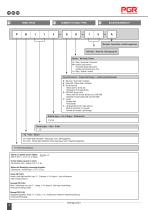
TEMEL TİPLER SUMMARY OF BASIC TYPES Montajlar / Assembiles / Ausführungsformen Tahvil (İN) / Ratio (İN) / Übersetzung (İN) Montaj / Mounting / Einbau H = Yatay / Horizontal / Horizontal M = Ayaksız yatay tasarım Horizontal design without feet Ausführung horizontal ohne Fuß V = Dikey / Vertical / Vertikal Çıkış mili tasarımı / Output shaft design / Ausführung Abtriebswelle S = Mil çıkışlı / Solid shaft / Vollwelle H = Delik milli / Hollow shaft / Hohlwelle D = Konik sıktırmalı Hollow shaft for shrink disk Hohlwelle für Schrumpfscheibe K = DIN 5480 (Kayıcılı şaft) Hollow shaft with involute splines...
Open the catalog to page 8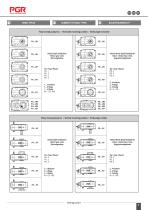
TEMEL TİPLER SUMMARY OF BASIC TYPES Yatay montaj pozisyonu / Horizontal mounting position / Einbaulage horizontal Helisel dişlili redüktörler Helical gear units Stirnradgetriebe Helisel-Konik Dişlili Redüktörler Bevel - Helical Gear Units Kegelstirnradgetriebe Tip / Type / Bauart PB...2 PB...3 PB...4 2...4 Kademe 2...4 Stage 2...4 Stufig iN = 5 - 400 PH...-HM PH...-DM PH...-KM PH...-FM PB...-HM PB...-DM PB...-KM PB...-FM Dikey montaj pozisyonu / Vertical mounting position / Einbaulage vertikal Helisel dişlili redüktörler Helical gear units Stirnradgetriebe 2...4 Kademe 2...4 Stage 2...4 Stufig...
Open the catalog to page 9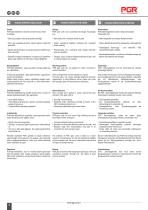
KARAKTERİSTİK ÖZELLİKLER CHARACTERISTIC FEATURES CHARAKTERISTISCHE VORZÜGE İmalat PGR dişli redüktörleri, tamamen yeniden dizayn edildi. Avantajları: Design PGR gear units are a completely new design. Advantages are: Konstruktion PGR Zahnradgetriebe wurden völlig neukonzipiert. Pluspunkte sind: • Daha az parçayla, daha fazla gövde büyüklüğü, • More sizes with a reduced variety of parts; • Mehr Baugrößen bei weniger Bauteilvarianten, • Artan güç kapasitesi ile daha yüksek işletme şartlarında güvenirlik, • Higher operational reliability combined with increased power capacity; • Höhere Betriebssicherheit...
Open the catalog to page 10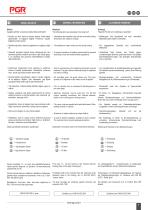
GENEL BİLGİLER GENERAL INFORMATION ALLGEMEINE HINWEISE Dikkat! Aşağıda belirtilen unsurlara mutlaka dikkat edilmelidir! Attention! The following items are absolutely to be observed! • Burada yer alan resim ve çizimler sadece örnek olarak gösterilmiştir ve bağlayıcı değildir. Firmamızın ölçüleri değiştirme hakkı saklıdır. • IIIustrations are examples only and are not strictly binding. • Abbildungen sind beispielhaft und nicht verbindlich. Maßänderungen bleiben vorbehalten. Dimensions are subject to change. Achtung! Folgende Punkte sind unbedingt zu beachten! • Belirtilen ağırlıklar, ortalama değerlerdir...
Open the catalog to page 11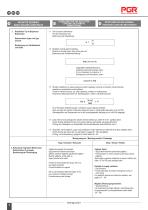
REDÜKTÖR SEÇİMİNDE DİKKAT EDİLMESİ GEREKENLER 1. Redüktörün Tipi ve Boyutunun Belirlenmesi Determination of gear unit type and size Bestimmung von Getriebebauart und Größe GUIDELINES FOR THE SELECTION CONSTANT MECHANICAL POWER RATING RICHTLINIEN FUR DIE AUSWAHL KONSTANTE LEISTUNG MECHANISCH 1.1 Tahvil oranının belirlenmesi Find the trasmission ratio Bestimmung der Übersetzung is = 1.2 Redüktör nominal gücünü belirleme Determine nominal power rating of the gear unit Bestimmung der Getriebenennleistung P2N ≥ P2 x f1 x f2 Aşağıdakileri belirleyebiliyorsanız, şirketimize danışmanıza gerek yoktur....
Open the catalog to page 12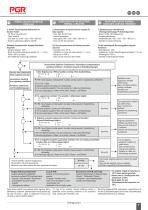
TERMAL KAPASİTE SEÇİMİ İÇİN KURALLAR GUIDELINES FOR THE SELECTION THERMAL CAPACITIES RICHTLINIEN FUR DIE AUSWAHL KONSTANTE LEISTUNG THERMISCH 3. Gerekli Termal Kapasite Belirlenmesi Pt Gereken Veriler: - Tip, Boyut, Nominal tahvil - Ortam sıcaklığı - Giriş devir hızı (1000 / 1200 / 1500 / 1800 d/d) - Daldırma yöntemiyle yağlamalı redüktör 3. Determination of required thermal capacity Pt. Data required: - Type, Size, Nominal ratio - Ambient temperature - Input speed (1000 / 1200 / 1500 / 1800 min-1) - Gear unit with dip lubrication 3. Bestimmung der erforderlichen Wärmegrenzleistungen Pt Notwendige...
Open the catalog to page 13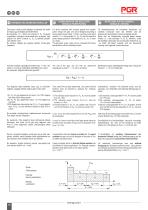
DEĞİŞKEN GÜÇ SEÇİMİ İÇİN KURALLAR Devir sayısı sabit ve gücü değişken iş makineleri için redüktör tespiti, güç denkliğine göre belirlenebilir. Bu kapsamda, I, II...n fazları için sırasıyla PI, PII...Pn güçlerini gerektiren iş döngüsü, temel olarak alınır ve burada, ilgili güçlerin her birinin sırasıyla XI, XII...Xn şeklinde yüzdelik süre dilimleri vardır. Bu verilerle, eşdeğer güç aşağıda belirtilen formüle göre hesaplanır: For driven machines with constant speeds and variable power ratings the gear unit can be designed according to the equivalent power rating. For this, a working cycle where...
Open the catalog to page 14All Polat Group Redüktör catalogs and technical brochures
 PYK Series
50 Pages
 PZ SERIES
12 Pages
 PEX Series
14 Pages
 PX / PPC SERIES
13 Pages
 PCS SERİSİ
491 Pages
 SV / ISV SERIES
133 Pages
 P - Pt/A SERIES
75 Pages
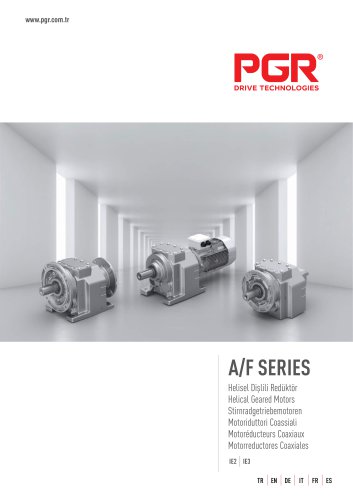 A/F SERIES
216 Pages
 GENERAL PART LIST
25 Pages
 PA-PF / PD-PM / PKD / PSH SERIES
104 Pages
 PA/PF SERIES
308 Pages
 PCS Series catalogue
491 Pages
 PSH Series catalogue
218 Pages
 PH-PB Series catalogue
259 Pages
 PKD Series Catalogue
372 Pages
- Electric gearmotor
- Planetary gearbox
- Coaxial gearhead
- Right angle gearhead
- Direct current gear-motor
- Compact gearhead
- Feeder
- Hollow-shaft gearhead
- Gear train gear reducer
- Gearbox for industrial applications
- Multi-stage gearhead
- Coaxial gearmotor
- Shaft gearhead
- Solid-shaft gear-motor
- Helical gear gearhead
- Gear train gearmotor
- Planetary gearmotor
- Compact gear-motor
- High-performance gearhead
- Low-noise gearhead