
- Catalogs
- Polat Group Redüktör
- PA/PF SERIES


- Products
- Catalogs
- News & Trends
- Exhibitions
PA/PF SERIES

PA/PF SERIES
The document is a technical catalog from Polat Group Redüktör, detailing their PA/PF series of helical gear units. It includes specifications, procedures, standards, and recommendations for selecting and using these gear units.
This section provides detailed technical data on the gear units, including calculations for radial loads and abbreviations used throughout the document.
The PA/PF series is introduced, highlighting their modular system and application areas. The document also includes a nomenclature section to clarify terms used.
Guidelines for selecting the appropriate gearbox are provided, emphasizing mechanical control, thermal limit control, and service factor checks. The importance of using recommended accessories and consulting PGR for non-standard applications is stressed.
Instructions for mounting positions, lubrication, and additional lubricant volume for specific positions are included. The document also covers oil cooling and mechanical seals.
Polat Group Redüktör emphasizes compliance with national and international standards, waste reduction, and continuous improvement of management systems. Employee training and customer satisfaction are prioritized.
The company's vision is to become a leading global entity that not only follows but creates developments. Their mission focuses on providing efficient and high-quality solutions using information technologies.
The catalog concludes with detailed selection tables, dimension tables, and part lists for various components, ensuring comprehensive guidance for users.
The document provides specifications for various transfer elements such as gears, chain sprockets, V-belt pulleys, and flat belt pulleys. Each element has a specific factor (fz) that affects the radial force on the shaft.
Allowable radial (FR) and axial (FA) forces for output shafts are listed in motor selection tables. Reinforced output shaft bearings are available for many gearbox types. The forces are valid for solid shaft output mountings of foot-mounted and flange-mounted gear units, provided that axial and radial forces do not act simultaneously. For applications with shock loads or long-term operation, a service factor greater than one should be considered, reducing allowable forces accordingly.
The point of force application is defined, and formulas are provided to calculate permissible radial force at any point on the shaft. The calculations consider service life and shaft stability, using two main formulas.
Radial load calculations are provided for different coupling types, including elastic couplings, spur gears, chain drives, and various belts. The formulas use required moment and diameter to determine radial load.
The document includes a list of abbreviations used in the calculations, such as service factor (fB), allowable axial load (FA), and output torque (M2).
The document describes the Helical Gear Units (PA/PF series) by Polat Group Redüktör, available in 27 different case sizes. These gear units range from single-stage (PA/PF 11 to 51) to multi-stage configurations, including 2-stage (PA/PF 02 to 52) and 3-stage (PA/PF 03 to 53) options. For high reduction ratios, 4, 5, and 6-stage reducers are available. The units are designed for heavy-duty applications with options for foot and flange mounting.
The gear units are developed according to the UNICASE principle, ensuring a one-piece body that integrates all bearings. This design enhances precision, rigidity, and durability, allowing for larger bearings and longer service life. The units are manufactured using advanced CNC technology, meeting international standards with high manufacturing tolerances. Materials used include GG 25-30, GGG 50-60, or aluminum.
The gear units offer high efficiency between 0.96 and 0.98 for each stage. They are designed to operate quietly and handle high loads at higher speeds with minimal heat generation. The units can deliver a maximum output torque of up to 26,000 Nm, with power ranging from 0.12 kW to 160 kW.
Regular lubrication of input shaft bearings is required, especially for units with W cylinders (free input shaft). Automatic lubricators or grease fittings should be used every 4000 operation hours, with Petamo GHY 133N recommended as a lubricant. An external fan can be requested to improve cooling.
The design and components, including gears, bearings, and shafts, comply with international norms such as DIN 3990 and DIN ISO 281. The units are designed to minimize vibration and noise, ensuring safe operation under challenging conditions.
The PA/PF series gear units are suitable for various industrial applications, offering flexibility with motorized and non-motorized versions, and input options including free input shaft, PAM, and IEC adaptors.
For gear units with automatic lubricators and motor body sizes 160 and above with IEC adapters, vertical mounting positions are not recommended. Direct motor mounting is advised. If vertical mounting (M4) is necessary, it must be checked and approved by the company under actual operating conditions. Maintenance intervals should be shorter in vertical positions (M2) due to potential reduction in the lifespan of sealing elements.
Automatic lubricators should be activated before use and replaced every 12 months for average daily working times of ≤ 8 hours, or every 6 months for longer daily operations. The grease is suitable for ambient temperatures between 0°C and 40°C. Special lubricants are required for temperatures outside this range.
IEC adapter couplings for motor frame sizes 63 to 180 are not fail-safe, except for sizes 160 and 180 when using automatic lubricators. Size 200 couplings are not fail-safe. Special precautions and calculations are necessary for applications involving potential accidents, such as lifts and cranes.
Compared to directly mounted motors, IEC adapters have additional shaft couplings and bearings, leading to higher load losses. Direct motor mounting is recommended for both technical and price advantages.
The document lists various applications for gear units, including mixers, blowers, brewing and distilling equipment, clay working machinery, compressors, conveyors, cranes, elevators, crushers, dredges, extruders, fans, feeders, food industry machinery, metal mills, rotary mills, and more. Each application is detailed with specific machinery types and operational conditions.
This document provides detailed specifications and configurations for various types of gear units and geared motors. The products are categorized based on mounting type, reduction stages, and adapter types.
- Foot Mounted Gear Units: Available in single, double, and triple reduction stages with options for IEC, PAM, and W adapters. Models include PA 02...PA 52 and PA 62...102 - PA 63...103.
- Flange Mounted Gear Units: Offered in single and double reduction stages, also with IEC, PAM, and W adapters. Models include PF 11...PF 51 and PF 62...102 - PA 63...103.
The document includes a comprehensive form to assist in selecting the appropriate gearbox. Key parameters include:
- Sector and Application Area: Information about the intended use and environment.
- Daily Working Hours: Options range from less than 4 hours to more than 16 hours.
- Revolution per Hour: Categories from 0-50 to over 1000 revolutions.
- Input and Output Options: Choices between motorized and non-motorized inputs, with specifications for motor power and rotation speed.
- Drive Type: Options include AC motor, servo motor, and hydromotor, among others.
- Mounting Position and Environmental Conditions: Details on mounting positions, altitude, ambient conditions, and temperature.
- Electrical Specifications: Voltage, frequency, and protection class (IP55, IP65, Exproof).
- Backstop and Brake Situations: Options for presence or absence of backstop and brake.
- ATEX Certification: Options for 2G, 2D, or none.
1. Lubrication should be changed more frequently than the specified operational hours if necessary. After changing lubrication, a slight decrease in lubrication level is normal and within tolerance.
2. Customers can request an oil level plug at an additional cost to monitor and correct oil levels.
3. Reducers are typically supplied with mineral oil, but synthetic oil is available for an extra charge.
4. Different sealing materials are required for temperatures below -30°C and above 60°C.
1. Mineral oil should be changed every 10,000 operational hours or two years.
2. Synthetic oil allows for extended intervals of 20,000 hours or four years.
3. It is recommended to clean the gearbox thoroughly during lubrication changes.
1. The backstop system allows rotation in only one direction (clockwise or counterclockwise) and can be removed if desired.
2. It operates without corrosion at speeds above 900 rpm.
1. Motor dimensions can vary based on customer options.
2. Hollow shaft tolerances follow ISO H7, while solid shaft tolerances vary based on diameter.
3. Flange centering tolerances are specified for different diameters.
1. Various types of lubricants are specified for different ambient temperatures and gearbox types.
2. Lubricants include mineral oils, synthetic oils, and greases, with specific brands and viscosity classes listed.
1. Detailed tables provide information on oil amounts in liters for different gearbox types and configurations.
2. Tolerances for shafts and flanges are specified according to international standards.
The document outlines the connection methods for servo motor adapters, specifying that SEP type adapters use a key connection, while SEK types use set screws. For high volume orders, production can accommodate different flange connections.
Details are provided for various gear unit types, motor sizes, and shaft dimensions. The document includes tables with specific measurements and configurations for different adapter types and motor platforms.
For vertical mounted gear units, an additional lubricant volume is recommended to prevent oil leakage due to foaming. This is especially advised for gear units with a ratio less than 20 and motor speeds over 1800 rpm. The document also describes an oil cooling system using a pump and heat exchanger to maintain optimal oil temperature.
Mechanical seals are recommended for environments with high liquid density and poor working conditions, providing maximum leakproofing and protection against dust and water.
The document describes the advantages of using motor platforms, including vibration reduction, corrosion resistance, and adjustable height for optimal belt tension. It provides guidelines for selecting the appropriate motor platform based on motor size and gear type.
Guidelines are provided for selecting V belts and pulleys, including adjustment ranges, belt lengths, and the number of belts required for different motor platform types.
- Specifications: The document provides detailed specifications for various motor types, including dimensions, power ratings, and pole numbers. It includes tolerance levels according to DIN standards and specific measurements for different motor components.
- Procedures: The document outlines the assembly and part lists for different motor configurations, such as foot-mounted motors, brake motors, and flange motors. It specifies the components required for each type, including housing, stator, rotor, bearings, and seals.
- Standards and Norms: Tolerances are specified according to DIN EN 50347 and DIN 6885 standards, ensuring compatibility and quality control in manufacturing and assembly processes.
- Recommendations: The document advises on the potential variation in static braking torque before the brake is run in, suggesting a possible change of ±20% from the reported value.
- Dimensions: Detailed dimensions for motor components such as shafts, bearings, and flanges are provided, with specific tolerances and measurements.
- Brake Specifications: The brake part list includes components like electromagnets, armature plates, torque springs, and discs, with specific dimensions and tolerances.
- Performance Parameters: The document lists static braking torque, maximum motor speed, input power, maximum noise levels, and weight for various brake models.
- Requirements: Compliance with DIN standards for tolerances and dimensions is critical for ensuring the quality and performance of the motors.
- Limitations: The static braking torque may vary by ±20% before the brake is fully operational, which should be considered during installation and testing.
- Best Practices: Adhering to the specified part lists and assembly instructions is essential for optimal motor performance and longevity.
Catalog excerpts

PA/PF SERIES Hel sel D şl l Redüktör Hel cal Gear Un ts St rnradgetr ebemotoren IE2 IE3 TR
Open the catalog to page 1
Kataloğumuzda yer alan bilgileri, önceden haber vermeksizin kısmen veya tamamen değiştirme veya iptal etme hakkını saklı tutmaktayız. We reserve the right to our company to make changes or modifications to catalogue without prior notice. Eine änderung in diesem Katalog der Technischen Werte sowie Daten und Maßen und Gewichte bleiben v
Open the catalog to page 2
KALİTE POLİTİKAMIZ UNSERE QUALITÄTSPOLITIK Polat Group Redüktör San. ve Tic. A.Ş., en iyiyi yakalamak için; İş Sağlığı ve Güvenliği, Çevre Güvenliği ve Kalite Yönetim Sistemi uygulamalarını, Üretim ve Hizmet sürecinin vazgeçilmez bir unsuru olarak değerlendirmekte ve uygulamaktadır. Polat Group Redüktör San. ve Tic. A.Ş., considers and applies Occupational Health and Safety, Environmental Safety and Quality Management System as the inseparable part of Production and Service process. Polat Group Redüktör San. ve Tic. A.Ş., um an das Beste zu gelangen; es bewertet und implementiert die Praktiken...
Open the catalog to page 6
TEKNİK BİLGİLER TECHNICAL INFORMATION TECHNISCHE INFORMATION Redüktör Seçimi Gearbox Selection Bir redüktör seçilirken, PGR üç fazlı asenkron AC motorları ve tek fazlı AC motorları kullanıldığını öngörür. Bu aynı zamanda teknik olarak karşılaştırılabilen tüm motorlar için de geçerlidir. Herhangi başka bir motor kullanımı halinde PGR'ye danışınız. Dişli ünitesinin seçimi yapılırken aşağıda belirtilen ana esaslara bağlı kalınmaz ise ünitede istenmeyen aşırı yüklenme durumları açığa çıkabilir. Bu durumda tarafımızdan verilen tüm garantiler kapsam dışına çıkar. Kullanılacak redüktörden yüksek verim...
Open the catalog to page 7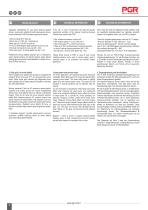
TEKNİK BİLGİLER TECHNICAL INFORMATION TECHNISCHE INFORMATION Aşağıdaki maddelerden iki veya daha fazlasının geçerli olması durumunda redüktörün belirli operasyonel durumu kontrol edilmelidir. PGR ile iletişime geçmenizi öneririz. If the two or more of below items are valid, the specific Wenn zwei oder mehr der folgenden Punkte zutreffen, sollte operational condition of the reducer should be checked. der spezifische Betriebszustand des Getriebes überprüft Please kindly contact with PGR. werden. Wir empfehlen Ihnen, sich an PGR zu wenden. ·Ortam sıcaklığı 40°C fazla ise ·Dönme hızı n1 1500 min-1...
Open the catalog to page 8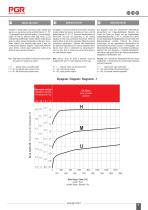
SERVICE FACTOR SERVİS FAKTÖRÜ Diyagram 1 günlük çalışma zamanına (saat), saatteki start sayısına ve uygulanılan yük tipi sınıflandırmasına “U”, “M”, “H” göre gerekli servis faktörünü gösterir. Çalışma düzgünlüğüne ve kütle hız faktörüne (maf) bağlı olarak, üç yük sınıflandırması belirlenmiştir. Hareket ettirilen mekanizmaya gelen dış etkiler çalışma düzgünlüğü sınıflamasını tanımlarken kütlesel ivme faktörüne bağlı olarak 3 farklı yük sınıflandırması belirlenir. Diagram 1 kullanılarak belirlenen servis faktörü, motorlu seçim tablolarında verilen servis faktörüne eşit ya da küçük olmalıdır. The...
Open the catalog to page 9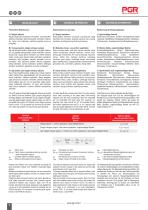
TECHNICAL INFORMATION TEKNİK BİLGİLER TECHNISCHE INFORMATION Determination of Load Class: U ) Düzgün çalışma Küçük karıştırıcılar, asansörler, konveyörler, montaj bantları, doldurma makinaları, bantlı konveyörler, temizleme makinaları, fanlar, test makinaları, santrifüj pompalar (ince sıvı pompalar). U ) Regular operation Small agitator, elevators, conveyors, mounting belt, filling machines, belt conveyors, cleaning machines, fans, testing machines, centrifugal pumps (fine liquid pumps). U ) gleichmäβiger Betrieb Kleinmischer, Elevatoren, Förderer, Montagebänder, Abfüllmaschinen, Bandförderer,...
Open the catalog to page 10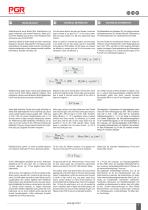
TEKNİK BİLGİLER TECHNICAL INFORMATION TECHNISCHE INFORMATION Redüktörümüzün servis faktörü fB'dir. Redüktörümüz için geçerli maksimum çıkış momenti Mamax'dır. Motor gücümüz P1'dir. Redüktör çıkış devrimiz n2'dir. Redüktörümüzün operasyonel çıkış momenti M2'dir. Fb is the service factor of our gear unit. Mamax is maximum output moment of our gear unit. P1 is the motor power. Gear unit output rotation is n2. M2 is the operational output moment. Der Betriebsfaktor des Getriebes (fb). Das gültige maximale Abtriebsdrehmoment für Getriebe (Mamax.) Motorleistung (P1) Abtriebsdrehzahl (n2) Abtriebsdrehmoment...
Open the catalog to page 11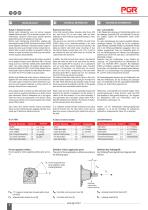
TEKNİK BİLGİLER Radyal ve Eksenel Kuvvetler Motorlu seçim tablolarında, çıkış mili üzerine müsaade edilebilir radyal kuvvetler (FR) ve eksenel kuvvetler (FA) ile listelenmiştir. Opsiyonel olarak birçok redüktör tipimizde güçlendirilmiş çıkış mili yataklarımız mevcuttur. Motorlu seçim tablolarında güçlendirilmiş yataklara etki eden radyal kuvvetler (FRGR) ve eksenel kuvvetler (FAGR) olarak değerleri belirtilmiştir. Tablolarda belirtilen radyal ve eksenel kuvvetler, ayak montajlı ve flanş montajlı dişli ünitelerinin dolu mil çıkışlı montajları için geçerlidir. Verilen bu eksenel ve radyal kuvvetlerin...
Open the catalog to page 12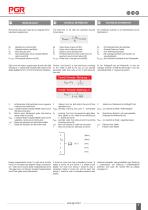
TEKNİK BİLGİLER Mil üzerinde ortaya çıkan radyal kuvvet, aşağıdaki formül kullanılarak hesaplanmıştır. TECHNICAL INFORMATION The radial force on the shaft was calculated using the formula below. TECHNISCHE INFORMATION Die auftretende Querkraft an der Getriebewelle wird wie folgt bestimmt: : Redüktör çıkış momenti [Nm] : Tablodaki radyal kuvvet faktörü : Etkin daire çapı [mm] : Seçim tablolarından alınan müsaade edilebilir radyal kuvvet [kN] FR vorth : Mil üzerindeki radyal kuvvet [kN] : Output torque of gear unit [Nm] : Factor which is taken from table : Effective circular diameter [mm] : Permitted...
Open the catalog to page 13All Polat Group Redüktör catalogs and technical brochures
 PYK Series
50 Pages
 PZ SERIES
12 Pages
 PEX Series
14 Pages
 PX / PPC SERIES
13 Pages
 PCS SERİSİ
491 Pages
 SV / ISV SERIES
133 Pages
 PH/PB SERIES
259 Pages
 P - Pt/A SERIES
75 Pages
 A/F SERIES
216 Pages
 GENERAL PART LIST
25 Pages
 PA-PF / PD-PM / PKD / PSH SERIES
104 Pages
 PCS Series catalogue
491 Pages
 PSH Series catalogue
218 Pages
 PH-PB Series catalogue
259 Pages
 PKD Series Catalogue
372 Pages
- Electric gearmotor
- Planetary gearbox
- Coaxial gearhead
- Right angle gearhead
- Direct current gear-motor
- Compact gearhead
- Hollow-shaft gearhead
- Gear train gear reducer
- Gearbox for industrial applications
- Multi-stage gearhead
- Coaxial gearmotor
- Shaft gearhead
- Solid-shaft gear-motor
- Helical gear gearhead
- Gear train gearmotor
- Planetary gearmotor
- Compact gear-motor
- High-performance gearhead
- Low-noise gearhead