- Catalogs
- PNR Italia
- MANUAL - SPRAY ENGINEERING HANDBOOK

- Company
- Products
- Catalogs
- News & Trends
- Exhibitions
MANUAL - SPRAY ENGINEERING HANDBOOK

MANUAL - SPRAY ENGINEERING HANDBOOK
PNR manufactures a wide range of spray nozzles for industrial applications, utilizing advanced technologies. The document provides an overview of products such as general-purpose spray nozzles, air-assisted atomizers, and tank washing systems. It highlights the importance of keeping technical literature updated and encourages customers to request the latest catalogues.
The document outlines the International System of Units (SI) and provides conversion tables for American units to SI units, temperature scales, and metric equivalents. It includes base and derived units relevant to fluid handling, such as length, mass, and pressure.
This section explains the function of nozzles in converting fluid energy into spray velocity, emphasizing their role in industrial processes. It covers nozzle types, coding, and factors like liquid viscosity and specific gravity affecting spray characteristics. Key parameters such as droplet spectrum, flow rate, spray angle, and distribution are discussed.
Information on PNR material codes and the properties of materials used in nozzle manufacturing is provided, including mechanical properties and chemical resistance, essential for selecting appropriate nozzle materials for specific applications.
The document includes data on pipes, economic pipe sizes, and pressure drop in clean steel pipes. It also provides flange dimensions and a sieve size conversion chart.
PNR offers a wide range of complementary products and systems to optimize spray jets and fluid control, including assembly fittings, air blowers, tank washing systems, and specialized nozzles for applications in paper mills, steelworks, and gas cooling.
The document concludes with gratitude to customers for their cooperation in developing efficient spray nozzles and systems, inviting feedback to improve the manual further.
Spray nozzles are used for cooling, washing, humidifying, metering liquids, applying products, and increasing liquid surface for heat transfer or chemical reactions. Effectiveness depends on the correct choice of nozzle specifications.
The performance of a spray nozzle is determined by characteristics such as liquid flow as a function of feed pressure, spray opening angle, nozzle efficiency, flow distribution evenness, droplet size distribution, and jet impact.
Various techniques produce different nozzle types, including pressure nozzles, turbulence nozzles, impact nozzles, and air-assisted atomizers.
Different spray patterns are used for various applications, such as full cone, flat jet, and hollow cone patterns.
Spray nozzles are identified using a coding system that describes product specifications, including thread type, special features, material code, capacity, flow rank, spray angle, and nozzle type.
Advanced software is used to optimize nozzle design by analyzing fluid dynamics, minimizing turbulence, and increasing efficiency.
The process involves the breakup of a liquid lamina into ligaments and then droplets, with different nozzle types producing varying droplet sizes.
The document explains pneumatic, two-phase, or twin-fluid atomization, crucial for precise spray characteristics in industrial applications.
PNR uses a Laser Interpherometer to measure droplet sizes and velocities, providing data on various mean diameters.
Understanding spray characteristics such as droplet size distribution, velocity, and number density is emphasized.
Using Bernoulli's law, the document explains how to calculate the discharge flow rate from a nozzle.
The spray angle affects spray coverage and density, with theoretical values provided based on nozzle spray angle and distance.
The document discusses spray nozzle geometry, focusing on capacity at a given pressure and the area covered by the spray.
Spray distribution is analyzed using patternators, providing data for distribution curves to identify spray patterns.
Distribution curves are evaluated based on uniformity, monotony, and symmetry.
Viscosity and specific gravity affect nozzle flow rate and spray characteristics, with correction factors applied for different liquids.
The impact of a spray jet is crucial in applications like steel descaling, with flow straighteners used to optimize impact force.
The document discusses nozzle design, emphasizing smooth internal profiles to minimize pressure drops and optimize flow.
The pressure drop through a nozzle is explained using the Bernoulli formula, highlighting the conversion of pressure energy into velocity energy.
The choice of material is crucial for nozzle longevity and performance, with various materials listed for different applications.
Detailed information on chemical composition, mechanical properties, and corrosion resistance of materials is provided, along with material standards.
Tables outline the tensile strength, corrosion resistance, and chemical compatibility of materials used in nozzle construction.
Different materials are recommended for specific applications based on their properties.
PNR Italia is headquartered in Voghera, Italy, with a global presence to support industrial needs worldwide.
Catalog excerpts

SPRAY NOZZLES FOR INDUSTRIAL APPLICATIONS SPRAY ENGINEERING BOOK
Open the catalog to page 1
GENERAL INFORMATION International system of units Prefix tables for SI units Conversion table : American units to SI units Conversion tables : temperature scales Metric and decimal equivalents of fractions of an inch Besides its main range of nozzles for industrial applications, PNR manufactures a wide range of complementary products and systems to optimize the use of spray jets and fluids control in most of the modern industrial processes LIQUID SPRAY AND SPRAY NOZZLES Liquid spray Spray nozzle types Spray nozzle coding Computerized fluid dynamics Spray generation Droplet spectrum Nozzle flow...
Open the catalog to page 2
GENERAL INFORMATION International system of units Prefix tables for SI units Conversion table : American units to SI units Conversion tables : temperature scales Metric and decimal equivalents of fractions of an inch GENERAL INTRODUCTION INFORMATION GENERAL INFORMATION Foreword Along many years PNR engineers have been involved with Customers to find out the appropriate solution to specific application problems in numberless different industries. This continuous cooperation has allowed us to gather a large quantity of information regarding practical spray nozzles applications, which we make available...
Open the catalog to page 3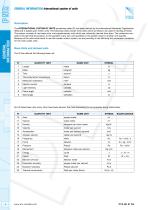
GENERAL INFORMATION International system of units GENERAL INFORMATION Description The INTERNATIONAL SYSTEM OF UNITS sometimes called SI, has been defined by the International Standards Organization (ISO) and is based upon metric units. The following notes include most units which are likely to be used in handing of fluids. The system consists of nine base units, and supplementary units which are coherently derived from them. The coherence consists in the fact that the product, or the quotient of any two unit quantities in the system result in another unit quantity. Because of the world wide trend...
Open the catalog to page 4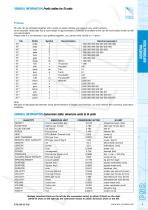
GENERAL INFORMATION Prefix tables for SI units Prefix yotta zetta exa peta tera giga mega kilo etto deca deci centi milli micro nano pico femto atto zepto yocto Million Thousand Hundred Ten Tenth Hundredth Thousandth Millionth GENERAL INFORMATION SI units can be indicated together with a prefix to easily indicate very large or very small numbers. As an example visible light has a wave length of approximately 0.0000005 m (meters) which can be more easily written as 500 nm (nanometers). Please note it is not allowed to use prefixes together, you cannot write 10.000 m = 1da-km Note Because of discrepancies...
Open the catalog to page 5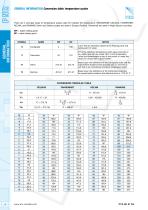
GENERAL INFORMATION Conversion table: temperature scales There are 4 principal types of temperature scales used for indicate the temperature: CENTIGRADE CELSIUS, FAHRENHEIT, KELVIN, and RANKINE; Kelvin and Celsius scales are used in Europe, Rankine, Fahrenheit are used in Anglo-Saxons countries. GENERAL INFORMATION MP = water melting point BP = water boiling point 0 and 100 are arbitrarily placed at the freezing point and boiling point of water. 0°F is the stabilized temperature when equal amounts of ice, water, and salt are mixed. 96°F is the temperature “when the thermometer is held in the...
Open the catalog to page 6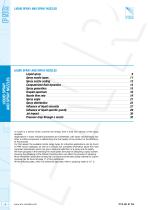
LIQUID SPRAY AND SPRAY NOZZLES LIQUID SPRAY AND SPRAY NOZZLES LIQUID SPRAY AND SPRAY NOZZLES Liquid spray Spray nozzle types Spray nozzle coding Computerized fluid dynamics Spray generation Droplet spectrum Nozzle flow rate Spray angle Spray distribution Influence of liquid viscosity Influence of liquid specific gravity Jet impact Pressure drop through a nozzle A nozzle is a device which converts the energy from a fluid into velocity of the spray droplets. Applications in many industrial processes are numberless, with spray nozzles being very often a critical component in determining the final...
Open the catalog to page 8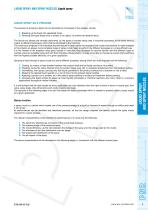
LIQUID SPRAY AND SPRAY NOZZLES Liquid spray LIQUID SPRAY AS A PROCESS The process of spraying a liquid can be described as composed of two phases, namely: 1. Breaking up the liquid into separated drops. 2. Directing the liquid drops onto a surface or an object, to achieve the desired result. The above two phases are normally performed, by the types of nozzles being used in industrial processes, at the same time by means of different techniques which shall be illustrated in the following. The continuous progress in the manufacturing techniques in recent years has requested the nozzle manufacturer...
Open the catalog to page 9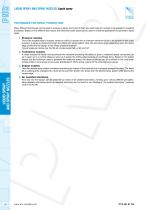
LIQUID SPRAY AND SPRAY NOZZLES Liquid spray TECHNIQUES FOR SPRAY PRODUCTION Many different techniques can be used to produce a spray, and most of them are used today for nozzles to be applied in industrial processes. Based on the different techniques, the following nozzle types can be used in industrial applications to generate a liquid spray. This is the simplest type of nozzles, where an orifice is opened into a chamber where the liquid to be sprayed is fed under pressure. A spray is produced through the orifice with spray pattern, flow rate and spray angle depending upon the orifice edge profile...
Open the catalog to page 10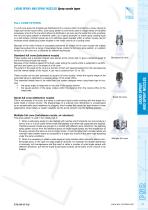
LIQUID SPRAY AND SPRAY NOZZLES Spray nozzle types FULL CONE PATTERN In a full cone spray the droplets are distributed into a volume which is limited by a cone, having its origin point at the nozzle orifice. Such spray pattern is commonly used in a large variety of industrial processes, since it is the one which allows to distribute in an even way the water flow onto a surface: the full cone spray pattern is therefore useful, as a typical example, to evenly spray cooling liquid on a still surface. Another typical use is to distribute liquid droplets within a certain volume, like for example evenly...
Open the catalog to page 11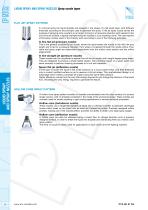
LIQUID SPRAY AND SPRAY NOZZLES Spray nozzle types FLAT JET SPRAY PATTERN In a flat jet spray the liquid droplets are sprayed in the shape of a flat liquid layer, with different thickness according to the principle used to generate the spray. A flat jet spray nozzle serves the purpose of spraying onto a surface or an object moving in a transverse direction with respect to the one of the jet surface, a typical example being the nozzles in a car washing tunnel. The vast majority of flat spray nozzles used in the industry work according to one of the following principles. In line flat jet (pressure...
Open the catalog to page 12All PNR Italia catalogs and technical brochures
 STEEL WORK NOZZLES Part 2 2024
32 Pages
 CATALOGUE - DESCALING NOZZLES
32 Pages