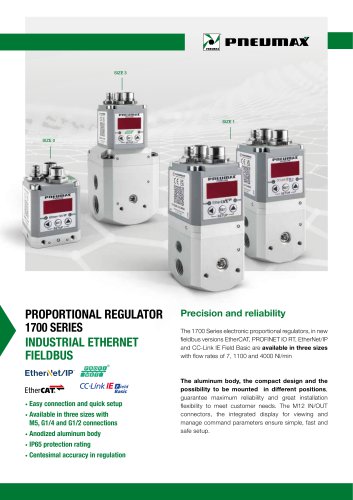
VACUUM TECHNOLOGY
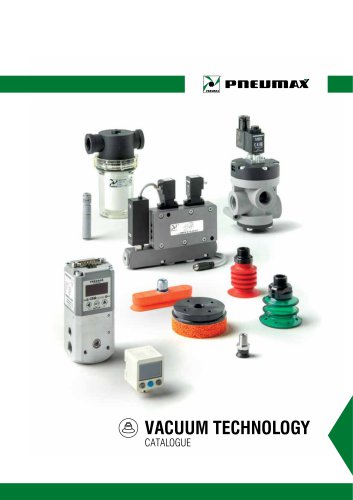
VACUUM TECHNOLOGY
Pneumax S.p.A., founded in 1976, is a prominent manufacturer of automation components, specializing in pneumatic components, electric actuators, and fluid control components. The company operates globally with 29 companies and over 850 employees, focusing on customized solutions across Industrial Automation, Process Automation, and the Automotive sector.
Vacuum is defined as a space with pressure lower than atmospheric pressure, categorized into low, medium, high, ultra-high, and extreme high vacuum. Industrial applications include low vacuum (0 to -20 KPa), industrial vacuum (-20 to -99 KPa), and process vacuum (higher than -99 KPa), used in industries like metallurgy, aerospace, food, microelectronics, and robotics.
Vacuum technology is utilized in moving fragile products, food packaging, robotics, cardboard box forming, transportation of powders and granules, vacuum clamping, evaporation and degassing, pick and place operations, vacuum infusion, thermoforming, and medical procedures.
Suction cups are crucial for lifting, clamping, or handling products that are difficult to grip. They adhere to surfaces by creating a pressure difference and are connected to vacuum pumps. Available in various shapes, they are used for gripping, handling, lifting, forming, palletizing, and positioning, suitable for materials like metals, plastics, and wood.
The document includes conversion tables for positive and negative pressure, as well as flow rate per unit of time, providing essential data for understanding and applying vacuum technology effectively.
Suction cups are categorized by volume, lifting force in vertical and parallel directions, and weight, with lifting force measured at different vacuum levels (-20 kPa, -60 kPa, -90 kPa). Material properties include color, hardness (Shore A), and working temperature range (10°C to 50°C).
- Round Bellows Suction Cups: Made of polyurethane, suitable for moving objects of various sizes and shapes, especially where level compensation is needed. They are mark-resistant and ideal for porous or irregular surfaces.
- Foam Rubber Suction Cups: Made from a special mixture called "NR," designed for rough and irregular surfaces, maintaining elasticity after multiple cycles, recommended for coarse surfaces like marble and textured sheets.
These devices manage height differences in applications, ensuring precise positioning. They come in three types: external spring, internal spring, and anti-rotation with internal spring, essential for systems where suction cups are fixed to rigid structures or used with robotic arms.
Suction cups and compensators are used in various industries for handling materials with different surface textures and conditions, including oily surfaces, food packaging, and rough surfaces like stone and marble.
The document emphasizes the versatility and durability of polyurethane suction cups and the importance of level compensators in ensuring precise and reliable handling in vacuum systems.
The document details specifications and performance characteristics of single-stage and multistage vacuum generators from the Series 1900, utilizing Venturi technology, designed for high suction capacity and suitable for dusty environments.
- Design: Use a large Venturi nozzle with a free-flow silencer for noise reduction.
- Applications: Suitable for environments requiring large suction capacity and varying degrees of vacuum (57 - 92 kPa).
- Technical Specifications: Operate at an inlet pressure of 5 bar, with air consumption ranging from 180 to 385 l/min, and noise levels around 72-75 dBA.
- Performance: Evacuation time and intake flow rate vary with the degree of vacuum, with maximum degrees of vacuum reaching up to 92 kPa.
- Design: Composed of multiple modules to optimize kinetic energy and improve volumetric flow rate while reducing air consumption.
- Applications: Suitable for industrial applications involving the transfer of powders, granules, and other materials.
- Technical Specifications: Operate at pressures between 1 to 8 bar, with air consumption and intake flow rates increasing with the number of modules used.
- Performance: Offer high suction capacity with low noise levels due to sound-absorbent materials.
Various silencers are available for different models to further reduce noise levels.
The Series 1900 vacuum generators are versatile and efficient solutions for applications requiring high suction power and adaptability to different industrial needs.
- Pressure Range: 1 to 8 bar
- Temperature Range: -10 to +80°C
- Weight: 178g
- Ordering Code: 19M38.M.15.SS.00
- Fluid: Unlubricated filtered air
- Noise Level: 93 dBA
- Material: PPS, SS, PA, NBR
- Maximum Inlet Pressure: 3.4 to 6 bar
- Degree of Vacuum: 89 to 92 kPa
- Intake Flow Rate: 1150 to 1500 l/min
- Air Consumption: 655 to 810 l/min
- Optimum Inlet Pressure: 3.4 bar
- Degree of Vacuum: 89 to 92 kPa
- Intake Flow Rate: 26 to 55 l/min
- Air Consumption: 19 to 47 l/min
- Multistage vacuum generators offer varied performance for industrial applications.
- Low noise levels due to sound-absorbent materials.
- Modular design allows for increased autonomous vacuum units.
- Suitable for controlling suction cup gripping systems for various materials.
- Equipped with solenoid pilot valves, vacuum switch, and flow regulator.
- Ensures compressed air savings and maintains vacuum within safety range.
- Ideal for industrial robotics and applications requiring high-performance equipment.
- Suitable for moving glass panes, marble slabs, ceramic slabs, plastic panels, cardboard boxes, and wood panels.
- Reduced Silencer G3/4” (19S34.R)
- Silencer G3/4” (19S34.S)
- Reduced Silencer G1” (19S10.R)
The document provides technical specifications and assembly instructions for modular multifunction vacuum generators, specifically the Series 1900, including information on various modules, screw kits, and configurations for assembling vacuum units.
The vacuum generators operate with unlubricated filtered air at a pressure range of 0 to 6 bar, with a flow rate of 185 Nl/m, operating at 24 VDC with a power consumption of 4 Watts, and rated with an IP65 protection class when using a connector. The operational temperature range is -5 to +50°C, and the weight is approximately 35.5 grams.
The document outlines how to assemble up to four vacuum units using standard screw kits or expand the manifold using threaded bars, with various module combinations provided, each with specific screw dimensions and codes.
The vacuum generators support a working pressure range of -100.0 to 100.0 kPa and a maximum supported pressure of 300 kPa, compatible with air and non-corrosive, non-combustible gases. The digital output features include a PNP N.O. configuration with a maximum load current of 80 mA and a voltage drop of ≤1 V.
The document describes a range of valves and solenoid valves designed for high flow rates and demanding industrial applications, including shut-off valves, poppet valves, and solenoid valves made from materials like technopolymer, aluminum, and stainless steel, designed to minimize pressure drops and maximize suction flow rates.
The valves have a minimum trigger flow rate of 25 l/min and are designed to close the suction line in case of air leakage, available in normally closed and normally open configurations, with specific construction characteristics for different applications.
The valves and solenoid valves have a service life of 10 to 15 million cycles under optimal conditions, do not require lubrication but should be protected from dirt and dust, with proper filtration recommended to prevent malfunctions.
This document provides technical specifications and operational characteristics for a series of valves and solenoid valves, focusing on vacuum technology, including details on various models, their construction, and operational parameters.
- Temperature Range: -5°C to +50°C
- Orifice Sizes: 15mm, 20mm, 25mm
- Working Port Sizes: G 1/2”, G 3/4”, G 1”
- Pilot Port Size: G 1/8”
- Minimum Piloting Pressure: 2 to 2.5 bar
- Response times vary based on the model and configuration (Normally Closed - N.C. or Normally Open - N.O.).
- For example, energized response times for N.C. range from 25ms to 55ms, while de-energized times range from 37ms to 320ms.
- Body, Operator, and End Cover: High resistance technopolymer
- Seals and Poppets: Oil resistant rubber (NBR)
- Piston and Shaft: Acetal resin
- Springs: AISI 303 stainless steel
- Fluid: Vacuum
- Various configurations for vacuum applications, including Normally Open and Normally Closed setups.
- Quick exhaust ports available for certain models to enhance response times.
- Different models have specific ordering codes, such as T773/V.32.11.1 and T771/V.32.0.1.BP.
- Weights vary from 330g to 680g depending on the model and configuration.
- Available in various voltages for both direct and alternating current.
- Standard and low consumption versions are available.
- Valves have an average service life of 10-15 million cycles under optimal conditions.
- No lubrication is required, but good filtration is recommended to prevent dirt accumulation.
- Ensure usage conditions align with specified limits for pressure and temperature.
This document is a technical catalogue for vacuum technology, focusing on valves and solenoid valves, including their specifications, ordering codes, and operational characteristics, providing detailed information on various series of valves, including Series N776, PVA, PVV, and regulators like Series 1700 and 1900.
- Valves and Solenoid Valves: The catalogue lists different models with their respective ordering codes and available voltages, both in direct current (D.C.) and alternating current (A.C.) forms, designed for various applications, with specifications such as weight, dimensions, and construction materials.
- Pad Valves Series PVA: Designed for fluid interception, featuring a bronze body and pneumatic control, with NBR, FPM, or PTFE seals, suitable for use with magnetic sensors.
- Vacuum Valves Series PVV: Designed for vacuum control with large suction capacities, featuring a 3-way body in aluminum or bronze and a double-acting compact cylinder for actuation.
- Construction Materials: Various materials are used, including anodized aluminum, brass, and chromed stainless steel, ensuring durability and efficiency.
- Operational Parameters: The valves operate under specific temperature ranges and pressures, with detailed specifications for each series.
- Manual Regulator Series 1700: Designed for high stability and accuracy in vacuum degree regulation, featuring a double diaphragm construction.
- Proportional Regulators Series 1900: These electronic regulators offer closed-loop control for dynamic pressure adjustments, suitable for various industrial applications.
- High precision and sensitivity in pressure regulation.
- Compatibility with magnetic sensors for enhanced functionality.
- Robust construction with materials like anodized aluminum and brass.
The document highlights applications in industrial settings where precise control of vacuum and pressure is critical, such as in pneumatic systems, packaging, and handling applications.
The document provides technical specifications and operational guidelines for the Serie 1900 vacuum technology regulators, including details on installation, operation, and electrical connections, as well as information on accessories and instruments.
The regulators are available in different sizes with specific pneumatic and electrical characteristics, with pneumatic connections varying by size, using a SUB-D 15-pole female connector for electrical connection, operating with a supply voltage of 24 VDC and specific current consumption rates.
The document outlines the procedure for pneumatic and electrical connections, emphasizing the importance of removing impurities from pipes and ensuring the air is filtered and dried, providing instructions for maintaining the system, including checking and replacing silencers and managing the solenoid valves during power interruptions.
The regulators use a closed-loop system with a pressure transducer that sends continuous signals to a microprocessor, which adjusts the solenoid valves accordingly, ensuring precise pressure management.
The regulators are designed to handle a range of pressures and flow rates, with specific requirements for fluid type and environmental conditions, constructed from durable materials like anodized aluminum and brass, with an IP65 rating for protection against dust and water.
The document lists various accessories, including vacuum switches, gauges, silencers, and filters, with detailed specifications for each, enhancing the functionality and adaptability of the regulators in different applications.
Catalog excerpts
VACUUM TECHNOLOGY CATALOGUE
Open the catalog to page 1
Vacuum technology Catalogue Vacuum Technology Catalogue Reliability, technology and quality of materials All Pneumax components for vacuum technology applications are made using carefully selected materials to ensure the best performance and the highest reliability. Overall dimensions and technical information are provided solely for informative purposes and may be modified without notice
Open the catalog to page 3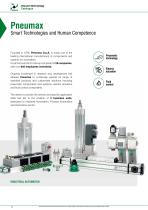
Vacuum technology Catalogue Smart Technologies and Human Competence Founded in 1976, Pneumax S.p.A. is today one of the leading international manufacturers of components and systems for automation. It is at the forefront of a Group comprised of 29 companies, with over 850 employees worldwide. Ongoing investment in research and development has allowed Pneumax to continually expand its range of standard products and customized solutions including pneumatic components and systems, electric actuators and fluid control components. Pneumatic technology Electric actuation Fluid control The desire to...
Open the catalog to page 4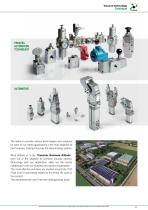
Vacuum technology Catalogue PROCESS AUTOMATION TECHNOLOGY The ability to provide various technologies and solutions for each of our clients applications is the main objective of the Company, making Pneumax the ideal strategic partner. What defines us is the “Pneumax Business Attitude”, born out of the capacity to combine industry sectors, technology and our application skills via the clients collaboration with our business and product specialists. The most effective solutions are studied around the TCO (Total cost of ownership) related to the entire life cycle of the product. This represents...
Open the catalog to page 5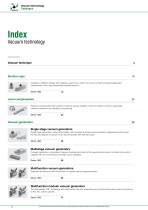
Vacuum technology Catalogue Vacuum technology Introduction Vacuum technique. Suction cups 10 Available in different shapes and materials, each one of which can meet a number of existing application requirements of the most demanding industrial sectors. Series 1900 10 Level compensators Range of compensators with external or internal spring, available in the anti-rotation version to guarantee maximum precision and reliability in positioning. Series 1900 23 Vacuum generators Single stage vacuum generators Single-stage generators, robust and reliable, with compact dimensions and suitable for applications...
Open the catalog to page 6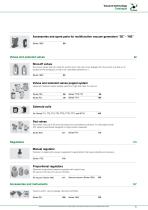
Accessories and spare parts for multifunction vacuum generators “SE” - “ME” Valves and solenoid valves Non-return valves that can close the suction line in the event of air leakage from the suction cup that is not located on the workpiece or that is not completely adherent to it. Valves and solenoid valves poppet system Valves and solenoid valves poppet system for high flow rates, for vacuum. Solenoid coils Pad valves, are one of the more functional and cost effective solutions, for intercepting fluids. PVV series is specifically designed for large suction capacities. Manual regulator Precision...
Open the catalog to page 7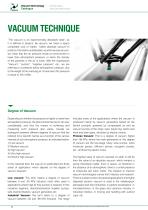
Introduction Vacuum technique “The vacuum is an experimentally attainable state”, as it is defined in physics. By vacuum, we mean a space completely void of matter, “called absolute vacuum”.In practice, this state is unattainable, so when we say vacuum, we mean that the air pressure inside an environment is lower than atmospheric pressure, or when the density of the particles in the air is lower. With the expressions “Vacuum”, “suction”, “negative pressure”, etc., we are referring to a pressure below atmospheric pressure, due to the weight of the overlying air. At sea level, this pressure is...
Open the catalog to page 8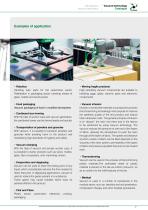
Introduction Vacuum technique Examples of application • Robotics Handling auto parts for the automotive sector, Palletisation in packaging sector, handling sheets of glass, marble and wood panels. Vacuum packaging of food in modified atmosphere With the help of suction cups and vacuum generators, the cardboard boxes can be formed easily and quickly. With vacuum, it is possible to transport powders and granules while avoiding harm to the product and maintaining high standards of hygiene and safety. With the help of vacuum and proper suction cups, it is possible to clamp products such as wood,...
Open the catalog to page 9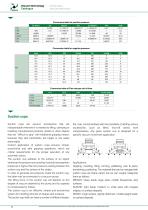
Introduction Vacuum technique Conversion table for positive pressure Gripping, handling, lifting, forming, palletising, pick & place, transferring, positioning. The materials that can be managed with suction cups are highly varied, but we can roughly categorise them as follows: METALS: heavy loads, large sizes, middle frequencies, dirty surfaces. PLASTIC: light loads, medium to small sizes with irregular shapes, no surface deposits. WOOD: rough surface, slightly deformed, middle-weight loads, no surface deposits. 8 Overall dimensions and technical information are provided solely for informative...
Open the catalog to page 10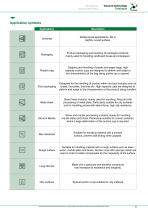
Application symbols STONE & MARBLE PACKAGING XXX XXX XXX PLASTIC PACKAGING BAG XXX XXX XXX XXX XXX XXX PLASTIC METAL BAG XXX XXX SHEET XXX XXX XXX PLASTIC XXX BAG XXX XXX XXX XXX XXX XXX XXX XXX XXX XXX XXX XXX XXX XXX XXX XXX XXX XXX XXX XXX XXX FOOD PACKAGING SLIP RESISTANCE XXX XXX XXX XXX XXX SLIP XXX RESISTANCE METAL XXX XXX SHEET XXX XXX XXX XXX ROUGH SURFACE METAL XXX XXX SHEET ROUGH XXX SURFACE XXX XXX METAL XXX SHEET XXX XXX XXX XXX XXX XXX XXX XXX XXX XXX XXX XXX XXX XXX XXX XXX XXX XXX XXX XXX XXX XXX XXX XXX XXX XXX XXX XXX XXX STONE & XXX XXX XXX MARBLE XXX XXX XXX XXX XXX XXX XXX...
Open the catalog to page 11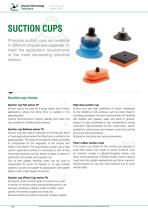
Vacuum technology Catalogue Suction cups Series 1900 SUCTION CUPS Pneumax suction cups are available in different shapes and materials, to meet the application requirements of the most demanding industrial sectors. Suction cup choice Suction cup Flat series TP Suction cup to be used for moving sheets and in those applications where the lifting force is parallel to the gripping plane. Internal reinforcements improve stability and make this cup suitable for handling heavy objects. Suction cup Bellows series TS Suction cup best used in particular for moving light items in those applications where...
Open the catalog to page 12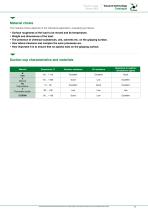
Suction cups Series 1900 The material choice depend on the individual application, evaluating as follows: • Surface roughness of the load to be moved and its temperature. • Weight and dimensions of the load. • The presence of chemical substances, oils, solvents etc. on the gripping surface. • How labour-intensive and complex the work processes are. • How important it is to ensure that no specks exist on the gripping surface. Overall dimensions and technical information are provided solely for informative purposes and may be modified without notice 11
Open the catalog to page 13All PNEUMAX catalogs and technical brochures
 PNEUMAX FLUID CONTROL
70 Pages
 PROCESS AUTOMATION
164 Pages
 GENERAL CATALOGUE 2025
1096 Pages
 AUTOMOTIVE CATALOGUE
240 Pages
 AUTOMOTIVE PRODUCT OVERVIEW
8 Pages
 AIRPLUS DIGITAL FLOW SENSOR
8 Pages
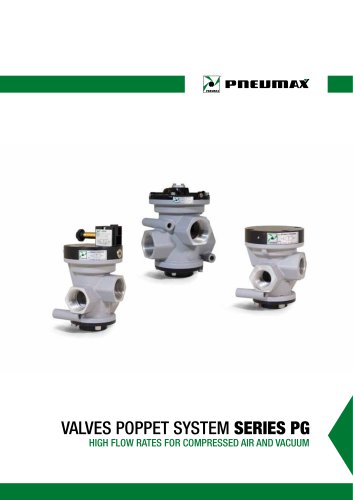 VALVES POPPET SYSTEM SERIES PG
19 Pages
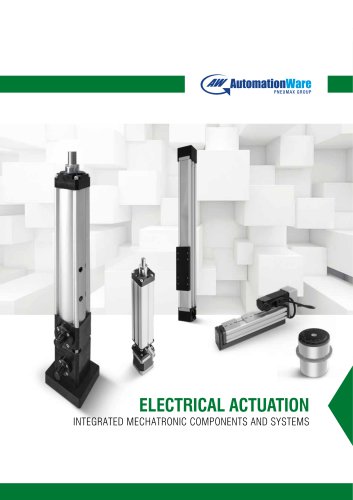 ELECTRICAL ACTUATION - AW
8 Pages
 PNEUMAX ACADEMY
12 Pages
 C O M P A N Y P R O F I L E
26 Pages
 SALES PROGRAM
170 Pages
 SOLENOID VALVES SAFELINE
20 Pages
 SERIES 1800 ELECTRIC CYLINDERS
38 Pages
 LT LINE
36 Pages
 ATEX OVERVIEW
28 Pages
 WOODWORKING INDUSTRY
8 Pages
 VOLUME BOOSTER
19 Pages
 PNEUMAX OVERVIEW
8 Pages
 MULTIPROTOCOL MODULE - SERIES PX
26 Pages