Electrical Secondary Air Pump and Secondary Air Valve
Electrical Secondary Air Pump and Secondary Air Valve
In 1990, Germany mandated the use of 3-way catalytic converters in new cars to reduce vehicle emissions. As regulations became stricter, additional exhaust gas after-treatment systems were needed. Pierburg GmbH developed a secondary air system, including a pump and air valve, to meet these demands. Over the past 15 years, expectations for these components have increased, requiring them to be light, quiet, compact, and reliable under extreme conditions.
Why Secondary Air?
Gasoline engines with stoichiometric operation can achieve over 90% conversion rates with catalytic converters, but only after reaching a light-off temperature of 300 to 350 °C. Most emissions occur during the cold start phase when the catalytic converter is not yet effective. The secondary air system injects air into the exhaust manifold, initiating exothermic oxidation of unburnt hydrocarbons, reducing emissions, and shortening the light-off time.
Secondary Air Pump
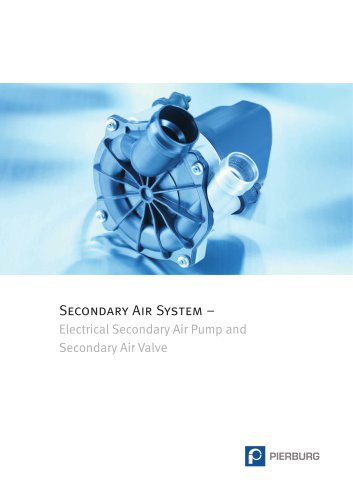
Pierburg's secondary air pumps, including a two-stage radial flow design and a side-channel blower, are known for quick air flow build-up and high delivery capacity. These pumps are reliable, rugged, and protected from dirt and splash water. They can be mounted on the engine or chassis, with isolation to prevent noise transmission.
Secondary Air Valve
The secondary air valve prevents backflow of exhaust gases and ensures fresh air flow into the exhaust manifold. Pierburg offers three valve types: the vacuum-controlled check valve (ARV), a self-opening valve (SLV), and an electric secondary air valve (ESV). The ESV, available since 2007, combines the benefits of ARV and SLV, offering quick response time and functional reliability even at low temperatures. It can be equipped with an integrated pressure sensor for diagnostic requirements.
Overall, Pierburg continues to enhance its secondary air system components to meet future applications and regulatory demands.
Catalog excerpts

Secondary Air System – Electrical Secondary Air Pump and Secondary Air Valve
Open the catalog to page 1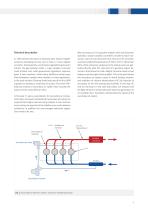
Technical description In 1990 vehicle emissions in Germany were reduced significantly by mandating all new cars to have a 3-way catalytic converter. Subsequently, as emissions regulations grew even stricter, the gap between what a 3-way catalytic converter could achieve and, what government regulations required, grew. It soon reached a level where additional exhaust gas after-treatments systems were needed, to meet regulations. In the early nineties, Pierburg GmbH was one of the first OEM suppliers to develop a secondary air pump. Since then Pierburg has evolved a secondary air system that includes...
Open the catalog to page 3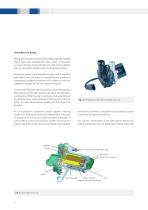
Secondary air pump Pierburg secondary air pumps of two-stage radial flow design (Fig. 2) have been established in the market. A secondary air pump working on the principle of a side-channel blower (Fig. 3) is the latest member of the Pierburg pump family. The service-proven radial flow blower lends itself to manifold applications and can resort to a comprehensive portfolio of components available worldwide which allows for their adaptation to virtually all and any customer requests. The new side-channel blower excels by an extremely quick air flow build-up and its high delivery capacity at minimal...
Open the catalog to page 4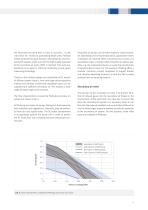
the secondary air pump best in class in acoustics, i.e. the radial flow fan. Thanks to painstaking detail work, Pierburg GmbH achieved this goal. Acoustic measurements of seriesproduced systems make sure that the high quality standard of the secondary air pump (SAP) is reached. This level was optimized once again in 2003 by introducing sound power measuring technology. Thanks to the modular design and availability of DC motors of different power outputs, now both large-volume gasoline engines and vehicles of restricted installation space can be supplied with sufficient secondary air. This enables...
Open the catalog to page 5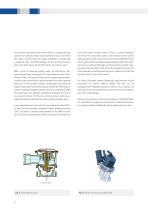
The vacuum controlled check valve (ARV) is a pneumatically operated on-off valve featuring low pressure loss. To activate this valve, vacuum from the intake manifold is supplied by a solenoid valve. The ARV operates on the check valve principle. This will reduce return flows when the valve is open With a view to reducing system costs, an alternative, selfopening valve was developed. This secondary air valve (SLV), shown in Fig. 5, will open as soon as the system pressure generated by the secondary air pump exceeds the valve opening pressure. The SLV enables system complexity to be distinctly...
Open the catalog to page 6
Pierburg GmbH · Alfred-Pierburg-Straße 1 · 41460 Neuss · GERMANY Tel. +49 2131 520-01 · Fax +49 2131 520-645 · www.kspg.com Subject to alterations. Printed in Germany. A|I
Open the catalog to page 8All Pierburg catalogs and technical brochures
 KS S800 – S803
4 Pages
 KS S705
4 Pages
 KS R30
4 Pages
 KS R25
4 Pages
 KS R21
4 Pages
 INNOVATION DRIVEN
11 Pages
 Secondary-air System
8 Pages
 Electric Drive Module
4 Pages
 Continuous casting stock ist
12 Pages
 KS P14
4 Pages
 KS R20
4 Pages
 Single-Vane Vacuum Pumps
8 Pages
 Variable Valve Trains
10 Pages