
- Catalogs
- Physik Instrumente
- Drivetrain Elements


Drivetrain Elements

Drivetrain Elements
Gearheads: Gearheads are positioned between the motor and drive screw to enhance position resolution and torque. Most models use preloaded gearheads to eliminate backlash.
Leadscrews: Leadscrews offer high resolution and smooth motion, consisting of a motor-driven screw with a nut coupled to the moving platform. They are self-locking due to higher friction, affecting velocity, motor power, and lifetime. Typical pitches range from 0.4 to 1 mm/revolution.
Recirculating Ball Screws: These have less friction than leadscrews, using rolling friction. They are efficient, not self-locking, and offer high velocities and long lifetimes. PI uses pitches of 0.5, 1, or 2 mm/revolution.
Threaded Spindle Drives: Utilize rolls instead of balls, achieving higher load ratings, velocities, and longer lifetimes.
Linear Ball Bearings: Balls run in a brass cage, preloaded for zero backlash and low friction, though load capacity is limited.
Recirculating Ball Bearings: High-precision stages with double linear rails, offering excellent load capacity, lifetime, and guiding accuracy.
Crossed Roller Bearings: Use line contact for stiffness and reduced friction, providing high guiding accuracy and load capacity.
Air Bearings: Utilize an air film for friction-free operation, offering superior guiding accuracy.
Flexure Guides: Based on elastic deformation, these guides are maintenance-free, vacuum compatible, and offer excellent guiding accuracy without friction.
Magnetic Bearings: Provide excellent guiding accuracy using magnetic levitation, suitable for vacuum environments.
Company Information: Physik Instrumente (PI) GmbH & Co. KG, headquartered in Germany, with subsidiaries worldwide, specializes in motion and positioning technologies.
Catalog excerpts
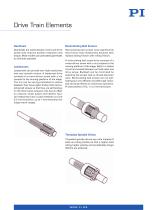
Gearhead Gearheads are used between motor and drive screw; they improve position resolution and torque. Most models use preloaded gearheads to eliminate backlash. Leadscrews Leadscrews can provide very high resolutions and very smooth motion. A leadscrew drive consists of a motor-driven screw with a nut coupled to the moving platform of the stage. The nut can be spring-preloaded to reduce backlash.They have higher friction than recirculating ball screws so that they are self-locking; on the other hand, however, this has an effect on velocity, motor power and lifetime. Typical leadscrews have a pitch between 0.4 and 0.5 mm/revolution, up to 1 mm/revolution for longer travel ranges. Recirculating Ball Screws Recirculating ball screws have significantly less friction than leadscrews because they replace sliding friction with rolling friction. A recirculating ball screw drive consists of a motor-driven screw with a nut coupled to the moving platform of the stage. Balls in a closed circuit are located between nut (ball case) and drive screw. Backlash can be minimized by selecting the proper ball-to-thread-diameter ratio. Recirculating ball screws are not selflocking but very efficient and offer high velocities and long lifetime in continuous operation. PI uses pitches of 0.5, 1 or 2 mm/revolution. Threaded Spindle Drives Threaded spindle drives use rolls instead of balls as rolling bodies so that a higher load rating, higher velocity and considerably longer lifetime are achieved.
Open the catalog to page 1
Linear Ball Bearing Recirculating Ball Bearings The balls run in a brass cage and are preloaded with regard to the hardened precision guiding shafts. Exact tolerances between guiding and bearing are necessary for zero backlash and low friction. Load capacity is limited. High-precision stages are equipped with precision double linear rails. Precision assembly allows these bearings to yield excellent results in terms of load capacity, lifetime, low maintenance and guiding accuracy. The moving part of the stages is supported by a total of four preloaded linear bearings with two rows of recirculating...
Open the catalog to page 2
Magnetic Bearings Flexure Guides Magnetic levitation ensures excellent guiding accuracy in a plane, both linear and rotational: The passive platform levitates on a magnetic field and is actively guided by it. Sequence errors are measured and compensated by very accurate noncontact sensors. Contrary to air bearings, which are also very accurate, magnetic bearings can also be used in vacuum. The motion of a flexure joint is based on the elastic deformation of a solid. Therefore, there is no static, rolling or sliding friction. Flexure elements have a high stiffness and load capacity and are very...
Open the catalog to page 3
Headquarters GERMANY_ © Physik Instrumente (PI) GmbH & Co. KG All contents, including texts, graphics, data etc., as well as their layout, are subject to copyright and other protective laws. Any copying, modification or redistribution in whole or in parts is subject to a written permission of PI. Although the information in this document has been compiled with the greatest care, errors cannot be ruled out completely. Therefore, we cannot guarantee for the information being complete, correct and up to date. Illustrations may differ from the original and are not binding. PI reserves the right to...
Open the catalog to page 4All Physik Instrumente catalogs and technical brochures
 A-143
A-1435 Pages
 A-811.CE
3 Pages
 G-902.RxI
5 Pages
 P-405
P-4054 Pages
 PRYY
PRYY7 Pages
 A-523
A-5235 Pages
 M-110 • M-111 • M-112 V6
4 Pages
 L-812
L-81218 Pages
 RS-40 V7
4 Pages
 A-68x
A-68x4 Pages
 G-901
G-9019 Pages
 G-910.RC02
6 Pages
 F-712.IRP
6 Pages
 G-910.RC01 • RC03
4 Pages
 C-663.12
3 Pages
 C-887.53x
5 Pages
 Piezoelectric Discs
7 Pages
 L-402
L-4025 Pages
 P-840
P-8404 Pages
 M-238
M-2385 Pages
 L-220
L-2205 Pages
 P-725
P-7259 Pages
 C-413
C-4133 Pages
 P-518 • P-528 • P-558
6 Pages
 PL112 – PL140
4 Pages
 U-628
U-6283 Pages
 P-545.3D8S
5 Pages
 P-611.XZ • P-611.2
4 Pages
 P-541.2 • P-542.2
5 Pages
 Leading in Precision Positioning
12 Pages
 Engineered Systems
8 Pages
 Precision Motion Control
4 Pages
 Motors and Drives
3 Pages
 Positioning with Piezo Systems
248 Pages
 Hexapod Positioning Systems
133 Pages
 PIRest Actuators - P-131
4 Pages
 High-Load Linear Stage - L-417
12 Pages
 PICA piezo amplifier module
3 Pages
 V-412 • V-418 • V-423
2 Pages
 S-335 Fast Tip/Tilt Platform
3 Pages
 Q-Motion® SpaceFAB
4 Pages
 A-131
A-1315 Pages
 d-891
d-8911 Page
 PI Datasheet V-275
5 Pages
 PI Datasheet V-273
5 Pages
 PI Datasheet VT-80
3 Pages
 A-65x
A-65x4 Pages
 A-60x.MTT
1 Page
 A-80x
A-80x3 Pages
 A-322
A-3223 Pages
 A-110
A-1103 Pages
 A-141
A-1413 Pages
 A-121
A-1215 Pages
 A-123
A-1235 Pages
 DT-34
DT-344 Pages
 D-015 • D-050 • D-100
5 Pages
 A-10x
A-10x3 Pages
 New Products 2015
48 Pages
 PI Products for Microscopy
36 Pages
 PI Electron Microscopy
16 Pages
 Piezo Motors and Stages
48 Pages
 Piezo Mike Linear Actuators
16 Pages
 PI Product Overview
34 Pages
 PILine® Ultrasonic Piezomotors
20 Pages
 Piezoelectric Actuators
74 Pages


Archived catalogs
 Piezo Amplifiers & Controllers
44 Pages
 Hexapods 6-Axis Stages
56 Pages
- Actuator
- Linear actuator
- Electric actuator
- Physik Instrumente positioning stage
- Physik Instrumente linear positioning stage
- Physik Instrumente motorized positioning stage
- Physik Instrumente precision positioning stage
- Screw actuator
- Motor controller
- DC actuator
- Physik Instrumente technology positioning stage
- 24-volt actuator
- Physik Instrumente 1-axis positioning stage
- DC motor controller
- 2-axis positioning table
- Precision actuator
- Extruded aluminum actuator
- Physik Instrumente compact positioning stage
- XY positioning table
- Physik Instrumente multi-axis positioning stage