
- Catalogs
- Physik Instrumente
- Catalog: PI Piezo Nano Positioning 2014/2015


Catalog: PI Piezo Nano Positioning 2014/2015

Catalog: PI Piezo Nano Positioning 2014/2015
Catalog excerpts
Piezo Nano Positioning 2014/2015
Open the catalog to page 1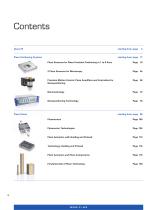
starting from page Piezo Positioning Systems starting from page 17 Piezo Scanners for Nano-Precision Positioning in 1 to 6 Axes Z Piezo Scanners for Microscopy Precision Motion Control: Piezo Amplifiers and Controllers for Nanopositioning Nanopositioning Technology Piezo Drives starting from page 99 Piezomotors Piezomotor Technologies Piezo Actuators with Guiding and Preload Technology: Guiding and Preload Piezo Actuators and Piezo Components Fundamentals of Piezo Technology
Open the catalog to page 2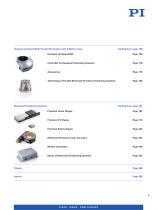
Hexapod and SpaceFAB: Parallel Kinematics with 6 Motion Axes Controller for Hexapod Positioning Systems starting from page 159 Technology of Parallel-Kinematic Precision Positioning Systems Motorized Positioning Systems starting from page 191 ^^ri^^^ Precision Linear Stages Page 192 ^^^rf^^^ Precision XY Stages Page 216 Precision Rotary Stages Page 222 J^^^L '.7 Motorized Precision Linear Actuators Page 234 Motion Controllers Page 244 Basics of Motorized Positioning Systems Page 252 PIEZO NANO POSITIONING
Open the catalog to page 3
No other company in the world offers a broader and deeper portfolio of precision motion technologies than the PI Group. Continuous growth through the development of novel products and technologies is one of the main characteristics of the PI Group. With more than 700 highly qualified employees all over the world, research and manufacturing centers on three continents and subsidiaries in 13 countries, the PI Group is in a position to fulfill almost any requirement with regard to innovative precision motion technology.
Open the catalog to page 4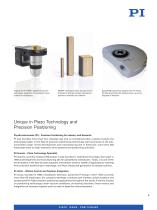
Typical for PI: PIFOC® objective scanner – nanometer resolution for precision focus control in microscopy PICMA® multilayer piezo actuators from PI Ceramic with all-ceramic coating for optimum reliability and lifetime SpaceFAB positioning system from PI miCos. Parallel kinematics for positioning in up to six degrees of freedom Unique in Piezo Technology and Precision Positioning Physik Instrumente (PI) – Precision Positioning for Industry and Research PI was founded more than four decades ago and is considered today a global market and technology leader in the field of precision positioning technology...
Open the catalog to page 5
PI UK PI France PI Italy miCos Iberia PI Japan PI Shanghai (with R&D and production) PI Singapore PI Korea PI Karlsruhe PI Ceramic PI miCos Locations for R&D, production, sales and service Locations for sales and service The PI Group is present in all key technology regions worldwide. Customers benet from its local representations around the globe in many ways: ■ Service facilities for diagnosis and repair as well as metrology equipment for tests, system calibration and quality assurance R&D departments, which are able to react promptly to the demands of the local markets and ensure a direct...
Open the catalog to page 6
Well-Positioned All Over the World 2004 Market launch of PICMA® multilayer piezo stack actuators 2004 Market launch of NEXLINE® Waldbronn, Germany high-performance piezo linear drives 1991 Market launch of 6-axis parallel-kinematics positioning systems (Hexapods) 2007 Market launch of NEXACT® piezo linear drives 1992 Foundation of PI Ceramic, Thuringia, 2010 More space for growth: Acquisition Germany; crucial step towards market leadership in nanopositioning of the expansion site next to the PI headquarters 1994 Market launch of capacitive position 2011 Acquisition of the majority shares 1998...
Open the catalog to page 7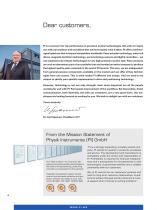
Dear customers, PI is a synonym for top performance in precision motion technologies. We wish to inspire you with our products and we believe that we have exactly what it takes. PI offers a technological spectrum that is beyond competition worldwide. Piezo actuator technology, voice-coil drives, magnetic levitation technology, nanometrology sensors and digital controllers – we can implement all of these technologies for any high-precision motion task. Piezo ceramics are such an elementary part of our portfolio that we founded an entire company to produce the highest quality piezo materials in...
Open the catalog to page 8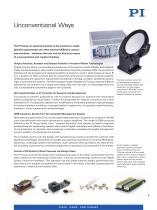
Unconventional Ways The PI Group can respond precisely to the customers‘ needs: eds: Specic requirements can often only be fullled by customomized solutions – solutions that can only be found by means eans of unconventional and creative thinking. Unique Solutions, Broadest and Deepest Portfolio in Precision Motion Technologies PI feels at home where unconventional solutions are of the essence in both industry and research. Today nanotechnology is also present in standardized industrial processes. With unconventional thinking and the broadest and deepest portfolio of precision motion technologies...
Open the catalog to page 9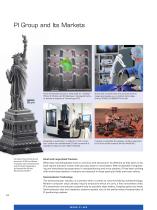
structure: Cells settle on ”handles“ Three-dimensional structu Bastmeyer, Zoological Institu(Photo: B. Richter and M. B Technology (KIT)) te, Karlsruhe Institute of Te In Hexapods in automation. I addition to PLC connecstandardized G-Code commands is tion, control over standard possible to allow for even higher flexibility Complex three-dimensional structure: A 300 μm Statue of Liberty was manufactured with 3D laser lithography by Nanoscribe (Photo: Nanoscribe GmbH) Drives that are both small and accurate improve imaging processes e.g. in medical technology. (Photo: SCHÖLLY FIBEROPTIC GmbH) Curiosity...
Open the catalog to page 10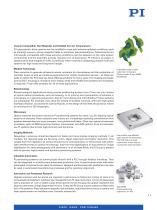
Vacuum-Compatible, Non-Magnetic and Suitable for Low Temperatures PI‘s piezoelectric drive systems can be modified to cope with extreme ambient conditions, such as ultrahigh vacuum, strong magnetic fields or extremely low temperatures. Piezoceramics are intrinsically compatible with these extreme conditions, but the selection of the right system components and the assembly process requires a lot of experience. PI miCos is an expert in classical drive technologies for UHV, in particular when it comes to designing complex multi-axis systems for high loads and long travel ranges. Medical Technology...
Open the catalog to page 11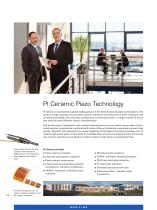
PI Ceramic Piezo Technology PI Ceramic is considered a global leading player in the field of piezo actuators and sensors. The product range includes various piezo ceramic elements manufactured in both multilayer and pressing technology. Piezo ceramic components are manufactured in a large number of forms and sizes and with different motion characteristics. The broad range of expertise in the complex development and manufacturing process of functional ceramic components combined with state-of-the-art production equipment ensure high quality, flexibility and adherence to supply deadlines. Prototypes...
Open the catalog to page 12All Physik Instrumente catalogs and technical brochures
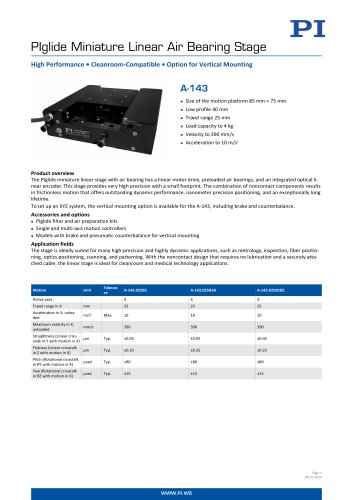 A-143
A-1435 Pages
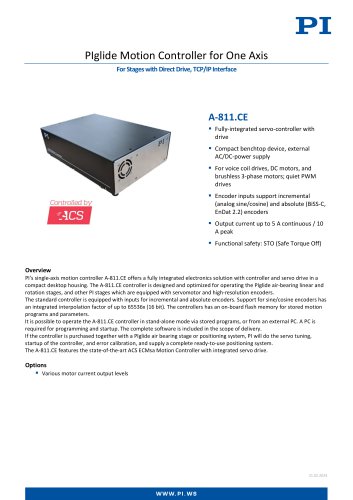 A-811.CE
3 Pages
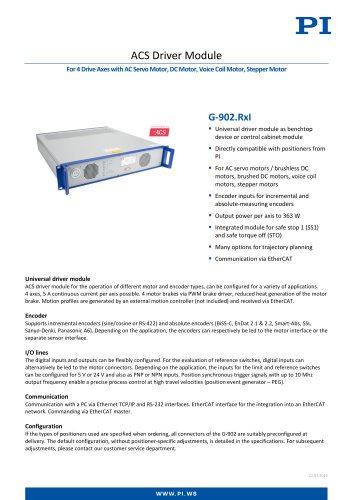 G-902.RxI
5 Pages
 P-405
P-4054 Pages
 PRYY
PRYY7 Pages
 A-523
A-5235 Pages
 M-110 • M-111 • M-112 V6
4 Pages
 L-812
L-81218 Pages
 RS-40 V7
4 Pages
 A-68x
A-68x4 Pages
 G-901
G-9019 Pages
 G-910.RC02
6 Pages
 F-712.IRP
6 Pages
 G-910.RC01 • RC03
4 Pages
 C-663.12
3 Pages
 C-887.53x
5 Pages
 Piezoelectric Discs
7 Pages
 L-402
L-4025 Pages
 P-840
P-8404 Pages
 M-238
M-2385 Pages
 L-220
L-2205 Pages
 P-725
P-7259 Pages
 C-413
C-4133 Pages
 P-518 • P-528 • P-558
6 Pages
 PL112 – PL140
4 Pages
 U-628
U-6283 Pages
 P-545.3D8S
5 Pages
 P-611.XZ • P-611.2
4 Pages
 P-541.2 • P-542.2
5 Pages
 Leading in Precision Positioning
12 Pages
 Engineered Systems
8 Pages
 Precision Motion Control
4 Pages
 Drivetrain Elements
4 Pages
 Motors and Drives
3 Pages
 Positioning with Piezo Systems
248 Pages
 Hexapod Positioning Systems
133 Pages
 PIRest Actuators - P-131
4 Pages
 High-Load Linear Stage - L-417
12 Pages
 PICA piezo amplifier module
3 Pages
 V-412 • V-418 • V-423
2 Pages
 S-335 Fast Tip/Tilt Platform
3 Pages
 Q-Motion® SpaceFAB
4 Pages
 A-131
A-1315 Pages
 d-891
d-8911 Page
 PI Datasheet V-275
5 Pages
 PI Datasheet V-273
5 Pages
 PI Datasheet VT-80
3 Pages
 A-65x
A-65x4 Pages
 A-60x.MTT
1 Page
 A-80x
A-80x3 Pages
 A-322
A-3223 Pages
 A-110
A-1103 Pages
 A-141
A-1413 Pages
 A-121
A-1215 Pages
 A-123
A-1235 Pages
 DT-34
DT-344 Pages
 D-015 • D-050 • D-100
5 Pages
 A-10x
A-10x3 Pages
 New Products 2015
48 Pages
 PI Products for Microscopy
36 Pages
 PI Electron Microscopy
16 Pages
 Piezo Motors and Stages
48 Pages
 Piezo Mike Linear Actuators
16 Pages
 PI Product Overview
34 Pages
 PILine® Ultrasonic Piezomotors
20 Pages
 Piezoelectric Actuators
74 Pages


Archived catalogs
 Piezo Amplifiers & Controllers
44 Pages
 Hexapods 6-Axis Stages
56 Pages
- Electric actuator
- Physik Instrumente motorized positioning stage
- Physik Instrumente precision positioning stage
- Screw actuator
- DC actuator
- Physik Instrumente technology positioning stage
- 24-volt actuator
- Physik Instrumente 1-axis positioning stage
- DC motor controller
- 2-axis positioning table
- Precision actuator
- Extruded aluminum actuator
- Physik Instrumente compact positioning stage
- XY positioning table
- Physik Instrumente multi-axis positioning stage