
- Catalogs
- Photon etc.
- ZephIR™ 2.5 - Deep-Cooled MCT Camera

ZephIR™ 2.5 - Deep-Cooled MCT Camera

ZephIR™ 2.5 - Deep-Cooled MCT Camera
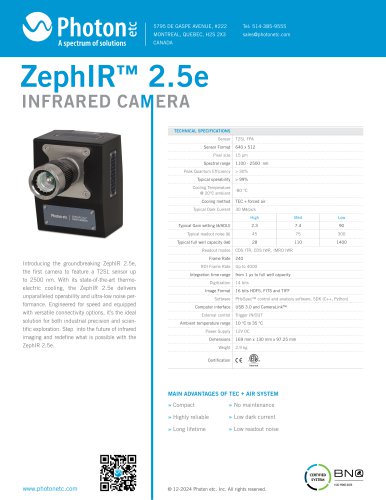
The ZephIR 2.5 is a high-performance HgCdTe camera designed for low noise detection and ease of use. It features a 320 x 256 pixel focal plane array (FPA) sensitive to wavelengths from 850 to 2500 nm. The camera is equipped with a four-stage thermoelectric cooler (TEC) that maintains an operating temperature as low as -80 °C, eliminating the need for maintenance associated with water or liquid nitrogen cooling systems.
Technical Specifications
- Sensor: MCT FPA with a format of 320 x 256 pixels and a pixel size of 30 µm.
- Spectral Range: 850 - 2500 nm with a peak quantum efficiency of 85%.
- Cooling: TEC with forced air, achieving -80 °C at 20°C ambient temperature.
- Performance: Full-frame rate of 340 fps, ROI frame rate up to 4000 fps, and a typical dark current of 20 Mē/px/s.
- Readout Modes: Standard (STD) and Integrate While Read (IWR).
- Integration Time: Ranges from 1 µs to full well capacity.
- Digitization: 14 bits with image formats including HDF5, FITS, and TIFF.
- Software and Interface: USB 3.0, CameraLink™, and external control via PHySpec™ software and SDK.
- Physical Characteristics: Dimensions of 169 mm x 130 mm x 97 mm, weight of 2.9 kg, and power supply of 12V DC.
Cooling System Overview
The document explains the thermoelectric cooling method using the Peltier effect, where semiconductors with different electron densities (n-type and p-type) are used to create a temperature difference. This system allows for effective heat dissipation without the need for water or air cooling, achieving a ΔT of 120 °C with four cascaded stages, resulting in an operating temperature of -80 °C.
Main Advantages
- Compact and highly reliable design.
- Long lifetime with no maintenance required.
- Low dark current and readout noise.
Catalog excerpts

* A spectrum of solutions CD 5795 DE GASPE AVENUE, #222 MONTREAL, QUEBEC, H2S 2X3 CANADA ZephIR™ 2.5INFRARED CAMERA TECHNICAL SPECIFICATIONS The ZephIR 2.5 is a fully integrated HgCdTe camera with a 320 x 256 pixels focal plane array (FPA) sensitive from 850 to 2500 nm. The camera provides low noise detection and easy operation. This is in large part due to a four stages thermoelectric cooler (TEC) which can maintain operating temperature as low as -80 °C. The TEC’s forced air heat dissipation requires none of the maintenance of a water or liquid nitrogen chilled unit and does not suffer from the limited lifetime of Stirling mechanical coolers. The camera’s hardware coded region-of-interest (ROI) enables the user to choose between a full-frame rate of 340 frames per second (fps) and a windowed rate of up to 4000 fps. Users can also choose to use Photon etc’s PHySpec camera control software or develop their own using an extensive software development kit (SDK). MAIN ADVANTAGES OF TEC + AIR SYSTEM » Highly reliable » Low dark current » Long lifetime » Low readout noise © 12-2023 Photon etc. Inc. All rights reserved.
Open the catalog to page 1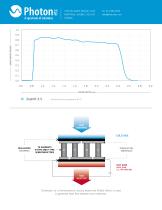
WHITE PAPER OVERVIEW OF COOLING METHODS THERMOELECTRIC COOLING Thermoelectric (TE) stages are solid-state devices composed of two differents faces. Those stages uses Peltier effect to generate a temperature difference between the two faces. Semiconductors with different electron densities, n-type and p-type (see FIG. 1), are placed in series and connected with a conducting material on each side. The passage of an electrical current through the junction induces a heat flow from one face to the other, creating a cold and a hot side. The cold face absorbs heat which is carried to the other side...
Open the catalog to page 2All Photon etc. catalogs and technical brochures


- Photon digital camera
- Visible imager
- CMOS camera module
- Industrial camera module
- Analysis software solution
- Photon infrared camera
- Monitoring camera system
- Windows software
- Microscope
- USB camera module
- Spectrometer
- Detection camera system
- Monochrome camera module
- Optical microscope
- Image processing camera module
- Inspection imager
- HD camera module
- Thermographic camera
- Laboratory microscope
- Automated software