- Catalogs
- PHOGRAIN TECHNOLOGY(SHENZHEN) CO., LTD.
- XSJ-10-D6-20-KB/25Gbps Φ20μm Bottom-illuminated PIN PD Chip


- Company
- Products
- Catalogs
- News & Trends
- Exhibitions
XSJ-10-D6-20-KB/25Gbps Φ20μm Bottom-illuminated PIN PD Chip

XSJ-10-D6-20-KB/25Gbps Φ20μm Bottom-illuminated PIN PD Chip
This document details a 25Gbps bottom-illuminated PIN photodiode chip with a mesa structure and a 20μm active area. It is designed for high data rate applications, offering high responsivity, low capacitance, low dark current, and excellent reliability. It is primarily used with 25Gbps transimpedance amplifiers for long-wavelength applications and single-mode fiber optical receivers.
Features
- Bottom-illuminated with a 20μm active area.
- Ground-Signal-Ground (GSG) bond pad structure on top.
- Low dark current and capacitance, high responsivity.
- Data rate of ≥25Gbps.
- Suitable for flip-chip processes.
- Reliability tested to Telcordia-GR-468-CORE standards.
- 100% testing and inspection.
Applications
- 100 Gigabit Ethernet
- 20GHz analog links
- High-speed test and measurement
Electro-Optical Characteristics
At a temperature of 22±3℃, the photodiode exhibits the following characteristics:
- Response Spectrum: 1260-1620 nm
- Dark Current: Max 1.0 nA at VR=5.0V
- Reverse Breakdown Voltage: Min 20V at IR=10μA
- Responsivity: Min 0.7 A/W at λ=1310nm
- Bandwidth: 22 GHz at λ=1550nm
- Capacitance: 0.08-0.11 pF at f=1MHz
Absolute Maximum Ratings
- Reverse Voltage: Max 20V
- Forward Current: Max 10 mA
- Reverse Current: Max 5 mA
- Optical Power Input: Max 10 mW
- Storage Temperature: -45 to 125℃
- Operating Temperature: -40 to 85℃
- Soldering Temperature: 320℃ for 60 sec
- Process Temperature: 185℃ for 2 hours
Dimensions
- Active Area: 20 μm
- Signal Bond Pad: 75x75 μm
- Ground Bond Pad: 75x75 μm
- Die Length: 390-410 μm
- Die Width: 390-410 μm
- Die Height: 140-160 μm
Cautions
- Implement ESD protective measures to prevent electrostatic damage.
- Handle InP-based chips carefully to avoid damage.
- Use vacuum adsorption instead of tweezers for handling.
- Set bonding force and temperature carefully to avoid chip damage.
Catalog excerpts

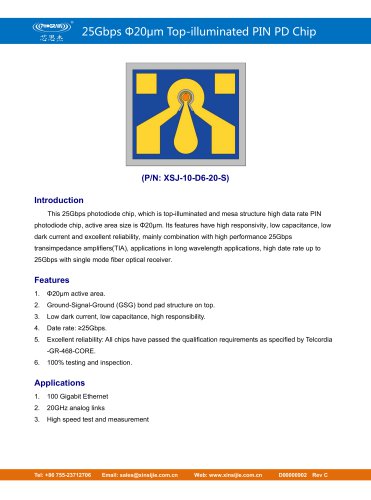
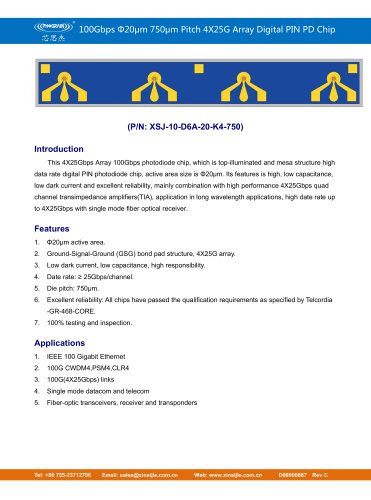
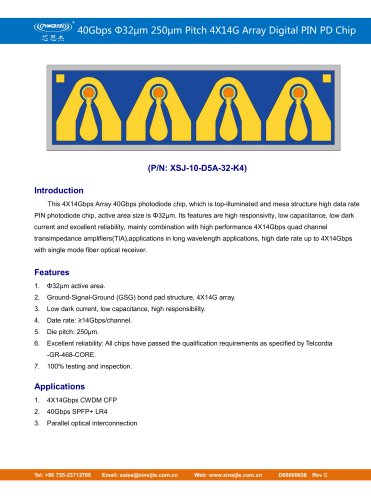
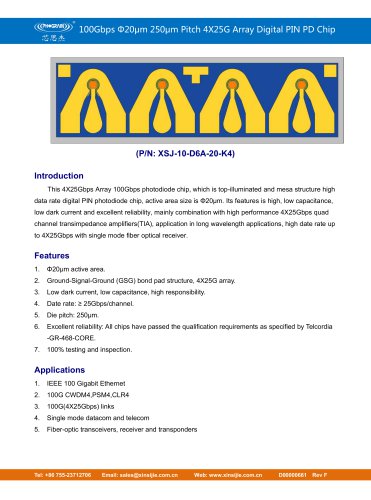
(P/N: XSJ-10-D6-20-KB) Introduction This 25Gbps photodiode chip, which is bottom-illuminated and mesa structure high data rate PIN photodiode chip, bottom active area size is Φ20μm. Its features have high responsivity, low capacitance, low dark current and excellent reliability, mainly combination with high performance 25Gbps transimpedance amplifiers(TIA), applications in long wavelength applications, high date rate up to 25Gbps with single mode fiber optical receiver. Bottom-illuminated: Φ20μm active area. Ground-Signal-Ground (GSG) bond pad structure on top. Low dark current, low capacitance, high responsibility. Bottom-illuminated type: suiting for flip-chip process. Excellent reliability: All chips have passed the qualification requirements as specified by Telcordia -GR-468-CORE. High speed test and measurement Email: [email protected]
Open the catalog to page 1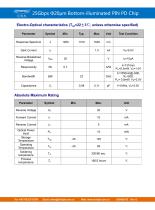
Tel: +86 755-23712706 Email: [email protected] Web: www.xinsijie.com.cn D00000753 Rev G
Open the catalog to page 2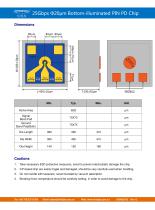
1. Take necessary ESD protective measures, avoid to prevent electrostatic damage the chip. 2. InP-based chip are easily fragile and damaged, should be very carefully used when handling. 3. Do not handle with tweezers, recommended by vacuum adsorption. 4. Bonding force, temperature should be carefully setting, in order to avoid damage to the chip. Tel: +86 755-23712706 Email: [email protected] Web: www.xinsijie.com.cn D00000753 Rev G
Open the catalog to page 3All PHOGRAIN TECHNOLOGY(SHENZHEN) CO., LTD. catalogs and technical brochures
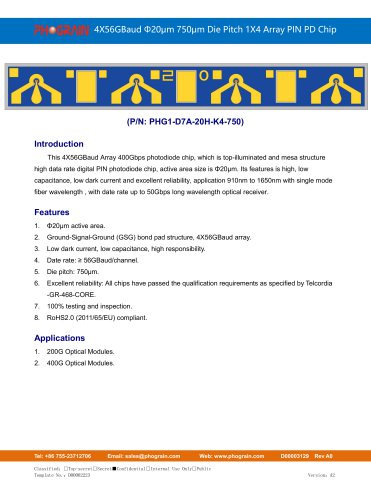 PHG1-D7A-20H-K4-750
3 Pages
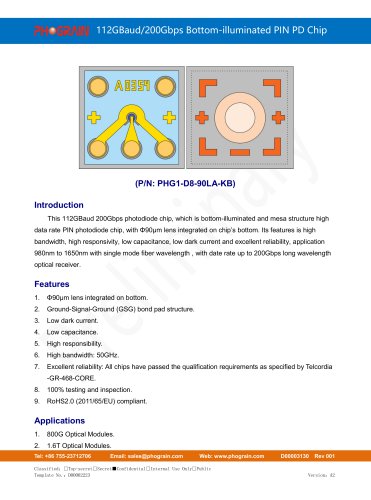 PHG1-D8-90LA-KB
4 Pages