
- Catalogs
- PHC Europe B.V. / PHCbi
- Cell Culture Incubators Cleaning and Decontamination Manual


- Company
- Products
- Catalogs
- News & Trends
- Exhibitions
Cell Culture Incubators Cleaning and Decontamination Manual

Cell Culture Incubators Cleaning and Decontamination Manual
Cell culture incubators are essential for maintaining a controlled environment at 37°C with regulated CO2 and O2 levels to ensure optimal conditions for cell cultures. The use of deionized water in humidifying trays is discouraged due to risks of corrosion and contamination.
Incubators should be installed in low-traffic, clean areas away from windows and HVAC systems to minimize contamination. Adequate clearances are necessary for maintenance and gas supply access.
Regular cleaning with 70% ethanol is recommended to inhibit bacterial growth. Incubators may include high heat or H2O2 sterilization cycles. All equipment and labware should be sterilized before use to prevent contamination.
Cleaning involves turning off the power, removing components, disinfecting with 70% ethanol, and ensuring the inner door gasket is properly adjusted. Components should be replaced in reverse order after cleaning.
Proper laboratory techniques and equipment placement can reduce contamination risks. Regular cleaning schedules and sterilization functions enhance contamination prevention.
Methods such as 24-hour UV decontamination, H2O2 decontamination, and dual heat sterilization are recommended for contamination management. Regular inspection and maintenance of stainless steel components are necessary to prevent rust.
Adhering to best practices, such as using gloves and maintaining a clean environment, is crucial for preventing contamination and ensuring the longevity of cell culture incubators.
Avoid using ultrapure, deionized, or reverse osmosis water in incubators. Wear gloves during cleaning and avoid using acid, alkali, or chlorine-based cleansers. Use a sterile non-woven cloth and do not reuse the same portion to prevent bacterial spread.
Increase cleaning frequency and replace humidifying water every two weeks. Use Biocidal ZF spray weekly to minimize contamination. Ensure the incubator is placed in a clean, draft-free area and maintain aseptic conditions when handling culture vessels. Minimize door opening frequency to reduce contamination risk.
For UV decontamination, turn off power, remove components, clean with neutral detergent, rinse, and wipe with ethanol. Activate UV lamp for 24 hours. For H2O2 decontamination, remove components, set up H2O2 generator, and follow a 135-minute cycle. Dual heat sterilization involves heating to 180ºC for 11 hours.
The UV lamp in the incubator automatically activates when the door is opened or closed, inhibiting the growth of various contaminants. Regular cleaning and predictive maintenance are crucial for maintaining a contamination-free incubator. Active decontamination requires user initiation, while passive decontamination is facilitated by the incubator's design.
PHC Europe B.V., Nijverheidsweg 120, 4879 AZ Etten-Leur, Netherlands. Phone: +31 (0) 76 543 3833, Fax: +31 (0) 76 541 3732, Website: www.phchd.com/eu/biomedical
Catalog excerpts
CELL CULTURE INCUBATORS CLEANING AND DECONTAMINATION METHODS Models: MCO-170AC-series MCO-170AIC-series MCO-170AICD-series MCO-230AIC-series MCO-170M-series MCO-50AIC-series MCO-50M-series Basic care for optimum performance and care in the event of contamination
Open the catalog to page 1
Introduction to cell culture incubators 4 Important points for the installation of incubators 6 Important points for usage 8 Cleaning and decontamination methods 8 Basic care of cell culture incubators 9 Tips to minimize contamination 13 Care in the event of contamination - 24 hour UV decontamination 14 - Dual Heat sterilisation 20 Care in the event of rust 21 Best practices and good laboratory technique 22
Open the catalog to page 3
Introduction to cell culture incubators A cell culture incubator is designed to artificially replicate in vitro conditions essential to in vivo physiology typical of human and animal models. Cell growth outside of a natural environment presents a multitude of challenges associated with exposure to microorganisms that are not present in the in vivo state. Depending on the type of cell cultures being managed, several operating parameters must be carefully controlled with accuracy, repeatability and flexibility in setpoint choices. These include temperature and gas control. • Cell culture incubators...
Open the catalog to page 4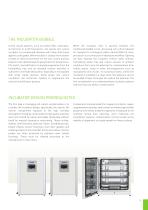
THE INCUBATOR BUBBLE Unlike closed systems, such as hollow-fiber substrates, stirred tank or airlift bioreactors, the typical cell culture incubator is a conditioned chamber with a door that closes against a soft gasket. When the door is closed, the incubator creates an ideal environment for the cell culture process based on user defined setpoint parameters for temperature, CO2 and O2. Humidification is naturally evaporative from the humidifying tray, and an elevated relative humidity is sufficient to eliminate desiccation, especially in microplates with small media volumes. Some larger cell culture...
Open the catalog to page 5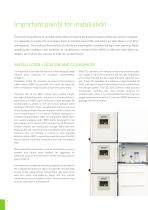
Important points for installation There are many factors to consider when determining the permanent location of the cell culture incubator. It is desirable to locate the unit where there is minimal foot traffic and where air disturbance is of little consequence. This reduces the volatility of outside air entering the incubator during a door opening. Avoid installing the incubator near windows, air conditioners, ceiling or floor HVAC air diffusers and return air intakes, all of which are sources of airborne contamination. INSTALLATION, LOCATION AND CLEARANCES It is important to consider the function...
Open the catalog to page 6
Locations where there is a lot of foot traffic are not suitable for the unit. • Locate the incubator in a dean room or location where few people enter • Choose a clean room that is safe or a place where there are as few people as possible. Set up the unit as high off the floor as possible • Since there are fewer airborne bacteria in the upper part of a room, the incubator should be placed on a laboratory table or a special stand. • If stacking two or three units on top of each other, use a special roller base for that purpose. Place in a location that is not directly affected by outside air •...
Open the catalog to page 7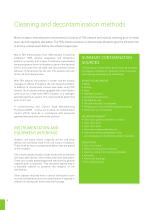
Why is 70% ethanol better than 100% ethanol in bacterial inhibition? 100% ethanol coagulates and dehydrates proteins so quickly that a layer of relatively impermeable denatured protein forms in the exterior parts of the bacterial cell (in and under the cell wall), and this prevents further diffusion of the alcohol into the cell. This protects the core of the cell from denaturation. With 70% ethanol, the process is slower and the alcohol manages to diffuse throughout the cell denature proteins. In addition to conventional manual wipe down using 70% ethanol, the incubator may be equipped with a...
Open the catalog to page 8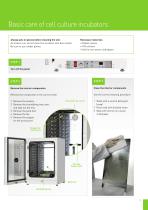
Basic care of cell culture incubators Always puts on gloves before cleaning the unit. As a basic rule, do not clean the incubator with bare hands. Be sure to use rubber gloves. Necessary materials • Rubber gloves • 70% ethanol • Sterile non-woven cloth/paper STEP 1 Turn off the power Remove the interior components. Clean the interior components Remove the components in the correct order. Use the correct cleaning procedure. 1 Remove the shelves 2 Remove the humidifying tray cover, and take out the tray 3 Remove the back duct 4 Remove the fan 5 Remove the stopper for the access port 1 Wash with...
Open the catalog to page 9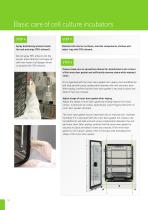
Basic care of cell culture incubators STEP 4 Spray disinfecting alcohol inside the unit and wipe (70% ethanol). Disinfect all interior surfaces, internal components, shelves and water tray with 70% ethanol. Do not spray 70% ethanol into the sensor holes directly! Just wipe off with non-woven cloth/paper which is sprayed with 70% ethanol. STEP 6 Please make sure to spread the ethanol for disinfection to all corners of the inner door gasket and sufficiently remove stains while wiping it clean. Sensor holes If it is operated with the inner door gasket not in place, the humidified air will leak and...
Open the catalog to page 10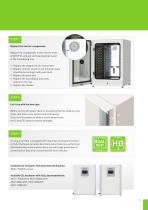
STEP 7 Replace the interior components. Replace the components in the reverse order of [STEP 2], and put sterilized distilled water in the humidifying tray. 1 Replace the stopper for the access port 2 Replace the fan, check to see if the fan spins smoothly by turning it with your hand. 3 Replace the back duct 4 Replace the humidifying tray cover, and put in the tray 5 Replace the shelves Let it dry with the door ajar. Before turning the power back on (restarting) let the inside dry out check that there is no alcohol smell remaining. If you turn the power on while it is still damp inside, the...
Open the catalog to page 11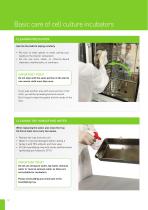
Basic care of cell culture incubators ClEanIng PrECauTIon Get into the habit of wiping carefully • Be sure to wear gloves to avoid cutting your hands on the interior component • Do not use acid, alkali, or chlorine-based cleansers, disinfectants, or sanitizers IMPorTanT PoInT Do not wipe with the same portion of the sterile non-woven cloth more than once. If you wipe another area with same portion of the cloth, you will be spreading bacteria around. Don’t forget to wipe the gasket and the inside of the door. ClEanIng ThE huMIdIfyIng WaTEr When replacing the water, also clean the tray. Do this...
Open the catalog to page 12All PHC Europe B.V. / PHCbi catalogs and technical brochures
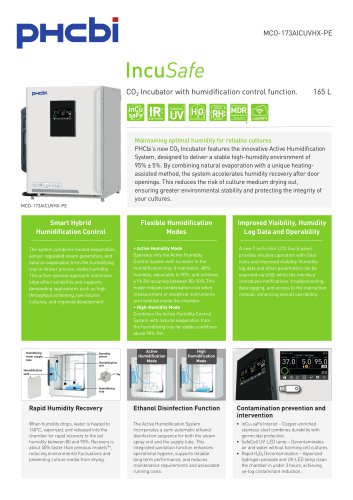 MCO-173AICUVHX-PE
3 Pages
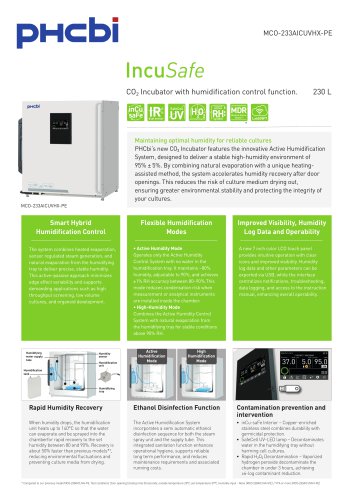 MCO-233AICUVHX-PE
2 Pages
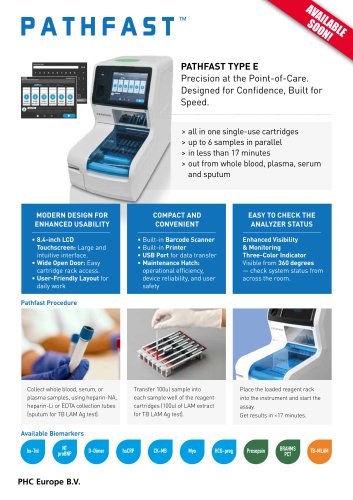 PATHFAST™ TYPE E
2 Pages
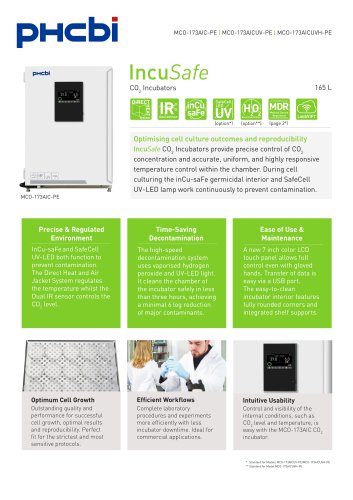 MCO-173AIC(UV)H)-PE
2 Pages
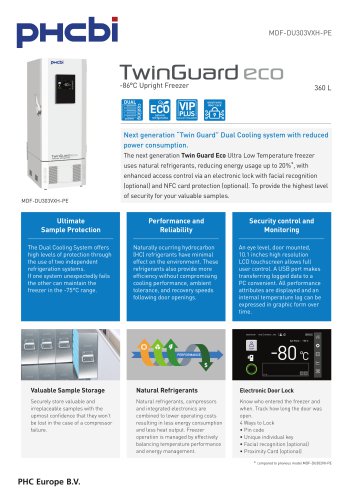 PHCbi_MDF-DU303VXH-PE
2 Pages
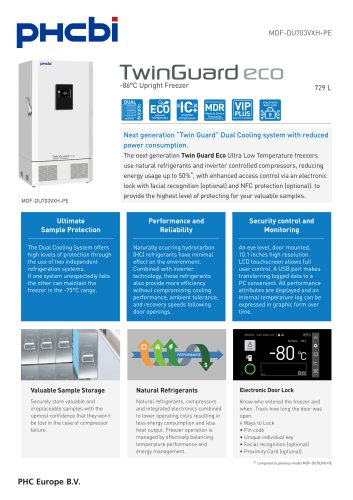 MDF-703VXH-PE Productsheet
2 Pages
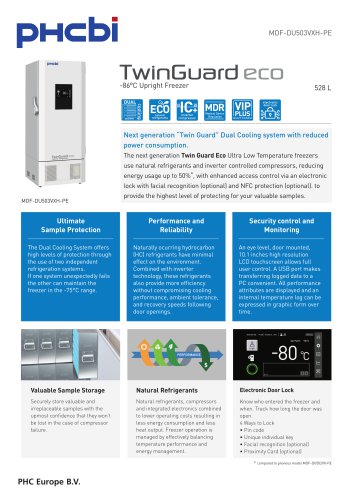 MDF-DU503VXH-PE Productsheet
2 Pages
 Real Time PCR Brochure
8 Pages
 ProteoSave™ Brochure
2 Pages
 STEMFULL™ Brochure
2 Pages
 Cryogenic Vials Brochure
2 Pages
 MCO-50AIC-PE CO2 Incubators
2 Pages
 MCO-50M-PE CO2 Incubators
2 Pages
 Cleanroom Classification
4 Pages
 MIR-554-PE Cooled Inucbator
2 Pages
 CO2 & MULTIGAS INCUBATOR SERIES
16 Pages
 MPR-514(R)-PE
2 Pages
 MPR-S150H-PE & MPR-S300H-PE
2 Pages
 MPR-N450FHD-PE
2 Pages
 Commitment to PHC Quality
32 Pages
 PRIMESURFACE®
4 Pages
 MPR-1014R-PE
2 Pages
 Hybrid Water Cooled Freezers
16 Pages
 TwinGuard
12 Pages
 MDF-U731M-PE -30°C Freezer
2 Pages
 MBR Blood Bank Refrigerators
2 Pages
 MCO-170AIC-PE CO2 Incubators
2 Pages
 MLR-352-PE Climate Chamber
2 Pages
 MIR COOLED INCUBATORS
6 Pages
 MIR-554 Cooled Incubator
2 Pages
 MIR-154-PE | MIR-254-PE
2 Pages
 MCO-170AC-PE CO2 Incubators
2 Pages
 MCO-230AIC-PE CO2 Incubators
2 Pages
 MIR Heated Incubators
2 Pages
 MCO-80IC-PE CO2 Incubator
2 Pages


Archived catalogs
 Vaccine Storage E-Book
14 Pages
 General Catalogue
60 Pages
 MCO-50AICL-PE Co2 Incubator
2 Pages
 MCO-5AC-PE CO2 Incubators
2 Pages
 MPR PHARMACEUTICAL REFRIGERATORS
12 Pages
 ULTRA LOW TEMPERATURE FREEZERS
16 Pages
 ULT VIP
12 Pages
 MIR-H163-H263
2 Pages
 Racking systems brochure
7 Pages
 Bloodbank Refrigerators
4 Pages
 MIR Cooled Incubators
4 Pages
 Storage Solutions
7 Pages
 TwinGuard ULT Freezers Brochure
12 Pages
 MDF-DU302VX-PE
2 Pages
 Cryopreservation brochure
28 Pages
 MCO-19AIC(UV)-PE
6 Pages
 MCO19-AIC/M Incubators
16 Pages
 MDF-U4186S-PE
2 Pages
 MBR-705GR
2 Pages
 KM-DU34H1E Flyer
2 Pages
 MPR-215F-PE & MPR-414F(S)-PE
2 Pages
 MDF-U7386S-PE
2 Pages
 MDF-C8V1-PE
2 Pages
 Autoclaven MLS-2420/3020
2 Pages
 MDF-U731M
2 Pages
 MDF-U5386S-PE
2 Pages
 MDF-U3386S-PE
2 Pages
 MDF-U33V
2 Pages
 MDF-U4186S
2 Pages
 MDF-U55V-PE
2 Pages
 MDF-U74V
2 Pages
 MDF-U500VX
2 Pages
 MDF-U700VX-PE
2 Pages
 Eco VIP Freezer
2 Pages
 Twin Guard Series
12 Pages
 Twinguard
12 Pages
 CHS promotional
2 Pages
 CardioHealth Station Patient
2 Pages
 CardioHealth Station
6 Pages
 Freezer storage systems
8 Pages





- Test cabinet
- Storage vessel
- Temperature test chamber
- Automatic analyser
- Climatic test cabinet
- Metal tank
- Benchtop analyser
- Work safety gloves
- Stainless steel vessel
- Humidity test cabinet
- Industrial safety gloves
- Environmental test chamber
- Continuous analyzer
- Real-time analyzer
- Laboratory analyzer
- PHC Europe laboratory incubator
- Thermal protection safety gloves
- Black protection gloves