
- Catalogs
- PHC Europe B.V. / PHCbi
- Biomedical Equipment catalogue 2012- 2013


- Company
- Products
- Catalogs
- News & Trends
- Exhibitions
Biomedical Equipment catalogue 2012- 2013

Biomedical Equipment catalogue 2012- 2013
In 2012, SANYO Biomedical in Europe transitioned to Panasonic Biomedical, maintaining the same products and customer experience. This change brought new engineering resources, promising innovative products and technical advancements. The European sales and service organization remains unchanged, ensuring continued high service levels and customer trust.
Panasonic aims to be the leading Green Innovation Company by 2018, focusing on environmental conservation and efficient resource use. The brand, established in 1955, is committed to enriching lives through innovative products and services.
Panasonic offers comprehensive service options, including preventative maintenance, repairs, and technical support, to maximize equipment lifespan. A dedicated team ensures high-quality service, with training available for third-party providers to maintain product integrity.
The catalogue includes a range of biomedical equipment such as ultra-low temperature freezers, blood bank refrigerators, CO2 incubators, and autoclaves. Each product is designed with advanced technology to ensure reliability and performance.
Panasonic Biomedical collaborates with certified dealers across Europe to provide consistent high-quality service and support. This network ensures that maintenance is performed by trained engineers, guaranteeing product and service excellence.
Panasonic emphasizes safety and quality, being one of the first in the industry to introduce Medical Device certification, reinforcing their commitment to high standards in biomedical equipment.
In 2010, Panasonic received TÜV-Süd certification to manufacture blood bank refrigerators, freezers, and incubators as Class IIa Medical Devices under directives 93/42/EEC and 2007/47/EC. Their quality systems comply with ISO9001 and ISO13485 standards.
Panasonic has pioneered ultra-low temperature storage technologies, including the -152°C freezer and CFC-Free refrigerants. They introduced Cool Safe compressors, enhancing durability and reducing power consumption, heat output, and noise.
Panasonic's refrigeration systems maintain uniform temperatures and offer superior performance even in high ambient temperatures. The systems use vacuum insulation panels (VIP) for increased storage capacity and advanced microprocessor controls for reliable operation.
The refrigeration cycle involves compressing refrigerant gas, which is then cooled and expanded to absorb heat, cooling the freezer. Dual or cascade systems are used for temperatures below -86°C, with separate low and high stages sharing a heat exchange area.
Panasonic's -152°C freezers prevent recrystallization of ice crystals in cells, using cryoprotective agents like glycerine and Me2SO. These freezers offer stable long-term preservation, avoiding contamination and operational issues associated with liquid nitrogen storage.
These freezers use HCFC-Free refrigerants and a specially designed compressor for -152°C temperatures. They feature microprocessor temperature control, high-efficiency oil separators, and special polyurethane insulation to maintain temperature stability.
These freezers are used in cancer research, blood preservation, bacteria research, and superconductivity experiments. They are suitable for universities, private institutes, public research centers, and hospitals.
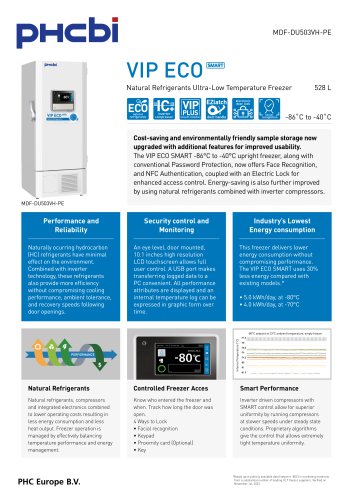
The MDF-C2156VAN freezer uses non-HCFC refrigerants and VIP insulation to reduce power consumption and environmental impact. It features new double door gaskets to prevent temperature leaks.
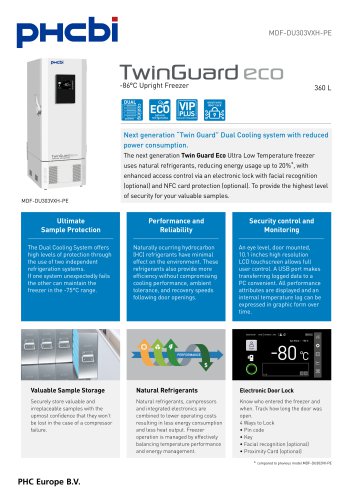
The document discusses Panasonic's ultra-low temperature VIP freezers, highlighting their energy efficiency, structural enhancements, and compliance with international standards. These freezers are designed for optimal performance in storing valuable research and clinical samples.
The freezers come in various models: MDF-U33V, MDF-U55V, MDF-U74V, and MDF-U76V, with capacities ranging from 333 to 728 liters. They are capable of storing 2” and 3” boxes, with specific capacities for each model.
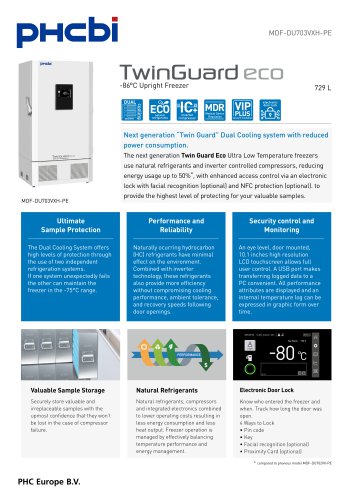
The freezers utilize energy-efficient refrigeration systems, including Panasonic Cool Safe compressors and environmentally friendly refrigerants. The integrated control center combines all control, alarm, monitoring, and data management functions, optimizing run time and minimizing energy consumption.
High-strength, insulated inner doors improve temperature uniformity and minimize changes during door openings. The ergonomic design includes one-handed door latches and quiet-running compressors for convenience and reduced noise.
A Panasonic-built microprocessor controller manages setpoints, alarms, monitoring, and diagnostics. It features a digital display and a status alert function to notify users of any abnormalities.
The design focuses on efficient heat exchange between high and low stage circuits, reducing stress on compressors and increasing system reliability. A water-cooled condenser option is available for facilities with chilled recirculating water systems, offering additional energy savings.
The freezers comply with the Montreal Protocol, IEC, CE, RoHS, and other standards, ensuring safety and performance. They feature high visibility LED displays, lockable doors, and adjustable shelves.
Optional features include liquid CO2 and N2 backup systems, temperature recorders, and communication interfaces. The freezers are equipped with vacuum relief valves and heated outer door gaskets to prevent ice build-up.
Graphs and charts in the document compare power consumption across different models and brands, demonstrating the energy efficiency of Panasonic's freezers. The document also includes performance characteristics such as pull-down and pull-up during power failure, and CO2 backup system operation.
Panasonic's MBR-series offers two storage styles: DH-type with coated steel wire shelves and GR-type with stainless steel roll-out drawers. These refrigerators are designed to meet AABB criteria, ensuring stable and reliable temperature control through Panasonic's proprietary technology, including a specially designed compressor for rapid cooling and quiet operation.
- Temperature Control: Utilizes two sensors in liquid-loaded monitor bottles shaped like blood bags, with microprocessor control for precise temperature management. A multi air-flow plenum system ensures uniform temperature distribution in larger models.
- Temperature Stability: Features like separated transparent inner doors and foamed-in-place insulation minimize cold air loss. A large air circulation fan aids rapid temperature recovery after door openings.
- Capacity: Models range from 79 to 1287 liters, accommodating 32 to 720 blood bags of 450 ml each.
- Options: Built-in temperature chart recorder, various chart papers, and storage baskets for different models.
- Cooling Performance: Maintains 4ºC ±1.5ºC at an ambient temperature of 35ºC.
- Selectable storage systems to suit user needs.
- Fluorescent interior lamp and large view window for easy visibility.
- Digital display for easy monitoring and calibration.
- Equipped with audible and visual alarms, door alarms, and key locks for safety.
- Environmentally friendly with CFC-free refrigerants and insulation.
These freezers feature a patented liquid nitrogen jacket for uniform storage temperatures in the -190°C range, eliminating the risk of cross-contamination and the need for additional packaging. They are certified to the Medical Device Directive 93/42/EEC: 1993 Class IIA and include the Series 2301 Auto-fill and Monitor System for sample security.
- Temperature uniformity and no liquid nitrogen contact in the storage area.
- Automatic operation with comprehensive alarm systems.
- Available in various models with capacities for up to 45,000 2ml vials.
- Straw Storage Inventory System: Designed for CBS V-1500AB and V-3000AB freezers, capable of holding thousands of straws in canisters.
- Controlled Rate Freezer: The 2101 model offers precise temperature control for biological sample freezing, with a dedicated laptop and software for programming.
These freezers are designed for cryogenic storage with advanced vacuum and insulation for thermal performance, available in various series to meet different storage needs.
The document discusses the design and utility of Vapor Shippers for the safe transportation of biological samples at cryogenic temperatures. It also highlights the LAB Series dewars, which are lightweight and efficient due to their high-efficiency super-insulation and aluminum construction. These dewars can be equipped with various accessories to aid in liquid nitrogen transfer.
BioCision offers CoolRack, CoolBox, and CoolCell products designed for reproducible sample handling and preparation. These products are used globally in various industries for pre-analytical sample standardization. CoolRacks provide temperature consistency and high reproducibility, while CoolBox offers ice-free cooling and freezing. CoolCell provides alcohol-free cell freezing with a consistent -1°C/minute freezing profile.
Panasonic CO2 and Multigas Incubators are designed for optimal cell cultivation conditions. They feature advanced technologies for temperature and CO2 control, including solid-state infrared sensors and PID control. The incubators also incorporate contamination control technologies like InCu saFe® and SafeCell UV to protect samples without compromising performance.
The MCO-80IC incubator is suitable for high-volume cell culture applications, offering advanced features like InCu saFe® interior, UV decontamination, and efficient CO2 gas consumption. It provides superior CO2 and temperature control with a horizontal laminar airflow system and P.I.D. temperature control, ensuring rapid recovery and uniform conditions.
The document provides detailed information on various CO2 incubators by Panasonic, focusing on models MCO-80IC, MCO-20AIC, and MCO-19AIC. It includes performance data, design features, and contamination control mechanisms.
- MCO-80IC: A large capacity CO2 incubator with 851 liters, featuring adjustable shelving, a large LED display, and a double-paned glass door for easy observation. It includes a copper-enriched stainless steel interior for contamination control and offers normal and high humidity modes.
- MCO-20AIC: This model employs continuous active background UV light sterilization and a Direct Heat, Air Jacket (DHA) heating system for stable temperature and humidity. It maintains 95% RH at 37°C and features an optical water level indicator.
- MCO-19AIC: Designed for demanding applications, it offers H2O2 decontamination, a SafeCell UV system, and precise control through a microprocessor. It includes a single-beam, dual detector IR CO2 sensor for accurate CO2 control.
Performance Data
- CO2 and temperature recovery characteristics are provided for door openings of 30 and 60 seconds, showing the efficiency of the incubators in maintaining stable conditions.
- CO2 consumption and retention times are compared between Panasonic models and competitor models, highlighting the efficiency of Panasonic incubators.
Contamination Control
- Panasonic incubators use copper-enriched stainless steel and UV sterilization to prevent contamination.
- The MCO-19AIC offers a unique H2O2 decontamination option, reducing downtime significantly compared to conventional methods.
Design and Usability
- All models feature user-friendly designs with large displays, easy-to-clean components, and options for additional accessories like automatic CO2 cylinder changeover systems and communication interfaces.
Conclusion
Panasonic's CO2 incubators are designed for high performance and reliability, offering advanced contamination control and efficient recovery characteristics, making them suitable for various biomedical and pharmaceutical applications.
- Temperature and Humidity Recovery: The MCO-5AC model features rapid recovery characteristics for temperature and humidity, ensuring stable conditions after door openings or power failures.
- CO2 Level Recovery: The incubator maintains precise CO2 levels, with quick recovery times facilitated by advanced sensors.
- Options: Includes various accessories such as shelves, roller bases, and CO2 gas pressure regulators.
- Temperature Control: Utilizes PID control and a chamber direct sensing system for high precision, maintaining temperature within ±0.1°C of the preset value.
- Design Features: Stainless steel interior with rounded corners for easy cleaning and sterilization. The water jacketed system ensures stable temperature during power failures.
- Contamination Prevention: Specific CO2 gas tubes and automatic control mechanisms minimize contamination risks.
- Advanced Control: Features an integrated microprocessor controller with an LCD display for managing CO2, O2, temperature, and humidity levels.
- Decontamination System: Utilizes a high-speed H2O2 decontamination system for efficient and safe chamber cleaning.
- Design and Ergonomics: Includes a middle door with small doors for easy access and a stackable, space-efficient design.
- Rapid Recovery: Equipped with a P.I.D. TC sensor and zirconia O2 sensor for fast recovery of CO2 and O2 levels.
- Contamination Control: InCu saFe® copper-enriched stainless steel chamber inhibits bacterial growth, complemented by SafeCell UV technology.
- Temperature Stability: The D.H.A. system provides precise temperature control, reducing condensation risks.
- Environmental Control: Offers programmable temperature, lighting, and humidity functions, ideal for research and testing.
- Data Logging: Automatically records operational data, which can be viewed on the control panel or transmitted to a PC.
- Energy Efficiency: Microprocessor PID and refrigeration capacity control minimize temperature fluctuations and save energy.
The document provides detailed specifications and functionalities of the Plant Growth Chamber MLR-352/MLR-352H and the Cooled and Heated Incubators MIR series by Panasonic. These devices are designed for precise environmental control, suitable for various biological and environmental research applications.
- Specifications: The MLR-352H model includes a high-accuracy humidity sensor and a graphic LCD control panel for intuitive operation. It has a capacity of 294 liters.
- Applications: Suitable for plant growth, culture of plant cells, acclimatization, insect rearing, electronic testing, and food testing.
- Features: Includes adjustable shelves, fluorescent lamps, and a control panel with a pop-up menu function.
- Models: MIR-154, MIR-254, MIR-554, MIR-162, MIR-262.
- Temperature Range: Wide control range from -10°C to +60°C, allowing for diverse experimental needs.
- Programmable Operation: Microprocessor control allows for up to 12-step operations, with options for continuous or repeated cycles. Up to 10 programs can be stored.
- Energy Efficiency: Features include a high-efficiency heater, compressor ON/OFF control, and automatic defrosting to save energy.
- Design: Includes a reversible door, low vibration settings, and a condensation prevention mode for certain models.
- Graphs illustrate temperature control and humidity ranges, showing the chamber's ability to maintain stable conditions under various loads and ambient temperatures.
- Automatic alarms for temperature deviations and independent over-temperature protection devices ensure safety and reliability.
- Optional accessories include stacking kits, additional illumination kits, and communication interfaces for data transfer.
The system includes a tamper-proof key lock to prevent unintentional changes and a self-diagnostic function to quickly identify malfunctions. The Panasonic DAQ system allows remote monitoring of cooled incubators.
The incubators feature microcomputer PID control and an air-jacketed system for precise temperature control, with accuracy within ±0.2°C and uniformity within ±1°C at 37°C. The temperature control range is from ambient temperature +5°C to 80°C. The design includes a touch keyboard and LED display, with a durable stainless steel interior.
This compact shaker offers low vibration and noise, with speeds from 50 to 500 RPM. It features a soft start to prevent spillage, a timer for operations up to 99.9 hours, and auto recovery after power interruptions. The shaker is made of stainless steel and can be used in high humidity conditions.
The MLS-3751L and MLS-3781L models offer portability and large chambers for up to 12 1000ml flasks. They feature a swing-up lid for easy access, multiple sterilization programs, and a scalding prevention guard. The autoclaves are designed for individual lab use, with a focus on safety and efficiency.
This document provides detailed specifications for various biomedical and ultra-low temperature (ULT) freezers. The specifications include dimensions, performance metrics, control systems, refrigeration details, construction materials, and alarm systems.
- Dimensions: External and internal dimensions are provided for each model, with specific notes on measuring conditions.
- Performance: Cooling performance is specified at ambient temperatures, with temperature setting and control ranges detailed for each model.
- Control Systems: Most models feature LED or LCD displays, with microprocessor controls and Pt-100 or Pt-1000 temperature sensors.
- Refrigeration: Systems include cascade and auto-cascade methods, using HFC refrigerants and rigid polyurethane foamed insulation (PUF).
- Alarms: Visual, buzzer, and remote alarms are standard for power failure, high and low temperatures, and door open alerts.
- Construction: Exterior materials are typically painted steel, with interior materials varying between aluminum and stainless steel.
- MDF-1156-PE: Features a cascade refrigeration system, LED display, and a temperature range of -125°C to -155°C.
- MDF-C2156VAN-PE: Offers an auto-cascade low-stage system with an LCD display and a temperature range of -125°C to -150°C.
- MDF-U33V-PE: Utilizes VIP insulation technology for maximum storage capacity and energy efficiency.
- MDF-U700VX-PE: Equipped with an independent dual-cooling system and VIP PLUS insulation for enhanced security and performance.
- Models are equipped with various options for temperature recorders, RS485 interface modules, and liquid CO2 or N2 backup systems.
- Freezers are designed for safe storage without cross-contamination risks and low operational costs.
- Air temperature measurements are taken at the freezer center under specified conditions.
- Exterior dimensions exclude handles and other projections.
- Specifications are subject to change without notice.
- Models: MPR-48B, MPR-721R-PE, MPR-1411-PE, MPR-514-PE, MPR-1014-PE, MPR-161DH-PE, MPR-311DH-PE, MPR-215F-PE, MPR-414F-PE.
- Key Features: These units feature forced air circulation, automatic defrosting, and are equipped with thermistors and microprocessors for temperature control. They have digital LED displays and various alarm systems for high/low temperature, door open, and power failure.
- Construction: Made with galvanized steel and stainless steel, with acrylic finishes. They include double or triple pane glass doors and various shelving options.
- Refrigerant: HFC, with temperature ranges from 2°C to 23°C or -5°C to 35°C depending on the model.
- Models: MBR-107DH-PE, MBR-506DH-PE, MBR-704GR-PE, MBR-1405GR-PE, MBR-305GR-PE.
- Key Features: Designed for stable temperature control, these units include thermistor sensors, microprocessor controls, and digital LED displays. They are equipped with alarms for temperature deviations and power failures.
- Construction: Feature acrylic and stainless steel finishes, with double or triple layer glass windows. They offer various storage options for blood bags.
- Temperature Control: Maintains a stable environment at 4°C ± 1°C, suitable for blood storage.
- Models: V-1500AB, V-3000AB, V-5000AB, S90-AB, S-1500AB, S-3000AB, S-5000AB.
- Key Features: These units provide outstanding temperature uniformity and are designed to prevent cross-contamination. They include liquid nitrogen capacity and static evaporation rates.
- Construction: Made with durable lightweight aluminum, these units offer easy access for storing and retrieving samples.
- Capacity: Varies by model, with maximum vial capacities ranging from 2,000 to 46,500 vials.
- All units are equipped with remote alarm contacts and RS485 interface modules for enhanced monitoring and control.
- Some models include options for electronic temperature control systems and fan-forced air circulation for improved cooling efficiency.
Catalog excerpts

Biomedical Equipment catalogue 2012- 2013 CAL N ET PEAN URO WORK E BIOMEDI join the european network of experts in conservation - incubation - sterilisation
Open the catalog to page 1
Portugal Spain
Open the catalog to page 2
Biomedical Equipment catalogue 2012- 2013 Finland Iceland Norway Estonia Russia Sweden Latvia Netherlands Lihuania Denmark Poland Great Britain Belgium Germany Czech Republic Slovakia France Austria Switzerland Hungary Slovenia Croatia Bosnia Italy Serbia Montenegro Bulgaria Macedonia Turkye Albania Greece Cyprus Malta Israel
Open the catalog to page 3
What’s in a name? As you can see, this new ‘SANYO’ catalogue is now a Panasonic catalogue, but the products and the customer experience are still the same. On 1st April 2012 the SANYO Biomedical company in Europe (SEEE) became the Panasonic Biomedical company (PHCBE), so from that date the name on our Biomedical equipment also changed to Panasonic. After more than 25 years of success in Europe this is an important step for our company. Bringing new engineering resources to the group will result in new products and even greater technical innovation. The European sales and service organisation...
Open the catalog to page 4
Join the benefits of our network
Open the catalog to page 5
D IC - TURKEY WITZERL - N O R WA ETWORK - DEN MA HERLA NET R U S SI TWORK - AL N E W O RK ET K- WO N ET R K IC A L N E K - UK - BI O M N ETWOR AL N E TWORK - B I O MED D IC M AL K- T D IC A L D IC A L N ETWORK N ETWOR - GREEC OR ETW K S ETWORK WO N ET RK N ETWOR D IC TWORK - ETWORK ORK TW - Name: Christophe r Busuttil Location in ou r Scientific Cons network: ul Panasonic Biomed tant for products at Evolical ve LTD, Malta. favourite place St. John’s Co-C: Valetta, Malta. athedral, attention to de Because of the corner which letail in every ads to grandeur Majestic. . ED IC AL BI A - OM ED IC...
Open the catalog to page 7
Panasonic Biomedical Sales Europe B. V. Since April 1st 2012 Panasonic Biomedical Sales Europe B.V. is the new name for SANYO Biomedical as a result of the completion of SANYO’s merger with Panasonic. We will continue to maintain and improve our high quality standards for our products and customer service. In addition, as a Panasonic company, we now have access to extensive research and development resources that will continue our long standing leadership position in innovative technologies, available via the Panasonic network of manufacturing and research facilities worldwide. We look forward...
Open the catalog to page 8
Panasonic Biomedical Sales Europe B. V. Panasonic Biomedical Sales Europe BV, part of the Panasonic Healthcare Company (HCC), manages sales, marketing, logistics and technical service of Panasonic laboratory products throughout Europe (including Russia and Turkey). Headquartered in the Netherlands with sales and service organizations in the UK, France and the Netherlands. In the Dutch warehouse, about 1.000 units are waiting to be delivered directly from stock. Within a couple of days, spare parts can be delivered in every part of Europe. That’s one of the strengths of Panasonic’s Biomedical...
Open the catalog to page 9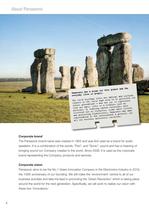
About Panasonic et and the for this plan has a dream le. Panasonic s of peop everyday live d cultural e natural an r tage sites ar ed to be preserved fo ri The world he e world that ne ence experi wonders of thtions - and the joy we just as genera easure tr future y lives is a ons, more from our dail reducing carbon emissi ter efforts precious. By e of resources, clean wa c has made ni efficient us ng biodiversity, Panaso priority for ment a preservi on and e. of the enivir conservation ness activities worldwid its busi all Corporate brand The Panasonic brand name was created in 1955 and was...
Open the catalog to page 10
Brand Promise Panasonic generates ideas for life... today and tomorrow. Through innovative thinking, we are committed to enriching people’s lives around the world. We believe the best idea’s come from attentive observation of everyday living, carefully listening to customers... and a constant commitment to making life easier, more comfortable, more fun. As a gobal company, Panasonic has been in touch with different peoples around the world for nearly a century. This puts us in a good position to translate “ideas for life” into the values and lifestyles our customers aspire to. Every Panasonic...
Open the catalog to page 11
Service Let us help you to protect your results - At Panasonic we appreciate how much your samples and products are worth to you. Your chosen equipment has been manufactured using world leading technology and specialist engineering, so it is important that we continue to provide the best support and care possible to maximise the potential and lifespan of your equipment. We have a dedicated team of Panasonic Service Specialists who are trained to carry out repairs and service to our exacting standards, ensuring the support you need during the life of your equipment. Using our many years of experience...
Open the catalog to page 12
leading technology Delta works, Brouwersdam, Zeeland 51º29’38.51”N . 3º50.38.51”E - DEN MA - BI O M ED IC AL N RK Name: Igor Sp ierenburg Location in o ur network: Service Mana ger, Panasoni c Biomedical Sa les Europe B. Etten Leur, The Netherla V., nds. Favourite pl ace: Brouwersdam, works have beZeeland. The Delta century. Tech en built in the last of the 7 modenically this is one rn wonders of the world. ETWORK NET EDICAL N HERLA B ND S I O M Installation l Commissioning l Calibration l Validation l Repairs l Fully equipped workshop l Genuine Panasonic spares R U S SI l K- Free Technical Support...
Open the catalog to page 13
Synergy in Europe Working together with one goal - Panasonic Biomedical has established a worldwide reputation as a manufacturer of high quality medical equipment over the past twenty five years. Together with the high standard of service we deliver, it makes us a major player in the biomedical market. Logically we want our Panasonic dealers to offer you the same high standard of service that belongs to our equipment. Therefore Panasonic only works with dealers that do guarantee this quality. So whether you buy directly from us, or from one of our European distributors, RW - NO A NM - D E AR...
Open the catalog to page 14All PHC Europe B.V. / PHCbi catalogs and technical brochures
 MPR Brochure
20 Pages
 Racks Brochure
16 Pages
 Cold Chain Brochure
16 Pages
 MIR Brochure
6 Pages
 MCO Cleaning Brochure
28 Pages
 Incusafe Brochure
36 Pages
 ULT Brochure
56 Pages
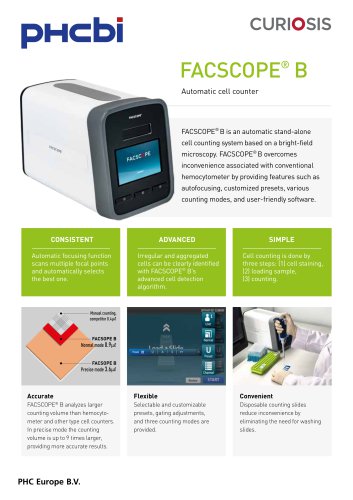 CUR-CRFCB-01 - FACSCOPE® B
2 Pages
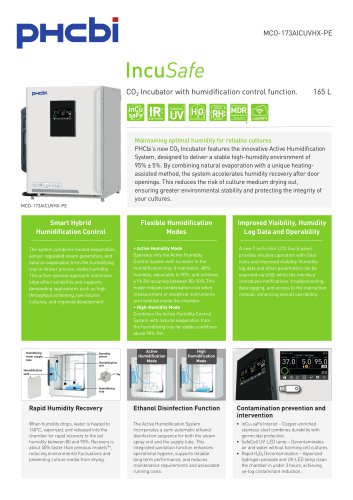 MCO-173AICUVHX-PE
3 Pages
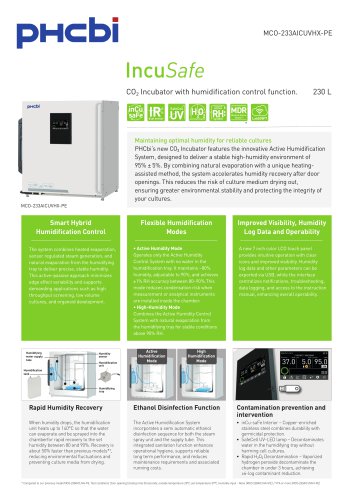 MCO-233AICUVHX-PE
2 Pages
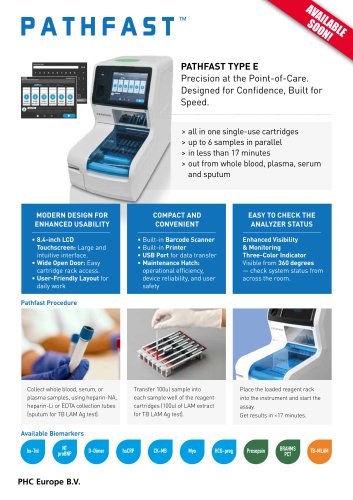 PATHFAST™ TYPE E
2 Pages
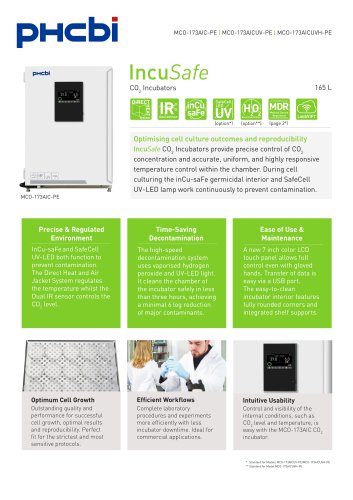 MCO-173AIC(UV)H)-PE
2 Pages
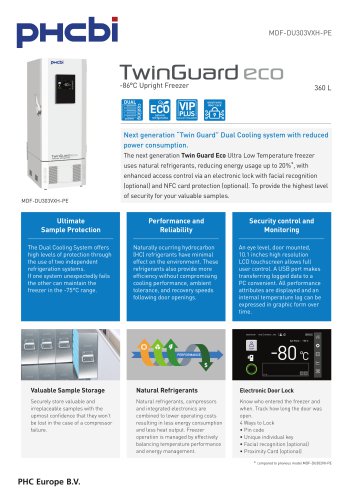 PHCbi_MDF-DU303VXH-PE
2 Pages
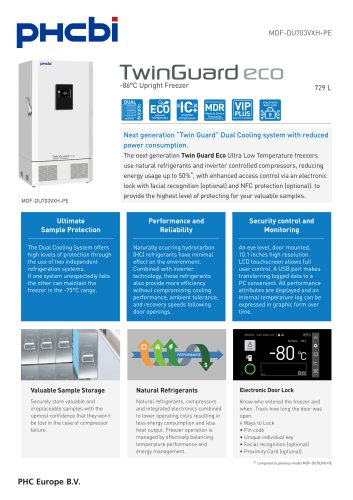 MDF-703VXH-PE Productsheet
2 Pages
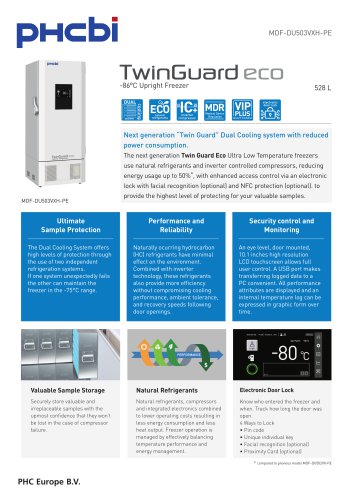 MDF-DU503VXH-PE Productsheet
2 Pages
 ProteoSave™ Brochure
2 Pages
 STEMFULL™ Brochure
2 Pages
 Cryogenic Vials Brochure
2 Pages
 MCO-50AIC-PE CO2 Incubators
2 Pages
 MCO-50M-PE CO2 Incubators
2 Pages
 Cleanroom Classification
4 Pages
 MIR-554-PE Cooled Inucbator
2 Pages
 MPR-514(R)-PE
2 Pages
 MPR-S150H-PE & MPR-S300H-PE
2 Pages
 MPR-N450FHD-PE
2 Pages
 Commitment to PHC Quality
32 Pages
 PRIMESURFACE®
4 Pages
 MPR-1014R-PE
2 Pages
 MDF-U731M-PE -30°C Freezer
2 Pages
 MLR-352-PE Climate Chamber
2 Pages
 MIR-554 Cooled Incubator
2 Pages
 MCO-170AC-PE CO2 Incubators
2 Pages
 MCO-230AIC-PE CO2 Incubators
2 Pages
 MCO-80IC-PE CO2 Incubator
2 Pages


Archived catalogs
 Vaccine Storage E-Book
14 Pages
 General Catalogue
60 Pages
 MCO-50AICL-PE Co2 Incubator
2 Pages
 MCO-5AC-PE CO2 Incubators
2 Pages
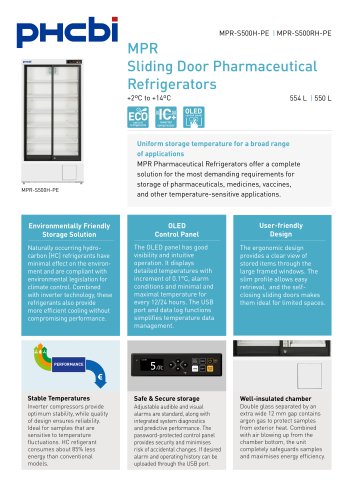
 MPR PHARMACEUTICAL REFRIGERATORS
12 Pages
 ULTRA LOW TEMPERATURE FREEZERS
16 Pages
 ULT VIP
12 Pages
 MIR-H163-H263
2 Pages
 Racking systems brochure
7 Pages
 Bloodbank Refrigerators
4 Pages
 MIR Cooled Incubators
4 Pages
 Storage Solutions
7 Pages
 TwinGuard ULT Freezers Brochure
12 Pages
 MDF-DU302VX-PE
2 Pages
 Cryopreservation brochure
28 Pages
 MCO-19AIC(UV)-PE
6 Pages
 MCO19-AIC/M Incubators
16 Pages
 MDF-U4186S-PE
2 Pages
 MBR-705GR
2 Pages
 KM-DU34H1E Flyer
2 Pages
 MPR-215F-PE & MPR-414F(S)-PE
2 Pages
 MDF-U7386S-PE
2 Pages
 MDF-C8V1-PE
2 Pages
 Autoclaven MLS-2420/3020
2 Pages
 MDF-U731M
2 Pages
 MDF-U5386S-PE
2 Pages
 MDF-U3386S-PE
2 Pages
 MDF-U33V
2 Pages
 MDF-U4186S
2 Pages
 MDF-U55V-PE
2 Pages
 MDF-U74V
2 Pages
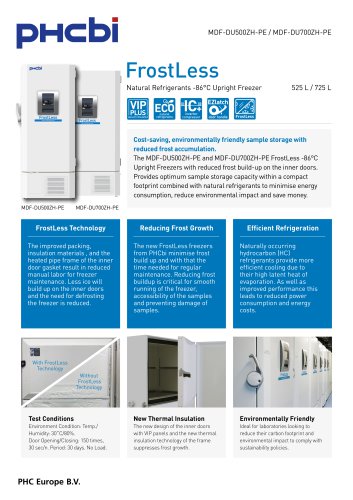
 MDF-U500VX
2 Pages
 MDF-U700VX-PE
2 Pages
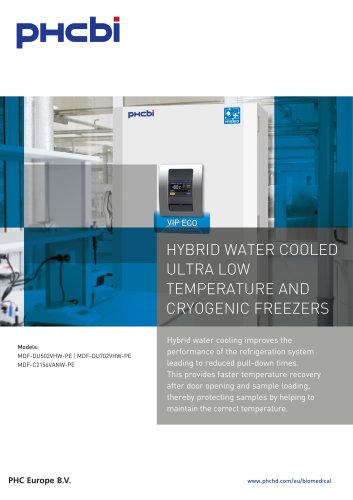
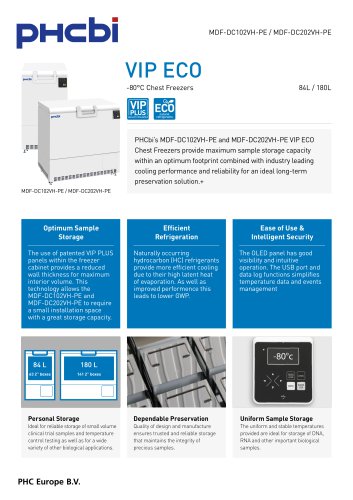
 Eco VIP Freezer
2 Pages
 Twin Guard Series
12 Pages
 Twinguard
12 Pages
 CHS promotional
2 Pages
 CardioHealth Station Patient
2 Pages
 CardioHealth Station
6 Pages
 Freezer storage systems
8 Pages




- Vessel
- Test cabinet
- Storage vessel
- Automatic analyser
- Temperature test chamber
- Metal tank
- Benchtop analyser
- Work safety gloves
- Climatic test cabinet
- Stainless steel vessel
- Industrial safety gloves
- Humidity test cabinet
- Continuous analyzer
- Environmental test chamber
- Real-time analyzer
- Laboratory analyzer
- PHC Europe laboratory incubator
- Thermal protection safety gloves
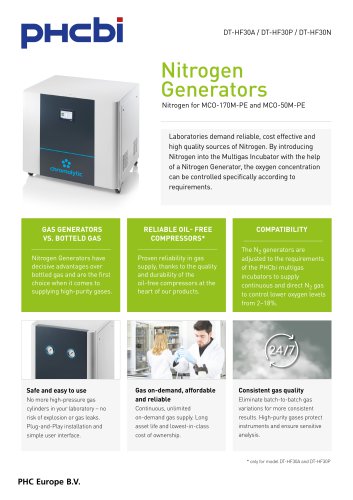
- Nitrogen generator