
- Catalogs
- Pfeiffer Vacuum+Fab Solutions
- Leak Detection Compendium

- Products
- Catalogs
- News & Trends
- Exhibitions
Leak Detection Compendium

Leak Detection Compendium
Leak detection is essential for maintaining system integrity by identifying structures that allow gases or liquids to pass through. The leakage rate is determined by the fluid's throughput under specific conditions, influenced by pressure gradients or concentration differences.
Leak detection theory involves understanding gas transport through leaks, which can occur in laminar, Knudsen, and molecular flow regimes. Assumptions are often necessary due to unknown leak geometries.
Helium and hydrogen are commonly used tracer gases due to their small molecular size, which allows them to pass through leak channels. The choice depends on the application and flow regime.
Various sensor technologies, such as mass spectrometric analyzers and quartz window sensors, are used based on specific leak detection requirements.
Methods include integral tests, spraying tests, sniffing tests, and bombing tests, chosen based on system type and sensitivity needs.
These systems maintain product quality and include helium recovery units to minimize resource wastage. Calibration and adaptation are crucial for accuracy.
Regular maintenance ensures equipment reliability. Training and seminars enhance personnel skills in leak detection.
Leak detection involves various leakage rates, often expressed exponentially. The SI unit for leakage rate is "Pa m3 s-1". Conversion between units involves converting individual physical properties.
Formulas cover calibration, pump down time, effective pumping speed, conductance in series, signal response time, permeation, and leak conversion between gases.
Includes tables and figures illustrating exponential displays, media transport through leaks, and permeation coefficients.
Conversion factors for leakage rates between different gases are provided, essential for converting rates from one gas to another.
Leakage rates between gases are inversely proportional to their molar masses.
Calculates tracer gas leakage rate from a liquid leakage rate, considering pressure and media viscosities.
Formula describes the maximum diameter of a leak that can be blocked by a liquid, considering surface tension and contact angle.
Conversion involves converting mass loss to pV leakage rate and then between gases using flow regime-specific formulas.
Defines standardized leakage rates under specific conditions and provides conversion formulas.
Formulas describe temperature dependence of gas transport through a leak in laminar flow regime.
Involves measuring tracer gas concentration rise in a chamber, with examples demonstrating calculation of minimum time required for process-safe measurement.
Helium and forming gas are preferred for their sensitivity and selectivity. Helium is abundant in the universe but rare on Earth, while hydrogen is used in forming gas mixtures.
Mass spectrometric analyzers and quartz window sensors are used for precise leak detection, each with specific advantages.
Compares magnetic sector field mass spectrometers, quadrupole mass spectrometers, and quartz window sensors, highlighting strengths and limitations.
Methods include spraying, sniffing, integral vacuum, and bombing tests, with selection based on tightness criteria and maximum acceptable leakage rate.
Components include test chamber, leak detector, calibration leaks, and gas supply, with emphasis on customization and adaptation.
Collect and reuse helium, offering cost-saving potential in high-consumption applications.
Pfeiffer Vacuum offers training programs on vacuum technology and leak detection, covering theoretical knowledge and practical skills.
Emphasizes extensive pre-sales and application support, with maintenance recommendations based on wear analysis.
Includes tables for flow rate and pressure conversion units, and major natural constants relevant to vacuum technology.
Overview of various helium leak detectors, detailing applications across different industries.
References DIN EN standards and guidelines related to non-destructive testing and leak detection.
List of recommended books and websites for more in-depth knowledge on vacuum technology and leak detection.
Catalog excerpts

Leading. Dependable. Customer Friendly. Pfeiffer Vacuum stands for innovative and custom vacuum solutions worldwide, for German engineering art, competent advice and reliable service. Ever since the invention of the turbopump, we’ve industry and Cbeen setting standards in our drive us in thethis claim OMPENDIUM to leadership will continue to future. ta subject to change without prior notice. PK 0084 PE (July 2010/10) Germany Pfeiffer Vacuum GmbH Headquarters Phone: +49 (0) 6441 802-0 [email protected] ited States iffer Vacuum Inc. one: +1 603 578 6500 itzerland iffer Vacuum (Schweiz) AG one: +41 44 444 22 55 [email protected] eden Are you looking for a iffer Vacuum Scandinavia AB solution? perfect vacuum one: +46 8 590Please contact us: 748 10 [email protected] Benelux Pfeiffer Vacuum GmbH Sales & Service Benelux Phone: +800-pfeiffer [email protected] China Great Britain Pfeiffer Vacuum Ltd. Phone: +44 1908 500600 [email protected] Sweden Pfeiffer Phone: sales@ India Pfeiffer Vacuum India Ltd. Phone: +91 40 2775 0014 [email protected] Switzer Pfeiffer Phone: info@p Italy Pfeiffer Vacuum Italia S.p.A. Phone: +39 02 93 99 05 1 United Pfeiffer Phone:
Open the catalog to page 1
Masthead Author: Team of authors Published by: Pfeiffer Vacuum GmbH, Headquarters Berliner Strasse 43, D-35614 Asslar/Germany T +49-(0) 6441-802-0, F +49-(0) 6441-802-1202 [email protected], www.pfeiffer-vacuum.com Subject to change without notice Note Leak Detection Compendium Regardless of their nature, the information and promotional statements contained in this Compendium and, in particular, the descriptions, photographs, illustrations, drawings, samples and information relating to quality, nature, composition, performance, consumption and usability, as well as the dimensions and weights...
Open the catalog to page 2
1 Leak Detection - Introduction 6 1.1 What Is a Leak? - Definition 6 2 Basic Leak Detection Theory 9 2.3 Formulas for Leak Detection Calculations 11 2.3.2 Pump Down Time 12 2.3.3 Effective Pumping Speed 13 2.3.5 Signal Response Time 14 2.3.7 Leak Conversion Between Gases in Laminar Flow Regime 17 2.3.8 Leak Conversion Between Gases in Molecular Flow Regime 18 2.3.9 Leak Conversion Between a Liquid and a Gas 18 2.3.10 Leaks Blocked by Liquids 19 2.3.11 Mass Loss Rates and Volume Leakage Rates in Laminar Flow Regime 20 2.3.12 Mass and Volume Leakage Rates in Molecular Flow Regime 21 2.3.13 Standardized...
Open the catalog to page 3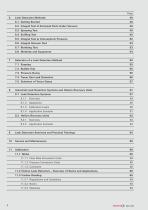
6 Leak Detection Methods 46 6.2 Integral Test of Enclosed Parts Under Vacuum 48 6.5 Integral Test at Atmospheric Pressure 52 6.6 Integral Vacuum Test 53 7 Selection of a Leak Detection Method 55 7.4 Tracer Gas Leak Detection 56 7.5 Selection of Tracer Gases 57 8 Industrial Leak Detection Systems and Helium Recovery Units 57 8.1 Leak Detection Systems 57 8.2 Helium Recovery Units 63 9 Leak Detection Seminars and Practical Trainings 64 11.1.1 Flow Rate Conversion Units 66 11.1.2 Pressure Conversion Units 66 11.2 Helium Leak Detectors - Overview of Series and Applications 68
Open the catalog to page 4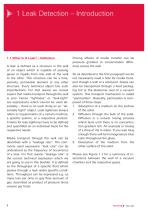
1 Leak Detection – Introduction 1.1 What Is A Leak? – Definition A leak is defined as a structure in the wall of an object which is capable of passing gases or liquids from one side of the wall to the other. This structure can be a hole, porosity, permeable element or any other structure. Every technical object has such imperfections. For that reason we cannot expect that media transport through the wall is zero. Hence “tightness” or “leak-tight” are expressions which cannot be used absolutely – there is no such thing as an “absolutely tight” object. Leak tightness always refers to requirements...
Open the catalog to page 6
Absorption Inclusion into solids or liquids. Follows adsorption Adsorption Attachment of gases on the surface of solids or liquids Permeation Consists of adsorption diffusion desorption Desorption Release of attached gases from the surface Leakage A hole in the wall High pressure Figure 1-1: Interactions between the wall of a vacuum chamber and the respective gases In case that the wall of a test object really has a small hole and there is a pressure difference from one side of the wall to the other we can observe media flow from the highpressure side to the low-pressure side. Both liquids and...
Open the catalog to page 7
1.2 How Large Is A Leak? In order to get a feeling for diameters of leaks one can calculate the diameter of a leak assuming that it is an ideal tube with smooth walls. Technically Gas tight tight Virus tight Bacteria tight Water tight Water dropping Leak diameter Leakage rate Escape time of a bubble with 1 cc Leak location by sniffing Leak quantification under atmospheric conditions Local and integral vacuum test Test of sealed objects Test methods Visual Ultrasonic Pressure decay Bubble test Tracer gas at ambient pressure Tracer gas in vacuum Figure 1-2: Magnitudes of leak size and leakage rate...
Open the catalog to page 8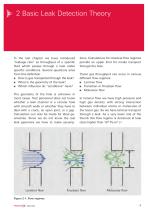
2 Basic Leak Detection Theory In the last chapter we have introduced “leakage rate” as throughput of a specific fluid which passes through a leak under specific conditions. Several questions arise from this definition: ■ How is gas transported through the leak? ■ What is the geometry of the leak? ■ Which influence do “conditions” have? The geometry of the hole is unknown in most cases. Test personnel does not know whether a leak channel is a circular hole with smooth walls or whether they have to deal with a crack, an open joint, or a gap. Calculation can only be made for ideal geometries. Since...
Open the catalog to page 9
Capillary diameter [µm] Figure 2-2: Transport of different media through a leak (calculated for a temperature of 20 °C and a wall thickness of 1 cm) In molecular flow we have low pressures and a low gas density. There are almost no interactions between individual atoms or molecules of the tracer gas. The molecular flow regime is dominant at leak rates lower than 10-8 Pa m3 s-1. The transition between laminar-viscous flow and molecular flow is not instantaneous. The transition regime is called Knudsen flow. If you are not certain, which flow regime you are in please calculate both alternatives...
Open the catalog to page 10All Pfeiffer Vacuum+Fab Solutions catalogs and technical brochures
 HiQuad Neo
8 Pages
 DuoVane 22
4 Pages
 Product overview
56 Pages
 HiCube Neo
8 Pages
 SpeedAir
8 Pages
 HiPace 80 Neo
12 Pages
 Duo 1.6/M
16 Pages
 SmartVane
8 Pages
 Turbo Pumping Stations - HiCube
20 Pages
 Pascal 2021 HW
4 Pages
 Roots Pumps
32 Pages
 Vacuum for life
32 Pages
 Rotary vane pumps - DuoLine
16 Pages
 ActiveLine Gauges
8 Pages
 Transmitters - ActiveLine
8 Pages
 Duo 3 DC - Rotary vane pumps
4 Pages
 HiPace 30 - Turbopumps
4 Pages
 Chambers and Components (Part 3.3)
399 Pages
 Vacuum generation (Part 3.1)
475 Pages
 Know-how book (Part 2)
140 Pages


Archived catalogs
 AMI 1000
8 Pages
- Pfeiffer valve
- Pfeiffer manual valve
- Fitting
- Pfeiffer stainless steel valve
- Ball valve
- Temperature probe
- Pneumatic valve
- Pneumatic fitting
- Pfeiffer vacuum generator
- Electrically operated valve
- Gas analyzer
- Pfeiffer vacuum pump
- Electric valve
- Pfeiffer single-stage vacuum pump
- Pressure gauge
- Gas valve
- Calibration system
- Pneumatically-operated valve
- Rotary joint
- Butterfly valve