
- Catalogs
- PETROSYSTEM
- Vent and Flare Gas Recovery System

Vent and Flare Gas Recovery System

Vent and Flare Gas Recovery System
The Vent Gas Recovery System (VGRS) was implemented to prevent large emissions of vent gas, which previously were released into the atmosphere. These gases include natural gas, BTEX, water, and inerts like nitrogen and carbon dioxide. The system is designed as a skid (SK-1000) and is located on the cellar deck, with five skids supplied so far.
The vent gas from the Still Vapour Condenser is released at approximately 40°C and is saturated. Condensate is drained to a holding tank where hydrocarbon and water phases are separated. The vapour is extracted via the LP vent line, which is designed to prevent liquid entrainment and is continuously drained to the holding tank. The line is process traced to maintain a minimum temperature of 30°C in winter to prevent condensation.
In the VGRS skid, vapour is compressed to 1.8 barA, cooled to about 5°C, and reheated to approximately 30°C. This process condenses a significant portion of the vapours, reducing the water content and allowing the gas to be reused as stripping gas. The BTEX condensation reduces the gas's calorific value to match the platform's production gas. Reheating prevents condensation in downstream systems, which are also trace heated.
Objectives & Benefits
- Comply with environmental legislation on emissions from offshore platforms.
- Avoid government penalties for emissions persisting past 2002.
- Maximize waste gas utilization to support the Glycol Generator and local burners/generators.
- The standalone function of the skids allows installation and commissioning with minimal process downtime.
Catalog excerpts
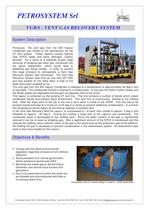
PETROSYSTEM Srl Via Gaspare Spontini, 29/4 - 00043 Ciampino (Roma) – Italy Tel:+39 06 7932.1621 Fax:+39 06 7932.1160 Email: [email protected] web: petrosystem.it VGRS - VENT GAS RECOVERY SYSTEM System Description Previously the vent gas from the Still Vapour Condenser was vented to the atmosphere via the LP vent system. These vapours contain Natural Gas, BTEX, water and inerts (Nitrogen, Carbon dioxide). As a result of a separate project large amounts of stripping gas were also introduced into the glycol regenerator, which would lead to additional gas being vented. In order to prevent this large emission to atmosphere a Vent Gas Recovery System was introduced. The Vent Gas Recovery System was built as one skid SK-1000 and was located on the cellar deck. A total of five skids have been supplied so far. The vent gas from the Still Vapour Condenser is released at a temperature of approximately 40 deg.C and is saturated. The condensate formed is drained to a holding tank. In this tank the Hydro Carbon phase and the Water phase are separated and brought via separate lines to the sump The vapour is extracted via the existing LP vent line. This line contains a number of bends which collect condensed liquids and prevent liquid entrainment. This vent line is continuously drained to the holding tank. After the drain point at the top of the line a tie-in point is made to the VGRS. This line has to be process traced and kept at a minimum of 30 deg.C in winter to prevent additional condensation. In summer this temperature will be higher as the tracing releases a constant heat. In the Vent Gas Recovery Skid the vapour is compressed to 1.8 barA, then cooled to approx. 5 deg.C and reheated to approx. 30 deg.C. During the cooling a large part of the vapours are condensed. The condensed liquid is discharged to the holding tank. Since the water content of the gas is significantly reduced it can be re-used as stripping gas. Also a significant amount of the BTEX is condensed and this reduces the heating value (calorific value) of the gas to the same level as the production gas of the platform. Re-heating the gas is necessary to prevent condensation in the downstream system. All downstream pipe work is also trace heated for this reason. Objectives & Benefits • Comply with the latest environmental legislation regarding emissions from offshore platforms. • Avoid penalties from central government where emissions persist past 2002. • Maximise the waste gas to aid the Glycol Generator and service local burners and generators. • Due to its stand alone function the skids can be installed and commissioned with little or no process down time. Compressor skid of a similar design is used for VGRS assemblies
Open the catalog to page 1All PETROSYSTEM catalogs and technical brochures
 Retractable Access System
3 Pages
 MEDUSA PACKERS Mod. MED
2 Pages
 BENDY PACKERS Mod. DP
2 Pages
 EGG SHAPED PACKERS Mod.ESB
2 Pages
 SHORT PACKERS Mod. LBTB
2 Pages
 LATERAL PACKERS Mod.PSTB
2 Pages
 JOINT TEST PLUG Model ET
2 Pages
 MANHOLE TEST PLUG Model RTB
2 Pages
 PIPE TEST PLUGS Model KTB
2 Pages
 C PIPE PLUG Model CKB
2 Pages
 MINI PIPE PLUGS Model KBM
2 Pages
 INFLATION EQUIPMENTS
1 Page
 Flameshield Gas Stopper
2 Pages
 PNEUMATIC STOPPER TYPE G
1 Page
 SPHERE TROLLEY
2 Pages
 PVDF FLOWMETER 800 series
3 Pages
 JIB CRANE
1 Page
 SPHERE RELEASE FINGERS
1 Page
 LAUNCHER & RECEIVER PIG TRAP
4 Pages
 CLAMP RING TYPE CLOSURE
3 Pages
 SECTOR TYPE CLOSURE
3 Pages
 Instrument Sunshade
1 Page
 2-4D Pigging Tool
2 Pages
 Bidirectional Metal Body Pig
2 Pages
 STAINLESS STEEL PLUG
2 Pages
 ALUMINIUM PLUG
3 Pages
 PVC Inflatable Bags
2 Pages
 NYLON PLUG
2 Pages
 MULTI-LOCK STEEL PLUG
3 Pages
 Bidirectional Cleaning Pig
2 Pages
 LOCKING BAND TYPE CLOSURE
3 Pages
 Air Bags
2 Pages
 FOAM PIGS
2 Pages
 PIGS
PIGS4 Pages
 PIPE PLUG Modello KB
11 Pages
 OMNI PIG
2 Pages
 INFLATABLE SPHERE
2 Pages
 Mechanical Pug Series 300
7 Pages


Archived catalogs
 Product Recovery Systems
2 Pages
 Pig localization system
6 Pages
 Gas Seal stopper
1 Page
 Rapid Opening Closure
2 Pages
 Coupon holder
1 Page
 Corrosion Monitoring Systems
4 Pages
 Sand Erosion Detectors
3 Pages
 Oval Gear Flow meters
8 Pages
 Solid Cast Pig
1 Page
 CEION® Measurement Technology
3 Pages
 Sphere Release Finger
1 Page
 Water Flowmeter
12 Pages
 Vortex Flowmeter
4 Pages
 In line magnetic Flow meters
2 Pages
 Flow computer Multiflow
3 Pages
 Water cut meter (BSW)
1 Page
 Butterfly Control Valve
4 Pages
 Knife edge gate valve
1 Page
 Moisture Oil Monitor
4 Pages
 inline density meter
3 Pages
 Desuperheaters
2 Pages
 Positioners and Actuators
2 Pages
 Safety relief valve
4 Pages
 Inflow Viscosity Meter
3 Pages
 CB-6
CB-68 Pages
 Separation and Batching Pig
5 Pages
 Rapid Opening End Closure
2 Pages
 GRIP LOCK PIPE PLUGS
1 Page
 Density Meter for gas
2 Pages
 Water in fuel Monitor
2 Pages
 Insertion type Density Meter
1 Page
 Thickness Gauge
2 Pages
 DM-250.1 SERIES
2 Pages
 TOTALISER and RATE of FLOW
2 Pages
 DC-40 SERIES
1 Page
 DENDi SERIES
1 Page
 Venturi Tubes
1 Page
 Vee-Notch Ball Valve
1 Page
 FOAM PIGS PE
2 Pages
 Globe Control Valve
1 Page
 Multidiameter Pig
1 Page


