
- Catalogs
- PerkinElmer
- In-situ Evolved Gas In 3D Printing Application Note

In-situ Evolved Gas In 3D Printing Application Note

In-situ Evolved Gas In 3D Printing Application Note
3D printing technology has gained significant attention due to its ability to create complex structures efficiently and without leftover materials. While thermoplastic materials are commonly used, advanced prototypes use thermoset precursors, which can emit harmful gases during printing. PerkinElmer offers solutions to analyze these gases using the TG-GC/MS platform.
Experimental Procedure
The study employed the TG-GC/MS module to analyze thermal decomposition and identify breakdown products. The TGA 8000 was set from room temperature to 800 °C at a rate of 20 °C/min, using helium to purge the system. The analysis involved both online and separation modes to monitor molecular debris.
Results
The polymer began pyrolysis at 585.17 °C with a 44.268% weight loss. Initial mass spectrometry at 630 °C indicated aromatic compounds, requiring further separation for precise identification. Key MS signals were observed at 315 °C and 605 °C, focusing analysis on these points. The evolved gases at 315 °C included linear hydrocarbons with triple-bonded nitrogen, while those at 605 °C contained aromatic structures.
Conclusion
The polymer is classified as a high-performance engineering polymer, with primary pyrolytic products being phenol and biphenyl derivatives, typical of aramid polymers. The unpleasant gases are mainly azoic compounds, likely used as chain extension initiators.
References
The document cites studies on 3D printing technologies and emissions, highlighting the relevance of the research.
Catalog excerpts

Hyphenated Technology Author: Hua Cheng PerkinElmer, Inc. Shanghai, China In-situ Evolved Gas Analysis During the 3D Printing Procedure Three-dimensional (3D) printing technology has received tremendous interests due to its capability of generating complex-shaped structures, unparalleled high efficiency and zero residual feedstock1,2,3. The invention and development of low-cost desktop printers has made this technology widely acceptable for applications both in industry and home4. Normally, thermoplastic materials are utilized as the raw material of 3D printers, while more advanced and sophisticated prototype uses the precursor of thermoset materials (or a prepreg) as the feedstock sources. Due to the reaction nature of the precursor, various unpleasant gases would emit during the printing procedure which may include regulation prohibited chemicals from time to time. PerkinElmer can provide effective hyphenated solutions to in-situ study the chemical nature of evolved gases during the 3D printing. At the same time, since the TGA 8000™ can cover the temperature range up to 1200 °C, we may also count on the TG-GC/MS platform to reverse-engineer target products regardless of a fully cured product or an additive included prepreg.
Open the catalog to page 1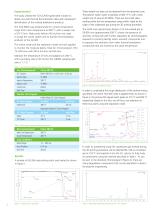
Experimental The study utillized the TG-GC/MS hyphenated module to obtain accurate thermal decomposition data with subsequent identification of the evolved breakdown products. The TGA 8000 was programmed for a linear temperature range from room temperature to 800 °C with a sweep rate of 20 °C/min. High purity helium (45 mL/min) was used to purge the whole system and to transfer the breakdown products to the GC/MS. The online mode and the separation mode are both applied to monitor the molecule debris, Total Ion Chromatogram (TIC) 15~500 amu with SIR at 44 amu and 94 amu. Maintain the temperature...
Open the catalog to page 2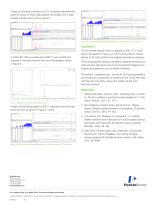
Analysis of the peaks evolved at 315 °C tentatively identified the peaks to consist of linear hydrocarbons terminated with a triple bonded nitrogen atom such as Figure 5. Figure 8. Evolved product of thermal degradation at a retention time of 24.50 minutes. Conclusion Figure 5. Linear hydrocarbon breakdown product generated at 315 °C. A similar 80~100 µL evolved gas at 605 °C was injected and analysed in the same manner with the chromatogram shown in Figure 6. The 3D-printed polymer starts to degrade at 585.17 ºC under helium atmosphere. It gives us a hint that this polymer should belong to the...
Open the catalog to page 3All PerkinElmer catalogs and technical brochures
 TGA 8000 Brochure
8 Pages
 Adulterant Screen Solutions
8 Pages
 AxION 2 TOF Brochure
8 Pages
 OilExpress Family Brochure
8 Pages
 Flexar SQ 300 MS Brochure
8 Pages
 AxION iQT GC/MS/MS
2 Pages
 Hyphenated Technology Guide
10 Pages
 Spectrum Two FT-IR Spectroscopy
12 Pages
 Clarus SQ8 GC/MS Brochure
12 Pages
 NexION 350 ICP-MS
12 Pages
 Onesource Overview Brochure
8 Pages
 XRpad 4336
2 Pages
 GC SNFR Olfactory Port
2 Pages
 AxION DSA Brochure
8 Pages


- Gas analyzer
- Concentration analyzer
- Automation software solution
- Management software solution
- Monitoring analyzer
- Analysis software solution
- Liquids analyzer
- Process software
- Automatic analyser
- Control software
- Benchtop analyser
- Spectrometer
- Portable analyzer
- Visualization software solution
- Laboratory analyzer
- Compact analyzer
- Development software
- Infrared analyser
- Reporting software
- Temperature analyzer