
- Catalogs
- PerkinElmer
- Detection of Additive in Gloves Application Note

Detection of Additive in Gloves Application Note

Detection of Additive in Gloves Application Note
Glove manufacturers aim to produce high-quality gloves at minimal cost. The quality is influenced by raw materials and manufacturing processes, including the use of rubber additives. Understanding these additives is crucial for optimizing glove production.
Detection of Additives Using TG-GC/MS
This study investigates the use of a dispersing agent in glove manufacturing. Two glove samples, one with and one without the dispersing agent, were analyzed using a TG-GC/MS hyphenation system to detect differences.
Experimental Setup
The experiment utilized the PerkinElmer TGA 8000 hyphenated with Clarus SQ 8 GC/MS. The setup involved specific temperature profiles and gas flow rates to analyze the thermal degradation of the dispersing agent.
Results
Both glove samples showed similar weight loss profiles, indicating the need for a more sensitive instrument. The GC/MS analysis revealed complex gas evolution, primarily from latex decomposition. However, trace amounts of the dispersing agent were detected in Glove B, not in Glove A.
Conclusions
The TG-GC/MS system effectively detected trace additives in glove manufacturing with minimal sample preparation. This method provides a faster and more comprehensive approach to material characterization.
References
1. Vanderbilt Chemicals Product Information, Latex Glossary.
Catalog excerpts
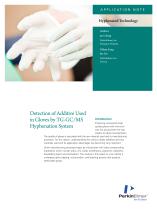
Hyphenated Technology Authors: Jia Yi Ling PerkinElmer, Inc. Selangor, Malaysia Tiffany Kang Joe Lee PerkinElmer, Inc. Taiwan Detection of Additive Used in Gloves by TG-GC/MS Hyphenation System Producing consistently high quality gloves with minimum cost has always been the top mission for glove manufacturers. The quality of gloves is associated with the raw materials used and its manufacturing processes. For this reason, understanding the various rubber additives and raw materials used and its application advantages has becoming very important. Glove manufacturing processes begin by mixing latex with latex compounding ingredients which include sulfur, zinc oxide, accelerators, pigments, stabilizers, dewebbing agent and antioxidant. The mixture is then leave to cure, before it undergoes glove dipping, vulcanization, and leaching process that produce stretchable gloves.
Open the catalog to page 1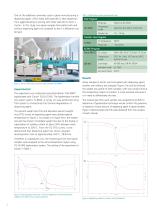
One of the additives commonly used in glove manufacturing is dispersing agent, which keep solid particles in latex dispersion from agglomerating or joining with other particles to form a cluster1. In this study, two glove samples formulated with and without dispersing agent are analyzed to see if a difference can be seen. Table 1. Hyphenation system experimental setup. Heat from 30 to 650 oC at 50 oC/min Sample size Temperature profile Transfer Line Program TL 8500 Pump rate GC/MS Program Clarus 680 GC GC column Temperature profile Scan range Ionization mode Results Figure 1. TG-GC/MS (Clarus...
Open the catalog to page 2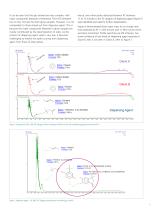
It can be seen that the gas evolved are very complex, with major compounds detected at Retention Time (RT) between two to four minutes for both glove samples. However, it is not comparable to those eluted out from dispersive agent. This is because the major compounds detected in glove samples are mainly contributed by the decomposition of latex. As the content of dispersing agent used is very low, it becomes challenging to resolve the peaks coming from dispersing agent from those of latex gloves. Hence, two other peaks detected between RT between 11 to 12 minutes in the TIC diagram of dispersing...
Open the catalog to page 3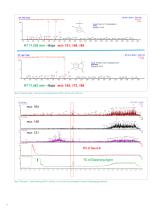
Figure 6. Dispersive Agent – Mass spectrum of selected peaks at RT 11.205 min and 11.563 min. Figure 7. Blue glove – Peak monitoring at RT 11.205 min, m/z 121, 149 & 164, showing trace amount of dispersing agent detected.
Open the catalog to page 4
Conclusions TGA is a useful tool when it comes to compositional analysis as it allows quantification of weight loss of a material at targeted temperature region. By hyphenating TGA to a GC/MS system, further identification of evolved gases can be carried out. In this case, TG-GC/MS hyphenation system successfully detect trace amount of additive used in glove manufacturing process. With minimum sample preparation, the TG-GC/MS serves as a much faster approach when it comes to sample differentiation, at the same time allowing a more complete thermal characterization of material. References 1. Vanderbilt...
Open the catalog to page 5All PerkinElmer catalogs and technical brochures
 TGA 8000 Brochure
8 Pages
 Adulterant Screen Solutions
8 Pages
 AxION 2 TOF Brochure
8 Pages
 OilExpress Family Brochure
8 Pages
 Flexar SQ 300 MS Brochure
8 Pages
 AxION iQT GC/MS/MS
2 Pages
 Hyphenated Technology Guide
10 Pages
 Spectrum Two FT-IR Spectroscopy
12 Pages
 Clarus SQ8 GC/MS Brochure
12 Pages
 NexION 350 ICP-MS
12 Pages
 Onesource Overview Brochure
8 Pages
 XRpad 4336
2 Pages
 GC SNFR Olfactory Port
2 Pages
 AxION DSA Brochure
8 Pages


- Gas analyzer
- Concentration analyzer
- Automation software solution
- Management software solution
- Monitoring analyzer
- Analysis software solution
- Liquids analyzer
- Process software
- Automatic analyser
- Control software
- Benchtop analyser
- Spectrometer
- Portable analyzer
- Visualization software solution
- Laboratory analyzer
- Compact analyzer
- Development software
- Infrared analyser
- Reporting software
- Temperature analyzer