
- Catalogs
- PCB Piezotronics GmbH
- Mining Equipment Monitoring & Protection Solutions


Mining Equipment Monitoring & Protection Solutions
Mining Equipment Monitoring & Protection Solutions
IMI Sensors offers a wide range of monitoring and protection solutions for mining equipment, emphasizing reliability, uptime, and safety. The equipment is engineered to withstand extreme vibration levels typical in mining operations, ensuring machinery health and preventing unscheduled downtime.
- Reliability Vibration Sensors: Includes underground sensors approved by MSHA and ATEX, sensors for hazardous environments, and wireless solutions for inaccessible areas.
- Industrial Hygiene: Provides worker safety products, environmental equipment, and acoustic calibrators.
- Accessories: Comprises cable assemblies, safety equipment, enclosures, and calibration units.
IMI Sensors offers vibration sensors compliant with the National Electric Code and ATEX directive, designed for safe operation in environments with ignitable substances.
- MSHA and ATEX Approved Models: Suitable for high-frequency response and route-based predictive maintenance data collection.
- High Temperature and Corrosive Environments: Sensors and cable assemblies are available for temperatures up to 325°F (162°C) and beyond, using materials like PTFE and FKM.
The Echo® Wireless Vibration Monitoring System facilitates automatic data collection in hazardous areas, minimizing the need for personnel to enter unsafe zones. It integrates with existing systems and provides real-time alerts and data storage.
- 4-20 mA Transmitters: Interfaces with PLC, DCS, and SCADA systems for continuous monitoring.
- Vibration Switches: Offer dual set points with alert and alarm relays, suitable for hazardous areas.
Portable vibration calibrators and handheld shakers are available for field checks of accelerometers and other sensors, ensuring accuracy and compliance with NIST traceability.
- Worker Exposure Compliance: Noise dosimeters and sound level meters help assess noise exposure risks and verify hearing protection programs.
- Noise Monitoring Systems: Designed for unattended use, providing real-time data and alerts for noise events.
Systems for monitoring driveshaft torque and motor temperature, using wireless telemetry to provide continuous feedback and maximize production output.
Catalog excerpts

MINING EQUIPMENT MONITORING& PROTECTION SOLUTIONS pcb.com/imi-sensors | 1 800 959 4464 ®IMI SENSORS
Open the catalog to page 1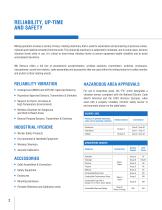
Mining operation involves a variety of heavy rotating machinery that is used for exploration and processing of precious metals, minerals and material extracted from the earth. This industrial machinery is subjected to moderate, and in some cases, extreme vibration levels while in use. It’s critical to trend these vibration levels to ensure equipment health reliability and to avoid unscheduled downtime. IMI Sensors offers a full line of piezoelectric accelerometers, wireless solutions, transmitters, switches, enclosures, microphones, sound level meters, cable assemblies and accessories that are...
Open the catalog to page 2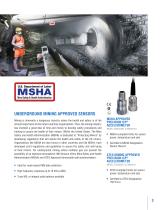
UNDERGROUND MINING APPROVED SENSORS Mining is inherently a dangerous industry where the health and safety is of the utmost importance to the miners and their organizations. Thus, the mining industry has invested a great deal of time and money to develop safety procedures and training to assure the health of their miners. Within the United States, The Mine Safety and Health Administration (MSHA) is dedicated to “Protecting Miners” by developing regulations that will assure the health and safety of the US miners. Organizations like MSHA are also found in other countries and like MSHA, have developed...
Open the catalog to page 3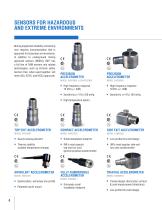
Mining equipment reliability monitoring now requires instrumentation that is approved for hazardous environments. In addition to underground mining approved sensors (MSHA), IMI® has a full line of PdM sensors and related technologies, such as intrinsic safety barriers that, when used together, will meet CSA, ATEX, and IECEx approvals. ■ High frequency response 15 kHz (+/- 3dB) ■ High frequency response 10 kHz (+/- 3dB) TOP EXIT ACCELEROMETER MODEL EX628F01 ■ Quartz sensing element (sudden temperature change) Small installation footprint ■ IMI’s most popular top-exit low cost general purpose accelerometer...
Open the catalog to page 4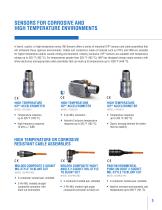
In harsh, caustic, or high temperature areas, IMI Sensors offers a series of industrial ICP® sensors and cable assemblies that will withstand these rigorous environments. Cables and connectors made of material such as PTFE and FKM are available for higher temperature and/or caustic mining environments. Industry exclusive, ICP® sensors are available with temperature ratings up to 325 °F (162 °C). For temperatures greater than 325 °F (162 °C), IMI® has designed charge output sensors with inline electronics and appropriate cable assemblies that can hold up to temperatures up to 1200 °F (649 °C)....
Open the catalog to page 5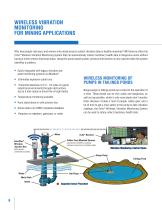
Why have people risk injury and venture into unsafe areas to collect vibration data on healthy machines? IMI Sensors offers the Echo® Wireless Vibration Monitoring System that can automatically collect machinery health data in dangerous areas without having a miner venture into those areas. Using this alarm based system, personal intervention is only required when the system identifies a problem. ■ Easily integrates with legacy vibration and plant monitoring systems via Modbus® WIRELESS MONITORING OF PUMPS IN TAILINGS PONDS Barge pumps in tailings ponds are critical to the operation of a mine....
Open the catalog to page 6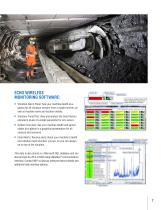
ECHO WIRELESS MONITORING SOFTWARE: ■ Vibration Alarm Panel: See your machine health at-a-glance for all vibration sensors from a single receiver, as well as machine name and location details. ■ Vibration Trend Plot: View and analyze the trend history and alarm levels of a single parameter for any sensor. ■ System Overview: See your machine health and sensor status at-a-glance in a graphical presentation for all sensors and receivers. ■ Email Alerts: Receive alerts about your machine’s health and vibration level wherever you are, so you can always be on top of the situation. This data is also...
Open the catalog to page 7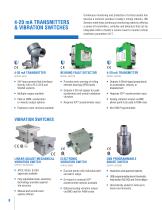
Continuous monitoring and protection of critical assets has become a common practice in today’s mining industry. IMI Sensors meet these continuous monitoring needs by offering a series of transmitters, switches and detectors that can be integrated within a facility’s control room to monitor critical machinery parameters 24-7. ■ 24V loop powered that interfaces directly with a PLC, DCS and SCADA systems ■ Multiple ranges available ■ Peak or RMS, acceleration or velocity output options ■ Explosion proof versions available ■ Provides early warning of rolling element bearings (RFB) faults ■ Outputs...
Open the catalog to page 8
PORTABLE CALIBRATORS HANDHELD VIBRATION SHAKER ■ Can perform up to 1,600 operating cycles in field without loss of battery power ■ Calibrates permanently mounted accelerometers at the machine ■ Confirms operation of cables, switching devices, and monitoring systems ■ Meets NIST traceability requirements PORTABLE VIBRATION CALIBRATOR MODEL 699B06 ■ Small and completely self-contained, ideal for field check of accelerometers, velocity transducers and proximity probes ■ Ruggedized, weatherproof enclosure dramatically improves durability and portability ■ Battery-powered unit offers extended life...
Open the catalog to page 9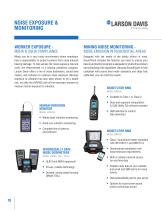
NOISE EXPOSURE & MONITORING Mines can be a very noisy environment where employers have a responsibility to protect workers from noise induced hearing damage. To help access the noise exposure risk and verify the effectiveness of a hearing protection program, Larson Davis offers a line of noise dosimeters, sound level meters, and software to measure noise exposure. Because exposure to vibration has also been shown to be a health risk, we offer the HVM100 with all the necessary sensors to measure human exposure to vibration. HUMAN VIBRATION MONITOR MODEL HVM100 INTRINSICALLY SAFE NOISE DOSIMETERS...
Open the catalog to page 10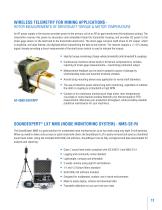
ROTOR MEASUREMENTS OF DRIVESHAFT TORQUE & MOTOR TEMPERATURE An RF power supply in the receiver provides power to the primary coil of an RF air gap transformer (the stationary pickup). The transmitter receives this power by secondary coils embedded inside the transmitter housing, and provides DC power to the strain gage sensor on the shaft and to the transmitter electronics. The strain gage converts shaft strain to mV output, which is amplified, anti-alias filtered, and digitized before transmitting the data to the receiver. The receiver outputs a +/- 10 V analog signal, thereby providing a direct...
Open the catalog to page 11All PCB Piezotronics GmbH catalogs and technical brochures
 STEEL ROLLING & ANNEALING
4 Pages
 4-20 mA Transmitters
20 Pages
 MACHINE TOOL SPINDLES
4 Pages
 Bearing Fault Detector
4 Pages
 MESURES ACOUSTIQUES
4 Pages
 IMI-HazArea-LowRes
2 Pages
 686B series
8 Pages
 Smart Vibration Sensors
4 Pages
 Model 682B05
4 Pages
 Platinum Stock Products
4 Pages
 Series 660
4 Pages
 Vibration Switches
6 Pages
![603 Series ICP® Accelerometers (Models [CS][EX]603CXX)](https://img.directindustry.com/pdf/repository_di/111589/603-series-icp-accelerometers-models-cs-ex-603cxx-673860_1mg.jpg)
![Industrial Triaxial ICP® Accelerometers (Models 604BXX and [EX]629AXX)](https://img.directindustry.com/pdf/repository_di/111589/industrial-triaxial-icp-accelerometers-models-604bxx-ex-629axx-673848_1mg.jpg)








Archived catalogs
 Data Collector Poles
2 Pages
 Bearing Fault Detector PLUS
2 Pages
 IMI Sensors - Gearboxes
4 Pages
 PAPER MACHINES & CONVEYORS
4 Pages
 Cables and Connectors
48 Pages
 PLATINUM STOCK SENSORS
20 Pages








- Electrical cable
- Force sensor
- Power cable
- Tension/compression force transducer
- Strain gauge force sensor
- Single-axis accelerometer
- Triaxial acceleration sensor
- Pressure transducer
- Compact accelerometer
- Torque transducer
- Coaxial electrical cable
- Analog pressure transducer
- Signal conditioner
- Industrial accelerometer
- Relay module
- MEMS accelerometer
- Stainless steel pressure transducer
- Measurement microphone