

- Products
- Catalogs
- News & Trends
- Exhibitions
OPGUD

OPGUD
- Pulse Amplitude: 100V - 1250V
- Duty Factor: 50% - 95%
- Frequency Range: 0.7 – 164Hz
- Trigger Output/Input: TTL
- Setting (SET) Mode: Allows parameter adjustments via front panel potentiometers. This mode is not necessarily stable.
- Normal Work (RUN) Mode: Blocks parameter changes, ensuring a stable generated signal.
- Internal Trigger (INT): Uses an internal signal.
- External Trigger (EXT): Reacts to an external rising pulse via a BNC connector on the rear panel.
- SET/RUN Mode Switch
- INT/EXT Trigger Switch
- AMPLITUDE: Pulse amplitude setting
- DUTY: Duty cycle regulation
- FREQUENCY: Cycle length regulation
- BNC Connector for Trigger (internal/output or external/input)
- OUTPUT and POWER Switch
- Jack Connector for 12V/3A power supply
- Amplitude = 1.160kV; Frequency = 164.2Hz
- Amplitude = 1.240kV; Frequency = 24.24Hz
- Amplitude = 440V; Frequency = 24.36Hz
Catalog excerpts

OPGUD HV is an ultrasonic pulser suitable for work with all ultrasonic transducers with about 500pF - 20nF impedance. The rising edge of the Trigger signal (see picture) initiates the transducer charging process. After a predetermined time, the end of charge of the transmitter occurs and the ultrasonic pulse trigger (falling edge pulse output) is generated. At the same time a pulse Trig output is generated. • Pulse amplitude: 100V - 1250V • Duty factor: 50% - 95% • Frequency: 0.7 - 164Hz • Trigger output/input: TTL Trig. input Pulse output Trig. output
Open the catalog to page 1
Working modes Generator can work in two modes: • Setting (SET) mode which allow to set parameters using potentiometers, available on the front panel. The generator is also normally working in this mode, but not necessarily stable. • Normal work mode (RUN). In this mode the possibility of changing the settings is blocked. The generated signal is stable in this mode. Trigger: • INT – Internal trigger • EXT – External trigger. In both cases trigger signal is sent or received by BNC (TRIG) connector on the rear panel. Trigger pulse is sent out after the transducer is discharged. In the case of external...
Open the catalog to page 2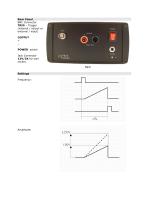
Rear Panel BNC Connector TRIG – Trigger (internal / output or external / input) OUTPUT + _ POWER switch Jack Connector 12V/3A for wall socket. Back Settings Frequency:
Open the catalog to page 3
External Trigger: Condition: Frequency 1/fp must be larger than the repetition rate f
Open the catalog to page 4
Examples of measured signals:
Open the catalog to page 5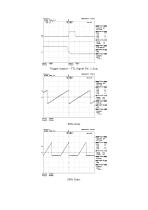
zoom: ik Delays" 0.000 ooo oos Hold Off — MIN ^—Trigger ™ NORMAL EDGE CHI *
Open the catalog to page 6All PBP Optel sp. z o.o. catalogs and technical brochures
 OPGS BURST GENERATOR
1 Page
 OPLabBox
1 Page
 OPCARD 2.0
2 Pages


- Measuring device
- Welder
- Transceiver module
- Portable gauge
- Industrial measuring module
- Single-phase welder
- 3D scanning system
- Measurement scanner
- Automatic measuring module
- Inspection scanner
- Welding power supply
- Laboratory measuring instrument
- Radio transceiver module
- Flaw detector
- Pulse generator
- Piezoelectric ultrasonic transducer
- Welder with integrated display
- Multiplexer