
- Catalogs
- Pawling Engineered Products, Inc.
- Designing With Inflatable Seals

Designing With Inflatable Seals
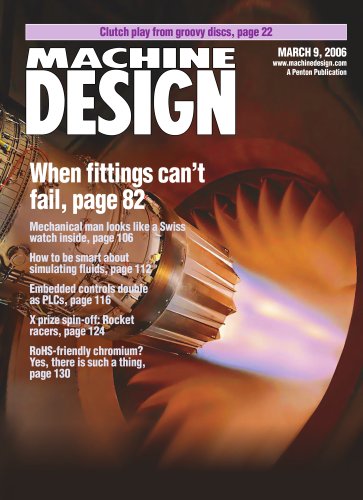
Designing With Inflatable Seals
Inflatable seals are preferred over compression seals for enclosures and equipment due to their flexibility and ease of use. They are particularly beneficial in environments where compressed air is available, such as factory floors. These seals are used in various industries, including food processing, pharmaceuticals, and high-end vehicles like yachts and aircraft.
Engineers must decide the direction of seal expansion (inward, outward, or axially) and consider factors such as cross-section, air connection, retention, materials, and reinforcing fabrics. Special attention is needed for corners, end treatments, and joining long seals.
Inflatable seals come in various shapes, with six basic designs meeting most needs. The footed seal is the most common, offering durability and pressure capacity. Other designs include footless, footed snap, heavy-duty snap, channel, and heavy-duty channel seals, each with specific applications and benefits.
Most seals require a single air connection, but additional connections may be necessary for faster cycling or larger seals. Retention methods include clips, adhesives, and extrusions, with materials like passivated aluminum or stainless steel recommended for components in contact with seals.
Inflatable seals are made from various elastomers, with EPDM being the most common due to its performance and cost-effectiveness. Materials can be combined for specific requirements, such as chemical resistance or EMI isolation.
Designers should consider corner radii, large-circumference seals, end treatments, and small-diameter seals. Air supply is a common concern, but solutions exist for both industrial and non-industrial applications.
Inflatable bladders are used in actuating and clamping applications, offering gentle handling and reliability. An example includes a conveyor brake system using an inflatable seal for soft stops.
Engineers should define key application elements early in the design process, including the type of material being sealed, pressure differentials, service temperature, duty cycle, and applicable standards.
Catalog excerpts
Clutch play from groovy discs, page 22 MARCH 9, 2006 > www.machinedesign.comA Penton Publication Mechanical man looks like a Swisswatchinside, page 106How to be smart aboutsimulatingfluids,page112Embedded controls doubleas PLCs, page 116X prize spin-off: Rocketracers, page124RoHS-friendly chromium?Yes, there is such a thing, page 130 >
Open the catalog to page 1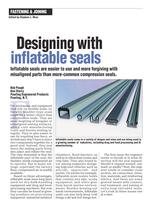
For enclosures and equipment that rely on flexible seals, in- flatable bladder-type seals might be a better choice than compression seals. They are more forgiving of irregular or misaligned mating surfaces, which cuts manufacturing costs and boosts sealing in- tegrity. Theyre also easier to use by requiring less force, so technicians donҒt have to force two components together for a good seal. Instead, they just move the mating parts freely into place and inflate the seal. The only downside is that the inflatable part of the seal, the bladder, needs compressed air to operate. But in many set-...
Open the catalog to page 2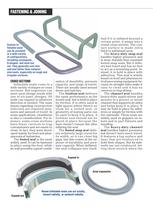
heavy-duty channelseal handles higher pressuresbut doesnt have much travel. It features a top surface and base that are reinforced to hold their shapes. But its side- walls are not reinforced, let- ting them stretch when the channel seal handlesheavy-duty applications and mounts in a groove or metal channel that supports its sides and helps keep it in place. It may be held in place by adhe- sives or simply by friction with the sidewalls. These seals are widely used as grippers on ro- bots and in part fixtures and handling.The heavy-duty snap seal handles higher pressures and is more durable than...
Open the catalog to page 3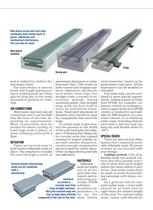
One-piece screw pins and clipscommonly hold footed seals in place. Adhesives and mechanical interference fits can also be used. One-piece retainerScrew pinClips seal is inflated to deliver thenecessary travel.For extra heavy or unevenloads and rough mating sur- faces, sealing pads are often placed atop any of the seals mounted in grooves or chan- nels. > Most seals need only one airconnection and it can be built into the base or the end, de- pending on requirements. More connections may be needed for faster cycling, to hold large seals in place, or when inflating seals with a fluid. > Cutting...
Open the catalog to page 4
Air supply: Engineers often dismiss inflat-able seals because of the air-supply issue. This neednt be a problem. In most industrial or bulk transport settings, compressed air is usually available. And there are often simple solutions for nonindustrial applications re- quiring infrequent seal cycling. On yachts, for example, the same foot pump or compressor that inflates rafts can easily activate the seals. For flood doors, which may be deployed only once or twice a season, built-in compressed air tanks fill the bill. The dip: Certain spots on inflatable sealsmay not rise to the full height of...
Open the catalog to page 6All Pawling Engineered Products, Inc. catalogs and technical brochures
 CVI series
2 Pages
 ePFE
ePFE2 Pages
 Pneuma-Seal
24 Pages
Archived catalogs
 Get a Gentle Grip
3 Pages