
- Catalogs
- Parker Tube Fittings Division
- Hose, Fittings, Accessories, and Equipment


Hose, Fittings, Accessories, and Equipment

Hose, Fittings, Accessories, and Equipment
- Fittings & Couplings: Available in both inch and metric sizes, covering SAE, BSP, DIN, GAZ, JIS, and ISO thread configurations. Materials include steel, stainless steel, brass, aluminum, nylon, and thermoplastic.
- Hose, Tubing, and Bundles: Offered in various sizes and materials such as rubber, wire-reinforced, thermoplastic, hybrid, and custom compounds.
- Size: Uses Dash Numbers to indicate hose and fitting size, measured in sixteenths of an inch.
- Temperature: Specifies ambient and media temperatures, with different ratings for various fluids. For example, 811HT hose ranges from -40°F to +257°F for petroleum-based fluids.
- Pressure: Hose selection must consider system working pressure and surge pressures. Parker hoses have a 4:1 safety factor for burst pressure.
- Application: Consider equipment type, environmental factors, mechanical loads, and space constraints.
- Media Compatibility: Ensure chemical compatibility with the fluid and environment using the Chemical Resistance Chart.
- Abrasion Resistance: Tough Cover and Super Tough cover hoses offer greater abrasion resistance compared to standard rubber cover hoses.
- Hose Routing: Recommendations for routing to avoid stretching, compressing, or kinking to ensure maximum service life.
- Temperature Range: The hoses operate within a temperature range of -40°F to +257°F (-40°C to +125°C), with some variations depending on the specific hose type.
- Materials: The inner tube is typically made of synthetic rubber, with reinforcement provided by steel wire braids or spirals. The cover is also synthetic rubber, often abrasion-resistant and MSHA accepted.
- Fittings: The document references various fitting series, such as the 43 Series and 71 Series, with specific page numbers for detailed fitting instructions.
- 304 Series: Designed for high-pressure applications with a working pressure up to 5000 psi. Suitable for petroleum-based hydraulic fluids.
- 431 Series: Suitable for petroleum-based hydraulic fluids and lubricating oils, with a temperature range of -40°F to +257°F.
- 451TC/ST Series: Offers constant working pressure, suitable for petroleum-based fluids, with a temperature range of -40°F to +212°F.
- 721 Series: Features a tough cover for enhanced abrasion resistance, suitable for high-pressure applications.
- 781 Series: Designed for extreme pressure applications, with a working pressure up to 5000 psi and a temperature range of -40°F to +257°F.
- Working Pressure: Varies across different series, with some hoses supporting up to 6500 psi.
- Minimum Bend Radius: Critical for installation, varies by hose size and type.
- Weight: Provided in lbs/ft and kg/m, important for handling and installation considerations.
- Ensure compatibility of hoses with the intended fluid and temperature range.
- Follow specific fitting instructions as per the series for optimal performance.
- Consider the minimum bend radius during installation to prevent hose damage.
- 731 Series: Designed for petroleum-based hydraulic fluids and lubricating oils. Features include a synthetic rubber inner tube, four spiral steel wire reinforcement, and a synthetic rubber cover. The temperature range is -40°F to +212°F. Working pressures vary from 3600 psi to 6000 psi depending on the hose size.
- 792TC/ST Series: Suitable for high-pressure applications with a temperature range of -40°F to +257°F. Reinforced with four or six spiral steel wires, these hoses are abrasion-resistant and MSHA accepted.
- 761 Series: High-pressure jack hoses with a working pressure of 8000 psi, reinforced with two braids of steel wire. The temperature range is -40°F to +120°F.
- 811 and 811HT Series: Designed for petroleum-based hydraulic fluids with a temperature range of -40°F to +257°F. These hoses feature multiple layers of fiber spiral and one helical wire reinforcement.
- 881 Series: Similar to the 811 series but with a focus on suction and return line applications, offering a temperature range of -40°F to +257°F.
- Push-Lok Series: Includes 801, 804, 821, and 831 series, suitable for pneumatic, petroleum-based hydraulic fluids, lubricating oils, and antifreeze solutions. These hoses are not recommended for fuel, refrigerant, or applications with extreme pulsation.
- 821FR Series: Fire-resistant cover hoses available in various colors, suitable for pneumatic and hydraulic applications with a temperature range of -40°F to +212°F.
- 271 Series: Air brake hoses compliant with D.O.T. FMVSS 106A, suitable for air brake systems with a temperature range of -50°F to +212°F.
- SS23CG Series: Designed for compressed natural gas and liquefied petroleum gas applications, with a temperature range of -40°F to +250°F.
- Assembly instructions for Parkrimp fittings are detailed in Section C.
- Field attachable assembly instructions are available in Section B.
- Temperature ranges for other media are listed in Section E.
- SS25UL Series: Designed for liquefied petroleum gas (LPG) with a synthetic rubber inner tube, fiber braid reinforcement, and a temperature range of -40°F to +250°F.
- 271 Series: Factory-made hose assemblies for transportation with a working pressure of 225 psi and a minimum bend radius of 1-3/4 inches.
- 293 Series: Air brake hoses with a PKR® inner tube, suitable for petroleum-based fluids, with a temperature range of -58°F to +302°F.
- 221FR Series: Marine fuel and engine hoses for gasoline and diesel fuels, featuring a synthetic rubber cover and a temperature range of -4°F to +212°F.
- 266 Series: Air brake hoses with a PKR® inner tube, designed for high-pressure applications up to 2000 psi.
- 201 and 206 Series: Hoses for hydraulic fluids and lubricating oils, with a temperature range of -40°F to +302°F.
- 225 Series: Hoses with rubber cover for hydraulic fluids, with a temperature range of -40°F to +212°F.
- 285 and 244 Series: Refrigerant hoses for R134a, with synthetic rubber and nylon barrier, suitable for temperatures from -22°F to +257°F.
- Parkrimp Series: Includes various series such as 25, 26, 43, 70, 71, 73, 76, 78, S6, 79, HY, and 81, each with specific applications and compatibility with different hose types.
- Field Attachable Series: Includes 20 and 21 Series, designed for easy assembly and maintenance.
- Field attachable and Parkrimp assembly instructions are provided in Sections B and C, respectively.
- Temperature effects on maximum working pressures are charted in Section E.
- Hoses are suitable for a variety of applications including transportation of LPG, air brakes, marine fuel, hydraulic fluids, and refrigerants.
- Each hose series is designed with specific materials and reinforcements to meet the demands of its intended application.
- Detailed specifications include hose inner and outer diameters, working pressures, minimum bend radii, weights, and vacuum ratings.
- Temperature ranges and fitting compatibility are also specified for each hose series.
- 73 Series Fittings: This section includes female metric swivel fittings with a 45˚ elbow and a 24˚ cone with an O-ring. It specifies the use of Parkrimp 2 with a specific die part number for certain fittings.
- 76 Series Fittings: This section covers female BSP parallel pipe swivel fittings with 45˚ and 90˚ elbows. It provides detailed dimensions and compatibility with 761 hoses.
- 78 Series Fittings: This section is extensive, covering various types of fittings including male NPTF pipe rigid, female JIC 37˚ swivel, and SAE Code 61 and 62 flange heads. It includes fittings with different elbow angles (22-1/2˚, 30˚, 45˚, 60˚, and 90˚) and specifies pressure ratings, typically 5,000 psi or 8,000 psi.
- Caterpillar® Flange Heads: These fittings conform to SAE Code 62 bolt hole patterns and require special flange halves and seals. They are noted for their thicker flange heads.
- Seal-Lok® Fittings: This section includes female Seal-Lok® swivel fittings, providing dimensions and thread specifications.
- Male SAE Straight Thread: Available in swivel and rigid configurations, these fittings are designed to relieve stress on hoses under pressure but are not suitable for continuous swiveling. They are not compatible with Phosphate Ester fluids.
- Male JIC 37˚: These rigid fittings are used for high-pressure applications and provide a secure connection with a 37-degree flare.
- Female JIC 37˚: Offered in swivel configurations with options for 45˚ and 90˚ elbows, these fittings allow for flexible hose routing.
- Seal-Lok® Fittings: These fittings include both male and female configurations with O-rings for enhanced sealing capabilities, suitable for high-pressure environments.
- Designed for use with 213, 285, and 293 hoses.
- Includes various configurations such as Female Tube-O Swivel with 45˚ and 90˚ elbows, available in short and long pilot versions.
- Key dimensions and part numbers are provided for each fitting type.
- Measure and cut the hose to the desired length, ensuring a clean, square cut.
- Flush the hose end with air or solvent to clean the interior.
- Use Hoze-Oil for lubrication during assembly, avoiding oil on the hose cover.
- Inspect the assembly for cleanliness and ensure swivel nuts turn freely.
- Compatible with 201, 206, 221FR, 225, 266, and SS25UL hoses.
- Includes Male NPTF Pipe, Female JIC 37˚ Swivel, and Female SAE 45˚ Swivel fittings.
- Dual seat fittings accept both JIC (37˚) and SAE (45˚) male configurations.
- Similar to the 21 Series, with additional steps for mandrel-style assembly.
- Special instructions for refrigerant hoses include using system-compatible oil.
- Designed for use with 213, 285, and 293 hoses.
- Includes Female JIC 37˚, Female SAE 45˚, and Female PTT 30˚ Swivel fittings.
- Mandrel assembly is required, with specific steps for male and swivel ends.
- Inspection and cleanliness are emphasized, similar to other series.
- Used with 302 hoses.
- Includes Male NPTF Pipe, Male Swivel, and various elbow configurations.
- All series emphasize the importance of proper measurement, cutting, and cleanliness during assembly.
- Contact information for technical support is provided for further assistance.
- Male NPTF Pipe - Swivel: Available in sizes ranging from 1/4 inch to 1 inch, with corresponding hose I.D. and dimensions provided.
- Male SAE Straight Thread with O-Ring - Rigid: Sizes range from 1/4 inch to 1/2 inch, with detailed dimensions for each part number.
- Male JIC 37° - Rigid: Includes sizes from 1/4 inch to 1 inch, with specific measurements for each fitting.
- Female JIC 37° - Swivel: Available in various sizes, with additional material options like stainless steel.
- Female Seal-Lok® - Swivel: Includes long and 90° elbow options, with ISO 12151-1 compliance.
- Identify the overall length of the hose assembly and cut the hose to the desired length using a fine tooth hacksaw or cutoff machine.
- Place the socket in a vice and screw in the hose counter-clockwise until it bottoms, then back out 1/2 turn.
- Lubricate the hose end and threads with Hoze-Oil or equivalent lubricant before assembly.
- Screw the nipple assembly into the socket using a wrench until it shoulders against the socket.
- Designed for easy die change out and compatible with 25, 26, 43, 81, and HY Series fittings.
- Specifications include dimensions of 15” wide, 12” deep, 27” high, and a weight of 54 lbs without the power unit.
- Rated at 30 ton force at 10,000 psi maximum with a full cycle time of 30 seconds using an electric pump.
- Compact bench mount design with integrated crimper and power unit.
- Specifications include dimensions of 26” wide, 20” deep, 25” high, and a weight of 275 lbs with the power unit.
- Rated at 30 ton force at 3,000 psi maximum with a full cycle time of 20 seconds.
- Portable and rugged design with multiple power unit options.
- Crimps both steel and stainless steel fittings, compatible with a wide range of series including 25, 26, 43, 70, 71, 73, 78, 81, and HY.
- Karrykrimp 2 specifications include dimensions of 14” wide, 15” deep, 30” high, and a weight of 100 lbs without the power unit, rated at 60 ton force at 10,000 psi maximum.
- PHastkrimp specifications include dimensions of 22” wide, 33” deep, 38” high, and a weight of 550 lbs, rated at 60 ton force at 4,200 psi maximum.
- Tabletop design engineered for durability, capable of crimping both steel and stainless steel fittings.
- Specifications include dimensions of 20” wide, 27” deep, 40” high, and a weight of 600 lbs, rated at 70 ton force at 5,000 psi maximum.
- Vertical design for easy use, capable of crimping a full range of Parker hoses from 1/4” to 2” I.D.
- Specifications include dimensions of 28” wide, 22” deep, 70” high, and a weight of 843 lbs, rated at 125 ton force at 5,000 psi maximum.
- All machines require reading the operations and technical manual before use.
- Ensure cleanliness of hose assemblies and avoid using non-Parker Hannifin power units to maintain warranty coverage.
- Hose Cut-Off Machine (Part No. 239 339): Available with a 230V single-phase motor or a 3 HP motor, 230V, 3 phase. It includes a scallop cutting blade and has a shipping weight of 115 lbs.
- Hose Cut-Off Machine (Part No. 332T-115V): Features a 1-1/2 HP, 3450 RPM motor, and a scallop cutting blade. It is designed for cutting spiral reinforced hoses up to 1-1/4” I.D. and weighs 71 lbs.
- Karrykut (Part No. 631075): A portable saw with a unique clamp system for cutting multi-braided wire reinforced hoses. It includes a power saw and universal clamp attachment, weighing 58 lbs.
- Handykut (Part No. 871522): A portable tool for efficient hose cutting, designed to be used on flat surfaces or in a vise.
- TH11-1: Designed for cutting textile reinforced hoses, with a shipping weight of 0.3 lbs.
- 316: A small, easy-to-use tool for quick cutting of textile reinforced hoses, weighing 6 lbs.
- Push-Lok Cut-Off & Assembly Tool (Part No. 881540): Combines cutting and assembly functions for Parker Push-Lok hoses, weighing 4 lbs.
- Hose Insertion Depth Blocks: Used for marking hose insertion depth to ensure accuracy and productivity.
- Fitting Push-On Stand (Part No. TH2-7): Facilitates the attachment of fittings onto hoses, eliminating the need for rubber mallets and oils.
- Hozembler (Part No. 432-115V): A power machine for attaching field attachable fittings, including a vise and adapters.
- Die Storage Racks: Modular racks for storing Parkrimp dies, available in various configurations.
- Lubricants: Accrolube and Hose Oil are provided for reducing wear and improving assembly processes.
- Flange/37˚ Flare Adapters: Various configurations are available for different hose and fitting sizes, with specific pressure ratings and materials.
- Ordering Information: Instructions for ordering Parker adapters, including catalog numbers and contact information for assistance.
The document provides detailed specifications for various hose clamps and accessories, including the Parker HC Clamp, which is a stainless steel worm gear clamp designed for low-pressure industrial hose applications. It adheres to SAE J1508, Type F and Type HD standards. The document lists part numbers and hose inner diameters for different series of hose clamps, such as the 88HC-H Series (High Torque Wormgear) and the 88DB Series (Heavy Duty Double Bolt Hose Clamp).
Instructions for the proper attachment of the 88HC-H clamp are referenced, indicating the need to consult the 88 Series Assembly Instructions. Additionally, the document outlines the setup and specifications for hose assembly workstations, including the HoseFab Table, Rotary Reel Rack, and Saw Table, which are designed to facilitate efficient hose assembly processes.
The document references various standards and specifications, including SAE J1508 for hose clamps and provides a comprehensive guide to hose, adapters, and fittings standards and specifications. It also includes assembly torque values and a thread guide for standard fitting configurations.
The document recommends using Parker Hose Protector Shields to prevent hose abrasion and extend hose life. These shields are resistant to oil, lubricants, gasoline, and most solvents, and can withstand temperatures from -40° to +300° F. They are easy to install with cable ties and do not require disconnecting hose lines.
Technical information includes flow capacities at recommended flow velocities, pressure drop data, temperature/pressure charts, and chemical resistance information. The document also provides a nomogram for determining the correct hose size based on flow rate and velocity requirements.
The document highlights the features of various hose assembly components, such as the Parker Kart, which is a portable unit designed to hold crimping equipment, a cut-off saw, hose reels, and fitting storage. It emphasizes the importance of having the right tools and materials on-site to reduce downtime and labor costs.
The document provides detailed specifications for various hose sizes, including their internal diameters and flow capacities. It includes a table listing hose dash sizes from -04 to -48, with corresponding internal diameters in inches. The flow capacities are given in gallons per minute, and pressure drop values are specified in psi per 10 feet of hose.
Pressure and Temperature Guidelines:
The document outlines the relationship between temperature changes and maximum working pressure for specific hoses. A temperature/pressure chart is provided to help calculate the maximum working pressure based on temperature changes. The chart is used by identifying the maximum working pressure, the application temperature, and calculating the pressure based on the percentage figure from the chart.
Fluid Compatibility:
Various hoses are listed with their compatible fluids, including petroleum-based hydraulic fluids, antifreeze solutions, diesel fuels, and marine lube oil. The document specifies the temperature ranges for each hose type and notes that maximum working pressures are reduced at temperatures above 212°F (100°C).
Installation Tips:
The document provides guidelines for proper hose installation to ensure longevity and efficiency. Key points include avoiding twisted installations, providing ample bend radius, using elbows or adapters to eliminate excess hose length, and securing hoses with clamps.
Ferrule-Fix System:
The Ferrule-Fix system is introduced as a fast, on-the-job repair solution for ruptured hose assemblies. It allows for the reuse of expensive bent tube ends with Parker Hose fittings, eliminating the need for emergency brazing or welding. The system includes a 3-piece design with a body, nut, and ferrule, and provides visible bite for safety assurance.
- Scope: This guide provides instructions for selecting and using hose, tubing, fittings, and related accessories. It emphasizes the importance of understanding the specific Parker publications for the products being used.
- Fail-Safe Design: Systems should be designed to ensure that failure of any component does not endanger people or property.
- User Responsibility: Users must ensure the suitability of products for their specific applications and comply with all relevant standards.
Hose and Fitting Selection Instructions
- Electrical Conductivity: Selection must consider whether the hose needs to be conductive or nonconductive, depending on the application.
- Pressure: The hose must withstand the system's maximum pressure, including surge pressures.
- Suction: Hoses for suction applications must be selected to prevent collapse under vacuum conditions.
- Temperature: Ensure that both fluid and ambient temperatures are within the hose's limits to prevent degradation.
- Fluid Compatibility: The hose and fittings must be compatible with the fluid being conveyed.
- Permeation: Consider the potential for permeation of gases or liquids through the hose, which can pose hazards.
- Size and Routing: Proper sizing and routing are crucial to minimize pressure loss and avoid damage.
- Environment and Mechanical Loads: Protect hoses from environmental factors and mechanical loads that could cause failure.
Safety Considerations
- Improper selection or use of products can lead to serious consequences, including injury or property damage.
- Special hoses are required for specific applications, such as airless paint spraying or CNG applications, to prevent static charge buildup.
Catalog excerpts

Fittings & Couplings: For information, Y our complete source contact the nearest Regional Sales office listed, or for quality tube fittings, hose & hose fittings, brass fittings & valves, quick-disconnect couplings, and assembly tools, locally-available from a worldwide network of authorized distributors. Central Region Sales Office & Northeast Region Sales Office Available in inch and metric sizes covering SAE, BSP, DIN, GAZ, JIS, and ISO thread configurations, manufactured from steel, stainless steel, brass, aluminum, nylon, and thermoplastic. Hose, Tubing, and Bundles: Worldwide Availability: Service Center Trenton, NJ Available in a wide variety of sizes and materials including rubber, wire-reinforced, thermoplastic, hybrid, and custom compounds. Parker operates Fluid Connectors manufacturing locations and sales offices throughout North America, South America, Europe and Asia- Pacific. call toll-free... (609) 586-5151 > Hose, Fittings, and Equipment Hiawatha, IA (319) 393-1221 (609) 586-3149 FAX (319) 393-1224 FAX Pacific Region Sales Office & Cleveland Region Sales Office Service Center Cleveland, OH (216) 896-2404 Portland, OR (503) 283-1020 (216) 896-4022 FAX (503) 283-2201 FAX Service Center Service Center Toledo, OH (419) 878-7000 Buena Park, CA (714) 522-8840 (419) 878-7001 FAX (714) 994-1183 FAX (419) 878-7420 (FCG Kit Operations) FAX Southeast Region Sales Office Greensboro, NC Great Lakes Region Sales Office (336) 373-1761 Otsego, MI (336) 373-9069 FAX for Sales Office (269) 694-2550 (269) 692-6634 FAX Service Center Conyers, GA (770) 929-0330 (770) 929-0230 FAX Louisville Service Center Louisville, KY (502) 937-1322 (502) 937-4180 FAX Southwest Region Sales Office Mansfield, TX (817) 473-4431 Minneapolis Region Sales Office (817) 453-8022 FAX (763) 513-3535 > (763) 544-3418 FAX Canada Sales Office & Service Center Service Center Minneapolis, MN (952) 469-5000 (952) 469-5729 FAX Grimsby, ONT (905) 945-2274 (905) 945-3946 FAX Service Center Oshkosh, WI (920) 426-8471 (Contact Grimsby for other Service Center locations.) (920) 426-8570 > Catalog 4400 US Ֆ Issued 08/06 Printed in U.S.A. 2006 Parker Hanniɯ́n Corporation size="-1">
Open the catalog to page 1
Hydraulic > Hose Suction and Return Push-Lok > Parkrimp (crimp)Field Attachable > Fittings Parkrimp Crimpers Die Selection Charts Pumps Hose Assembly Equipment > Equipment Flange Adapters and Kits O-Rings > Hose Guards Clamps Workstations > Size Temperature > Accessories Application Media Pressure Information > Part Number Index Safety Guide > Technical
Open the catalog to page 2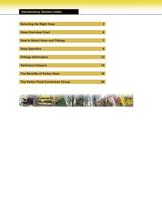
Selecting the Right Hose 2 Hose Overview Chart 6 How to Select Hose and Fittings 7 Hose Specifics 8 Fittings Information 12 Parkrimp Crimpers 14 The Benefits of Parker Hose 18 The Parker Fluid Connectors Group 20 >
Open the catalog to page 3
Outer Cover ReinforcementInner Tube and Refrigerant HosesTransportation and Refrigerant Hoses > Dash No. Inches Millimeters Inches Millimeters >
Open the catalog to page 4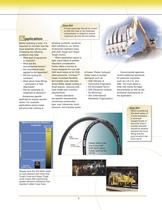
Hose Hint A hose assembly should be routed so that the hose is not stretched, compressed, or kinked to assure maximum service life and safety. Before selecting a hose, it is > important to consider how the hose assembly will be used. Answering the following questions may help: What type of equipment is involved?Օ What are the tight, bend radius is another important consideration. Parker offers a full line of environmental factors? Are mechanical loads hoses designed for one-half applied to the assembly?Օ Will the routing be confined? What about hose կ́ttings permanent or ֯́eld SAE bend radius...
Open the catalog to page 5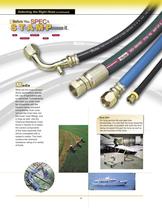
Size Application Pressure Temperature Media What will the hose convey? > Some applications require the use of specialized oils or chemicals. Consequently, the hose you order must be compatible with the medium being conveyed. Compatibility must cover not just the inner tube, but the cover, hose fittings, and o-rings as well. Use the > Hose Hint Chemical Resistance Chart > For long service life and leak-free functionality, it is vital that the hose assembly be chemically compatible with both the fluid being conveyed through the hose as well as the environment of the hose. found in Section E to select...
Open the catalog to page 6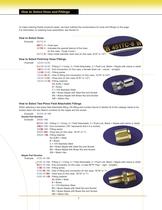
To make ordering Parker products easier, we have outlined the nomenclature for hose and fittings on this page. For information on ordering hose assemblies, see Section A. > Example: 451TC-8 451 TC-8 - Hose type 451 TC -8 - Indicates the special feature of the hose (in this case, Tough Coverђ) 451TC- 8 - Hose inside diameter dash size (in this case, 8/16" or 1/2") > Example: 1JC43-12-8C 1 JC43-12-8C - Fitting (1 = Crimp, 2 = Field Attachable, 3 = Push-Lok, Blank = Nipple with clamp or shell) 1 JC 43-12-8C - End connection (In this case, a female Seal-Lok swivel ֖ straight) 1JC 43 -12-8C - Fitting...
Open the catalog to page 9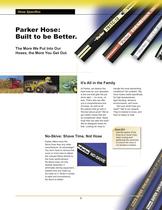
handle the most demanding conditions? No problem. We have hoses made speciү́cally best hose for your operation is the one that gets the job done right no more, no less. Thatגs why we offer for high temperatures, tight bending, abrasive you a comprehensive line environments, and more. Not sure what hose you need? Talk to our experts. Theyre trained to know, and of hoses, as well as all the options that go with it. Worried about price? WeҒve got rubber hoses that are theyre happy to help. an exceptional value. Need hose that can take the heat? WeҒve designed hoses for that. Looking for hose to...
Open the catalog to page 10
Our expanded line of abrasion-resistant hose offers radius of our wire-braided > Optional Covers Compactҙ hoses to the wide ů̂uid compatibility and > Type Features you a world of protection, not to mention a choice of covers: Tough Cover (TC) high pressure performance > Tough Cover (TC)Very good abrasion resistance. Fair resistance to ozone and cold flexibility.Super Tough (ST)Excellent abrasion resistance. Very good resistance to ozone and cold flexibility. of our No-Skive spiral for tough environments; and Super Tough (ST) for the really rough stuff. Our TC- and ST-covered hoses can hoses our...
Open the catalog to page 11All Parker Tube Fittings Division catalogs and technical brochures
 JIS Fittings
8 Pages
 Pipe Swivels
8 Pages
 Pipe Fittings and Port Adapters
26 Pages
 ParKlamp Inch Tube Clamps
16 Pages
 O-Rings and Seals
10 Pages
 Metric Tube
6 Pages
 Metric Clamps
12 Pages
 Komatsu® Style Adapters
6 Pages
 K4 BSP Adapters
10 Pages
 JIS Fittings
8 Pages




Archived catalogs
 Conversion Adapters
6 Pages
 Couplings & Equipment
20 Pages
 Catalog 0600P-9/USA
4 Pages
 Quick Coupling Products
214 Pages
 USA Industrial Hose Products Catalog
258 Pages
 Quick Coupling Products
209 Pages
 Prestolok Plus Fittings Catalog
8 Pages
 Global Connect Fittings Catalog
12 Pages
 X-treme Silicone Hose
36 Pages


