
- Catalogs
- Parker Industrial Gas Filtration and Generation Di
- Food Contact Compressed Air Point-of-Use Filtration


Food Contact Compressed Air Point-of-Use Filtration
Food Contact Compressed Air Point-of-Use Filtration
Preventative food safety is crucial for both food manufacturing facilities and retailers. The Global Food Safety Initiative (GFSI) was established to enhance consumer trust by improving food safety through corporate responsibility and safer supply chains. GFSI endorses several voluntary food safety schemes, including SQF, BRC, and FSSC 22000, which are often required by major retailers.
Government and Voluntary Regulations
The USDA and FDA regulate food safety in the US, with specific mandates for different food categories. In addition to government regulations, voluntary schemes like SQF, BRC, and FSSC 22000 are implemented to meet retailer requirements.
Compressed Air in Food Safety
Compressed air used in food production can pose contamination risks if not properly treated. The FDA and other standards like BRC and FSSC 22000 provide guidelines to ensure compressed air does not contaminate food products. Key recommendations include using point-of-use filtration and ensuring air is filtered to remove dust, oil, and water.
Filtration Requirements and Guidelines
Various standards and guidelines, such as the FDA CFR Title 21 and BRC Food Standard, outline the need for monitoring and filtering compressed air to prevent contamination. The SQF guidance document recommends a final filtration stage with a 0.01 micron rating and 99.999% efficiency.
3-Stage Compressed Air Filtration
A three-stage filtration process is recommended to reduce microbial contamination risks. This includes removing bulk liquid and particulate matter, oil and water aerosols, and microbial contamination. The use of air dryers to achieve a dew point of -40°F/C is also advised to prevent microbial growth.
Filtration Efficiency and Log Reduction
Filtration efficiency is crucial for removing microbiological particles. A 5-log reduction, equating to 99.999% efficiency, is recommended for food contact air applications.
Conclusion
Implementing effective filtration systems and adhering to both government and voluntary food safety standards are essential for maintaining food safety and meeting retailer requirements.
Catalog excerpts
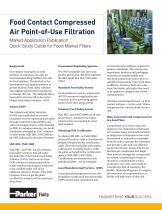
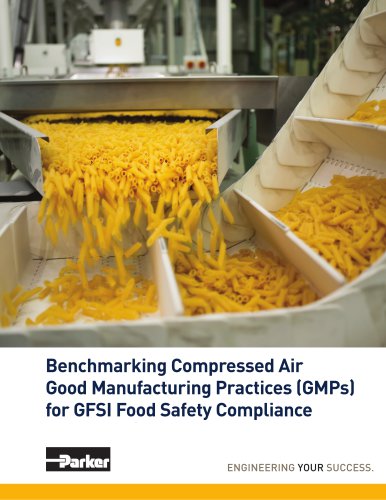
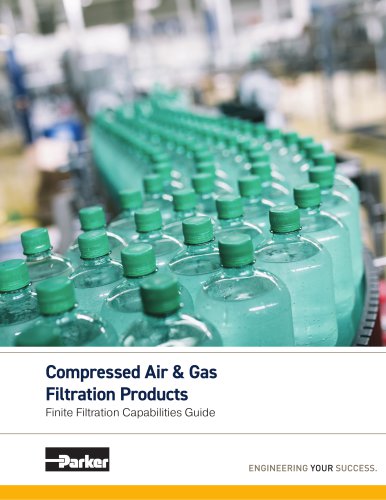
Food Contact Compressed Air Point-of-Use FiltrationMarket Application PublicationQuick Study Guide for Food Market FiltersBackground Preventative food safety is at the forefront of awareness not only for food manufacturing facilities, but also for food retailers. This has led to the development and implementation of private industry food safety schemes that augment government regulations to manage this risk. The umbrella these food safety schemes fall under is the Global Food Safety Initiative - GFSI. The Global Food Safety Initiative (GFSI) was established to increase consumer trust by improving food safety through corporate responsibility and safer food supply chains. GFSI, founded in 2000, is a nongovernment, non-profit foundation managed by The Consumer Goods Forum. SQF, BRC, FSSC2000 are all GFSI endorsed Food Safety Schemes. SQF, BRC, and FSSC are all voluntary food safety schemes that fall under the umbrella of the Global Food Safety Initiative (GFSI). The focus on these GFSI schemes is driven primarily by major retailers requiring the producers to be certified under one of the endorsed schemes. Simply, if the food company does not get the plant certified the retailers will not purchase from them. The USDA regulates raw meat and poultry processing. The FDA regulates all other foods that don't fall under USDA. Food producers need to comply with all US Government regulations and mandates for the governing agency under which their products fall. SQF, BRC, and FSSC 22000 are all non government, voluntary food safety schemes that are required by most food retailers. To obtain SQF, BRC, or FSSC22000 plants will contract with a consultant to prepare the plant for the certification audit. Then the food plant will employ a third-party certifying body to audit the plant on behalf of the certification agency (SQF, BRC, FSSC2200). Certifications are awarded by each individual plant - not by company. Good manufacturing practices are the foundation of safe food manufacturing. GMPs are the basic operational and environmental conditions required to produce safe foods. They ensure that ingredients, products and packaging materials are handled safely and that food products are processed in a suitable environment. Every food plant is different, however, there are some basic food safety principles that need to be applied to mitigate risk of food contamination. Anything contacting the food - or food contact surfaces - can be a risk. Where compressed air contacts food can be a risk. Compressed air is not as clean as it appears to be. Untreated compressed air contains many potentially harmful or dangerous contaminants that must be removed or reduced to acceptable levels in order to protect the consumer and provide a safe and cost-effective production facility. Along with the air bacteria get compressed and begin their journey through the compressed air system. Introducing this type of microbial contamination to food products is very risky and would be considered a lack of control by the facility. Understanding how to integrate the treatment of compressed air in a facility will help ward off that risk. ENGINEERING YOUR SUCCESS.
Open the catalog to page 1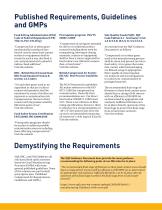
Food & Drug Administration (FDA) Code of Federal Regulations (CFR) Title 21, Part 110.40 (g) “Compressed air or other gases mechanically introduced into food or used to clean food-contact surfaces or equipment shall be treated in such a way that food is not contaminated with unlawful indirect food additives”. BRC - British Retail Consortium: BRC Food Standard Version 8, section 4.5.2 states “Air and other gases used as an ingredient or that are in direct contact with products shall be monitored to ensure this does not represent a contamination risk. Compressed air that is in direct contact with...
Open the catalog to page 2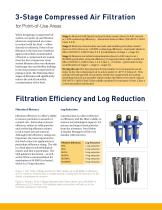
3-Stage Compressed Air Filtration for Point-of-Use Areas When designing a compressed air system, use point-of-use filtration wherever compressed air comes in contact with the food — either directly or indirectly. Point-of-use filtration is the best line of defense against microbial contamination of food in a compressed air system. Even the best compressor room system filtration does not eliminate harborage sites and biofilm buildup in the downstream compressed air piping system. The following three stages of filtration will significantly reduce the risk of microbial contamination of the food....
Open the catalog to page 3
Parker Filtration Group Aerospace Filtration Division Greensboro, North Carolina 336 668 4444 Bioscience & Water Filtration Division Bioscience Filtration Oxnard, California 877 784 2234 Water Purification Carson, California 310 608 5600 Engine Mobile Aftermarket Division Kearney, Nebraska 308 234 1951 Engine Mobile Original Equipment Division Modesto, California 209 521 7860 HVAC Filtration Division Jeffersonville, Indiana 866 247 4827 Hydraulic & Fuel Filtration Division Metamora, Ohio 419 644 4311 Industrial Gas Filtration & Generation Division Lancaster, NY 800 343 4048 Australia Filtration...
Open the catalog to page 4All Parker Industrial Gas Filtration and Generation Di catalogs and technical brochures
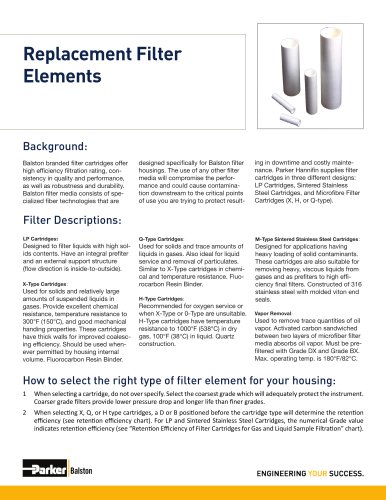 Replacement Filter Elements
2 Pages
Archived catalogs
 HY17-8557-UK_K170
24 Pages
 HY17-8504-UK_L90
44 Pages
 HY17-8602-UK_VV6
8 Pages
 HY17-8542-UK_QDS6
8 Pages
 Y14
Y142 Pages
 HY17-8702-UK_PLC
12 Pages
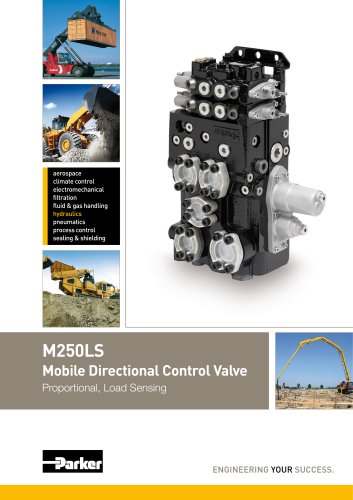 HY17-8562-UK_M250LS
24 Pages
 7-EN%205150-B%20-%20CAR.
15 Pages
 Cover
Cover2 Pages
 HY14-3000FrtCvr
2 Pages
 HY17-8534-UK_F130
32 Pages
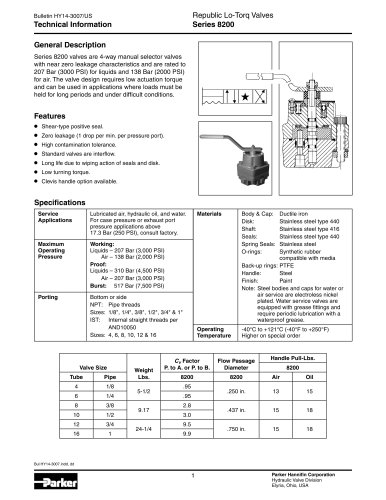 20Lo-Torq
2 Pages
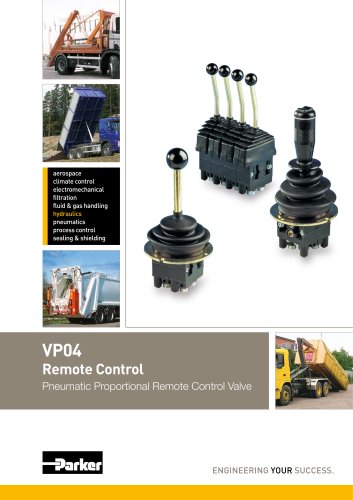 HY17-8356-UK_VP04
12 Pages
 Natural Gas Solutions
12 Pages
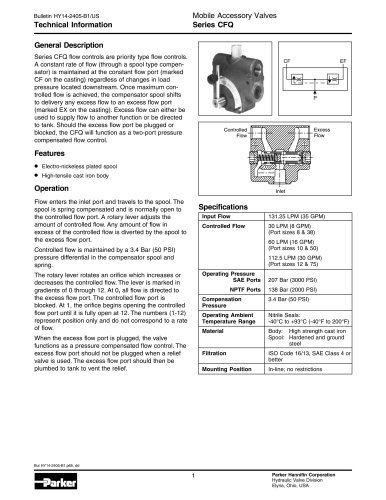






- Chiller
- Parker cartridge filter
- Filter cartridge
- Liquid recirculation chiller
- Industrial use filter
- Pressure separator filter
- Stainless steel pre-filter
- Industrial filter cartridge
- Fine filter cartridge
- Filtration unit
- Water recirculation chiller
- Automatic test kit
- Industrial cooling system
- Parker compressed air dryer
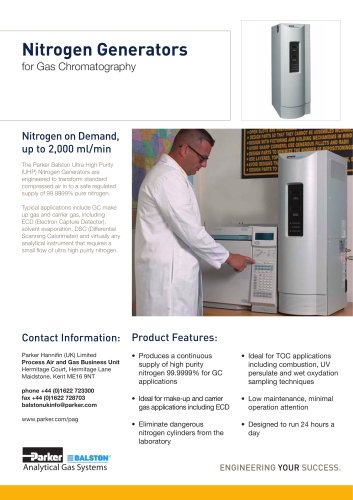
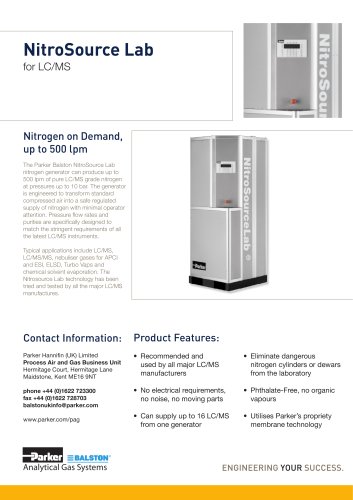
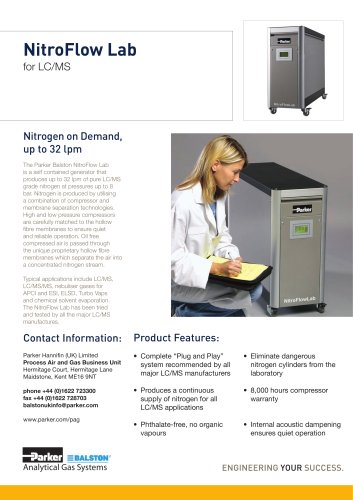
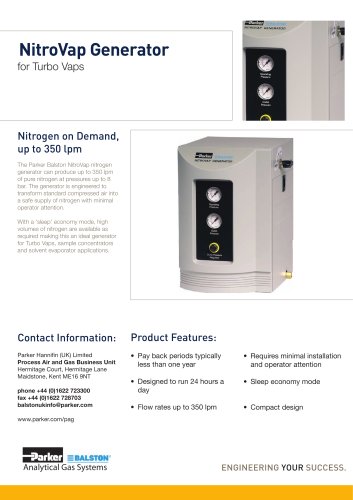
- Nitrogen generator
- Water filter cartridge
- Plastic filter cartridge
- Compact recirculation chiller
- General purpose filter cartridge
- Parker gas filter