
- Catalogs
- Parker Industrial Gas Filtration and Generation Di
- Benchmarking Compressed Air Good Manufacturing Practices (GMPs) for GFSI Food Safety Compliance


Benchmarking Compressed Air Good Manufacturing Practices (GMPs) for GFSI Food Safety Compliance
Benchmarking Compressed Air Good Manufacturing Practices (GMPs) for GFSI Food Safety Compliance
Compressed air is extensively used in food manufacturing but poses hidden hazards. Food manufacturers must ensure air quality to protect consumers. This document clarifies risks and provides guidelines for Good Manufacturing Practices (GMPs) in line with Global Food Safety Initiative (GFSI) standards.
Understanding the Potential Risks
Untreated compressed air may contain harmful contaminants like bacteria, moisture, and particulates, which can contaminate food products. Identifying where compressed air contacts food is crucial as it can be invisible and leave no trace.
Managing Contamination Risks
Filtration and drying in the compressor room alone are insufficient. Point-of-use filtration is recommended to prevent microbial contamination. A well-designed system with sterile air filtration and proper maintenance can significantly reduce risks.
Preventing Microbe Growth
Microbes thrive in warm, moist environments. Drying air to a low dew point and using point-of-use filtration can inhibit microbial growth. Regular monitoring of compressed air purity is advised to ensure safety.
GFSI/SQF Environment
Many food manufacturers adopt GFSI-endorsed schemes like the SQF Code, which includes guidelines for compressed air. Key points include using high-efficiency filters at points where air contacts food and regular monitoring of air quality.
System Design GMPs
Designing a compressed air system involves drying air to reduce moisture and using point-of-use filtration to prevent contamination. Three stages of filtration are recommended to remove particulates, aerosols, and microbial contamination.
Sanitation Standard Operating Procedures
Regular maintenance of filters and monitoring of compressed air purity are essential. Filters should be changed periodically, and air quality should be tested at least annually.
Recommendations for Meeting GFSI Standards
Parker has developed GMPs to help food processing facilities comply with GFSI standards. These include removing moisture from air and ensuring effective filtration at points of use.
Specifications
The document emphasizes maintaining a dew point of -40°F/C for optimal conditions. It recommends using point-of-use sterile air filtration wherever compressed air contacts food or food contact surfaces. The final stage of filtration should have a 0.01-micron rating with a particulate removal efficiency of 99.999%, ensuring a 5-log reduction in microbial contamination.
Procedures and Recommendations
Following GMPs for treating compressed air is crucial. The document highlights that point-of-use filtration is the best defense against contamination. It provides contact information for further inquiries and references various standards and guidelines for compliance.
Standards and References
The document lists several references, including FDA regulations, 3A standards, and ISO guidelines, which provide detailed information on maintaining food safety and quality through proper compressed air management.
Conclusion
Effective management of compressed air in food processing plants is essential for preventing contamination. Adhering to specified filtration standards and GMPs ensures food safety and quality.
Catalog excerpts
Benchmarking Compressed Air Good Manufacturing Practices (GMPs) for GFSI Food Safety Compliance Parker ENGINEERING YOUR SUCCESS.
Open the catalog to page 1
Lee Scott, compressed air and gas treatment product manager, Parker Industrial Gas Filtration and Generation Division. Lee has over 30 years of experience in pneumatic and filtration technologies for the food and beverage and industrial manufac turing industries. At Parker IGFG, one of his primary focus areas is on compressed air treatment solutions for food safety compliance. Lee has an B.S. in Business Administration and Management and an MBA from the University of New Hampshire. Any modern food manufacturing facility employs compressed air extensively in the plant. As common as it is, the...
Open the catalog to page 2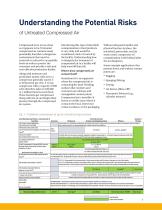
Compressed air is not as clean as it appears to be. Untreated compressed air contains many potentially harmful or dangerous contaminants that must be removed or reduced to acceptable levels in order to protect the consumer and provide a safe and cost-effective production facility. Along with moisture and particulate matter, inlet air to a compressor generally carries 5 to 50 bacteria per cfm. A 75-hp compressor with a capacity of 300 scfm therefore takes in 100,000 to 1 million bacteria each hour. These bacteria get compressed along with the air and begin their journey through the compressed...
Open the catalog to page 3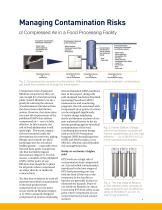
Almost** rit conlaminaliOn entering the compressor Tonal contamination entering Ihe compresaed air distribution system - Water Vapor - Water Aerosoia - Condensed Liquid Water - Pipe scale Compressor room drying and filtration are good, but they are not enough for a food processing plant. System filtration can do a good job reducing the amount of contaminants introduced into the downstream distribution system. However, that alone does not meet the requirements of the published GMPs that address compressed air — nor is it fully effective. In this scenario, the risk of food adulteration is still...
Open the catalog to page 4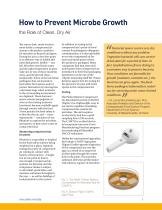
The warm, dark, moist environment inside a compressed air system is the perfect condition for microbes to flourish and grow. Drying the air to a low dew point is an effective way to inhibit this microbial growth. Inhibit — not kill. Microbes need food, water, and the right temperature to grow. Take one or two of those nutrients away, and the growth stops — temporarily. Some of the microbial pathogens that are hazards to food safety form spores and/or protect themselves by moving into a dormant stage when nutrients in the surrounding environment are depleted. These dormant spores resume propagation...
Open the catalog to page 5
Due to the risks mentioned previously, the number of food manufacturing companies adopting GFSI-endorsed food quality schemes is steadily growing. One of the most popular schemes in the U.S. is the SQF Code. Beginning with the 7th edition of the SQF code, released in July of 2012, awareness of potential contamination from compressed air was highlighted. Edition 8 of the SQF code, published November, 2017, includes verbiage relating to compressed air in Module 11: Good Manufacturing Practices for Processing of Food Products. SQF has also published a Guidance Document to accompany the Edition 8...
Open the catalog to page 6
Recommendations for Meeting GFSI Standards in Food Plants To help companies adhere to GFSI standards, Parker has developed recommended GMPs for compressed air systems in food processing plants based on benchmarking published practices. The following three simplified GPMs are recommended for food processing facilities using compressed air. 1 Remove as much moisture as possible from the air before distributing it throughout the plant. A dew point of -40F/C is ideal. 2 Use point-of-use sterile air filtration wherever compressed air comes in contact directly or indirectly with food or food contact...
Open the catalog to page 7
Identifying the risks and potential hazards compressed air introduces in a food processing plant is the easy part. Determining — and following — Good Manufacturing Practices for effectively treating the compressed air is not so straightforward. In the end, the best and final defense against all types of compressed air contamination is point-of-use filtration. For more information, contact the author, Lee Scott by email: [email protected] or call him directly at 978-478-2750. You can also visit our website at www.parker.com/igfg. 2. https://www.fda.gov/food/guidanceregulation/ guidancedo cumentsregulatoryinformation/...
Open the catalog to page 8All Parker Industrial Gas Filtration and Generation Di catalogs and technical brochures
 Replacement Filter Elements
2 Pages
Archived catalogs
 HY17-8557-UK_K170
24 Pages
 HY17-8504-UK_L90
44 Pages
 HY17-8602-UK_VV6
8 Pages
 HY17-8542-UK_QDS6
8 Pages
 Y14
Y142 Pages
 HY17-8702-UK_PLC
12 Pages
 HY17-8562-UK_M250LS
24 Pages
 7-EN%205150-B%20-%20CAR.
15 Pages
 Cover
Cover2 Pages
 HY14-3000FrtCvr
2 Pages
 HY17-8534-UK_F130
32 Pages
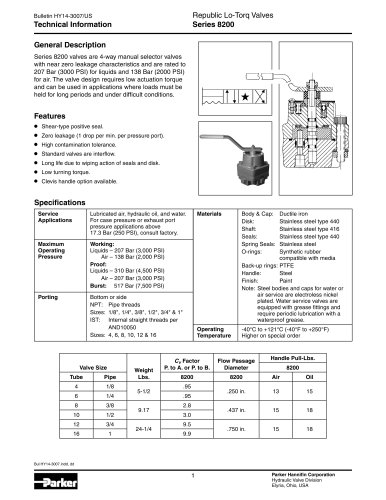 20Lo-Torq
2 Pages
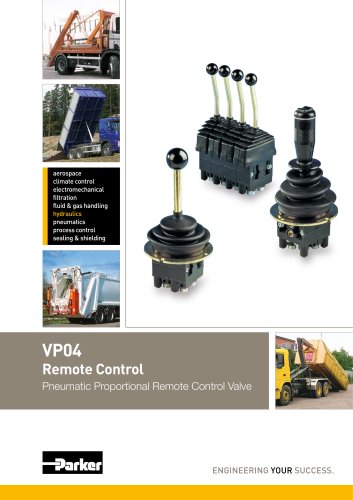 HY17-8356-UK_VP04
12 Pages
 Natural Gas Solutions
12 Pages







- Chiller
- Parker cartridge filter
- Filter cartridge
- Liquid recirculation chiller
- Industrial use filter
- Pressure separator filter
- Stainless steel pre-filter
- Industrial filter cartridge
- Fine filter cartridge
- Filtration unit
- Water recirculation chiller
- Automatic test kit
- Industrial cooling system
- Parker compressed air dryer
- Nitrogen generator
- Water filter cartridge
- Plastic filter cartridge
- Compact recirculation chiller
- General purpose filter cartridge
- Parker gas filter