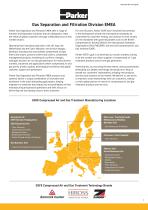
Overview: The Parker Hannifin Corporation's 2020 catalogue for Compressed Air and Gas Treatment provides a comprehensive guide to their products and solutions in the Gas Separation and Filtration Division EMEA. The catalogue is structured to cover various aspects of compressed air and gas treatment, including filtration, drying, purification, and gas generation.
Main Sections:
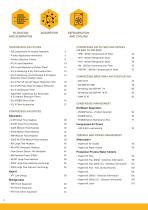
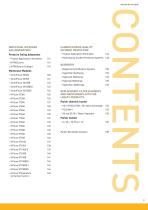
- Compressed Air Filters and Dryers: This section details the range of filters and dryers available, specifying their applications and selection criteria. It includes products like OIL-X Liquid Separators, Coalescing Filters, and various adsorption and refrigeration dryers.
- Compressed Breathing Air Purification: Focuses on systems designed to purify air for breathing, highlighting products like the BAC-4015 and Breathing Star BSP-MT series.
- Thermal and Power Management: Discusses aftercoolers and production process water chillers, emphasizing the Hyperchill Plus series for efficient thermal management.
- Industrial Nitrogen Gas Generators: Covers Pressure Swing Adsorption and Membrane Modules, detailing products like NITROSource and SmartFluxx series for nitrogen generation.
- Carbon Dioxide Quality Incident Protection: Provides information on systems designed to protect against CO2 quality incidents, such as the PCO2 Quality Incident Protection Systems.
- BioEnergy: Discusses biogas dehumidification systems and related products like Hyperfilter and Hypercool BioEnergy.
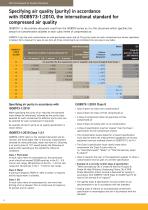
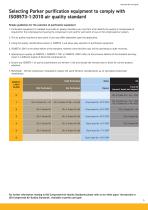
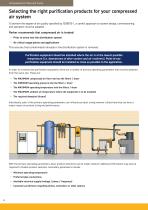
Standards and Specifications: The catalogue emphasizes compliance with ISO8573-1:2010 standards for compressed air quality, detailing the classification system for contaminants like solid particulates, water, and oil. It provides guidelines for selecting purification equipment to meet these standards.
Key Recommendations: The document recommends a systematic approach to air treatment, suggesting that air should be treated both at the compressor room and at the point of use to ensure optimal quality and cost-effectiveness. It also highlights the importance of specifying air quality standards accurately to ensure proper equipment selection.
Conclusion: Parker Hannifin's catalogue serves as a detailed resource for engineers and professionals in industries requiring high-quality compressed air and gas treatment solutions. It underscores the company's commitment to innovation, quality, and customer support in delivering effective and efficient products.
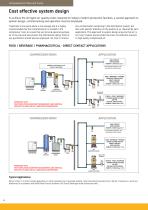
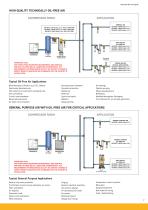
Introduction: This document outlines the specifications and guidelines for using high-quality oil-free air in various industrial applications, including medical, dental, lasers, robotics, and more. It emphasizes the importance of adhering to ISO 8573-1:2010 standards for air purity.
Specifications: The document specifies different classes of air quality according to ISO 8573-1:2010, ranging from Class 1:1:0 to Class 2:3:0, depending on the application. It highlights the need for oil-free air in critical applications and general industrial use.
Purification Equipment: Purification equipment requirements are identical for both oil-free and oil-lubricated compressors. The document stresses the importance of installing purification equipment where the air is at the lowest possible temperature and as close as possible to the application point.
Operating Parameters: Key parameters for sizing purification equipment include maximum compressed air flow rate, minimum operating pressure, maximum operating temperature, and required dewpoint. These parameters significantly impact product sizing and performance.
Compressed Air Filters and Dryers: The document provides guidelines for selecting compressed air filters and dryers, emphasizing the importance of maximum flow rate, minimum inlet pressure, and maximum inlet temperature. It also discusses the impact of ambient temperature on dryer performance.
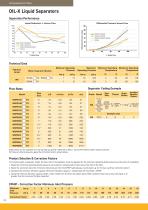
Product Selection and Correction Factors: To select the correct separator model, the flow rate must be adjusted for the minimum operating pressure. Correction factors are provided for various pressures to ensure accurate product selection.
Technical Data: Detailed technical data is provided for various models, including dimensions, weight, and performance metrics. The document includes tables for correction factors and flow rates to assist in product selection.
Conclusion: Proper selection and installation of purification equipment are crucial for maintaining air quality standards. The document provides comprehensive guidelines and technical data to aid in the selection process.
Filter Specifications and Coding: The document provides detailed specifications for Parker's OIL-X Coalescing & Dry Particulate Filters. It includes a coding system for identifying filter models based on grade, model, pipe size, thread type, drain option, and incident monitor option. For example, the code 'AO P010 A G F I' denotes a specific configuration of these parameters.
Product Models and Flow Rates: The document lists various models (e.g., P010A, P010B) with their respective pipe sizes, flow rates in L/S, m³/min, m³/hr, and cfm, along with replacement element numbers. It specifies that models 150 - 500 are unsuitable for pressures above 16 bar g (232 psi g).
Weights and Dimensions: Dimensions and weights for each model are provided, with measurements in both metric and imperial units. For instance, model 010A has dimensions of 180 mm height, 76 mm width, and 65 mm depth, weighing 0.84 kg.
Filtration Performance: The document outlines the filtration efficiency and specifications for different grades, such as AO and AA, which offer varying levels of particle reduction and oil content removal. It also details the initial dry and saturated differential pressures and the recommended change intervals for filter elements.
Operating Conditions: Minimum and maximum operating pressures and temperatures are specified for different filter grades. For example, AO/AA filters have a minimum operating pressure of 1 bar g and a maximum of 16 bar g.
Correction Factors and Product Selection: The document provides correction factors for minimum inlet pressure and outlines a procedure for selecting the appropriate filter model based on the minimum filtration capacity, which is calculated using these correction factors.
Oil Vapour Reduction Filters: Specifications for OVR (Oil Vapour Reduction) filters are included, detailing their particle removal capabilities, maximum remaining oil content, and filtration efficiency. The document also provides guidelines for selecting OVR models based on system information such as inlet pressure, temperature, and oil vapour concentration.
Product Selection & Correction Factors: For optimal operation,
compressed air dryers must be sized based on maximum inlet and ambient temperatures during summer, minimum inlet pressure, required outlet dewpoint, and maximum flow rate. The Minimum Drying Capacity (MDC) is calculated using the formula:
MDC = System Flow x CFMIT x CFMAT x CFMIP x CFOD. Select a dryer with a flow rate equal to or above the MDC.
Dryer Models and Specifications: Various models such as K-MT, KA-MT, CDAS HL, OFAS HL, and FBP HL are available, each with specific dewpoint options and ISO8573-1:2010 classifications. The models are designed to operate at different pressures and temperatures, with correction factors provided for varying conditions.
Technical Data and Performance: Flow rates are specified for operation at 7 bar (g) with reference to 20°C and 1 bar (a). Correction factors are applied for different pressures and temperatures. The document provides detailed dimensions, weights, and pipe sizes for each model.
Filtration and Catalogue Numbers: Each dryer model includes specific filtration requirements and comes with catalogue numbers for versions with and without dewpoint sensors. The document lists the required and included filtration types for each model.
Key Correction Factors: - Maximum Inlet Temperature (CFMIT) - Maximum Ambient Temperature (CFMAT) - Minimum Inlet Pressure (CFMIP) - Outlet Dewpoint (CFOD) These factors are crucial for adjusting the dryer performance to meet specific operational conditions.
Overview: This document provides technical specifications and guidelines for selecting and operating various models of compressed air dryers, specifically focusing on the FBP HL, CDAS HL ATEX, and MXS series. It includes details on dewpoint classifications, operating conditions, correction factors, and product selection criteria.
Specifications:- Dewpoint Classifications: The document outlines dewpoint options and their corresponding ISO8573-1:2010 classifications for different dryer models, such as Class 2.2.0 for -40°C and Class 2.1.0 for -70°C.
- Operating Conditions: Minimum and maximum operating pressures, temperatures, and ambient conditions are specified for each dryer model. For example, the FBP HL series operates between 4 bar g (58 psi g) and 16 bar g (232 psi g) with a maximum ambient temperature of 55°C (131°F).
- Electrical Supply: Standard and optional electrical supply options are provided, such as 85-265V 1ph 50/60Hz for the FBP HL series.
Procedures:- Product Selection: The document emphasizes the importance of sizing dryers based on maximum inlet and ambient temperatures, minimum inlet pressure, required outlet dewpoint, and maximum flow rate. The Minimum Drying Capacity (MDC) formula is provided: System Flow x CFMIT x CFMAT x CFMIP x CFOD.
- Correction Factors: Correction factors for maximum inlet temperature, ambient temperature, and minimum inlet pressure are detailed to ensure accurate dryer sizing and performance.
Technical Data:- Flow Rates: Detailed flow rate information is provided for each model, including single and multi-banked configurations for the MXS series.
- Dimensions and Weights: The document includes dimensions and weights for each dryer model, aiding in installation planning.
Recommendations:- Filtration: Recommended pre and post-filtration options are listed for each model to achieve optimal air quality, including the use of OIL-X filters for oil vapor reduction.
- Ordering Notes: Important notes on ordering MXS dryers, including the need for separate orders for inlet/outlet flange kits and filtration components.
Overview: This document provides detailed specifications and guidelines for selecting and installing Parker's MX series compressed air dryers. It includes dimensions, weights, recommended filtration, and flow control device (FCD) selection for various models.
Specifications:- Dimensions and Weights: The document lists the height, width, depth, and weight for each model from MX102C to MX108.
- Pipe Size and Filtration: Details the pipe size and recommended filters for each model, including general-purpose pre-filters and high-efficiency filters.
- Catalogue Numbers: Provides catalogue numbers for different pressure dew points (-20°C, -40°C, -70°C) for each model.
Procedures:- Ordering Notes: When ordering MXP heatless dryers, additional items such as inlet/outlet flange kits, pre/post filtration, and flow control devices must be ordered separately.
- Flow Control Device (FCD): Essential for multi-bank installations to prevent overflow and maintain constant outlet pressure dewpoint. The document explains the benefits and provides product selection guidelines based on dryer model, dewpoint, inlet pressure, and temperature.
Tables and Data:- Pressure and Temperature Tables: Extensive tables provide FCD product selection based on inlet temperature (35°C, 40°C, 45°C, 50°C) and pressure dewpoint (-20°C, -40°C, -70°C) for each model and pressure range (4 bar to 13 bar).
Recommendations:- Ensure correct sizing of FCDs based on installation parameters to avoid system inefficiencies.
- Order appropriate connection kits and filtration components to match the specific dryer model requirements.
Overview: This document provides technical specifications, product selection guidance, and performance data for Parker's MX Heatless Dryers, KE-MT Large Flow Heatless Adsorption Dryers, MXLE Large Flow Heatless Low Energy Adsorption Dryers, and WVM Large Flow Vacuum Low Energy Adsorption Dryers.
Specifications:- MX Heatless Dryers: Equipped with a fault alarm relay, normally closed inlet valves, power requirements of 15W (MXS, MXSDS) and 35W (MXA), and an IP65 rating. A Quick Re-pressurisation Valve (QRV) is optional for inlet pressures ≥9 bar.
- KE-MT Models: Operating pressures range from 5 to 10 bar, temperatures from 5°C to 50°C, and noise levels between 65-95 dB(A). Dewpoint options include -25°C, -40°C, and -70°C.
- MXLE Models: Operating pressures from 5 to 13 bar, temperatures from 5°C to 50°C, and noise levels <75 dB(A). Dewpoint options include -20°C, -40°C, and -70°C.
- WVM Models: Operating pressures from 4 to 10 bar, temperatures from 5°C to 40°C, and noise levels <75 dB(A). Dewpoint options include -40°C and -20°C.
Product Selection & Correction Factors:- Dryers must be selected based on maximum inlet and ambient temperatures, minimum inlet pressure, required outlet dewpoint, and maximum flow rate.
- Correction factors are provided for various conditions to ensure proper sizing and operation.
Performance Data:- Flow rates and correction factors are detailed for each model, with specific data for inlet flow rates, power consumption, and dimensions.
- ISO8573-1 classifications are provided for standard and optional configurations.
Recommended Filtration:- Specific filters are recommended for each model to ensure optimal performance, including pre-filters, high-efficiency filters, and oil vapor reduction filters.
Weights & Dimensions:- Detailed dimensions and weights are provided for each model, facilitating installation planning and logistics.
Overview: This document provides detailed specifications and guidelines for selecting and operating Parker compressed air dryers, including models WVM, ATT, SPE, and PST. It includes technical data, correction factors, and product selection criteria to ensure optimal performance.
Specifications: The document lists various dryer models with their respective catalogue numbers, dimensions, weights, and power requirements. It specifies the dewpoint classifications according to ISO8573-1:2010 standards, with options for different dewpoint temperatures.
Operating Conditions: The dryers are designed to operate at specific pressures and temperatures. The document provides correction factors for maximum inlet and ambient temperatures, minimum inlet pressure, and outlet dewpoint to adjust the dryer performance under varying conditions.
Product Selection: To select the appropriate dryer, users must calculate the Minimum Drying Capacity (MDC) using the formula: MDC = System Flow x CFMIT x CFMAT x CFMIP x CFOD. The document provides tables with flow rates and correction factors to assist in this calculation.
Technical Data: Detailed technical data is provided for each model, including pipe sizes, inlet flow rates, and average power consumption. The document also includes noise levels and electrical supply requirements.
Filtration and Accessories: The document outlines recommended filtration options and additional accessories like electronic drains and energy-saving features for enhanced dryer performance.
Conclusion: This comprehensive guide ensures users can select and operate Parker compressed air dryers effectively, optimizing performance based on specific installation conditions and requirements.
Technical Specifications: The document outlines the operating parameters for compressed air dryers and filters, including maximum and minimum operating pressures and temperatures. The standard electrical supply is 400V 3ph 50Hz, with optional configurations available. Thread connections are specified as DIN Flange, and noise levels are maintained below 75 dB(A).
Flow Rates and Correction Factors: Flow rates are provided for operation at 7 bar (g) with specific reference conditions. Correction factors are necessary for different operating conditions, including maximum inlet and ambient temperatures, minimum inlet pressure, and outlet dewpoint.
Product Selection: The selection of dryers and filters requires calculating the Minimum Drying Capacity (MDC) or Minimum Filtration Capacity using correction factors. The document provides detailed tables for correction factors based on various parameters.
Model Specifications: Detailed specifications for various models (PST, SPH, PSH) are provided, including dimensions, weight, and recommended filtration. Each model has specific catalogue numbers for air-cooled and water-cooled versions.
Filtration Performance: The document describes different filtration grades (WS, AO, AA, ACS) with their respective performance metrics, including particle reduction, oil content, filtration efficiency, and differential pressure.
Important Notes: The document emphasizes the importance of using correct filter housings and the different lifespan of adsorption filter elements compared to coalescing and dry particulate filters.
Overview: This document provides detailed specifications and guidelines for selecting and operating Parker compressed air filters and dryers, focusing on filtration performance, technical data, and product selection criteria.
Specifications: The document outlines various filter grades (V, ZP, XP, A) with specific filtration capabilities, including particle reduction down to 0.01 micron and oil content reduction. Each grade has defined filtration efficiency, differential pressure, and replacement intervals.
Filtration Performance: Filters are categorized by their ability to remove particulates and oil aerosols, with efficiency ratings up to 99.9999%. The document specifies maximum remaining oil content and differential pressures for dry and saturated conditions.
Product Selection: Selection involves calculating the minimum filtration capacity using correction factors for inlet pressure and temperature. The document provides tables for correction factors and flow rates to aid in selecting the appropriate filter model.
Technical Data: Detailed dimensions, weights, and operating conditions (pressure, temperature) are provided for each filter and dryer model. The document includes correction factors for various operating conditions to ensure optimal performance.
Quality Assurance: Products comply with ISO 9001 and ISO 14001 standards, with specific approvals for pressure vessels. The document emphasizes the importance of using the correct filter elements for different applications, such as oil vapour reduction.
Recommendations: Regular maintenance and timely replacement of filter elements are recommended to maintain efficiency. The document advises on the use of activated carbon for oil vapour adsorption and highlights the different lifespan of adsorption filters compared to coalescing filters.
Technical Specifications: The document outlines the specifications for various models of compressed air purification systems. Key parameters include operating pressure, temperature ranges, electrical supply options, and noise levels. The systems are designed to operate within specific pressure and temperature limits, with standard electrical supply options of 230V/115V at 50-60Hz.
Flow Rates and Correction Factors: Flow rates are provided for different models, with specific values for regeneration air requirements. Correction factors are necessary for adjusting flow rates based on varying inlet pressures and temperatures. These factors ensure the systems operate efficiently under different environmental conditions.
Filtration Performance: The document details the filtration capabilities of the systems, including general-purpose pre-filters, high-efficiency filters, and oil vapor reduction filters. Filtration efficiency is highlighted, with particle reduction capabilities down to 0.01 microns and oil aerosol content limits specified.
Quality Assurance and Approvals: The systems are manufactured under ISO 9001 and ISO 14001 standards, with IP55 ingress protection for indoor use. They are approved under the EU Pressure Equipment Directive and other regional standards, ensuring compliance with safety and quality regulations.
Product Selection and Sizing: Proper sizing of the purification systems is crucial for optimal performance. The document provides guidelines for selecting the appropriate model based on system flow, inlet temperature, and pressure. It also discusses the impact of incorrect sizing on system performance and outlet water quality.
Condensate Management: The document addresses the management of condensate in compressed air systems, emphasizing the importance of selecting the right oil/water separators. It categorizes lubricants into bands based on their separation characteristics and provides guidance on drainage methods to prevent emulsification.
Refrigeration Dryers: The inclusion of refrigeration dryers in a system can increase condensate production, necessitating appropriate sizing of oil/water separators. The document provides flow capacities for systems with and without refrigeration dryers, highlighting the need for correct product selection based on climatic conditions and oil types.
Compressor Specifications and Performance: The document provides detailed specifications for various compressor models (ES2100 to ES2600) under different system conditions. It includes flow rates in liters per second (L/s), cubic meters per minute (m3/min), cubic meters per hour (m3/hr), and cubic feet per minute (cfm) for both rotary screw and vane compressors. The performance varies based on whether a refrigeration dryer is installed and the type of oil used (Band A, B, or C).
System Conditions: The ambient temperature at the compressor inlet, relative humidity, minimum system temperature, compressor discharge temperature, and system pressure are specified for different scenarios. The outlet quality of oil in water is also detailed, with conditions for systems with and without refrigeration dryers.
Oil Types: The document categorizes oil types into Band A (Turbine, Additive Free), Band B (Mineral, PAO, TMP, PE), and Band C (Diesters, Triesters, PAG), which affect the performance and selection of compressors.
Separator Models and Performance: Separator models (ES2100 to ES2600) are designed to deliver specific residual oil in water levels (<20mg/L, <10mg/L, <5mg/L). The document includes details on inlet and outlet connections, settlement tank capacity, maximum pressure, and temperature ranges.
Weights and Dimensions: The dimensions and weights of the ES2000 series oil/water separators are provided, including height, width, depth, and weight when empty and full.
Maintenance and Service Kits: Maintenance kits and service kits for vent filters are listed for each model, with specific part numbers for ordering.
Condensate Management: The document outlines the technical data for zero air loss external float drains and electronic level sensing drains, including flow rates, pipe sizes, and electrical supply requirements.
Hypercool Air and Water Cooled Aftercoolers: Technical data for Hypercool air and water-cooled aftercoolers are provided, detailing flow rates, maximum operating pressure, pipe connections, electrical supply, absorbed current, pressure drop, and noise levels.
Overview: This document provides technical specifications and options for the Hyperchill Industrial Process Chiller, focusing on models with different cooling capacities and configurations. It includes details on available kits, accessories, and correction factors for optimal performance.
Specifications:- Cooling Capacity: Ranges from 76.0 kW to 360 kW depending on the model.
- Compressor Power: Varies from 15.4 kW to 82 kW.
- Power Supply: 400V/3Ph/50Hz with no neutral.
- Refrigerant: R407C.
- Fan Types: Axial and centrifugal fans with specific power and airflow capacities.
- Water Cooled Version: Includes condenser water flow and connection specifications.
Procedures and Standards:- Operating Conditions: Ambient temperatures from 5°C to 45°C and water temperatures from 0°C to 30°C.
- Correction Factors: Adjustments based on ambient temperature, water outlet temperature, glycol percentage, and condenser water inlet temperature.
Options and Features:- Pumps: Options for 1.5 bar, 3 bar, and 5 bar pumps.
- Control Features: Close control with +/- 0.5°C precision, low ambient operation, and antifreeze heating.
- Construction: Non-ferrous hydraulic circuits and stainless steel tanks available.
Kits and Accessories:- Fill Kits: Ambient manual, ambient automatic, and pressurized automatic kits with expansion tanks.
- Remote Controls: Base and advanced versions for monitoring and control.
- Additional Accessories: Wheels for transport, control panel covers, and manual external bypass options.
Model Breakdown: Detailed part number breakdowns for different configurations, including air-cooled, water-cooled, and laser models, specifying features like pump type, tank presence, and control options.
Overview: The document provides detailed information on industrial nitrogen gas applications, focusing on the use of nitrogen in various sectors such as pharmaceuticals, food and beverage, lasers, heat treatment, and fire prevention. It also covers technical specifications for nitrogen gas generators and their maintenance.
Specifications: The document lists standard part numbers for various components like remote control bases, closed circuits, and control panel covers. It also details the specifications for air-cooled systems with axial fans, including models HLS076, HLS090, and HLS116.
Applications: - Pharmaceuticals: Nitrogen is used for blanketing product ingredients, pressure transfer, and preventing oxidation in manufacturing and laboratory settings.
- Food and Beverage: Nitrogen is used in modified atmosphere packaging to extend shelf life and improve product quality by reducing oxidation.
- Lasers: Nitrogen assists in laser cutting, sintering, ablation, and eye surgery by preventing oxidation and contamination.
- Heat Treatment: Nitrogen is used to exclude oxygen in processes like brazing, carburizing, and annealing.
- Fire Prevention: Nitrogen is used to reduce oxygen levels in archives and museums to prevent fire damage.
Nitrogen Quality and Purity: The document discusses the importance of nitrogen purity, noting that most applications do not require ultra-high purity. It provides guidelines for different purity levels required for various applications, emphasizing cost and energy savings.
Technical Data: Detailed technical data is provided for NITROSource PSA Nitrogen Gas Generators, including flow rates, inlet parameters, environmental conditions, and electrical specifications. The document also includes dimensions and weights for different models.
Maintenance: Preventative maintenance kits are outlined for both high and low purity generators, specifying service intervals and kit contents.
Specifications: The document outlines the specifications for Parker membrane systems used in industrial nitrogen gas generation. The design pressure is set at 15 bar g (217 psi g) with a design temperature of 65ºC (149ºF). The housing is made of stainless steel with no coating, and material certificates are provided as per EN10204-3.1. The maximum operating pressure is 13.0 bar g (190 psi g), and the operating temperature ranges from +2°C to +50°C (+36°F to 122°F). The system filters particles at a 0.01 µm cut-off and maintains a maximum oil vapor content of <0.01 mg/m3.
Procedures: The document advises using bulletin S3.1.240 for feed-air consumption at temperatures other than 20ºC. It also provides guidelines for flow rate corrections under varying conditions. The nitrogen flow rate and feed-air consumption are detailed for different pressures and purities, with specific instructions to contact Parker for performance information tailored to specific applications.
Performance Data: Performance data is based on a feed-air temperature of 20°C and an ambient pressure of 1013 mbar. The document includes tables showing typical nitrogen flow rates and feed-air consumption at various pressures and purities. It highlights that actual performance may vary based on feed air pressure and temperature.
Safety Notes: The document warns that nitrogen-enriched air can cause suffocation, and oxygen-enriched air increases fire hazards. It emphasizes that oxygen-enriched air should be available at ambient pressure to prevent performance issues.
Material and Design: The housing is primarily made of aluminum with an ESPC coating to RAL 7039 (Quartz Grey) and a dry film thickness of 60 microns. The document provides details on dimensions, weight, and connection types for various models.
Recommendations: Users are advised to ensure clean air without contaminants and to maintain ambient conditions within specified temperature and pressure ranges. For higher purities and specific performance requirements, contacting Parker is recommended.
Overview: This document provides technical specifications and performance data for Parker membrane systems used in industrial nitrogen gas generation. The systems separate oxygen from pressurized air to produce nitrogen-enriched air, which must be handled with care due to potential suffocation and fire hazards.
Specifications:- Maximum operating pressure: 13.0 bar g
- Design pressure: 13-15 bar g depending on the model
- Operating temperature range: +2°C to +50°C
- Maximum oil vapor content: <0.01 mg/m³
- Particles filtered at 0.01 µm cut off
- Housing material: Aluminum or Stainless Steel with EN10204-3.1 certification
Performance Data:- Performance is based on a feed-air temperature of 20°C and ambient pressure of 1013 mbar.
- Maximum pressure drop is less than 0.8 bar.
- Nitrogen flow rates vary with pressure and purity levels, with detailed tables provided for different bar g levels and purities ranging from 95% to 99.5%.
Flow Rate Corrections:- For feed-air temperatures other than 20°C, refer to bulletin S3.1.059 for corrections.
- Maximum nitrogen flow rate is calculated as the minimum flow rate plus 10%.
Mechanical Design and Materials:- Design temperature: 50-65°C depending on the model
- Housing dimensions and weight vary by model, with detailed specifications provided.
- Connection types: G¾ female for inlet/outlet and G1 female for vent.
Safety and Handling:- Nitrogen-enriched air can cause suffocation, and oxygen-enriched air increases fire hazards.
- Ensure no pressure build-up of enriched oxygen at the outlet to prevent performance issues.
Additional Notes:- 3D model CAD STEP files are available for design purposes.
- Material certificates are available for stainless steel housings.
Specifications: - Operating pressure: 9.0 bar g - Operating temperature range: +2°C to +50°C - Maximum oil vapor content: <0.01 mg/m3 - Particle filtration: 0.01 µm cut off - Relative humidity: <100% (non-condensing) - Housing material: Aluminum - Dimensions: 1740 x 280 mm - Weight: 46 kg - Connection inlet/outlet: G2½ female - Vent: 100 mm OD
Performance and Procedures: - Parker membranes separate oxygen from pressurized air, determining nitrogen content by subtracting residual oxygen from 100%. - Performance data is based on 20°C feed-air temperature and 1013 mbar ambient pressure. - Maximum pressure drop: <0.3 bar. - Maximum nitrogen flow rate is 30% above the minimum flow rate. - Design pressure: 15 bar g; Design temperature: 65ºC.
Flow Rate and Correction Factors: - Nitrogen flow rate and feed-air consumption vary with temperature and pressure. - Correction factors are provided for different temperatures and pressures to adjust flow rates. - Example calculations are provided for corrected nitrogen and feed-air flow at 50ºC and 97% purity.
Carbon Dioxide Quality Incident Protection: - PCO2 systems ensure CO2 purity for beverage industries, removing impurities using multi-layer gas adsorbent technology. - Systems are rated for a maximum operating pressure of 24.1 bar g / 350 psi g. - ISBT guidelines provide voluntary quality standards for CO2 purity and contaminants.
Technical Data and Maintenance: - PCO2 models vary in flow rate and dimensions, with preventative maintenance kits required every 8000 hours. - Systems include multiple filtration stages to remove particles, water vapor, hydrocarbons, and sulfur compounds.
Biogas Dehumidification Systems: - Hyperchill, Hypercool, and Hypersep BioEnergy systems are designed for biogas applications, providing efficient cooling and separation. - Systems are installed on a galvanized steel frame and include water connections and isolating valves.




 ES2000 Series
 Compressed Air Filters
 PNEUDRI
 OIL-X EVOLUTION
 Analytical Gas Systems
 Waveguide Air Pressure Unit
 Regenerative CBRN Protection
 Regenerative breathing air
 Breathing Air Purifiers


 CARBOFLOW Filter Cartridges
 PCO2
PCO2 MAXIGAS generic brochure
 PNEUDRI DH
 OIL-X EVOLUTION
 Compressed Air Heaters
