
- Catalogs
- Parker Electromechanical and Drives Division Europ
- Torque Motors – Kit version


Torque Motors – Kit version

Torque Motors – Kit version
This technical manual is designed for qualified personnel involved in the selection, installation, operation, and maintenance of PARKER TK Torque Motors. It stresses the importance of understanding the manual before operation and clarifies that PARKER's responsibility is limited to the torque motors themselves.
Parker Hannifin Manufacturing France SAS declares that the TK series servomotors comply with directives such as the Low Voltage Directive, RoHS, and EMC. The final conformance is the integrator's responsibility.
The manual provides an overview of the TK series, including motor descriptions, technical data, and product codes. It details specifications for natural and water-cooled motors, efficiency curves, and electromagnetic losses.
This section covers motor selection criteria, including altitude and temperature derating, drive selection, and current limitations. Detailed characteristics of the TK series, such as torque, speed, and power, are included.
Standard configurations for various models are provided, along with motor mounting recommendations and mechanical interface details.
Details on natural and water cooling systems are provided, including additives for water cooling, cooling circuit pressure drops, and chiller selection.
Information on alarm tripping with PTC thermistors and temperature measurement with KTY sensors is included.
Guidelines for wire sizes, motor cable lengths, and ground connections are provided.
Instructions for commissioning, handling, storage, and machine integration are detailed. This section also covers electrical connections, encoder cable handling, and troubleshooting.
The manual emphasizes the importance of following safety instructions to prevent injuries, death, or property damage. It mandates that all operations be performed by qualified personnel familiar with safety standards and local regulations.
Servo drives contain non-insulated live components. Users must follow the commissioning manual and ensure no access to live parts before installation. Dangerous voltages can occur in various motor states.
Servomotors can accelerate quickly, causing dangerous movement. Moving parts should be screened off, and operators must stay clear of danger areas.
Motor surfaces can exceed 100°C, posing a burn risk.
The TK frameless servomotor consists of a rotor and stator and must be integrated into a system for full functionality. Designed for high torque at low speed, these motors are compact, efficient, and require no maintenance.
The motors are permanent-magnet synchronous types with Nd-Fe-B magnets. They have high polarity and various shaft heights. Cooling can be water or natural, with specific temperature and altitude ratings.
Altitude and temperature affect motor performance. Torque derating occurs above 1000m altitude and at temperatures above 40°C.
Drive selection depends on rated power and mode. The AC890 Parker drive provides rated current based on mode selection.
The document provides detailed specifications for brushless servomotors, including rated power, torque, speed, current, and cooling requirements.
Key parameters include rated power, torque, speed, and cooling requirements.
The document outlines the selection criteria for compatible drives, emphasizing the need for drives that can handle specific permanent and transient currents.
Guidelines are provided for managing current limitations, especially under stall conditions and peak current scenarios.
The document includes torque vs. speed graphs illustrating the motor's performance across different operational conditions.
The motors require water cooling, with specific flow and pressure conditions.
Several application scenarios are provided, detailing the motor and drive selection process based on specific torque and speed requirements.
The document outlines the necessity for compliance with regulations such as CE and IEC60034.
Grounding circuit continuity and dielectric tests are recommended for safety and regulatory compliance.
The document provides a list of symptoms, possible causes, and solutions for motor issues.
Catalog excerpts

Torque Motors – Kit version TK Series Technical Manual PVD3645
Open the catalog to page 1
Parker Hannifin Manufacturing France SAS Electromechanical & Drives Division Europe Etablissement de Longvic 4 Boulevard Eiffel - CS40090 21604 LONGVIC Cedex - France manufacturer, with brand name Parker, declare under our sole responsibility that the products SERVOMOTORS TYPE TK satisfy the arrangements of the directives : Directive 2014/35/EU : “Low Voltage Directive”, LVD Directive 2011/65/EU : “Restriction of Hazardous Substances”, RoHS Directive 2014/30/EU : “Electromagnetic Compatibility”, EMC and meet standards or normative document according to : EN 60034-1:2010/AC:2010 : Rotating electrical...
Open the catalog to page 2
1. INTRODUCTION 1.1. Purpose and intended audience This manual contains information that must be observed to select, install, operate and maintain PARKER TK Torque Motors in kit. The design, tests, certification, commissioning, operation and maintenance of the equipment should be carried out by qualified personnel. A qualified person is someone who is technically competent and familiar with all safety information and established safety practices; with the installation process, operation and maintenance of this equipment; and with all the hazards involved. Reading and understanding the information...
Open the catalog to page 5
General Safety Rules Generality DANGER: The installation, commission and operation must be performed by qualified personnel, in conjunction with this documentation. The qualified personnel must know the safety (C18510 authorization, standard VDE 0105 or IEC 0364) and local regulations. They must be authorized to install, commission and operate in accordance with established practices and standards. Electrical hazard Servo drives may contain non-insulated live AC or DC components. Respect the drives commissioning manual. Users are advised to guard against access to live parts before installing...
Open the catalog to page 6
2. PRODUCT DESCRIPTION 2.1. Quick URL All informations and datas are avaible on : http://www.parker.com/eme/tk 2.2. Overview The TK frameless servomotor are the active parts of a servo motor: a rotor and a stator. The TK series can not be used alone and must integrated into a complete system to provide a complete torque motor. The design, the construction, the certification and the tests are the responsibility of the integrator. TK Torque Motors Series in kit version from PARKER are innovative direct drive solutions designed for industrial applications requiring high torque at low speed. TK Torque...
Open the catalog to page 7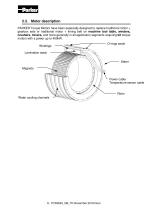
2.3. Motor description PARKER Torque Motors have been especially designed to replace traditional motor + gearbox sets or traditional motor + timing belt on machine tool table, winders, crushers, mixers, and more generally in all application segments requiring kit torque motors with a power up to 400kW. Windings O-rings seals Lamination stack Stator Magnets Power cable Temperature sensor cable Rotor Water cooling channels
Open the catalog to page 8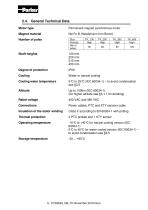
2.4. General Technical Data Motor type Permanent-magnet synchronous motor Magnet material Nd-Fe-B (Neodymium Iron Boron) Size: Polarity: Nbr of poles: Shaft heights Water or natural cooling Cooling water temperature Up to 1000m (IEC 60034-1) (for higher altitude see §3.1.1 for derating) Rated voltage Power cables, PTC and KTY sensors cable Insulation of the stator winding Class F according to EN 60034-1 with potting Thermal protection Operating temperature -15°C to +40°C for natural cooling version (IEC 60034-1) 0°C to 40°C for water cooled version (IEC 60034-1) – to avoid condensation see §3.5...
Open the catalog to page 9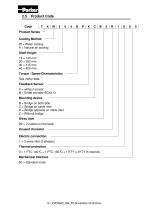
2.5. Product Code Code Product Series Cooling Method W = Water cooling A = Natural air cooling Shaft Height 13 = 130 mm 20 = 200 mm 30 = 315 mm 40 = 400 mm Torque / Speed Characteristics See motor data. Feedback Sensor K = without sensor B = Endat encoder ECN113 Mounting device B = Bridge on both side C = Bridge on cable inlet D = Bridge opposite on cable inlet Z = Without bridge Wires inlet B2 = 2 meters on the back Unused character Electric connection 1 = 3 wires inlet (3 phases) Thermal protection 0 = 1 PTC 140°C + 1 PTC 150°C + 1 KTY (+1KTY in reserve) Mechanical Interface 00 = Standard motor...
Open the catalog to page 10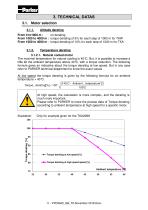
3. TECHNICAL DATAS 3.1. Motor selection 3.1.1. Altitude derating From 0 to1000 m : no derating From 1000 to 4000 m : torque derating of 5% for each step of 1000 m for TKW From 1000 to 4000 m : torque derating of 10% for each step of 1000 m for TKA 3.1.2. Temperature derating 3.1.2.1. Natural cooled motor The maximal temperature for natural cooling is 40°C. But, it is possible to increase a little bit the ambient temperature above 40°C, with a torque reduction. The following formula gives an indicative about the torque derating at low speed. But in any case refer to PARKER technical department...
Open the catalog to page 11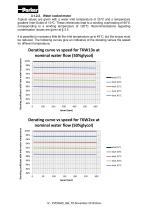
3.1.2.2. Water cooled motor Typical values are given with a water inlet temperature of 25°C and a temperature gradient Inlet-Outlet of 10°C. These references lead to a winding overheating of 95°C corresponding to a winding temperature of 120°C. Recommendations regarding condensation issues are given at § 3.5 It is possible to increase a little bit the Inlet temperature up to 45°C, but the torque must be reduced. The following curves give an indicative of the derating versus the speed for different temperature. Derating coefficient with inlet water temperature Derating curve vs speed for TKW13x...
Open the catalog to page 12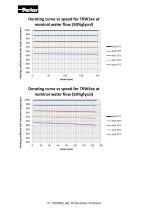
Derating coefficient with inlet water temperature Derating curve vs speed for TKW3xx at nominal water flow (50%glycol) 100% 98% 96% 94% 92% Derating coefficient with inlet water temperature Derating curve vs speed for TKW4xx at nominal water flow (50%glycol) 100% 98% 96% 94% 92%
Open the catalog to page 13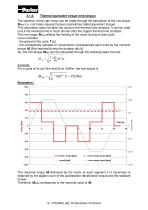
Thermal equivalent torque (rms torque) The selection of the right motor can be made through the calculation of the rms torque Mrms (i.e. root mean squared torque) (sometimes called equivalent torque). This calculation does not take into account the thermal time constant. It can be used only if the overload time is much shorter than the copper thermal time constant. The rms torque Mrms reflects the heating of the motor during its duty cycle. Let us consider: - the period of the cycle T [s], - the successively samples of movements i characterized each ones by the maximal torque Mi [Nm] reached...
Open the catalog to page 14All Parker Electromechanical and Drives Division Europ catalogs and technical brochures
 AC15 Variable Speed Drive
16 Pages
 Belt Driven
32 Pages
 SensoNODETM
2 Pages
 Medical solutions
2 Pages
 RS and AXEM Series
14 Pages
 AC890
AC89025 Pages
 HPLA Linear Actuators
40 Pages
 AC10 Variable Speed Drive
26 Pages
 AC30 Variable Speed Drive
42 Pages
 Parker Automation Controller
20 Pages
 Explosion Proof Servo Motors
44 Pages
 Parker Gearboxes
36 Pages
Archived catalogs
 GVM Global Vehicle Motor
24 Pages
 Frameless Servo Motors
44 Pages
 ETH Electro Cylinder_2019
60 Pages
 GVI Global Vehicle Inverter
16 Pages
 RTS, RS, RX and AXEM Series
24 Pages
 Motion Solutions
16 Pages
 PE Series
12 Pages
 Belt Driven Positioners
151 Pages
 PSD1 Parker Servo Drive
12 Pages
 DC590+ Product Catalog
20 Pages
 PSD1 Parker Servo Drive
16 Pages
 ETHERNET Powerlink
20 Pages
 PTN Planetary Gearbox
4 Pages
 PS / RS Series
16 Pages
 HKW Series
133 Pages
 SMB Motors
28 Pages
 TMW Series Torque Motors
32 Pages
 DC590P
28 Pages
 ETH Electro Cylinder_2012
56 Pages


- Cylinder
- Parker actuator
- Parker linear actuator
- Planetary gearbox
- Parker electric actuator
- Coaxial gearhead
- Parker positioning stage
- Precision gearhead
- Hydraulic cylinder
- Parker linear positioning stage
- Solid-shaft gearhead
- Pneumatic cylinder
- Gear train gear reducer
- Motorized positioning table
- Servo-amplifier
- Gearbox for industrial applications
- Compact actuator
- Parker precision positioning stage
- Parker performance servomotor