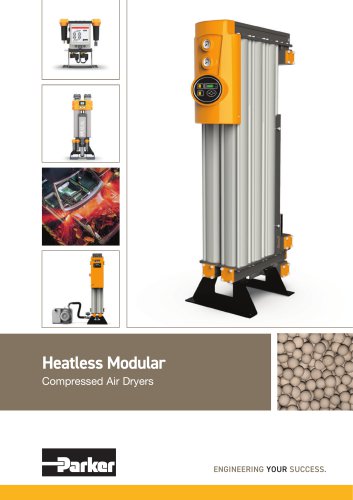
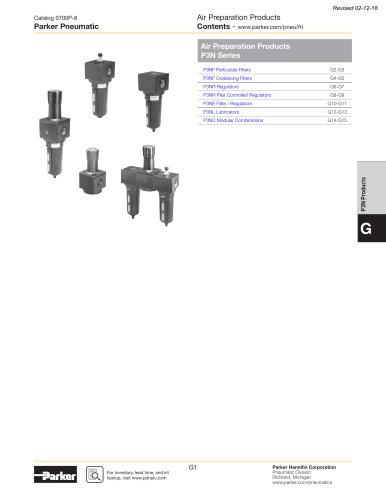
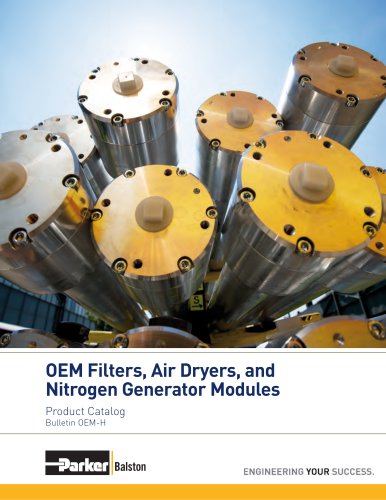
Overview: The document is a product catalog from Parker Hannifin Corporation, detailing various products such as OEM filters, air dryers, and nitrogen generator modules. It emphasizes their application in enhancing machine and process efficiency.
Specifications: The catalog outlines specifications for product lines like the 8000 Series High Efficiency Coalescers, membrane air dryers, and disposable filter units. Key specifications include filtration efficiency, pressure and temperature ranges, and material construction.
Procedures: Installation recommendations for the 8000 Series filters are provided, emphasizing proper placement in compressed air lines for optimal performance. Filters should be placed downstream from compressors and at critical end-use points.
Norms and Standards: Parker Hannifin products are manufactured under ISO 9001 standards, ensuring high quality and uniformity. The document stresses user responsibility in selecting appropriate products based on application-specific requirements.
Recommendations: The catalog advises using coalescing filters to protect equipment from contaminants and recommends specific configurations for different applications. Point-of-use filters are suggested to remove impurities and condensed water.
Key Data: The document includes a table of contents listing various product categories and their respective pages, such as custom product capabilities, filter media, and compressed air filters. It also provides technical specifications for filter media and disposable filter units.
Critical Information: The document contains warnings about the potential risks of improper product selection or use, emphasizing the need for thorough analysis and testing by users to meet performance and safety requirements.
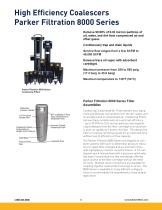
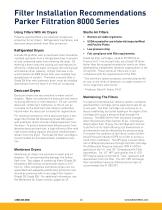
Compressor Filter Specifications: Specifications for the 8000 Series Filter Cartridge Grade DX are outlined, emphasizing the importance of selecting a filter size based on a flow chart and ensuring the port size is equal to or larger than the line size. Automatic drains are recommended, and differential pressure indicators are optional.
Filter Protection for Air Dryers: Filters provide essential protection for refrigerated, membrane, and desiccant dryers. Recommendations include using a Grade DX prefilter with an automatic drain upstream for refrigerated dryers and a two-stage filter system for desiccant and membrane dryers.
Filter Maintenance: Filters should be replaced when the pressure drop reaches 10 psi to maintain efficiency. A Differential Pressure Indicator (DPI) can be installed to monitor filter conditions.
Sterile Air Filters: Grade SA filter cartridges are highly efficient, removing 99.9999+% of 0.1 micron particles, and comply with FDA requirements. They are suitable for use in meat and poultry plants.
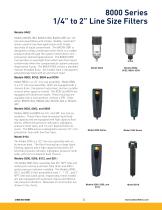
Filter Installation Recommendations: Detailed specifications for various models of the 8000 Series filters are provided, including port sizes, materials, and pressure ratings. Guidelines for selecting filter cartridges and housings based on application needs are included.
Modular Configurations: The 8000 Series offers modular configurations for ease of integration into OEM products, available in two or three-stage assemblies with DX, BX, and CI filter elements.
Principal Specifications: Specifications for various filter models focus on flow rates, retention efficiency, and construction materials. Retention efficiency grades are provided for different particle sizes, with DX at 93%, BX at 99.99%, and SA at 99.9999+%.
Filter Cartridge Description: Cartridges operate within a temperature range of -150°F to 300°F and a maximum pressure differential of 100 psi. They are constructed from borosilicate glass microfibers with a fluorocarbon resin binder, resistant to water and various lubricants.
Options and Accessories: Various options include different bowl materials and drain types, such as manual twist and automatic float drains. Product selection charts for air preparation units and compressed air filters are listed.
Flow Characteristics: Graphs and tables illustrate the relationship between flow rates and pressure drops for different filter models, aiding in the selection of appropriate filters for specific applications.
Material Specifications: The document details materials used in construction, such as plastic for the body and collar, nitrile for the diaphragm and seals, and steel for springs.
Regulator Kits & Accessories: Various kits and accessories are available, including bonnet assembly kits, control knobs, gauges, mounting bracket kits, and service kits.
Warnings: The document warns against connecting regulators to bottled gas and exceeding maximum primary pressure ratings to prevent product rupture and serious injury.
Technical Information: Details on construction materials, pressure, and temperature ratings for different components are provided, including specifications for automatic and manual drains, filter element kits, and mounting brackets.
Flow Characteristics: Graphs illustrate the relationship between flow rates and pressure drops for different port sizes and configurations.
Specifications: Detailed specifications for air preparation units, including gauge ports, port threads, pressure ratings, and temperature ratings, are provided.
Relief and Flow Characteristics: Detailed flow characteristics for different port sizes at a primary pressure of 100 PSIG are provided, with graphs illustrating the relationship between flow and pressure drop.
Materials of Construction: Construction materials include steel for the adjusting stem and springs, aluminum for the body and bonnet, plastic for the knob and piston, brass for the poppet assembly, and nitrile for the seals.
Features and Options: Air preparation units offer features such as excellent water removal efficiency, unbalanced poppet standard, solid control piston for extended life, and a space-saving package that combines filter and regulator features. Options include different bowl materials and drain types.
Warnings and Cautions: The document includes warnings about potential product rupture if the regulator is connected to bottled gas or if the maximum primary pressure rating is exceeded. It also cautions about regulator pressure adjustment, advising that pressure should be set by increasing to the desired setting for best performance.
Specifications: Detailed specifications for air preparation units, specifically the 06E and FB11 series filter/regulators, are provided. The units are available in various port sizes and are designed to handle different pressure and temperature ratings depending on the bowl material.
Procedures: The document outlines the procedure for adjusting the regulator pressure, emphasizing that the knob adjustment allows for a full range of outlet pressures, but caution is advised as the knob is not a limiting device.
Norms and Standards: Compliance with ISO 1179-1 standards for 1/4" and 3/8" port sizes is mentioned, along with the FB11 series meeting NACE specifications MR-01-75/ISO-15156 for corrosive environments.
Recommendations: It is recommended not to connect the regulator to bottled gas and not to exceed the maximum primary pressure rating to avoid product rupture and potential injury.
Key Features: The 06E series features a compact design with options for manual twist drain or automatic float drain. The FB11 series is constructed with stainless steel for durability in corrosive environments and includes a large diaphragm for precise regulation. Both series offer high flow capacities and various bowl options.
Ordering Information: Detailed ordering information, including part numbers for different configurations and accessories such as bonnet kits, drain kits, filter element kits, and gauges, is provided.
Flow Characteristics: Graphs illustrate the relief and flow characteristics for different port sizes and configurations, showing the relationship between secondary pressure and flow rate.
Principal Specifications: Specifications for various models of filter regulators and membrane air dryers are outlined, including port sizes, materials of construction, maximum temperature and pressure, and dimensions.
Ordering Information: Details on how to order products based on desired port size and regulating pressure range are provided, including a matrix for selecting model numbers and specifying the inclusion of automatic drains and replacement filter cartridges.
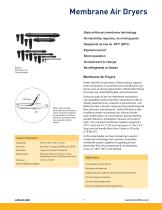
Applications: Various applications for Parker Membrane Air Dryers are listed, such as pneumatic equipment, purging electronic cabinets, and providing dry air for hazardous areas. These dryers offer advantages like no electricity requirement, explosion-proof design, and silent operation.
Membrane Air Dryers: The operation of membrane air dryers is described, which use coalescing filtration and membrane technology to remove water vapor from compressed air. The dryers are designed for continuous operation with minimal maintenance.
Product Specifications: Specifications for different models of membrane air dryers are provided, including flow rates, inlet and outlet port sizes, and dimensions. The importance of using genuine replacement parts for consistent performance is noted.
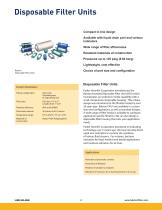
Balston Disposable Filter Units: Balston disposable filter units are introduced, ideal for gas and liquid filtration applications in various industries. Specifications include maximum pressure and temperature ratings, inlet/outlet port sizes, and housing materials.
General Purpose DFU Specifications: Specifications for general-purpose disposable filter units are detailed, including pressure and temperature limits, port sizes, and housing materials. Ordering information for different models and grades is provided.
Overview: Detailed specifications and ordering information for various models of Disposable Filter Units (DFUs) and Disposable Adsorption Units (DAUs) manufactured by Balston Filters are provided, outlining technical specifications, material construction, and application guidelines for each model.
Specifications: Specifications for models like 7825, 4433-05, 9922-05, 9922-11, 9900-05, 8800-12, and 9953-11 are provided, detailing pressure, temperature, construction materials, and internal volumes.
Ordering Information: Each model is available in different packaging options and grades, with specific adsorbents available for certain models.
Considerations for Adsorbent Cartridges: Solid adsorbents are effective only for vapors and must be preceded by an efficient coalescing filter. Adsorbent cartridges have a limited holding capacity and should be replaced before reaching saturation. Adsorption efficiency is influenced by operating conditions such as temperature, pressure, and flow rate.
Filtration Efficiency: Retention ratings for liquid and gas filtration are provided, with specific flow rates at different pressures.
Chemical Compatibility: Suitable, limited use, and unsuitable chemicals for models constructed with PVDF and nylon materials are listed.
Installation Instructions: Guidelines for sterilization and flow direction are provided, along with recommendations for tubing and fittings.
General Description: Technical specifications and guidelines for gas and liquid filtration systems are provided, focusing on connections to pressure pipes or tubing. Compression fittings available from Parker-Hannifin Corp can be reused when changing filters.
Filtration Grades and Media Selection: Different filtration grades are outlined, such as Grade BQ, BK for complete oil and water droplet removal, and Grade AAQ for commercially sterile applications. Media selection for various purposes, including general-purpose and submicron particle removal, is described.
Compressed Air and Gas Water Separators: Balston’s water separators are designed for efficient removal of bulk liquid contamination from compressed air, emphasizing air flow management and separation efficiency. International approvals and benefits such as high liquid removal efficiencies and low maintenance are highlighted.
Technical Specifications: Detailed specifications for various water separator models are provided, including port sizes, flow rates, operating pressures, and temperature ranges. Correction factors for line pressure and dimensions and weights for each model are included.
Nitrogen Generators: Parker Hannifin offers nitrogen generators using membrane technology, providing a continuous source of nitrogen. The benefits of on-board nitrogen generation and specifications for nitrogen module performance, including flow rates for different nitrogen purities, are discussed.
Design Criteria and Operating Conditions: Design criteria for nitrogen modules, including required inlet compressed air conditions and performance specifications, are outlined. Operating conditions, such as pressure and temperature ranges, and unique features of Parker's membrane technology are highlighted.
HiFluxx Nitrogen Module Specifications: These modules are designed for nitrogen generation with varying stages of filtration. Specifications include different models with specific dimensions, weight, and connection sizes. Modules are equipped with prefiltration and hydrocarbon filters to ensure high nitrogen purity ranging from 95% to 99.5%.
SmartFluxx Module Specifications: SmartFluxx modules provide nitrogen purity between 95% and 99.5%. They are available in stainless steel and have specific operating conditions such as a minimum and maximum operating pressure of 60 – 189 psig and an ambient temperature range of 36°F – 122°F. The modules require no electrical input and have a pressure drop of less than 4.5 psid.
Membrane Module Performance: Membrane modules are designed to separate gases with varying rates of diffusion. Fast diffusing gases include H2O, H2, and He, while slower ones include N2, Ar, and CO. Modules ensure a high level of nitrogen purity by removing particles greater than 0.01 micron.
Operating Conditions and Recommendations: For optimal performance, the inlet air temperature should be within 10°F of the ambient temperature, and the inlet residual oil content should be less than 0.01 ppm. Modules are designed to operate under non-condensing conditions with a relative humidity of compressed air below 100%.
Contact Information: Parker Hannifin Corporation provides comprehensive support and has multiple contact points across North America, Europe, Asia Pacific, Latin America, and Africa for assistance with filtration and gas separation solutions.






 Pneumatic Products Spare Parts
 Heavy Duty Hydraulic Cylinders
 ETH Electro Cylinder