video corpo

ParFab Design Guide

ParFab Design Guide
1 / 40 PagesView full catalog

ParFab Design Guide

Product catalog summary
Overview: This document is a technical guide from Parker Hannifin Corporation's TechSeal Division, focusing on ParFab products, which include extruded and spliced/fabricated sealing solutions using hot vulcanization processes.
Product Specifications: TechSeal offers a variety of extruded profiles such as Solid & Hollow-O, Solid & Hollow-D, U-Channel, Rectangular, Solid & Hollow Square, and Hollow-Dart configurations. These are available in both standard and custom designs, with materials meeting standards from agencies like UL, ASTM, and FDA.
Material and Product Types: The guide lists standard materials and offers custom options. Products include spliced rings, PSA-backed gaskets, custom fabricated gaskets, and bulk cords. Spliced rings are hot vulcanized and available in various configurations, with a minimum spliced diameter of 1.500 inches.
Design and Manufacturing Guidelines: Detailed guidelines are provided for designing and manufacturing gaskets, including surface preparation for PSA application, gasket installation procedures, and selection of seal cross-sections. Emphasis is placed on optimal seal profile and material selection for specific applications.
Pressure Sensitive Adhesives (PSA): Two types of PSA are offered: Standard (ST) and High Temp (HT), with details on their properties, including service temperature ranges and shelf life conditions. PSA-backed extrusions are suitable for low-pressure sealing without grooves.
Installation and Attachment Options: Various attachment methods are discussed, such as standard O-ring grooves, dovetail grooves, and PSA-backed extrusions, each suited for different applications with specific installation and adhesion considerations.
Technical Data and Tolerances: The guide includes tables for developed length tolerances, PSA widths, and peel strength data, along with recommendations for deflection in static sealing applications, emphasizing tolerance stack-ups.
Seal Compression and Squeeze Calculations: Formulas for calculating minimum and maximum cross-section squeeze percentages for seals are outlined, crucial for establishing the compression range of a seal, influenced by factors such as seal material properties, cross-section dimensions, and gland configuration.
Compressive Force: Defined as the force required to deflect a seal’s cross-section, influenced by the seal material, cross-section dimensions, and the amount of compression. Proper material selection and adjustment of squeeze and gland fill parameters are recommended to optimize load deflection characteristics.
Installation Stretch: Occurs when the seal's inside diameter is smaller than the gland's inside diameter, requiring the seal to stretch to fit. Formulas for calculating minimum and maximum installation stretch percentages are provided, with a maximum stretch of 30% recommended to avoid splice failure.
Cross-Section Squeeze: Defined as the percentage of compression applied to a seal, with a formula provided for calculating this percentage. Proper groove design is emphasized to prevent over-compression.
Gland Fill: The percentage of the gland cross-sectional area occupied by the seal material, with a maximum gland fill of 95% recommended for static applications, considering tolerance stack-ups.
Seal Material Selection: Advises optimizing the balance of physical properties and environmental factors to select the best sealing solution, with additional information provided on pages 8-10.
Gland Groove Considerations: Proper groove design is crucial to prevent over-compression and ensure effective sealing, with discussions on the importance of surface finish and corner radius in gland design.
Seal Profiles: Various seal profiles, including solid and hollow cross-sections, are discussed. Solid profiles like O-rings are preferred for ease of deflection, while hollow profiles are used for applications with clearance gaps or low closure force requirements.
Application-Specific Requirements: Addresses specific functional requirements such as friction fit, wandering grooves, and venting for spliced hollow profiles, highlighting the importance of design considerations to prevent seal twisting and parting lines.
Elastomer Descriptions: Provides descriptions of commonly used elastomers, including silicone rubber and nitrile (NBR), detailing their properties, temperature resistance, and chemical compatibility.
Rubber Compounds Overview: Details various rubber compounds used in sealing solutions, including Ethylene Propylene Rubber (EPM, EPDM), Fluorocarbon (FKM), Chloroprene (CR), and Fluorosilicone (FVMQ), with specifications for heat resistance, cold flexibility, chemical resistance, and limitations.
Material Testing and Standards: Various compounds are tested for properties such as hardness, tensile strength, elongation, and compression set, with Underwriter’s Laboratory (UL) ratings provided for specific compounds.
Recommendations: Customers should test seal materials under actual operating conditions for compatibility and contact Parker TechSeal Division for detailed fluid media compatibility information.
Specifications and Material Properties: Hollow cross-sections are generally not used in dynamic applications except for container seals, which act as static seals once assembled. Higher durometer compounds offer better abrasion resistance than softer compounds.
Volume Change and Swell: Volume change in elastomers is measured as a percentage change after fluid contact, with static applications tolerating up to 50% swell and dynamic applications typically allowing 15-20% unless gland design adjustments are made.
Compression Set: The percentage by which an elastomer fails to recover its original size after compression, with a low compression set desirable but not always critical.
Thermal Effects: High temperatures can cause elastomers to soften and undergo irreversible chemical changes, while low temperature effects are usually reversible.
Resilience and Deterioration: Resilience is the ability of a material to return to its original shape after deflection, while deterioration refers to permanent chemical changes in the elastomer.
Corrosion and Permeability: Corrosion results from chemical reactions between the fluid, compound, and metal surfaces, while permeability is the tendency of gases to diffuse through elastomers.
Coefficient of Friction and Thermal Expansion: Influenced by material hardness and lubrication, with elastomers having a high coefficient of thermal expansion.
Compression Stress Relaxation: Measures the change in resistant force over time under constant compression, providing insights into long-term sealing ability.
Standard Test Procedures: ASTM procedures outline standard specimen sizes for consistent test results, with part geometry significantly affecting physical properties.
Environmental Changes and Aging: Environmental factors like humidity and fluid changes can affect material properties, with aging involving molecular changes due to environmental exposure.
Storage: Storage conditions, rather than age, affect seal life, emphasizing the importance of environmental control.
Storage Recommendations for Elastomer Products: Maintain ambient temperatures below 120°F (49°C) and exclude air, contamination, light, ozone, radiation, and moisture.
Physical Property Definitions & Material Selection: Definitions for durometer, tensile strength, elongation, modulus, and specific gravity are provided, with guidelines for material selection.
Aged Physical Properties: Evaluate resistance to service environment using ASTM Method D471, monitoring changes in hardness, tensile strength, elongation, and volume.
Compression Set: Reported as the material's failure to recover after compression, following ASTM test procedures.
Low Temperature Resistance: Determine flexibility at the lowest expected temperature using the TR-10 test.
Terms and Conditions of Sale: All sales governed by specified terms and conditions, with payment due net 30 days from delivery, warranty covering defects for 365 days or 2,000 hours of use, and seller's liability limited to repair, replacement, or refund.
Intellectual Property Rights: The seller is responsible for addressing claims of intellectual property infringement related to the items sold, with options to secure the right for the buyer to continue using the item, modify it to avoid infringement, or accept its return with a depreciation allowance.
Force Majeure: The seller is not liable for delays or failures to perform due to events beyond their control, such as natural disasters, labor disputes, governmental actions, or material shortages.
Entire Agreement and Governing Law: The agreement, including any written amendments, constitutes the entire contract between the parties, governed by the laws of the State of Ohio, with legal actions to be initiated within two years of the cause of action.
See more

Catalog excerpts

ParFab Design Guide-1

are typically supplied oncardboard or plasticspools, or free-coiled in lengths of up to 5000 feetdepending upon cross-section. Long Length Extrusions > TechSeal offers manystandard extruded profilesin Solid & Hollow-O, Solid& Hollow-D, U-Channel, Rectangular, Solid &Hollow Square, andHollow-Dart configurations. These profiles are typicallyused for fabrication intospliced rings or custom gaskets; they also can be supplied in bulk cord. Seepages 13 through 19 for a complete listing of standardprofiles and groove recommendations. > Please refer to page 11 for TechSealْs standard material offering of our most commonly used compounds. Please contact the TechSeal Division if you have a requirement fora material other than those listed. TechSeal offers a broadrange of materials for many different markets. Many TechSeal compounds meet or exceed specialty grade The Parker TechSeal Division JBL Operations produces awide range of standardӔ and customӔ extruded products fabricated from a variety of Sealing GradeӔ materialformulations. This brochure contains a listing of standardextruded profiles used to fabricate spliced rings, gaskets or long length bulk footage on a spool or coiled for customerfabrication standards set by the UL, ASTM, Military, FDA, USP Class VI, NSF and other agencies. . > Extruded and Spliced/Fabricated Products are madeutilizing a hot vulcanization process to provide spliced ringsand custom gaskets from either standardӔ or customӔcross-sectional profiles. TechSeals precision extruded and splicedproducts offer an ideal, cost-effective sealing solution for many applications. Theseinclude low-closure forceseals, large diameter profiles that cannot be molded, orrequirements for hollow O-rings, non- standard solid O-rings, and otherextruded profiles with aninside diameter larger than 1.500Ҕ (38.1mm). All TechSeal extruded and spliced partsare ԓHot Vulcanized, and provide the designer with atremendous amount of flexibility and can be attached/ assembled into grooves or onto flat surfaces. ParFab products contained in this brochure or any custom extruded profile can be supplied as: > Please contact the TechSeal Divisions Sales and Market-ing Department for part number assignment for all non-standard cross-sections for spliced or fabricated parts. Spliced Rings All TechSeal Spliced Rings are ғHotVulcanized and can be provided in any of TechSealԒsstandard or customer specified cross-sectional configura-tions. Minimum spliced diameter is 1.500 (38.1mm) insidediameter, however this is cross-sectional dependant. 1 > Parker Hannifin Corporation TechSeal DivisionJBL Operations

 Open the catalog to page 1
ParFab Design Guide-2

F our-Corner Spliced Picture Frame Gaskets are a goodsolution for flat panel no groove sealingӔ when PSA is addedto backing and are typically used for environmental sealing applications. To specify a Four-Corner Picture Frame Gasket,simply give us the outside dimensions or prepare a drawingwith the selected cross-section and the outside gasket dimen- sion (see Fig. 2). Please contact the factory formanufacturability if selected cross-section is less than .100.See Table 2 for outside gasket length tolerances. To order TechSeal Spliced Rings, simply choose the cross-section and inform TechSeal...

 Open the catalog to page 2
ParFab Design Guide-3

TechSeal offers two types of PSA; Standard (ST) and HighTemp (HT). Product utilizing the ST Type PSA is ourstandard and will be lower cost. > Pressure-Sensitive Adhesive Widths Available Inch (mm):.090 (2.29).200 (5.08).100 (2.54).250 (6.35).125 (3.17).375 (9.52) .160 (4.06).625 (15.87)Table 3 - Standard PSA Widths Available It is very important to follow the following instructions to ensuremaximum adhesion of the PSA to the metal substrates.Failure to comply with the cleaning process could result in poor adhesion. Proper safety precautions should also befollowed to protect the operator. TechSeals...

 Open the catalog to page 3
ParFab Design Guide-4

Optimum Application Temperatures Hardware Captured : This attach-ment method typically does notrequire adhesive to hold the seal inplace nor a groove, while assuring capture of the seal by utilizinghardware. Temperatures below 50F (10аC) can cause poor gasketadhesion to substrate surface during assembly. Idealgasket installation temperature is 72F (22аC), or room temperature. All materials should be stored at thistemperature when not in use. If hardware gasketmaterials are stored below 50F (10аC) these parts should be brought to a warmer environment and al-lowed to come to room temperature before...

 Open the catalog to page 4
ParFab Design Guide-5

The following information is intended to serve as a guide toassist in selecting the best profile candidate and establish- ing the gland needed to generate an effective seal for the application. Compressive Force Cross-Section Squeeze Compressive force or load deflection is defined as theforce required to deflect a seals cross section along eachlinear inch of the seal. Factors that can influence thischaracteristic include the physical properties of the sealmaterial, the dimensions of the cross-section, the configu-ration of the seal cross-section (profile shape, hollowversus solid, etc.), the...

 Open the catalog to page 5
ParFab Design Guide-6

and splice surface contact area can have a synergistic effecton the required stretch force. Seal recovery time should beallowed into the process when high installation stretchpercentages occur.It is also suggested that an installed ID (IP) stretch percentageof 0.5% to 3% be used for all traditional gland configurations.Beyond 3%, the life of the seal may be reduced, and exces-sive strain can occur at the spliced joint. Designing in a smallamount of installation stretch can assist the assembly process,holding the seal in the proper position until the mating compo-nents are in place. This can also...

 Open the catalog to page 6
ParFab Design Guide-7

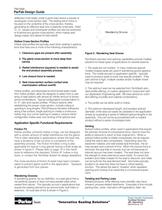
deflected more easily under a given load versus a square orrectangular cross-section seal. The sealing return force is focused on the centerline of the cross-section, therebygenerating an effective seal over a relatively small area. SolidO-, D-, square and rectangular profiles can also be produced to fit almost any groove cross-section, which makes sealdesign easier, and allows for field retrofit. Figure 5 - Wandering Seal Groove Hollow Cross-Section Profiles TechSeals extrusion and splicing capabilities provide multiplesolutions for these types of applications for several reasons: Hollow seal...

 Open the catalog to page 7

Archived catalogs

  1. Metal Seals

    16  Pages

*Prices are pre-tax. They exclude delivery charges and customs duties and do not include additional charges for installation or activation options. Prices are indicative only and may vary by country, with changes to the cost of raw materials and exchange rates.