
- Catalogs
- Parker bioscience and water filtration division
- Glas-Tech II Mini-Capsules

Glas-Tech II Mini-Capsules

Glas-Tech II Mini-Capsules
- High flow rate and long service life reduce processing time and change-out frequency.
- Natural positive charge improves particle retention.
- Thermally bonded construction minimizes extractables for cleaner filtrates.
- Filter Media: Borosilicate Microfibers
- Media Binder: Acrylic
- Support Layers: Polyester
- Structure: Polypropylene
- Nominal Filter Ratings: 0.25, 0.5, 1, 3, 5 micron
- Maximum Differential Pressure/Temperature: Forward: 70 psid (4.8 bar) @ 75°F (24°C); Reverse: 30 psid (2.1 bar) @ 75°F (24°C), 15 psid (1.0 bar) @ 140°F (60°C)
- Maximum Operating Temperature: 160°F (71°C)
- Autoclavable and sanitizable at 266°F (130°C)
- Biological Safety: Meets USP Class VI – 121°C biological tests for plastics
Catalog excerpts

Encapsulated Filters with Pleated Glass Fiber Media for Small Volume Pre-Filtration Applications Glas-Tech II Mini-Capsules feature a borosilicate microfiber depth media that has an exceptionally high dirt- loading capacity. The natural, positive charge of the glass fiber also aids in the retention of negatively charged particulates such as bacteria, endotoxin, and a variety of colloidal The encapsulated design maximizes efficiency by providing faster, easier change-out without laborious cleaning procedures. Eliminating the need to open reusable housings for cartridge replacement minimizes the chance of introducing contamination into the process and promotes safety by reducing the risk of exposure to potentially hazardous fluids. Glas-Tech Mini-Capsules are available in a variety of sizes and end fitting Parker Hannifin Corporation Process Advanced Filtration Division Contact Information: Benefits • High flow rate/long service life reduces processing time • Long service life minimizes change-out frequency • Natural positive charge enhances particle retention • Thermally bonded construction minimizes extractables for cleaner • Tissue Culture Media • Highly Viscous Solutions • Cutting Oils ENGINEERING YOUR SUCCESS.
Open the catalog to page 1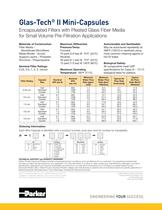
Encapsulated Filters with Pleated Glass Fiber Media for Small Volume Pre-Filtration Applications Filter Media - Borosilicate Microfibers Media Binder - Acrylic Support Layers - Polyester Structure - Polypropylene Nominal Filter Ratings: Maximum Differential Maximum Operating most common cleaning agents or Biological Safety: biological tests for plastics. Ordering Information Each Mini-Capsule is identified with a product numPer, pore size, and lot numPer for traceaPility. TECHNICAL SUPPORT and PRODUCT ORDERING Parker Process Advanced Filtration provides unsurpassed product consistency and cost-efficiency...
Open the catalog to page 2All Parker bioscience and water filtration division catalogs and technical brochures
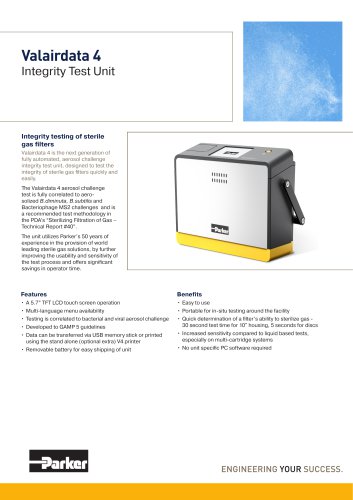 BULBEFEVALAIRDATA4-EN
2 Pages
Archived catalogs
 Glas-Tech II Mini-Cartridges
2 Pages
 Fulflo SWC Filter Cartridges
2 Pages
 Fulflo NP Filter Housing
2 Pages
 Fulflo Metallic
2 Pages
 Fulflo MegaBond Plus
2 Pages
 Fulflo DuraBond Cartridges
2 Pages
 Fulflo Abso-Mate Cartridges
2 Pages
 Fluoroflow Filter Cartridges
2 Pages
 Fluorocap-XF Filter Capsules
2 Pages
 Claripor Filter Cartridges
2 Pages
 Clariflow-E Mini-Cartridges
2 Pages
 Clariflow-E Mini-Capsules
2 Pages
 Avasan Filter Cartridges
2 Pages
 ZVP housing
1 Page
 Housings - Fulflo LT Series
2 Pages
 Municipal Filtration Systems
4 Pages
 Bottled water industry
5 Pages


- Electrical cable
- Temperature probe
- Liquid filter
- Resistance temperature sensor
- Filter with cartridge
- Filter cartridge
- Industrial use filter
- Electrical data cable
- Pressure separator filter
- Pressure probe
- Volumetric dosing unit
- Stainless steel pre-filter
- Waterproof temperature sensor
- Industrial filter cartridge
- Liquids dispensing system
- Fine filter cartridge
- Water pre-filter
- Filtration unit
- Filter housing
- Leak tester