
- Catalogs
- Panasonic Robot & Welding system solutions
- TAWERS Integrated Robot Welding System


- Company
- Products
- Catalogs
- News & Trends
- Exhibitions
TAWERS Integrated Robot Welding System

TAWERS Integrated Robot Welding System
Panasonic has been a leader in welding technology for over 60 years, specializing in laser, MIG, MAG, and TIG welding for both robotic and manual applications. The European headquarters in Neuss, Germany, coordinates sales and engineering across Europe.
Products & Services
Panasonic offers turnkey automated welding systems, including robots, power sources, and torches, ensuring seamless integration. The TAWERS system is a key product, integrating robot control with welding power source control for enhanced performance.
TAWERS System Overview
The TAWERS system integrates robot, controller, power source, and wire feed into a single unit, offering high-speed communication and eliminating delays. Key features include SP-MAG, lift start/end, automatic wire control, and collision detection.
Advantages of TAWERS
- User-friendly handling and reduced spatter welding.
- Easy parameter setup with Weld Navigator.
- Reduced heat input and prevention of re-work.
- Capability for both thin and thick plate welding with one power source.
Innovative Welding Processes
- SP-MAG Process: Reduces spatter through waveform superimposition and constriction control.
- HD Pulse Process: Offers better penetration and quality at higher speeds with reduced notch effects.
- Active Wire Process (AWP): Provides stable short arc cycles and significant spatter reduction.
- Super Active Wire Process (S-AWP): Enhances welding speed and reduces spatter with precise wire feed control.
Specialized Processes
- Active Aluminum Process: Ensures good seam appearance and spatter reduction for aluminum welding.
- Zi-Tech Software: Allows low-spatter welding of zinc galvanized components with HD Pulse and Active Wire Process options.
Conclusion
Panasonic's TAWERS system and its associated processes offer significant advancements in welding technology, providing high-quality, efficient, and flexible solutions for various industrial applications.
Introduction to TAWERS TIG Welding
TAWERS TIG is part of the TAWERS solution, allowing TIG welding with the same robot and power source by switching components. It offers unique properties that enhance the welding process.
Compact Gas Nozzle
The TAWERS TIG welding torch is compact, even with wire feeding hardware, enabling use in narrow spaces and offering design flexibility for clamping jigs.
High-Speed TIG Welding
TAWERS TIG increases TIG welding speed and accessibility. The torch feeds filler wire at a steeper angle, inducing a shunt current that preheats the wire, increasing deposition rate and welding speed.
HF TIG Process Option
Suitable for stainless steel sheets under 2 mm, offering three times the speed of conventional TIG welding.
Optional Software Features
- Welding Data Management: Monitors compliance with set limits, records parameters, and stores data for analysis.
- TAWERS Spiral Weave Function: Ideal for aluminum MIG welding, synchronizing parameters for varying plate thicknesses.
Automatic Distance Control
Features auto-extension for programming uneven workpieces and compensating for heat distortion.
Cooperative Multi-Robot Control
Enables communication and synchronized movement between multiple robots.
Arc Sensor System
Measures changes in welding current during weave welding to maintain correct parameters.
Contact Sensor System
Detects and corrects deviations between programmed and actual welding start points.
Optional Hardware and Software
Available for both MIG/MAG and TIG processes.
Catalog excerpts

SIMPLY WELDING. INTEGRATED ROBOT WELDING SYSTEM
Open the catalog to page 1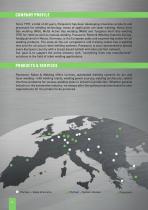
COMPANY PROFILE Since 1957, a total of 60 years, Panasonic has been developing innovative products and processes for welding technology. Areas of application are laser welding, Metal Inert Gas welding (MIG), Metal Active Gas welding (MAG) and Tungsten Inert Gas welding (TIG) for robot as well as manual welding. Panasonic Robot & Welding Systems Europe, headquartered in Neuss, Germany, is the European sales and engineering center for all welding products. The state-of-the-art competence and training center has a welding test area for all actual robot welding systems. Panasonic is also represented...
Open the catalog to page 2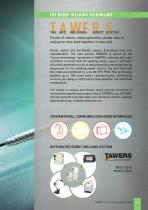
THE ROBOT WELDING TECHNOLOGY ROBOT SYSTEM Fusion of robots, robot controller, power source and servo wire feed together in one unit. Faster, better and worldwide unique. Everything from one manufacturer. The idea behind TAWERS is based on the “fusion technology” contained in TAWERS, whereby the robot controller is fused with the welding power source controller. All control parameters such as data processing and programming sequences for the welding power source, the wire feed and the robot are combined on a 64-bit CPU PCB. This technology enables up to 250 times faster communication, eliminating...
Open the catalog to page 3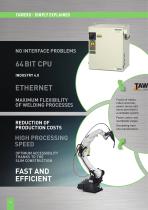
TAWERS - SIMPLY EXPLAINED ETHERNET MAXIMUM FLEXIBILITY OF WELDING PROCESSES REDUCTION OF PRODUCTION COSTS HIGH PROCESSING SPEED OPTIMUM ACCESSIBILITY THANKS TO THE SLIM CONSTRUCTION Fusion of robots, robot controller, power source and servo wire feed to a complete system. Faster, better and worldwide unique. Everything from one manufacturer.
Open the catalog to page 4
YOUR ADVANTAGES USER-FRIENDLY HANDLING WELD DATA MONITORING AND RECORDING EASY CREATION OF WELDING PARAMETERS THROUGH WELD NAVIGATOR TAWERS 100 KHZ INVERTER TECHNOLOGY SPATTER REDUCED WELDING HEAT INPUT REDUCED WELDING THIN AND THICK PLATE WELDING WITH ONE POWER SOURCE TAWERS – The Arc Welding Robot System
Open the catalog to page 5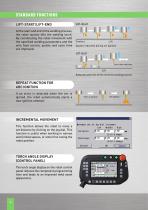
STANDARD FUNCTIONS LIFT-START/LIFT-END At the start and end of the welding process, the robot quickly lifts the welding torch. By coordinating the robot movement with the specified welding parameters and the wire feed control, quality and cycle time are improved. Spatter reduction during arc ignition Cycle time reduction Lift Reduced cycle time at the end of the welding process REPEAT FUNCTION FOR ARC IGNITION If an error is detected when the arc is ignited, the robot automatically starts a new ignition attempt. INCREMENTAL MOVEMENT This function allows the robot to move a set distance by clicking...
Open the catalog to page 6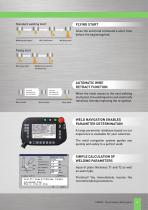
Standard welding start FLYING START Gives the start/end command a short time before the beginning/end. Welding start point Wire feed start Welding start Flying start Wire feed start Welding start point / welding start AUTOMATIC WIRE RETRACT FUNCTION Forward movement to the next point Forward movement to the next point Wire retract Next weld When the robot moves to the next welding start point, the welding wire is automatically retracted, thereby improving the re-ignition. WELD NAVIGATION ENABLES PARAMETER DETERMINATION A large parameter database based on our experience is available for your selection....
Open the catalog to page 7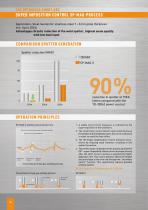
SUPER IMPOSITION CONTROL SP-MAG-PROCESS Application: Steel /austenitic stainless steel 1 – 2 mm plate thickness Arc: Up to 200 A Advantages: Drastic reduction of the weld spatter, highest seam quality with low heat input COMPARISON SPATTER GENERATION Spatter reduction (MAG) 350GB2 100 reduction in spatter at 150 A (when compared with the YD-35062 power source) OPERATION PRINCIPLES SP-MAG II welding characteristic line 1. A stable short-circuit sequence is achieved by the superimposition of the waveform. Short circuit cycle (conventional mixed gas welding) 2. The constriction control detects neck...
Open the catalog to page 8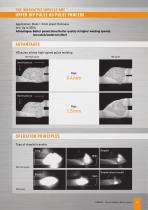
HYPER DIP PULSE HD PULSE PROCESS Application: Steel > 3 mm sheet thickness Arc: Up to 350 A Advantages: Better penetration/better quality at higher welding speeds, low notch/undercut effect ADVANTAGES HD pulse allows high-speed pulse welding Normal pulse OPERATION PRINCIPLES Type of droplet transfer Droplet Long Wide Normal pulse Droplet (short circuit) Slim TAWERS – The Arc Welding Robot Sys
Open the catalog to page 9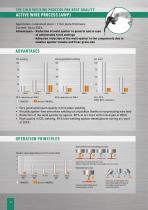
THE COLD WELDING PROCESS FOR BEST QUALIT Y ACTIVE WIRE PROCESS (AWP) Application: (stainless) steel < 2 mm plate thickness Current: Up to 200 A Advantages: · Reduction of weld spatter in general and in case of unfavorable torch settings · Adhesion reduction of the weld spatter to the components due to smaller spatter volume and finer grain size Active TAWERS Very good weld seam quality in thin plate welding Virtually spatter-free even when welding out of position thanks to reciprocating wire feed Reduction of the weld spatter by approx. 80 % at arc start with mixed gas at 200 A High quality in...
Open the catalog to page 10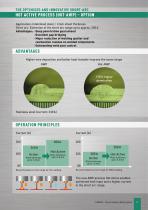
THE OPTIMISED AND INNOVATIVE SHORT-ARC HOT ACTIVE PROCESS (HOT-AWP) – OPTION Application: (stainless) steel < 3 mm sheet thickness Short arc: Extension of the short arc range up to approx. 250 A Advantages: · Deep penetration guaranteed · Excellent gap bridging · Major reduction of welding spatter and combustion residue on welded components · Outstanding weld pool control ADVANTAGES Higher wire deposition and better heat transfer improve the seam shape AWP Stainless steel (current: 230 A) OPERATION PRINCIPLES Current (A) Active Plate thickness up to 3.2 mm Hot Active Plate thickness up to 6.0 mm...
Open the catalog to page 11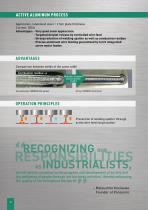
ACTIVE ALUMINUM PROCESS Application: (stainless) steel < 2 mm plate thickness Current: 200 A Advantages: · Very good seam appearance · Targeted droplet release by controlled wire feed · Strong reduction of welding spatter as well as combustion residue · Precise aluminum wire feeding guaranteed by torch integrated servo motor feeder ADVANTAGES Comparison between welds of the same width Combustion residue > Spatter > Conventional TAWERS (DC pulse) Reduction of spatter and combustion residue Active TAWERS Aluminum OPERATION PRINCIPLES Prevention of welding spatter through active wire feed reciprocation...
Open the catalog to page 12All Panasonic Robot & Welding system solutions catalogs and technical brochures
 Multi-Purpose Robot LA-1800
4 Pages
 POSITIONERS & PERIPHERALS
2 Pages
 PC-Software DTPS
10 Pages
 PerformArc Welding Systems
12 Pages
 Robot Welding Torches
2 Pages
 Wire Booster
2 Pages


Archived catalogs
 POSCAP
40 Pages
 Power Choke Coil
19 Pages
 Electric Double Layer Capacitors
12 Pages
 PAN1326C2
1 Page
 Panasonic Torches
2 Pages
 PAN1326 Design Guide
22 Pages
 PAN9026
82 Pages
 PAN1326C
40 Pages
 PAN9420 Command Specification
95 Pages
 PAN1762
17 Pages
 Drive systems Catalogue 2019
12 Pages
 Wireless Connectivity 2019
2 Pages
 PAN1326C2 2019
48 Pages
 802.15.4-Modem PAN4580
2 Pages
 EMERGENCY LIGHTING
2 Pages
 EUROPEAN E-CALL
2 Pages
 PAN1761
2 Pages
 PAN1740
41 Pages
 PAN1760A
2 Pages
 SOFT PYROLYTIC GRAPHITE
2 Pages
 WEARABLES LI-ION PIN-TYPE
2 Pages
 SMD Lytic Capacitor V Chip
2 Pages
 E-Bike Systems
12 Pages
 WIRELESS CONNECTIVITY
2 Pages
 Pin-type Li-ion batteries
2 Pages
 Batteries Short-Form-Catalog
52 Pages
 Microcomputer
24 Pages
 YD-350GB2
2 Pages
 TAWERS Hyper Dip Pulse
2 Pages
 SP-MAG Process
2 Pages
 PerformArc Automotive
1 Page
 TIG Filler System
1 Page
 PerformArc C Series
1 Page
 PerformArc TT Series
1 Page
 PerformArc MT Series
1 Page
 PerformArc ET Series
1 Page
 TAWERS Zi-Tech Process
2 Pages
 Handling Robots YS080G3
2 Pages
 Handling robots HS-G3 Series
4 Pages
 Welding Systems Solutions
12 Pages
 Welding Robots G3 Series
6 Pages
 Panasonic G3 Welding Robots
6 Pages
 TAWERS WG3 Series
12 Pages
 WG3 Welding Robots
12 Pages
 G3 Robot Controller
1 Page
 Panasonic Positioner
4 Pages
 TAIWERS-Welding Solution
12 Pages
 Handling Robots
2 Pages
 Positioners
4 Pages
 Welding Power Sources
2 Pages
 DTPS-G3
4 Pages
 DTPS G3-Software
4 Pages
 Panasonic Eco ideas
2 Pages


- Welding system
- Panasonic industrial robot
- Automation software solution
- Management software solution
- Analysis software solution
- Automatic welding machine
- Real-time software
- Panasonic articulated robot
- Control software
- Servo-motor
- Panasonic 6-axis robot
- Monitoring software solution
- Handling robot
- Floor-mounted robot
- 3D software solution
- Inspection system
- Visualization software solution
- Simulation software solution
- AC servo-motor
- Metal welding machine