
- Catalogs
- Panasonic Robot & Welding system solutions
- SP-MAG Process


- Company
- Products
- Catalogs
- News & Trends
- Exhibitions
SP-MAG Process

SP-MAG Process
The TAWERS welding platform utilizes a 100kHz super high frequency primary side inverter, enabling a precise welding arc control cycle of 10 micro-seconds. This allows real-time control of the welding waveform, particularly beneficial for the SP-MAG (Super-Imposition Metal Active Gas) welding process, which is ideal for thin material mild steel welding (1mm to 2mm). The process is characterized by advanced weld spatter control, fast travel speeds, and a wide process window.
The SP-MAG process significantly reduces spatter by up to 90% due to the high processing speed enabled by the 100kHz inverter. This reduction decreases overall welding costs by increasing deposition rates and reducing post-weld cleanup. The process also minimizes the size of the spatter, reducing the likelihood of it sticking.
By controlling the waveform with the TAWERS' secondary switching circuit, the arc operates at lower voltages (1-2 volts lower than conventional systems), allowing for faster processing speeds (benchmarked at 1m/min) and maintaining bead quality with low spatter output.
The ability to run at lower arc voltages reduces total heat input, preventing burn-through and allowing welding with gaps. The TAWERS system also allows mode switching during welding, providing flexibility for various applications.
The SP-MAG waveform is designed to reduce arc volatility by using advanced hardware and software to monitor and control amperage and voltage feedback. Key controls include Initial Short Control, Neck Control, SP Control, and HS (Hyper Stability) Control, each contributing to minimizing spatter and stabilizing the arc.
YAHATA SEIKO in Osaka, Japan, uses TAWERS for welding mild steel of varying thicknesses. The system's ability to handle different thicknesses without performance compromise and its stable arc with minimal spatter generation are highlighted benefits. The latest installation includes a Hi-Power TAWERS (450A version) for thicker jobs, with flexibility to use SP-MAG for thinner materials.
Catalog excerpts
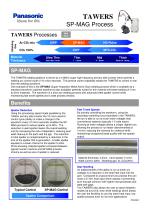
TAWERS SP-MAG Process Shielding Gas Mild Steel Material Thickness Ultra Thin SP-MAG The TAWERS welding platform is driven by a 100kHz super high frequency primary side inverter which permits a welding arc control cycle of 10 micro-seconds. This precise control capability allows the TAWERS to control in real time the welding waveform. One example of this is the SP-MAG (Super-Imposition Metal Active Gas) welding process which is available as a standard waveform (optional waveforms also available) perfectly suited for thin material mild steel welding of 1mm to 2mm materials. The waveform is a short arc welding process with advanced weld spatter control while maintaining fast travel speeds and a wide process window. Benefits Spatter Reduction Using the processing speed made possible by the 100kHz primary side inverter the 10 micro second control cycle (ability to make a change to the waveform every 10 micro seconds) enables the SPMAG process to reduce spatter up to 90%. The reduction in weld spatter lowers the overall welding cost by increasing the rate of deposition, reducing post weld cleanup to the parts and the jigs. The reduction in total spatter is complimented by a reduction in the size of the spatter that is generated – smaller spatter equates to a lower chance for the spatter to stick. Photo showing collected spatter compared between typical inverter machine and SP-MAG process. Volume as well as size of spatter is reduced. Fast Travel Speeds By actively controlling the waveform, using the secondary switching circuit standard in the TAWERS, the arc is able to run at much lower voltages than conventional systems (typically 1-2 volts lower). Running at lower voltages allows a crisper (tighter) arc allowing the process to run faster (benchmarked at 1m/min, reducing the chances for undercut while maintaining exceptional bead quality with low spatter output. Material thickness: 2.3mm, travel speed: 1m/min Weld current: 220A, Shielding gas: Ar+CO2(20%) Typical Control SP-MAG Control Spatter Comparison Gap Handling An added benefit of the ability to run at lower arc voltages is a reduction in the total heat input into the part. Compared to a typical short arc process this can mean a 5-10% heat input which assists in preventing burn through common with higher heat processes and weld with gaps. The TAWERS also allows the user to switch between modes (at any time, even while welding) which allows the user the flexibility to use this lower heat input, low spatter process even for non-thin applications. P0003EF
Open the catalog to page 1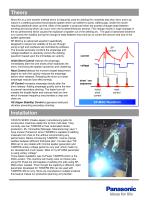
Theory Short-Arc is a wire transfer method which is frequently used for welding thin materials less than 3mm and is by nature is a welding process that produces spatter which can adhere to parts, welding jigs, inside the nozzle requiring additional clean up time. Most of the spatter is produced when the process changes state between shorting and arcing which can occur over one hundred times per second. This change results in huge changes in the arc phenomena which causes the explosion of spatter out of the welding arc. The goal of advanced waveform is to control the volatility during the change...
Open the catalog to page 2All Panasonic Robot & Welding system solutions catalogs and technical brochures
 Multi-Purpose Robot LA-1800
4 Pages
 POSITIONERS & PERIPHERALS
2 Pages
 PC-Software DTPS
10 Pages
 PerformArc Welding Systems
12 Pages
 Robot Welding Torches
2 Pages
 Wire Booster
2 Pages


Archived catalogs
 POSCAP
40 Pages
 Power Choke Coil
19 Pages
 Electric Double Layer Capacitors
12 Pages
 PAN1326C2
1 Page
 Panasonic Torches
2 Pages
 PAN1326 Design Guide
22 Pages
 PAN9026
82 Pages
 PAN1326C
40 Pages
 PAN9420 Command Specification
95 Pages
 PAN1762
17 Pages
 Drive systems Catalogue 2019
12 Pages
 Wireless Connectivity 2019
2 Pages
 PAN1326C2 2019
48 Pages
 802.15.4-Modem PAN4580
2 Pages
 EMERGENCY LIGHTING
2 Pages
 EUROPEAN E-CALL
2 Pages
 PAN1761
2 Pages
 PAN1740
41 Pages
 PAN1760A
2 Pages
 SOFT PYROLYTIC GRAPHITE
2 Pages
 WEARABLES LI-ION PIN-TYPE
2 Pages
 SMD Lytic Capacitor V Chip
2 Pages
 E-Bike Systems
12 Pages
 WIRELESS CONNECTIVITY
2 Pages
 Pin-type Li-ion batteries
2 Pages
 Batteries Short-Form-Catalog
52 Pages
 Microcomputer
24 Pages
 YD-350GB2
2 Pages
 TAWERS Hyper Dip Pulse
2 Pages
 PerformArc Automotive
1 Page
 TIG Filler System
1 Page
 PerformArc C Series
1 Page
 PerformArc TT Series
1 Page
 PerformArc MT Series
1 Page
 PerformArc ET Series
1 Page
 TAWERS Zi-Tech Process
2 Pages
 Handling Robots YS080G3
2 Pages
 Handling robots HS-G3 Series
4 Pages
 Welding Systems Solutions
12 Pages
 Welding Robots G3 Series
6 Pages
 Panasonic G3 Welding Robots
6 Pages
 TAWERS WG3 Series
12 Pages
 WG3 Welding Robots
12 Pages
 G3 Robot Controller
1 Page
 Panasonic Positioner
4 Pages
 TAIWERS-Welding Solution
12 Pages
 Handling Robots
2 Pages
 Positioners
4 Pages
 Welding Power Sources
2 Pages
 DTPS-G3
4 Pages
 DTPS G3-Software
4 Pages
 Panasonic Eco ideas
2 Pages


- Welding system
- Panasonic industrial robot
- Automation software solution
- Management software solution
- Analysis software solution
- Automatic welding machine
- Real-time software
- Panasonic articulated robot
- Control software
- Servo-motor
- Panasonic 6-axis robot
- Monitoring software solution
- Handling robot
- Floor-mounted robot
- 3D software solution
- Inspection system
- Visualization software solution
- Simulation software solution
- AC servo-motor
- Metal welding machine