


- Company
- Products
- Catalogs
- News & Trends
- Exhibitions
PAN1326C

PAN1326C
The Panasonic PAN1326C is a compact Bluetooth RF module featuring Texas Instrument's CC2564C core, compliant with Bluetooth 4.2. It offers superior RF performance with an extended range and is designed for easy integration with a PCB pad pitch of 1.3 mm.
- Bluetooth 4.2 compliance up to the HCI layer
- Exceptional Bluetooth RF performance
- Compact dimensions: 9.0 mm x 9.5 mm x 1.8 mm
- Interfaces include UART, GPIO, and PCM
- Receiver sensitivity: -93 dBm
- Output power: 11.5 dBm
- Power supply range: 1.7 to 4.8 V
- Power consumption: Tx 40 mA, Rx 20 mA, Sleep mode 135 µA
- Operating temperature: -45 ºC to +85 ºC
Includes a Texas Instruments CC256x BT-HCI Chip, UART, GPIOs, Audio PCM/I2C, Reset, 32 kHz input, Vcc 3.3 V, LPF, and a Crystal 26 MHz.
Features various pins for ground, UART communication, PCM audio, and power supply, including HCI_RX, HCI_TX, HCI_RTS, and HCI_CTS.
- Default Test Conditions
- Absolute Maximum Ratings
- Recommended Operating Conditions
- Current Consumption
- nSHUTD Requirements
- External Digital Slow Clock Requirements
- Bluetooth Reliability Tests
- Recommended Soldering Profile
- Design, Installation, and Usage Condition Notes
- Storage and Safety Cautions
- Bluetooth Declaration
- Life Support Policy
- Ordering Information
- Contact Details
The module requires two power sources and supports three power supply configurations. It includes on-chip voltage regulators and can connect directly to a battery or an external converter.
An external slow clock is required to start the internal controller. The module supports Bluetooth 4.2 features and uses a UART module with a maximum baud rate of 4 Mbps.
Includes a codec interface supporting PCM and I2S formats, with configurable data formats and clock-edge operations.
The modules have specific dimensions and tolerances, with a symmetric footprint layout. Packaging ensures minimal empty spaces and proper cover tape placement.
Optimal RF performance requires avoiding storage in environments with corrosive gases, direct sunlight, or extreme temperatures and humidity. Products should not be stored for more than one year.
Specifications ensure product quality, and users must evaluate product operation in their systems. Failsafe functions are recommended to prevent unsafe conditions.
Products should not be used for unintended purposes and must include fail-safe functions. They are not designed for environments with liquids, direct sunlight, dust, condensation, or harmful gases.
The module has specific QDID numbers for different components, verifiable on the Bluetooth Launch Studio website.
This product is not intended for life support systems where failure could result in injury.
Catalog excerpts
PAN1326C Bluetooth Basic Data Rate and Low Energy Module
Open the catalog to page 1
Parasonic PAN1326C Bluetooth Module Overview Panasonic's new PAN1326C is a Host Controlled Interface (HCI) Bluetooth RF module that brings Texas Instrument's seventh generation Bluetooth core integrated circuit, the CC2564C, to an easy-to-use module format. The PAN1326C is Bluetooth-4.2-compliant and it offers best-in-class RF performance with about twice the range of other Bluetooth Low Energy solutions. Panasonic's tiny footprint technology has produced a module of only 85.5 mm2. The module is designed to accommodate PCBs pad pitch of 1.3 mm and as few as two layers for easy implementation...
Open the catalog to page 2
By purchase of any of the products described in this document the customer accepts the document's validity and declares their agreement and understanding of its contents and recommendations. Panasonic reserves the right to make changes as required at any time without notification. Please consult the most recently issued Product Specification before initiating or completing a design. © Panasonic Industrial Devices Europe GmbH 2017. This specification sheet is copyrighted. Reproduction of this document is permissible only if reproduction is without alteration and is accompanied by all associated...
Open the catalog to page 3
Parasonic PAN1326C Bluetooth Module Product Specification Rev. 1.1 Page 4
Open the catalog to page 4
Parasonic PAN1326C Bluetooth Module 1 About This Document 1.1 Purpose and Audience This Product Specification provides details on the functional, operational, and electrical characteristics of the Panasonic PAN1326C module. It is intended for hardware design, application, and Original Equipment Manufacturer (OEM) engineers. The product is referred to as “the PAN1326C” or “the module” within this document. Please refer to the Panasonic website for related documents ^ 6.2.2 Product Information. Product Specification Rev. 1.1 Page 5
Open the catalog to page 5
PAN1326C Bluetooth Module 2 Overview 2 Overview Panasonic’s new PAN1326C is a Host Controlled Interface (HCI) Bluetooth RF module that brings Texas Instrument’s seventh generation Bluetooth core integrated circuit, the CC2564, to an easy-to-use module format. The PAN1326C is Bluetooth-4.2-compliant and it offers best-inclass RF performance with about twice the range of other Bluetooth Low Energy solutions. Panasonic’s tiny footprint technology has produced a module of only 85.5 mm². The module is designed to accommodate PCBs pad pitch of 1.3 mm and as few as two layers for easy implementation...
Open the catalog to page 6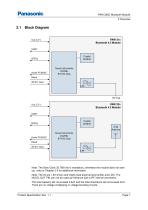
Parasonic PAN1326C Bluetooth Module PAN131x Bluetooth 4.2 Module UART ◄- Texas Instruments CC256x BT-HCI Chip PAN132x Bluetooth 4.2 Module UART ◄-► Chip Antenna Texas Instruments CC256x BT-HCI Chip Note: The Slow Clock 32.768 kHz is mandatory, otherwise the module does not start up, refer to Chapter 2.4 for additional information. Note: The IO are 1.8V driven and might need external level shifter and LDO. The MLDO_OUT PIN can not be used as reference due to RF internal connection. The total capacity will not exceed 2.8uF and the total inductance will not exceed 0nH. There are no voltage multiplying...
Open the catalog to page 7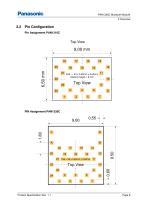
PAN1326C Bluetooth Module 2 Overview
Open the catalog to page 8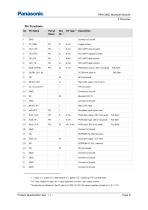
Parasonic PAN1326C Bluetooth Module Product Specification Rev. 1.1 Page 9 I = input; O = output; IO = bidirectional; P = power; PU = pulled up; PD = pulled down I/O Type: Digital I/O cells. HY = input hysteresis, current = typ. output current No signals are allowed on the IO pins if no VDD_IO (Pin 22) power supplied, except pin 7, 8, 17-19.
Open the catalog to page 9
Parasonic PAN1326C Bluetooth Module For RF conducted measurements either use the PAN1323ETU or de-solder the antenna and solder an antenna connector to the hot pin. HCI_CTS is an input signal to the CC2564C device: • When HCI_CTS is low, then CC2564C is allowed to send data to Host device. • When HCI_CTS is high, then CC2564C is not allowed to send data to Host device. 4 ESD: Human Body Model (HBM). JEDEC 22-A114 5 I = input; O = output; IO = bidirectional; P = power; PU = pulled up; PD = pulled down 6 I/O Type: Digital I/O cells. HY = input hysteresis, current = typ output current Product Specification...
Open the catalog to page 10
PAN1326C Bluetooth Module 2 Overview Device Power Supply The PAN13x6C Bluetooth radio solution is intended to work in devices with a limited power budget such as cellular phones, headsets, hand-held PC’s and other battery-operated devices. One of the main differentiators of the PAN13x6C is its power management – its ability to draw as little current as possible. The PAN13x6C device requires two kinds of power sources: 1. Main power supply for the Bluetooth - VDD_IN = VBAT 2. Power source for the 1.8 V I/O ring - VDD_IO The PAN13x6C includes several on-chip voltage regulators for increased noise...
Open the catalog to page 11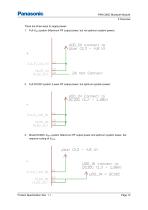
Parasonic PAN1326C Bluetooth Module There are three ways to supply power: 1. Full-VBAT system (Maximum RF output power, but not optimum system power): ^JDD_IN connect to JJbat <2.2 - 4.8 U) ril_DO_IN MLDCLOUT _Po Not Connect 2. Full-DC2DC system (Lower RF output power, but optimum system power): 3. Mixed DC2DC-VBAT system (Maximum RF output power and optimum system power, but requires routing of VBAT): Product Specification Rev. 1.1 Page 12
Open the catalog to page 12
Parasonic PAN1326C Bluetooth Module 2.4 Clock Inputs The slow clock is always supplied from an external source. It is connected to the SLOW_CLK_IN pin number 8 and can be a digital signal with peak to peak of 0-1.8 V. The slow clock's frequency accuracy must be 32.768 kHz r250 ppm for Bluetooth usage (according to the Bluetooth specification). The Slow Clock 32.768 kHz is mandatory to start the internal controller; otherwise the module does not start up. 2.5 Bluetooth Features • Bluetooth-4.2-compliant up to the HCI layer • Up to seven active devices • Scatternet: up to three piconets simultaneously,...
Open the catalog to page 13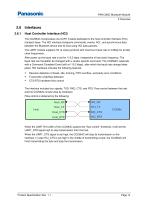
PAN1326C Bluetooth Module 2 Overview Interfaces Host Controller Interface (HCI) The CC2564C incorporates one UART module dedicated to the host controller interface (HCI) transport layer. The HCI interface transports commands, events, ACL, and synchronous data between the Bluetooth device and its host using HCI data packets. The UART module supports H4 (4-wires) protocol with maximum baud rate of 4 Mbps for all fast clock frequencies. After power up the baud rate is set for 115.2 kbps, irrespective of fast clock frequency. The baud rate can thereafter be changed with a vendor specific command....
Open the catalog to page 14All Panasonic Robot & Welding system solutions catalogs and technical brochures
 Multi-Purpose Robot LA-1800
4 Pages
 POSITIONERS & PERIPHERALS
2 Pages
 PC-Software DTPS
10 Pages
 PerformArc Welding Systems
12 Pages
 Robot Welding Torches
2 Pages
 Wire Booster
2 Pages


Archived catalogs
 POSCAP
40 Pages
 Power Choke Coil
19 Pages
 Electric Double Layer Capacitors
12 Pages
 PAN1326C2
1 Page
 Panasonic Torches
2 Pages
 PAN1326 Design Guide
22 Pages
 PAN9026
82 Pages
 PAN9420 Command Specification
95 Pages
 PAN1762
17 Pages
 Drive systems Catalogue 2019
12 Pages
 Wireless Connectivity 2019
2 Pages
 PAN1326C2 2019
48 Pages
 802.15.4-Modem PAN4580
2 Pages
 EMERGENCY LIGHTING
2 Pages
 EUROPEAN E-CALL
2 Pages
 PAN1761
2 Pages
 PAN1740
41 Pages
 PAN1760A
2 Pages
 SOFT PYROLYTIC GRAPHITE
2 Pages
 WEARABLES LI-ION PIN-TYPE
2 Pages
 SMD Lytic Capacitor V Chip
2 Pages
 E-Bike Systems
12 Pages
 WIRELESS CONNECTIVITY
2 Pages
 Pin-type Li-ion batteries
2 Pages
 Batteries Short-Form-Catalog
52 Pages
 Microcomputer
24 Pages
 YD-350GB2
2 Pages
 TAWERS Hyper Dip Pulse
2 Pages
 SP-MAG Process
2 Pages
 PerformArc Automotive
1 Page
 TIG Filler System
1 Page
 PerformArc C Series
1 Page
 PerformArc TT Series
1 Page
 PerformArc MT Series
1 Page
 PerformArc ET Series
1 Page
 TAWERS Zi-Tech Process
2 Pages
 Handling Robots YS080G3
2 Pages
 Handling robots HS-G3 Series
4 Pages
 Welding Systems Solutions
12 Pages
 Welding Robots G3 Series
6 Pages
 Panasonic G3 Welding Robots
6 Pages
 TAWERS WG3 Series
12 Pages
 WG3 Welding Robots
12 Pages
 G3 Robot Controller
1 Page
 Panasonic Positioner
4 Pages
 TAIWERS-Welding Solution
12 Pages
 Handling Robots
2 Pages
 Positioners
4 Pages
 Welding Power Sources
2 Pages
 DTPS-G3
4 Pages
 DTPS G3-Software
4 Pages
 Panasonic Eco ideas
2 Pages


- Welding system
- Panasonic industrial robot
- Automation software solution
- Management software solution
- Analysis software solution
- Automatic welding machine
- Real-time software
- Panasonic articulated robot
- Control software
- Panasonic 6-axis robot
- Servo-motor
- Monitoring software solution
- Handling robot
- Floor-mounted robot
- 3D software solution
- Inspection system
- Visualization software solution
- Simulation software solution
- Metal welding machine
- AC servo-motor