
- Catalogs
- Panasonic Industry Europe GmbH
- Batteries Panasonic Lithium


- Products
- Catalogs
- News & Trends
- Exhibitions
Batteries Panasonic Lithium

Batteries Panasonic Lithium
Panasonic is a leading global battery manufacturer, offering a wide range of power solutions for both portable and stationary applications. Their products include Lithium-Ion, Nickel-Metal Hydride, and Nickel-Cadmium batteries. All manufacturing processes comply with ISO 9000 and ISO 14000 standards.
Panasonic provides tools such as a Mediapool for battery images and videos, a Battery Finder application, and technical white papers to assist customers in selecting and applying Panasonic batteries effectively.
Handling lithium batteries requires caution. Key precautions include avoiding charging, short-circuiting, disassembling, or exposing batteries to heat. Proper disposal involves insulating terminals to prevent short circuits, and batteries should be kept out of children's reach.
Panasonic has been producing lithium batteries since 1971, offering various shapes and sizes. Known for high energy density and voltage, these batteries are suitable for miniaturized applications and are UL safety approved.
The document compares different lithium chemistries, such as Poly-carbonmonofluoride (BR series) and Manganese Dioxide (CR series), highlighting their voltage, discharge capacity, and reliability. Available in cylindrical, coin, and pin types, they come in both primary (non-rechargeable) and secondary (rechargeable) options.
Lithium batteries offer high voltage, energy density, low self-discharge rates, and superior storability. They maintain significant capacity even after long-term storage, making them ideal for various applications.
The open circuit voltage (OCV) vs. depth-of-discharge (DoD) curve for lithium batteries is relatively flat between 5-85% DoD, making it difficult to determine remaining capacity from OCV readings.
Models like BR-2/3A and BR-2325 demonstrate stable voltage maintenance over extended periods under low-load conditions across various temperatures.
Rechargeable lithium batteries, such as the VL series, offer long-term reliability, high capacity, low self-discharge rates, and resistance to continuous and over-discharge.
Primary batteries (BR and CR series) and secondary batteries (VL, ML, MT, CG series) are compared based on material, nominal voltage, operating temperature range, self-discharge rate, and charge-discharge cycles.
Lithium batteries are used in automotive, communication, home appliances, marine, medical, metering, security, and more. Guidance is provided on selecting the appropriate battery based on specific equipment requirements.
Model numbers for coin-type lithium batteries are indicated using two uppercase letters and a series of digits, representing battery type, shape, diameter, and height.
Specifications and replacement guidelines for lithium batteries in electrical circuits are outlined. Batteries marked with an asterisk (*) should only be replaced by qualified engineers.
For using multiple Vanadium (VL series) or Manganese (ML series) rechargeable lithium batteries in series or parallel, consultation with Panasonic is advised.
Emphasizes selecting batteries based on equipment current consumption, expected battery life, and operating temperature. Highlights the importance of using reverse current blocking diodes and protective resistors.
Detailed specifications for various battery models, including nominal voltage, capacity, dimensions, weight, and discharging temperature range, are provided.
Panasonic's Poly-Carbonmonofluoride Lithium batteries (BR series) are suitable for applications requiring long-term reliability and wide temperature range handling.
Graphs illustrate discharge temperature characteristics and operating voltage versus discharge current for different battery models.
Specifications for consumer and industrial battery models, including CR-2, CR-123A, CR-AAK, and CR-AAU, are detailed.
Stable operation voltage, good pulse discharge capability, low self-discharge rate, and high current discharge performance are highlighted.
Graphs illustrate voltage changes over time under various temperature conditions and discharge currents.
Consumer applications include high-energy flashlights and sanitary equipment, while industrial applications cover medical equipment, automotive, smoke detectors, security systems, marine devices, and smart meters.
The data provided are for descriptive purposes only and do not imply any guarantee or warranty.
Specifications for various lithium battery models, including CR-2025, CR-2032, CR-2330, CR-2354, CR-2412, and CR-2450, are provided.
Designed for Panasonic coin type Lithium batteries, ensuring easy loading/removal and preventing inverted insertion.
Graphs indicate voltage and capacity variations under different loads and temperatures.
Illustrates the relationship between operating voltage and discharge current.
Shows how capacity changes with different load resistances.
Specifications and applications for VL-3032 model are detailed.
Specifications and charging guidelines for various models are provided.
Emphasizes the importance of correct charging methods and environmental conditions for optimal performance and longevity.
Charging and discharging conditions for lithium-ion rechargeable batteries are outlined.
Details procedures for terminal welding and soldering.
Batteries comply with UL 1642 and are manufactured in ISO 9001 and ISO 14001 certified facilities.
For soldering, avoid direct contact with the battery body and ensure quick processing to prevent overheating.
Lithium battery transportation is regulated by IATA, ICAO, and ADR.
Examples of battery ignition and rupture due to improper storage and handling are provided.
Recommendations for preventing battery contact issues and memory erasure problems are provided.
Catalog excerpts

Technical Handbook Industrial Batteries for Professionals
Open the catalog to page 1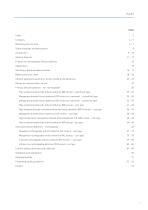
PAGE Index Marketing service tools Safety warnings and precautions Introduction General features Primary vs. rechargeable lithium batteries Selecting a battery/model mumber Battery selection chart General safety precautions for using, handling and designing Design for memory back-up use Primary lithium batteries – non rechargeable Poly-carbonmonofluoride lithium batteries (BR series) – cylindrical type Manganese dioxide lithium batteries (CR series for consumer) – cylindrical type Manganese dioxide lithium batteries (CR series for industrial) – cylindrical type Poly-carbonmonofluoride lithium...
Open the catalog to page 3
ONE OF THE WORLD’S LARGEST BATTERY MANUFACTURERS 271,869 EMPLOYEES*1 Panasonic Industry Europe Headquarters in Ottobrunn (near Munich)
Open the catalog to page 4
Panasonic Industry Europe Panasonic Batteries Batteries Factory Solutions Panasonic Industry Europe Panasonic Industry Europe GmbH is part of the global Panasonic Group and provides industrial products and services in Europe. As a partner for the industry sector, Panasonic researches, develops, manufactures and supplies technologies that contribute to a better life and a better world. Looking back on over 100 years of engineering knowhow in electronics, Panasonic is the right supplier when it comes to engineering expertise combined with solution competence. The portfolio covers key electronic...
Open the catalog to page 5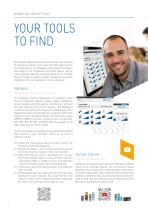
MARKETING SERVICE TOOLS YOUR TOOLS TO FIND At Panasonic Batteries we offer diverse services intended to make the customer´s life easier. Find the right pictures and media files in our Mediapool, gain insight into battery technology in our handbooks and white papers and be entertained by watching amazing videos at our YouTube Channel. Finally, our Battery Finder will help you to find the right battery for your application. Test our services! Mediapool Download the right battery media files The Panasonic Industry Mediapool is a complete online library of Panasonic battery images, videos, handbooks,...
Open the catalog to page 6
MARKETING SERVICE TOOLS Short Form Catalog and Handbooks Get the right product overview Our range of digital tools to help you in your daily work are complemented by our ‘classics’ on paper: the Short Form Catalog and the technical handbooks on the various battery product groups. These remain popular with customers as valuable reference aids. Battery Finder Find the right battery for your application Designed for engineers, electronics specialists and developers who need batteries for their projects, the Battery Finder Application provides an overview of what‘s available in the Panasonic range...
Open the catalog to page 7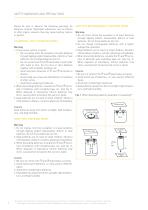
SAFETY WARNINGS AND PRECAUTIONS Please be sure to observe the following warnings. As batteries contains flammable substances such as lithium or other organic solvents, they may cause heating, rupture or ignition. CYLINDRICAL TYPE LITHIUM BATTERIES Warning 1. It may cause rupture or ignite. ⃝⃝ Do not charge, short (an exception is to pass batteries through dipping solder) disassemble, deform or heat batteries. Do not throw batteries into fire. ⃝⃝ Do not connect the and electrodes to each other with metal or wire. Do not carry or store batteries together with a metallic necklace, etc ⃝⃝ Avoid inversed...
Open the catalog to page 8
LITHIUM & MICRO BATTERIES: TYPES AND FEATURES Ever since Panasonic became the first company in the world to develop and commence the mass production of lithium batteries for consumer products in 1971, Panasonic has launched a series of lithium batteries in many shapes and sizes including cylindrical types, coin types and pin types. Panasonic has also successfully introduced coin type rechargeable lithium batteries to the market for applications such as memory back-up or watches. Today, lithium batteries have a proven track record of opening up a host of new fields where conventional batteries...
Open the catalog to page 9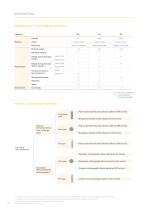
COMPARISON OF LITHIUM PRIMARY CHEMISTRY* 1 Chemistry Lithium metal Organic electrolyte Organic electrolyte Discharge capacity Lithium metal Organic electrolyte Electrolyte Nominal voltage Lithium metal Voltage during discharge (Initial) High current Voltage during discharge (End of capacity) High current Storage performance Pulse performance at low temperature Safety Environment –*3 ++ Very good capability + Good capability - Not good capability TYPES OF LITHIUM & MICRO BATTERIES Cylindrical type Primary lithium batteries (non-recharge able) Poly-carbonmonofluoride lithium batteries (BR series)...
Open the catalog to page 10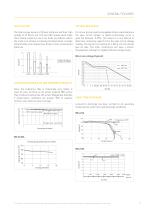
GENERAL FEATURES HIGH VOLTAGE The high energy density of lithium batteries and their high voltage of 3V (there are 1.5V and 3.8V lineups also) make them ideally suited for use in all kinds of products where the trend is to achieve increasing miniaturization. A single lithium battery can replace two, three or more conventional batteries. For all2,1 primary and rechargeable lithium metal batteries our the open circuit voltage vs depth-of-discharge curve is 2,0 1 2 3 ~5-85%. 90 91 92 it is very difficult quite flat0between4-84 85 88This means93 94 95 96 97 98 100 to determine remaining capacityDoD...
Open the catalog to page 11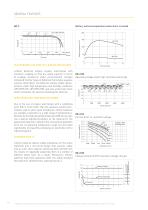
Duration (hours) Battery surface temperature when short-circuited 45°C (days) (years) OUTSTANDING ELECTROLYTE LEAK AGE RESISTANCE SUPERIOR SAFETY Lithium batteries feature stable substances for the active materials and a structural design that assures safety and, as such, their superior safety has been verified from the results of repeatedly subjecting them to a number of different safety tests. As a result, Panasonic’s Lithium batteries have been approved under the safety standard (UL1642) of UL (Underwriters Laboratories Inc.). BR-2325 Operating voltage under high-resistance discharge 80˚C...
Open the catalog to page 12
GENERAL FEATURES LEAK AGE RESISTANCE TEST RESULTS Conditions Model number Temp. cycle Heat shock Leakage resistance evaluation items Test conditions High temperature storage High temperature High humidity storage Temperature cycle Heat shock Early battery deterioration region Duration (hours) Prohibited operating range 60˚C withstand voltage limit 3.5 Adequate charge voltage range (guaranteed specified value) The lower the charging voltage becomes, the less the capacity becomes. Operational range Voltage at 50% 85°C The data in this document are for descriptive purposes only and are not intended...
Open the catalog to page 13All Panasonic Industry Europe GmbH catalogs and technical brochures
 NCR18650BD
4 Pages


- IEC battery
- High-performance battery
- Electric vehicle battery
- Cylindrical battery
- 3 V battery
- UPS battery
- Lithium-ion battery
- Nickel battery
- Battery for medical applications
- Solar battery
- Battery for automotive applications
- High-reliability battery
- Prismatic battery
- Battery for marine applications
- Flat battery
- 6 V battery
- Emergency lighting battery
- Power tool battery
- High-temperature battery