
- Catalogs
- Panasonic Industry Europe GmbH
- Batteries Panasonic Alkaline Handbook Professionals


- Products
- Catalogs
- News & Trends
- Exhibitions
Batteries Panasonic Alkaline Handbook Professionals

Batteries Panasonic Alkaline Handbook Professionals
Panasonic Industry Europe GmbH, part of the global Panasonic Group, specializes in industrial products, notably high-reliability batteries such as Lithium-Ion, Nickel-Metal Hydride, and Alkaline. The company prioritizes quality and environmental management, with all factories certified to ISO standards.
Panasonic offers various marketing tools, including a Mediapool for battery images and videos, a YouTube channel for educational content, and a Battery Finder Application to assist users in selecting suitable batteries. Technical expertise is shared through white papers.
Alkaline Manganese batteries are highlighted for their higher capacity, longer shelf life, and superior performance compared to Zinc-Carbon batteries, making them ideal for high-performance applications.
The battery's anode is made of Zinc powder, the cathode of Manganese dioxide, with a Potassium hydroxide electrolyte. A separator paper prevents short-circuiting, and the battery can is made of Nickel-plated steel.
The production process includes can drawing, trimming, and electrolyte pouring, with quality control measures like CT scans to ensure high standards.
Alkaline batteries have a nominal voltage of 1.5V, with performance influenced by factors such as temperature, affecting internal resistance and capacity.
IEC standards cover battery denomination, size, voltage, testing, packaging, storage, and usage. Safety measures include proper labeling and transport guidelines.
Panasonic adheres to environmental standards, ensuring sustainable and environmentally friendly battery production processes.
Different discharge types—constant resistance, constant current, and constant power—affect battery performance. Useful capacity is influenced by internal resistance and cut-off voltage.
Alkaline batteries have a shelf life of about 5 years, maintaining over 70% of their initial capacity if stored properly. Temperature, humidity, and internal construction affect shelf life.
Specifications for various battery models include size, nominal voltage, and weight. Panasonic Alkaline batteries are noted for high performance, suitable for applications like smoke detectors and medical equipment.
Designed for high and medium drain appliances, Panasonic Alkaline batteries offer reliable energy, long shelf life, and excellent leakage resistance.
Graphs illustrate discharge characteristics under different conditions, showing how voltage changes over time during discharge for various applications.
Panasonic batteries comply with IEC standards and EU directives, ensuring safety and environmental friendliness, with no added heavy metals.
Technical specifications for battery types like LR20AD and 6LR61AD include:
- Type: Alkaline Foil
- Nominal Voltage: 1.5V for LR20AD and 9.0V for 6LR61AD
- Electrolyte: Potassium Hydroxide
- Operating Temperature Range: -20°C to +55°C
- Storage Temperature Range: +10°C to +25°C
- Compliance: IEC 60086-1, IEC 60086-2, IEC 60086-5, EU directive 2006/66/EC, Nordic Ecolabel
Discharge characteristics are influenced by temperature, resistance, and voltage, with graphs showing discharge times at various temperatures and voltages.
IEC standards ensure compatibility and safety across devices and manufacturers, covering battery denomination, size, voltage, and testing.
Packaging prevents mechanical damage and electrical conduction during transport. Recommended storage temperatures are between +10°C and +25°C.
Batteries should be used promptly after being brought back to ambient temperature from cold storage. Avoid extreme humidity and direct sunlight.
Replace all batteries in a device simultaneously with the same type. Turn off appliances after use and remove batteries if not used for extended periods.
IEC 60086-part 5 outlines safety tests to prevent explosions, including storage, transportation, and installation tests.
Dry cell batteries are not classified as dangerous goods but must be securely packed to prevent short circuits.
Capacity, expressed in milliampere-hours (mAh), depends on discharge mode, cut-off voltage, and temperature.
Alkaline batteries have production and shelf-life date codes, indicating the period for optimal performance.
Details about Panasonic's Alkaline Battery models and contact information for inquiries.
Leaked liquid can damage skin and eyes. Batteries pose explosion risks if disposed of in fire or heated excessively.
Alkaline batteries contain manganese dioxide, graphite, zinc, potassium hydroxide, and water.
Panasonic commits to sustainable resource use and environmental protection, with ISO 14000 certification and CO2 neutral production.
Panasonic offers various packaging solutions, including bulk and shrink options.
Contact details for Panasonic offices across Europe for further inquiries.
Catalog excerpts

TECHNICAL HANDBOOK INDUSTRIAL BATTERIES FOR PROFESSIONALS
Open the catalog to page 1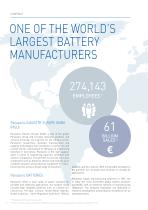
ONE OF THE WORLD’S LARGEST BATTERY MANUFACTURERS 274,143 EMPLOYEES*1 Panasonic INDUSTRY EUROPE GMBH (PIEU) Panasonic Industry Europe GmbH is part of the global Panasonic Group and provides industrial products and services in Europe. As a partner for the industry sector, Panasonic researches, develops, manufactures and supplies technologies that contribute to a better life and a better world. Looking back on 100 years of engineering knowhow in electronics, Panasonic is the right supplier when it comes to engineering expertise combined with solution competence. The portfolio covers key electronic...
Open the catalog to page 2
PIEU OFFICE IN HAMBURG BATTERIES PIEU HEADQUARTER IN OTTOBRUNN (NEAR MUNICH) CERTIFICATIONS ‘Quality is our Business’ – this is what Panasonic stands for. It is the principle for all our batteries and supporting services. This commitment is confirmed by numerous certifications. Our battery production facilities use leading-edge manufacturing processes that meet the toughest quality standards. All our factories are certified to ISO standards – with ISO 9000 and ISO 14000 being the minimum benchmarks. This means each factory has its own quality and environmental manage ent, delivers products that...
Open the catalog to page 3
MARKETING SERVICE TOOLS YOUR TOOLS TO FIND At Panasonic Batteries we offer diverse services intended to make the customer´s life easier. Find the right pictures and media files in our Mediapool, gain insight into battery technology in our handbooks and white papers and be entertained by watching amazing videos at our YouTube channel. Finally, our HTML Battery Finder will help you to find the right battery for your application. Test our services! MEDIAPOOL DOWNLOAD THE RIGHT BATTERY MEDIA FILES The Panasonic Mediapool is a complete online library of Panasonic battery images, videos, handbooks,...
Open the catalog to page 4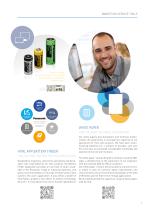
MARKETING SERVICE TOOLS WHITE PAPER FIND THE RIGHT TECHNICAL INFORMATION HTML APP BATTERY FINDER FIND THE RIGHT BATTERY FOR YOUR APPLICATION Designed for engineers, electronics specialists and developers who need batteries for their projects, the Battery Finder Application provides an overview of what‘s available in the Panasonic range of industrial batteries, and gives a recommendation on the type of battery that‘s best suited to the user‘s application. It also offers a wealth of information, graphics and videos on battery technology. All in all – it’s now easier than ever to find the right...
Open the catalog to page 5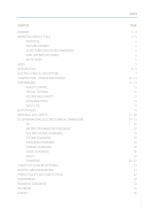
MARKETING SERVICE TOOLS YOUTUBE CHANNEL SHORT FORM CATALOG AND HANDBOOKS HTML APP BATTERY FINDER WHITE PAPER INTRODUCTION ELECTRO-CHEMICAL DESCRIPTION CONSTRUCTION - PRODUCTION PROCESS QUALITY CONTROL SPECIAL TESTINGS DISCHARGE TYPES SHELF LIFE BATTERY INDEX INDIVIDUAL DATA SHEETS IEC (INTERNATIONAL ELECTROTECHNICAL COMMISSION) BATTERY DENOMINATION STANDARDS SIZE AND VOLTAGE STANDARDS TESTING STANDARDS PACKAGING STANDARDS STORAGE STANDARDS USAGE STANDARDS CAPACITY OF ALKALINE BATTERIES BATTERY LABELING MARKINGS PRODUCT SAFETY DATA SHEETS (PSDS) PANASONIC STANDARDS
Open the catalog to page 7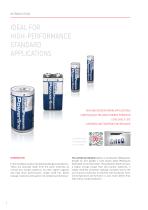
IDEAL FOR HIGH-PERFORMANCE STANDARD APPLICATIONS HIGH AND MEDIUM DRAIN APPLICATIONS CONTINUOUSLY RELIABLE ENERGY PROVISION LONG SHELF LIFE SUPERIOR LOW TEMPERATURE BEHAVIOR Scan QR code to view product series video. INTRODUCTION In this handbook we describe Alkaline Manganese batteries. These are basically made from the same materials as normal Zinc-Carbon batteries, but offer higher capacity and high drain performance, longer shelf life, better leakage resistance and superior low temperature behaviour. The cylindrical Alkaline battery is composed of Manganese dioxide (+), Zinc powder (-) and...
Open the catalog to page 8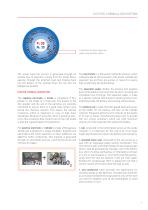
ELECTRO-CHEMICAL DESCRIPTION The actual electrical current is generated through an outside flow of electrons coming from the anode (Zinc), passing through the attached load and flowing back into the battery at the cathode (from the can into the Manganese dioxide). ELECTRO-CHEMICAL DESCRIPTION The negative electrode or anode is composed of Zinc powder in the shape of a mixed gel. The quality of the Zinc powder and the size of the particles are carefully controlled to ensure there is a good wide surface area during the chemical reaction. This lowers the internal resistance, which is important in...
Open the catalog to page 9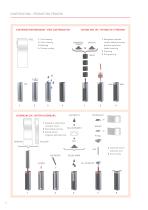
CONSTRUCTION - PRODUCTION PROCESS CAN PRODUCTION PROCEDURE - STEEL CAN PRODUCTION CATHODE UNIT LR6 - MIXTABLETS (+) PRESSING 1 Can drawing 2 Can trimming 3 Washing 4 Carbon coating 1 Manganese dioxide carbon tablet pressing (positive pole) and tablet inserting 2 Pressing 3 Can grooving ASSEMBLING LR6 - BATTERY ASSEMBLING 1 Separator and bottom insulator insert 2 Electrolyte pouring 3 Gelled-anode (negative pole) pouring 4 Collector insert Collector unit 5 Can curling
Open the catalog to page 10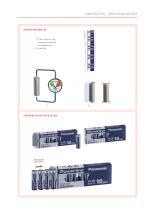
CONSTRUCTION - PRODUCTION PROCESS 1 Final check on volt, amperage, leakage and appearance 2 Labeling PACKAGING LR6 INTO 10 PIECES BOX
Open the catalog to page 11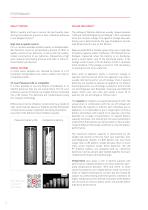
QUALITY CONTROL What is quality and how to secure the best quality level during the production process of tons of Alkaline batteries in our Belgian factory? The voltage of Alkaline batteries usually ranges between 1.55V and 1.65V OCV (Open Circuit Voltage). 1.5V is considered to be the nominal voltage. The speed of voltage decrease during use is determined by the type of appliance and the load (drain) which is put on the battery. High tech in quality control For us, the best possible product quality is indispensable. We therefore invest an extraordinary amount of effort in quality control of...
Open the catalog to page 12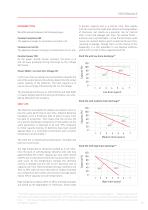
Constant current (A) The appliance keeps running on constant drain in A or mA. Constant power (W) As the power should remain constant, the drain in A will increase gradually during discharge as the voltage decreases. Power (Watt) = Current (A) x Voltage (V) In this case, the increasing internal resistance towards the end of the useful battery life will also determine the actual useful capacity of the batteries. The total capacity is of course also strongly influenced by the cut-off voltage. The discharge (continuous or intermittent) and load (light or heavy) largely determine what performance...
Open the catalog to page 13All Panasonic Industry Europe GmbH catalogs and technical brochures
 NCR18650BD
4 Pages
 Batteries Panasonic Lithium
96 Pages


- Lithium battery
- IEC battery
- High-performance battery
- Electric vehicle battery
- Cylindrical battery
- 3 V battery
- UPS battery
- Lithium-ion battery
- Nickel battery
- Battery for medical applications
- Solar battery
- Battery for automotive applications
- Prismatic battery
- Battery for marine applications
- Flat battery
- 6 V battery
- Emergency lighting battery
- Power tool battery
- High-temperature battery