
- Catalogs
- Panasonic Industrial, Robot & Welding
- Connected Society, Connected Future. Industrial Batterires

Connected Society, Connected Future. Industrial Batterires

Connected Society, Connected Future. Industrial Batterires
- Avoid exposing batteries to liquids or high temperatures to prevent damage and potential hazards like heat, smoke, rupture, or fire.
- Charge rechargeable batteries only with approved chargers under specified conditions to prevent abnormal chemical reactions.
- Ensure correct battery polarity and avoid forceful insertion to prevent reverse charging and hazards.
- Do not connect batteries directly to AC or vehicle outlets to avoid electric shock and excessive current flow.
- Using batteries for unapproved applications can affect performance and safety.
- Do not incinerate or expose batteries to high temperatures, as this can damage safety mechanisms and cause fires.
- Avoid short-circuiting by keeping batteries away from metal objects.
- Prevent physical damage to batteries to avoid leakage and other hazards.
- Do not disassemble or modify batteries, as this can compromise safety features.
- Handle leaked electrolyte with care, washing affected areas immediately and seeking medical help if necessary.
- Keep batteries out of reach of children to prevent accidental ingestion.
- Avoid placing batteries in microwave ovens or high-pressure containers.
- Do not mix new and used batteries or different types, as this can cause over-discharging or over-charging.
- Stop using batteries if any unusual symptoms are detected.
- Follow proper disposal regulations for used batteries.
- Avoid direct sunlight and high temperatures to prevent leakage and reduced performance.
- Consult Panasonic for the appropriate temperature range for charging batteries.
- Read and follow the instruction manual for safe battery usage.
- Secure battery terminals during transit to prevent short-circuiting.
- Panasonic offers a range of batteries including lithium, nickel-metal hydride, and dry batteries, suitable for various applications such as automotive, infrastructure, and consumer electronics.
- Panasonic batteries are known for their reliability, long life, and safety features, contributing to various industries and applications worldwide.
Panasonic provides a range of batteries designed for various applications, including automotive, IoT, wearables, and medical devices. These batteries are engineered to offer reliability, safety, and long-lasting performance, even in challenging conditions.
Battery Types and Applications
- Automotive Applications: Panasonic batteries are used in anti-theft security systems and eCall systems, ensuring reliable performance during emergencies.
- IoT and LPWA Devices: These batteries are designed for long-distance data communication with minimal power consumption, suitable for hard-to-access locations.
- Wearables and Medical Devices: Pin-type lithium-ion batteries are ideal for small portable devices, offering high output and safety.
Battery Features
- Coin-type Lithium Batteries: Available in CR and BR series, these batteries are known for their performance in high-temperature environments and long-term stability.
- Cylindrical-type Lithium Batteries: Suitable for high-drain devices like cameras and flashlights, as well as security devices.
- Nickel-Metal Hydride Batteries: These offer a longer-lasting alternative to nickel-cadmium batteries, with rapid charging capabilities.
Performance Characteristics
- Panasonic batteries exhibit excellent discharge characteristics across a wide range of temperatures, making them suitable for various environmental conditions.
- They are designed for high safety and reliability, with features like high-strength stainless exterior cases and faster recharge times.
Environmental Impact
Panasonic emphasizes eco-friendly power solutions, with reusable designs that limit wastage and reduce environmental impact.
Conclusion
With over 40 years of experience in battery design and innovation, Panasonic continues to provide high-quality, reliable batteries for a global market, supporting a wide range of applications from consumer electronics to industrial devices.
The document outlines the nominal voltage, capacity, continuous drain, dimensions, mass, and operating temperature range for different battery models, including VL, ML, MT, CTL, and CG series. Each series has specific characteristics tailored for various applications.
Features
Key features include high-discharge voltage performance, support for multiple charge-discharge cycles, high current endurance, and long-term reliability. Some batteries are designed for rapid charging and high safety with stainless steel casings.
Applications
The batteries are suitable for memory backup in devices like printers, medical equipment, and cameras, as well as for use in watches, sensing devices, and solar applications. Pin-type lithium-ion batteries are ideal for wearable devices and other nominal-drain applications.
Charge/Discharge Characteristics
The document includes graphs and data on charge-discharge cycles for various battery models, highlighting their performance under different conditions. For example, the CTL920F and MS614 models are shown with specific charge and discharge parameters.
Recommendations
The document suggests using these batteries in applications where battery replacement is inconvenient or impractical, emphasizing their suitability for memory backup and solar watches.
Safety and Standards
The batteries are tested for safety, with certifications to standards like IEC62133 and UL1642. They are designed to prevent swelling, leaks, explosions, and fires.
Environmental Considerations
Nickel-metal hydride batteries are highlighted as eco-friendly alternatives to nickel-cadmium batteries, with long operational life and efficient charging in high temperatures.
Conclusion
Panasonic's range of rechargeable batteries offers diverse solutions for various technological needs, ensuring high performance, safety, and reliability across different applications.
- Nickel-metal hydride batteries offer extended charge/discharge life of about 1,800 cycles, low self-discharge, and excellent temperature resistance.
- Various models are available to suit applications such as power tools, medical equipment, and consumer electronics.
- Operating temperature ranges for discharge and charge vary by model, with some capable of functioning from -30°C to 65°C.
Features
- High-current discharge characteristics and rapid charging capabilities are highlighted.
- Secure and reliable performance with a focus on safety and longevity.
Applications
- Power tools, electric toys, medical equipment, and household devices like electric toothbrushes and shavers.
Battery Construction and Safety
- Incorporation of thermistors, thermal protectors, and protective circuitry is recommended for safety.
- Battery packs are designed considering voltage, current, and usage conditions, with a focus on safety and reliability.
Charging Methods
- Various charging methods are discussed, including constant-current and trickle-charging, with recommendations for optimal battery performance.
- Charging circuits vary in complexity and cost, with some methods extending battery life by preventing overcharge.
Dry Batteries
- Alkaline and manganese batteries are detailed, with specifications on nominal voltage, dimensions, and applications.
- Applications include portable radios, flashlights, and remote controllers.
Performance Charts
- Example discharge and charge characteristics are provided, illustrating performance under various conditions.
Conclusion
Panasonic's batteries are engineered for high performance and reliability across a range of industrial and consumer applications, with a strong emphasis on safety and compliance with industry standards.
Catalog excerpts
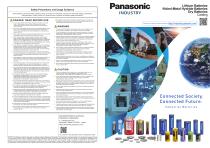
Safety Precautions and Usage Guidance Some batteries contain flammable substance which, if misused or mishandled, may result in electrolyte leakage, deformation, heat-generation, rupture, and/or fire. Please be sure to observe the following safety precautions. DANGER: READ BEFORE USE 1. Do not expose batteries to fresh water, seawater, beverages, or any other liquid, or allow batteries to get wet. Built-in safety equipment may be compromised, potentially resulting in heat-generation, smoke-generation, rupture, and/or fire. 2. Do not use or leave batteries near fires, stoves, or other high-temperature objects 80 °C or over. If the plastic separator gets damaged due to heat exposure, short-circuiting inside batteries may cause heat-generation, smoke-generation, rupture, and/or fire. 3. Never charge any battery type except rechargeable batteries. Ensure the device’s circuit design prevents current intrusion from other power sources. 4. When charging batteries, use approved battery chargers only and observe battery-charging usage conditions specified by Panasonic. When charging batteries in other charging conditions (undesignated temperatures, undesignated voltage, current, or modified chargers), over-charging, charging with abnormal current flow, an abnormal chemical reaction inside batteries may occur, resulting in heat-generation, smoke-generation, rupture, and/or fire. 5. Every battery has a predetermined polarity. If a battery does not fit comfortably in a battery charger or appliance, do not insert the battery by force. Instead, check the battery’s polarity. In case of reverse connection, batteries may charge backwards causing an abnormal chemical reaction which may result in leakage, heat-generation, smoke-generation, rupture, and/or fire. 6. Do not attach batteries to an AC outlet or directly to a vehicle’s electrical outlet. This may result in electric shock, voltage spikes, and excessive current flow within the battery, potentially causing leakage, heat-generation, smoke-generation, rupture, and/or fire. 7. Using batteries for unapproved applications may affect battery performance or reduce battery life. Usage in some devices may damage batteries due to abnormal current flow, resulting in heat-generation, smoke-generation, rupture, and/or fire. 8. Do not incinerate batteries or heat them to high temperatures. This will melt the insulator, damaging the gas valve and other safety measures, or ignite the electrolyte, resulting in heat-generation, smoke-generation, rupture, and/or fire. 9. Do not connect the positive terminal and negative terminal of a battery with any metal object. Also, do not store or carry batteries where they could contact keys, hairpins, paper clips, jewelry, etc. This may cause short-circuiting and excessive current flow resulting in heat-generation, smoke-generation, rupture, and/or fire, or heat the contacted metals. 10. Do not subject batteries to high impact or shock. This may result in leakage, heat-generation, smoke-generation, rupture, and/or fire. If built-in safety equipment gets damaged, batteries may charge abnormally, causing an abnormal chemical reaction inside they battery which may result in heat-generation, smoke-generation, rupture, and/or fire. 11. Do not penetrate batteries with nails, strike with a hammer, etc. This will destroy safety equipment, cause battery deformation, or short-circuit the battery, resulting in heat-generation, smoke-generation, rupture, and/or fire. 12. Do not directly solder batteries or drop batteries into a solder bath. Heat may melt the insulation or cause damage to the safety valve and related equipment, resulting in heat-generation, smoke-generation, rupture, and/or fire. 13. Never disassemble, modify, or twist batteries inside the pack. Built-in safety equipment or protective mechanisms in the battery or battery pack may be compromised, potentially resulting in heat-generation, smoke-generation, rupture, and/or fire. 14. Do not peel or scratch off the protective outer tube of a battery. Doing so can easily cause the batteries to leak, generate heat, or explode. 15. Do not charge batteries near fires or inside cars in hot weather. In high-temperature locations, a safety mechanism works to prevent danger but may impede charging or destroy the safety mechanism, resulting in heat-generation, smoke-generation, rupture, and/or fire due to charging via abnormal current flow/voltage or abnormal chemical reaction inside the battery. 16. Some batteries incorporate a gas-venting structure to discharge internal gases. For this reason, do not deform the positive electrode. 17. Some batteries cannot be installed in hermetically sealed equipment. Doing so may cause gas buildup inside the device, which may result in rupture or explosion if ignited. 18. Some batteries contain alkaline electrolyte. Accidental exposure may result in loss of eyesight. If contact occurs, do not rub the eye, but immediately wash with clean water and seek medical assistance as soon as possible. Lithium Batteries Nickel-Metal Hydride Batteries Dry Batteries Catalog Please visit our website for the latest information: https://industria .panasonic.com/ https industrial.panasonic.co WARNING 1. To avoid accidental ingestion of small batteries, keep devices and batteries out of reach of children. If swallowed, seek emergency medical care immediately. 2. Do not place batteries in microwave ovens, high-pressure containers, or induction cookware. This may suddenly heat batteries or compromise their seal, resulting in heat-generation, smoke-generation, rupture, and/or fire. 3. Keep new batteries separate from used batteries, and never mix batteries of different capacities, types, or brands. This may result in heat-generation, smoke-generation, rupture, and/or fire due to over-discharging or over-charging and other abnormal chemical reactions inside the batteries when in use. 4. If an abnormal odor, temperature, discoloration, deformation, or other unusual symptom is detected when using, charging, or storing batteries, take them out of the device or charger, and do not use them. Using them as-is may result in heat-generation, smoke-generation, rupture, and/or fire. 5. When charging exceeds the specified replenishment time, stop charging the battery as soon as possible. Failing to do so may cause over-charging or result in heat-generation, smoke-generation, rupture, and/or fire. 6. Take extreme care to prevent batteries from contacting fire if leakage or unusual smell is detected. Leaked electrolyte may ignite, resulting in smoke-generation, rupture, and/or fire. 7. If leaked electrolyte contacts eyes, do not rub them. Immediately wash the affected area with clean water and consult a doctor. Exposure to electrolyte may result in loss of eyesight if left untreated. 8. Secure in strong packaging so batteries inside a case do not move during transit. Failure to do so may cause damage or short-circuit the metal terminals. 9. When discarding used batteries, follow all relevant government laws and regulations in your country or region. CAUTION 1. Do not place batteries in direct sunlight, use, or store batteries inside cars in hot weather. This may result in battery leakage, heat-generation, and/or smoke-generation. Product performance and lifespan may be also be reduced. 2. Do not use batteries where static electricity greater than 100 V may damage built-in battery safety mechanisms, resulting in battery leakage, heat-generation, smoke-generation, rapture, and/or fire. 3. Regarding temperature range when charging batteries, contact your Panasonic sales representative or dealer for more details. Charging batteries outside the designated temperature range may result in battery leakage, heat-generation, and/or rapture, or reduce battery performance and lifespan. 4. Be sure to read instruction manual before use. Keep it in a safe place and refer to it when needed. 5. Carefully read the instruction manual(s) of the dedicated charger to learn how to properly and safely charge batteries. 6. If you notice oxidization, abnormal odor, excessive heat, or other unusual symptoms when using batteries for the first time after purchasing, do not use them and return them to point of purchase. 7. When batteries are likely to be used by small children, caregivers should provide advice on safe usage based on the user manual and provide adequate supervision to ensure the batteries are properly used. 8. Do not put flammable substances on batteries or cover them during charging or discharging. This may result in heat-generation, rupture, and/or fire. 9. If leaked electrolyte ever contacts skin or clothes, immediately wash the affected area with clean water. Failure to do so may result in rashes or other skin conditions. 10. Secure the battery terminals with adhesive tape or similar when wire leads or other metal terminals are exposed. Failure to do so may cause short-circuiting, resulting in heat-generation, fire, and/or rapture. Industrial Solutions Company Panasonic Corporation 1-1, Matsushita-cho, Moriguchi, Osaka, 570-8511, Japan https://industrial.panasonic.com/ The contents of this catalog are valid as of September, 2020 NOTICE: This literature contains information on batteries made by Panasonic Corporation. The information contained within is for descriptive purposes only and is not intended to make, imply, or represent any warranty or guarantee. Panasonic Corporation reserves the right to change or modify design, appearance, and specification without prior notice. Panasonic lithium batteries comply with all relevant and applicable safety and regulatory standards for commercial sale. Panasonic cannot accept responsibly for damage or misadventure due to mishandling or misuse, improper storage, shipping, or operation by the user, nor support any guarantees concerning claimed device performance except those explicitly made by Panasonic Corporation. © Copyright Panasonic Corporation, 2019. Connected Society, Connected Future. Industrial Batt
Open the catalog to page 1All Panasonic Industrial, Robot & Welding catalogs and technical brochures
 Conductive Polymer Capacitors
146 Pages
 LAPRISS series
8 Pages
 Gouging power source
1 Page
 350VR1 series
6 Pages
 GZ4 series
2 Pages
 LA-1800
2 Pages
 Aluminum Electrolytic Capacitors
87 Pages
 Device Product Catalog 2018
17 Pages
 Film Capacitors
100 Pages
 Automotive Devices Catalogue
10 Pages
 Device Product Catalog 2017
17 Pages
 Positioners & Peripherals
6 Pages
 TA/TB Series
5 Pages
 TA-WG Series
6 Pages
 TSP
TSP1 Page
 200BL2
1 Page
 TR6
TR61 Page
 TIG STAR WX4
1 Page
 300BZ3
1 Page
 300BP4
1 Page
 KR2series/600KH2
6 Pages
 600RF2/FR1 series
6 Pages
 500CL5/180SL7
6 Pages
 400GT3
6 Pages
 350GZ4/GR3series
6 Pages
 350GE2
6 Pages
 350GB2
6 Pages


Archived catalogs
 CO2/MAG Welding Machines
4 Pages
 MIG Welding Machines
4 Pages


- Panasonic welding machine
- Industrial robot
- Chiller
- Panasonic automatic welding machine
- Articulated robot
- 6-axis robot
- Liquid recirculation chiller
- Floor-mounted robot
- Water recirculation chiller
- Panasonic metal welding machine
- Arc welding machine
- Panasonic manual welding machine
- High-speed robot
- Panasonic laser welding machine
- Panasonic precision welding machine
- Industrial cooling system
- Ceiling-mounted robot
- Welding robot
- Panasonic standalone welding machine
- Compact sealer