
- Catalogs
- Pallmann Maschinenfabrik
- Plast-Agglomerator, type PFV

- Products
- Catalogs
- News & Trends
- Exhibitions
Plast-Agglomerator, type PFV

Plast-Agglomerator, type PFV
- Material-gentle agglomeration using frictional heat.
- Compact design requiring low space.
- Fully automatic start-up and continuous operation.
- Minimal thermal stress on materials.
- Precut feed material is fed into the Plast-Agglomerator using a dosing screw.
- Agglomeration occurs through frictional heat just below the melting point.
- Material is pressed through a die and cut by rotating knives.
- Granules are transported to a hot melt granulator for further size reduction.
- Granules are sifted to separate fine particles.
Catalog excerpts
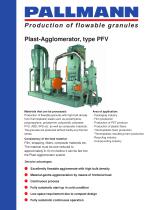
Production of flowable granules Plast-Agglomerator, type PFV Materials that can be processed: Production of flowable granules with high bulk density from thermoplastic waste such as polyethylene, polypropylene, polystyrene, polyamide, polyester, PVC, ABS, XPS etc. as well as composite materials. The granules are produced without hardly any thermal stress. Consistency of the feed material: Film, strapping, fibers, composite materials etc. The material must be size reduced to approximately 8-10 mm before it can be fed into the Plast-Agglomerator system. Area of application: - Packaging industry - Film production - Production of PET products - Production of plastic fibers - Thermoplastic foam production - Thermoplastic insulating foam production - Recycling industry - Compounding industry Decisive advantages: Excellently flowable agglomerate with high bulk density Material-gentle agglomeration by means of frictional heat Continuous process Fully automatic start-up in cold condition Low space requirement due to compact design Fully automatic continuous operation
Open the catalog to page 1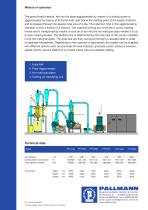
Method of operation: The precut feed material, fed into the plast-agglomerator by means of a dosing screw is agglomerated by means of frictional heat right below the melting point of the plastic material and is pressed through the special hole size of a die. The retention time in the agglomerating chamber is only a fraction if a second. The material coming out of the die is cut by rotating knives and is transported by means of cool air of fan into the hot melt granulator where it is cut to even sized granules. The particle size is determined by the hole size of the screen installed in the hot...
Open the catalog to page 2All Pallmann Maschinenfabrik catalogs and technical brochures
 Impact Hammer Mill PHPS
4 Pages
 Refiner System PR
8 Pages
 Drum Chipper PHT
4 Pages
 Knife Ring Flaker PZKR/PZSC
8 Pages
 PDD
PDD2 Pages
 PHMC
PHMC2 Pages
 TurboFiner®, type PLM
2 Pages
 PolyGrinder®type PMM
2 Pages
 Polygrinder®, type PKM
2 Pages
 PS-C
PS-C2 Pages
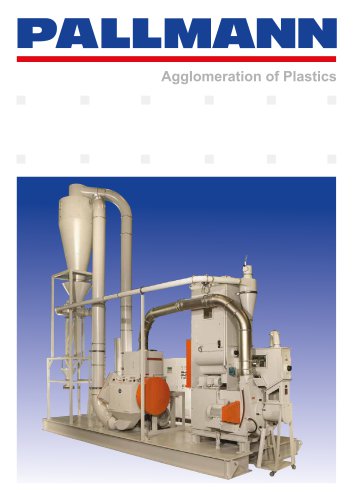 Agglomeration of plastics
12 Pages
 UltraGranulator PANTHER
4 Pages
 Singleshaft Shredder TIGER
4 Pages
 Doubleshaft Shredder LION
4 Pages
 Singleshaft Shredder LEOPARD
4 Pages
 Shearing ledge Shredder PUMA
4 Pages
 Briquetting Press PVB
4 Pages
 Double Stream Mill PSKM
8 Pages
 Classifier Mill PCM
8 Pages
 Contra-Selector Mill PPS
8 Pages
 Turbo Mill PP
8 Pages
 Turbo Mill REF
8 Pages
 The TIGER
4 Pages
 The LEOPARD
4 Pages
 Double shaft Shredder LION
4 Pages
 HydroFiner
2 Pages
 E-Line K 653
4 Pages
 P-Line K 652
8 Pages
 WPC K 651
8 Pages
 Preparation of Rubber
12 Pages
 Cryogenic Grinding PPST
4 Pages
 Masterbatch producer
4 Pages
 Preparation of Plastics
20 Pages
 Pulverizing of Plastics
16 Pages
 Granulating of Plastics
16 Pages

- Grinding mill
- Crushing plant
- Stationary crushing plant
- Horizontal lump breaker
- Vertical pulverizer
- Cutting mill
- Waste chopper
- Impact pulverizer
- Recycling grinding mill
- Plastic grinding mill
- Knife chopper
- Hammer grinding mill
- Wood chipper
- Disc pulverizer
- Robust grinding mill
- Lump breaker for the plastics industry
- Wood pulverizer
- Wet grinding mill
- Rubber mill
- Fine cutting mill