
- Catalogs
- Pallmann Maschinenfabrik
- Agglomeration of plastics

- Products
- Catalogs
- News & Trends
- Exhibitions
Agglomeration of plastics
1 /12Pages
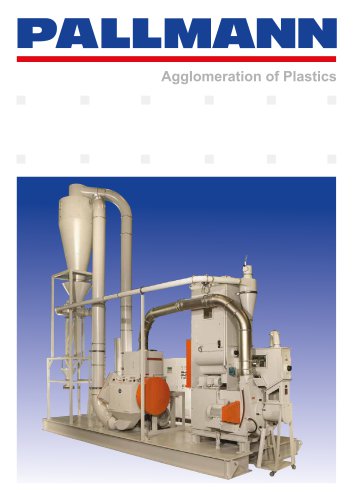
Agglomeration of plastics
1 /12Pages
Catalog excerpts
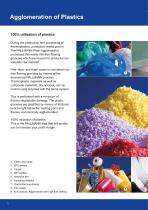
During the production and processing of thermoplastics, production waste occurs. processes this waste into free-flowing granules which are reused for production as Film- fiber- and foam waste is converted into free-flowing granules by means of the economical PALLMANN process. Thermoplastic materials as well as composite materials, dry or moist, can be continuously recycled with the same system. This is performed with a minimum of thermo-degradable damage. The plastic granules are plastified by means of frictional heat to right below the melting point and thereby economically agglomerated. This...
Open the catalog to page 2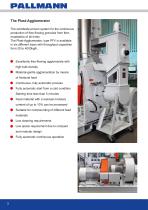
The worldwide proven system for the continuous production of free flowing granules from ther- The Plast-Agglomerator, type PFV is available in six different sizes with throughput capacities # Excellently free-flowing agglomerate with high bulk density • Material-gentle agglomeration by means # Continuous, fully automatic process # Fully automatic start from a cold condition Starting time less than 5 minutes # Feed material with a residual moisture # Suitable for compounding of different feed • Low space requirement due to compact # Fully automatic continuous operation
Open the catalog to page 4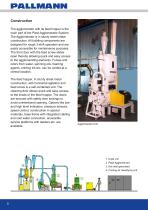
The agglomerator with its feed hopper is the main part of the Plast-Agglomerator System. The Agglomerator is in sturdy sheet metal construction. All building components are designed for rough 3-shift operation and are easily accessible for maintenance purposes. The front door with the feed screw slides open thereby allowing quick and easy access to the agglomerating elements. Fumes and odors from water, spinning oils, foaming agents, printing ink etc. can be vented at a central location. The feed hopper, in sturdy sheet metal construction, with horizontal agitators and feed screw is a self-contained...
Open the catalog to page 6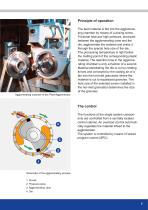
The feed material is fed into the agglomera- ting chamber by means of a dosing screw. Frictional heat and high pressure, produced between the agglomerating vane and the die, agglomerate the material and press it through the special hole size of the die. The processing temperature is right below the melting point of the corresponding plastic material. The retention time in the agglome- rating chamber is only a fraction of a second. Material penetrating the die is cut by rotating knives and conveyed by the cooling air of a fan into the hot-melt granulator where the material is cut to equalsized...
Open the catalog to page 7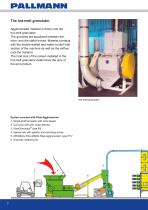
Agglomerated material is drawn into the hot-melt granulator. The granules are equalized between the rotor- and the stator knives. Material contacts with the double-walled and water-cooled inlet section of the machine as well as the airflow The hole size of the screen installed in the hot-melt granulator determines the size of Hot-melt granulator System concept with Plast-Agglomerator 1. Single-shaft shredder with ramp feeder 2. Conveyor belt with metal detector 4. Special silo with agitator and discharge screw 5. ORIGINAL PALLMANN Plast-Agglomerator, type PFV
Open the catalog to page 8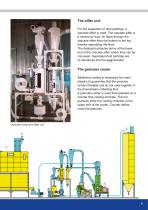
For the separation of dust particles, a cascade sifter is used. The cascade sifter is a vertical air duct. Air flows through the cascade sifter from the bottom to the top, thereby separating the fines. The dedusted granules arrive at the lower end of the cascade sifter where they can be conveyed. Separated dust particles are re-introduced into the agglomerator. Additional cooling is necessary for many plastics to guarantee that the granules remain flowable and do not cake together in the downstream collecting bins. A granules cooler is used that operates on a counter flow cooling principle. The...
Open the catalog to page 9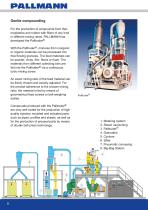
Gentle compounding For the production of compounds from ther- moplastics and rubber with fillers of any kind in different mixing ratios, PALLMANN has With the Palltruder®, mixtures from inorganic or organic materials can be processed into free flowing granules. The feed materials can be powder, chips, film, fibers or foam. The materials from different collecting bins are fed into the Palltruder® via a continuous turbo mixing screw. An exact mixing ratio of the feed material can be freely chosen and exactly adjusted. For the precise adherence to the chosen mixing ratio, the material is fed by...
Open the catalog to page 10
Technical data Drive, precutting mill kW Cool water consumption l/h Drive, hot-melt granulator kW Total installed capacity * kW Throughput rates Throughput rate Bulk density PVC-rigid film PVC-soft film PVC-soft foam Carpet waste Synthetic rubber with sifter + cooler "Above throughput rates, which have been achieved during tests, serve as a guideline only. To establish exact performance data with your material in continuous operation, trials can be performed in our research and technology center.
Open the catalog to page 11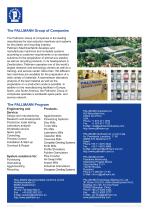
The PALLMANN Group of Companies The Pallmann Group of companies is the leading manufacturer for size reduction machines and systems for the plastic and recycling industry. Pallmann Machinenfabrik develops and manufactures machines and complete systems according to customer requirements or as standard solutions for the preparation of almost any plastics as well as recycling products. In its headquarters in Zweibriicken, Pallmann operates one of the world's largest research and technology centers as well as a training- and service center. More than 130 different test machines are available for...
Open the catalog to page 12All Pallmann Maschinenfabrik catalogs and technical brochures
 Impact Hammer Mill PHPS
4 Pages
 Refiner System PR
8 Pages
 Drum Chipper PHT
4 Pages
 Knife Ring Flaker PZKR/PZSC
8 Pages
 PDD
PDD2 Pages
 PHMC
PHMC2 Pages
 TurboFiner®, type PLM
2 Pages
 PolyGrinder®type PMM
2 Pages
 Polygrinder®, type PKM
2 Pages
 PS-C
PS-C2 Pages
 Plast-Agglomerator, type PFV
2 Pages
 UltraGranulator PANTHER
4 Pages
 Singleshaft Shredder TIGER
4 Pages
 Doubleshaft Shredder LION
4 Pages
 Singleshaft Shredder LEOPARD
4 Pages
 Shearing ledge Shredder PUMA
4 Pages
 Briquetting Press PVB
4 Pages
 Double Stream Mill PSKM
8 Pages
 Classifier Mill PCM
8 Pages
 Contra-Selector Mill PPS
8 Pages
 Turbo Mill PP
8 Pages
 Turbo Mill REF
8 Pages
 The TIGER
4 Pages
 The LEOPARD
4 Pages
 Double shaft Shredder LION
4 Pages
 HydroFiner
2 Pages
 E-Line K 653
4 Pages
 P-Line K 652
8 Pages
 WPC K 651
8 Pages
 Preparation of Rubber
12 Pages
 Cryogenic Grinding PPST
4 Pages
 Masterbatch producer
4 Pages
 Preparation of Plastics
20 Pages
 Pulverizing of Plastics
16 Pages
 Granulating of Plastics
16 Pages

- Crushing plant
- Stationary crushing plant
- Horizontal lump breaker
- Vertical pulverizer
- Cutting mill
- Waste chopper
- Impact pulverizer
- Recycling grinding mill
- Plastic grinding mill
- Knife chopper
- Hammer grinding mill
- Wood chipper
- Disc pulverizer
- Robust grinding mill
- Lump breaker for the plastics industry
- Wood pulverizer
- Wet grinding mill
- Rubber mill
- Fine cutting mill