
- Catalogs
- Palazzoli S.p.A.
- Atex catalogue 2015-2016


Atex catalogue 2015-2016

Atex catalogue 2015-2016
- Order Confirmation: Prices and terms are binding only upon written confirmation of the order.
- Offer Validity: Terms are valid only if the order includes everything in the offer.
- Property Rights: Estimates and projects are proprietary and cannot be disclosed without approval.
- Alterations: Any changes must be in writing and explicitly agreed upon.
- Technical data in catalogues are approximate until confirmed at ordering.
- Prices may change due to market conditions or cost variations without notice. Prices are ex-factory, with transport and duties charged to the customer unless agreed otherwise.
- Returns on packing are not accepted. Goods travel at the buyer's risk, even with free delivery agreements.
- Delivery terms are approximate and not binding. The company is not liable for delays.
- Payment terms must be agreed in writing. Delayed payments incur interest. Non-compliance may lead to delivery interruptions.
- Claims must be made within 12 days of delivery. The company may replace defective goods but will not cover unauthorized repairs.
- Warranties last 12 months from the invoice date. The company will repair or replace defective parts but reserves the right to decide the method.
- Contracts are governed by Italian law, with Brescia as the competent court.
- Palazzoli specializes in manufacturing electrical appliances with safety features for various applications. Products conform to technical and safety standards.
- Palazzoli's ATEX equipment is certified for use in hazardous areas, complying with relevant EU directives and standards.
- Includes plugs, sockets, control devices, and lighting fixtures, designed for safety and reliability in hazardous environments.
- Rated insulation voltage: 500V
- Insulation class: II
- Operating temperature: -20°C to +40°C
- Rated current options: 16A, 20A, 32A, 40A, 63A
- Thermal current (Ith): 16A, 32A, 63A
- Short circuit withstand capacity: ≥ 10kA
- Protection rating: IP66
- AC21A, AC22A, AC23A: 16A, 32A, 63A
- AC23A power ratings at 230V, 400V, 500V: 4.5kW, 8.5kW, 20kW; 7.5kW, 15kW, 34kW; 8.5kW, 17kW, 44kW respectively
- AC3 power ratings at 230V, 400V, 500V: 4.5kW, 8.5kW, 18kW; 7.5kW, 15kW, 31kW; 8.5kW, 17kW, 40kW respectively
- Entry cable sections: 1-10 mm², 6-16 mm²
- Entry cable diameters: 12-18 mm, 16-25 mm, 22-32 mm
- Conforms to ATEX Directives 94/9/EC and 2014/34/EU
- Suitable for explosive atmospheres (Zones 0, 1, 2, 20, 21, 22)
- TUV certified
- Wall-mounted watertight interlocked sockets in antistatic thermosetting (GRP)
- Mechanical interlock system made of metal
- Stainless steel screws and non-ageing elastomer gasket for sealing
- Available with fuse-holder or MCB options
- Suitable for hazardous areas with gas and dust risks
- Compatible with TAIS-EX software for designing and installing socket boards
- Insulated cable gland included
- Technical accessories available for compositions
The document outlines various standards and directives applicable to electrical equipment, including EN 60079-15:2010, EN 60079-31:2014, and Directive 2006/95/EC. It specifies the ATEX execution for equipment suitable for zones 1, 2, 21, and 22, with protection ratings of IP66 and IP67 as per IEC/EN 60529. The materials used include aluminium alloy and antistatic thermosetting (GRP), with surface treatments like passivation with fluoro-zirconium and hot polymerized non-toxic polyester painting.
Procedures:
The document provides instructions for testing the restricted breathing of sockets according to EN60079-15 standards. It includes details on the installation of junction boxes and the use of technical accessories like enclosures and backplates.
Norms and Standards:
Compliance with ATEX Directives 94/9/EC and 2014/34/EU is emphasized, along with conformity to EN 60079-0:2012 + A11:2013, EN 60079-7:2007, and EN 62208:2011. The document also mentions the self-extinguishing grade V0 as per UL94 and resistance to abnormal heat and fire as per IEC/EN 60695-2-10.
Recommendations:
The document recommends using the specified equipment in areas at risk of explosive atmospheres, ensuring compatibility with the defined zones. It highlights the importance of using the correct cable glands and maintaining the equipment within the specified operating temperature range of -20°C to +75°C.
Key Data from Tables:
The tables provide detailed specifications for plugs and interlocked sockets, including rated current (16A, 32A, 63A), rated voltage (50V - 500V), and entry cable sections and diameters. They also list Palazzoli codes for various configurations and the maximum power dissipation allowed for different box dimensions.
- Junction boxes are made from aluminium alloy with IP66 protection, suitable for zones 1, 2, 21, and 22.
- Maximum ambient temperature for power dissipation is 40°C.
- Boxes can be customized with cable glands and terminals, certified by a Notified Body.
- To customize terminal boxes, specify the number and type of terminals, cable glands, and maximum operating current.
- Boxes can be drilled on four sides for cable entries, with specifications depending on box dimensions and cable gland sizes.
- Conforms to ATEX Directives 94/9/EC and 2014/34/EU, EN 60079 series standards.
- Protection methods include Ex-e and Ex-tb for cable glands and adaptors.
- Choose appropriate ambient temperature ranges to optimize box dimensions.
- Use Palazzoli cable glands or compatible brands for compliance.
- Cable glands available in technopolymer and nickel-plated brass, suitable for various threading types (Pg, metric).
- Adaptors available for conduit/box coupling, suitable for zones 1-2 (gas) and 21-22 (dust).
- CAM-EX series devices are available in antistatic thermosetting (GRP) and aluminium alloy, suitable for zones 2, 21, and 22.
- Features include IP66 protection, high mechanical durability, and compliance with multiple EN standards.
- Isolator and Selector Switches: Made from aluminum alloy, suitable for wall mounting with IP66/IP67 protection. Available in various configurations with different rated currents and dimensions.
- Sirens and Bells: Constructed from aluminum alloy, designed for continuous operation in explosive atmospheres. Sirens have an IP66 rating, while bells have an IP55 rating. They conform to multiple EN standards and ATEX execution codes.
- Control Devices: Available in antistatic thermosetting (GRP) and aluminum alloy, these devices are suitable for zones 2 and 22. They feature IP66 protection and are designed to prevent electrostatic charge deposits.
- Lighting Fixtures: Made from aluminum alloy and stainless steel, these fixtures are suitable for zones 2, 21, and 22. They include bulkhead lamps and lighting fixtures with various power ratings and protection levels.
- Products are designed for specific hazardous zones, ensuring safety in explosive atmospheres.
- High protection ratings (IP65, IP66, IP67) ensure durability and resistance to environmental factors.
- Materials used include aluminum alloy, stainless steel, and thermosetting (GRP), providing robustness and corrosion resistance.
- Products are equipped with features like insulated cable glands, internal and external earth terminals, and predispositions for restricted breathing tests.
The document provides detailed specifications and guidelines for the RINO-EX Series lighting fixtures, designed for use in potentially explosive atmospheres. These fixtures are constructed from stainless steel and tempered glass, ensuring durability and safety in hazardous environments.
Specifications:
- Material: Stainless steel AISI 304 and tempered glass.
- Protection: IP66 rating with silicone gasket, suitable for Zones 1, 2 (Gas) and 21, 22 (Dust).
- Standards Compliance: Conforms to Directives 94/9/EC, 2014/34/EU, and EN 60079 series.
- Electrical: Rated voltage of 110/230/240 Vac-dc, frequency 0-50-60Hz, with a G13 T8 non-sparking lampholder.
- Temperature Range: Operates between -40°C and +55°C.
Installation and Accessories:
- Includes stainless steel fixing hooks and reinforced gaskets for sealing.
- Supplied with M20 cable gland and internal/external earth connections.
- Various mounting options available, including swivelling supports, "V" brackets, and collars for tube mounting.
ATEX and Safety Considerations:
- Designed according to ATEX directives for use in explosive atmospheres.
- Detailed classification of gases and dusts, with emphasis on safety requirements and protection types.
- Historical context provided on the development of safety measures in explosive environments.
Additional Information:
- The document includes a comprehensive guide on electrical installations in ATEX environments, covering technical aspects, zone classifications, and protection levels.
- It also discusses legislative and certification aspects, comparing ATEX and IECEx schemes.
- Specific case studies are provided to illustrate risk analysis in various industrial settings.
The document highlights the importance of electrical equipment materials in preventing electrostatic charge accumulation, which can lead to discharges capable of igniting explosive mixtures. It notes that static electricity from a person can reach 135 mJ, sufficient to ignite most explosive mixtures. Industrial operations prone to electrostatic discharge include tank cleaning, metal sandblasting, and high-speed transport of liquids or dusts.
The classification of hazardous areas is based on the frequency and duration of explosive atmospheres, as defined by IEC standards. Zones are categorized for gas (Zone 0, 1, 2) and dust (Zone 20, 21, 22) environments, with corresponding durations of explosive atmospheres. North American standards use a division system (Division 1 and 2) for similar classifications. Equipment Protection Levels (EPL) are defined to ensure safety by preventing ignition through non-sparking, temperature control, and material selection.
Protection methods are categorized into containment, segregation, and prevention. Each method aims to minimize ignition risks through specific construction techniques. Examples include flameproof enclosures (Ex-d), increased safety (Ex-e), intrinsic safety (Ex-i), and encapsulation (Ex-m). Each type is designed to meet specific standards and is suitable for different zones and conditions.
These enclosures contain potential explosions and prevent flame propagation. They are suitable for Zone 1 installations and are typically used for equipment that may spark or reach high temperatures.
This protection applies to non-sparking equipment, enhancing safety through design measures to prevent arcs or sparks. It is suitable for Zone 1 and requires enclosures with a minimum IP54 rating.
Intrinsic safety limits the energy in circuits to prevent ignition. It applies to systems with components in hazardous areas and includes safety barriers to control energy levels.
Components are encapsulated in resin to prevent ignition. This method provides good insulation but requires equipment replacement upon failure.
These protections are suitable for Zone 2 and include sparking and non-sparking devices, as well as restricted-breathing enclosures.
Ex nC - Hermetically Sealed and Enclosed Break: Suitable for non-sparking components, requiring a minimum IP54 protection rating to prevent ingress of external bodies or water. Applicable to all gases in Group II.
Ex nA - Non-Sparking Devices: Designed for non-sparking components with IP54 protection. Suitable for Group II gases, commonly used in lighting devices and junction boxes.
Ex nR - Restricted-Breathing Enclosure: Used for both sparking and non-sparking components, limiting power dissipation to delay explosive atmosphere ingress. Requires a testing port and regular maintenance.
Ex-o - Oil Immersion: Involves immersing devices in mineral oil to prevent ignition. Suitable for Zone 1 installations but less common due to maintenance challenges.
Ex-q - Powder Filling: Fills components with material to prevent ignition, suitable for Zone 1 with specific electrical ratings. Rarely used due to maintenance difficulties.
Ex-p - Pressurized Enclosure: Utilizes protective gas to maintain pressure inside the enclosure, preventing explosive atmosphere ingress. Divided into px, py, and pz types based on zone classification reduction.
Ex-t - Protection by Enclosures: Suitable for dust environments, preventing explosive atmosphere ingress through enclosure design. Requires specific IP ratings based on dust type.
Combined Protection Types: Devices may use multiple protection types, each part meeting respective standards, e.g., Ex d e or Ex e mb.
Requirements for Ex Devices:
Classification: Devices are classified by gas group (I, II) and subgroup (IIA, IIB, IIC) based on gas type and maximum surface temperature. Temperature classes (T1-T6) indicate maximum safe surface temperatures.
Dust Classification: Group III devices are classified by dust type (IIIA, IIIB, IIIC) with maximum surface temperature requirements.
General Requirements: Enclosures must pass thermal and mechanical resistance tests, maintain IP ratings, and ensure gasket sealing to prevent ignition in explosive atmospheres.
The gasket must be secured to one of the mating faces to prevent loss or incorrect assembly. The gasket material must withstand the device's operating temperature range. Adhesives used must share the gasket's thermal characteristics and be compatible with the materials they attach to without causing damage.
Non-metallic enclosures must meet light resistance standards as per IEC/EN 60079-0. Materials meeting ANSI/UL 746C ultraviolet light exposure requirements are satisfactory. If not protected from light, a UV resistance test is required. Equipment protected from light must be marked with an "X".
Devices must avoid ignition risks from electrostatic charges. This can be achieved by selecting materials with specific surface resistance, limiting non-metallic surface areas, or using conductive coatings. Specific guidelines are provided for different equipment groups and zones.
Specifications for non-metallic enclosures must include manufacturer details, material identification, and thermal endurance properties. Elastomeric materials must also include continuous operating temperature and UV resistance information.
The ATEX Directives ensure safety in explosive atmospheres. Directive 99/92/EC focuses on worker safety, requiring risk assessments and area classifications. Directive 94/9/EC addresses equipment safety requirements, categorizing equipment by protection levels and zones. The new Directive 2014/34/EU emphasizes obligations for economic operators, maintaining technical specifications from 94/9/EC.
- Draw up an EU declaration of conformity and affix the CE marking.
- Maintain technical documentation and the EU declaration for 10 years post-market placement.
- Ensure series production remains in conformity with the Directive.
- Products must have identifiable type, batch, or serial numbers.
- Provide instructions and safety information in a language understandable by end-users.
- Take corrective measures if a product is found non-compliant, including withdrawal or recall.
- Acts on behalf of the manufacturer with a written mandate.
- Does not need to prepare technical documentation.
- Must keep the EU declaration of conformity for 10 years.
- Ensure products from third countries comply with EU standards before market placement.
- Verify CE marking and accompanying EU declaration of conformity.
- Indicate their name or trademark on the product or packaging.
- Ensure instructions and safety information are understandable by end-users.
- Maintain storage and transport conditions to ensure compliance.
- Keep a copy of the EU declaration of conformity for 10 years.
- Take corrective actions for non-compliant products.
- Ensure products bear CE marking and are accompanied by the EU declaration of conformity and safety instructions.
- Maintain storage and transport conditions to ensure compliance.
- Take corrective actions for non-compliant products.
- CE marking must be visible, legible, and indelible on the product or packaging.
- ATEX products require additional explosion protection marking.
- Marking indicates compliance with essential safety requirements.
- Group I Category M1 and Group II Category 1 require third-party certification by a Notified Body.
- Group II Category 3 allows for self-certification by the manufacturer.
- Must include product classification, standards applied, safety requirements, and test reports.
- Safety instructions must be clear and in the end-user's language.
- Ignition risk analysis document is crucial for demonstrating compliance.
- Must accompany the product and include manufacturer details and compliance information.
1. Fire Prevention and Area Classification
Garages with a surface up to 300 m² are not subject to fire prevention control. Flammable substances in garages include gasoline, LPG, and CNG. Diesel is considered less hazardous due to its higher flash point. The presence of vehicles increases the probability of unexpected fuel release, influencing risk analysis.
2. Sources and Grades of Release
Fuel release in garages can occur due to anomalies like broken fuel delivery tubes. LPG and CNG systems compliant with ECE/ONU 67-01 are considered to have negligible release. Gasoline releases are considered secondary grade, with a negligible load of release estimated at 0.005 mg/s.
3. Hazardous Area Classification
Garages are classified as ZONE 2 NE, indicating a negligible extension of explosive atmosphere. The major risk remains fire due to the high number of vehicles.
Car Repair Shops
1. Environment and Flammable Substances
Car repair shops are categorized into A (no fuel activities) and B (fuel activities). Flammable substances include gasoline, LPG, and CNG.
2. Sources and Grades of Release
Sources include normal operations like washing mechanical parts and anomalies like fuel tube breakage. Releases are classified as primary and secondary grade.
3. Hazardous Area Classification
ZONE 2 NE is configured for areas with skilled personnel and immediate removal of fuel puddles. ZONE 1 is configured for areas with tank emptying and battery recharging.
Natural Gas Thermal Plants
1. Environment and Flammable Substances
The plant uses natural gas, with operations performed by skilled personnel. Natural gas is lighter than air, leading to upward dispersion.
2. Sources and Grades of Release
Sources include anomalies at pipe discontinuities. Releases are secondary grade, with expected loads of 0.01 g/s to 0.1 g/s depending on gasket type.
3. Hazardous Area Classification
ZONE 2 is confirmed for releases from compressed fiber gaskets, while other gaskets may downgrade to ZONE 2 NE.
The document discusses the concept of hazardous distance, which is approximately 50 cm, though this is a rounded value and should be calculated specifically for each case. It also covers hazardous area classification, particularly in thermal plants and carpentries, where different zones (Zone 2, Zone 20, Zone 21, Zone 22) are identified based on the presence and handling of combustible dust and flammable substances.
Carpentries involve woodworking activities that generate dust, which can create explosive atmospheres. The document emphasizes the need for extraction systems to manage dust and prevent explosions. It details the characteristics of wood dust, particularly beech sawdust, and outlines the sources and grades of dust release, as well as the types of zones where dust can create hazards.
This section focuses on industries dealing with agricultural products like cereals and legumes, which also produce dust capable of forming explosive atmospheres. It provides data on flammable substances and discusses the sources and types of dust release, similar to the carpentry section, with emphasis on the need for proper dust management systems.
The document outlines installation methods for electrical systems in hazardous areas, emphasizing the importance of preventing explosive atmospheres and removing ignition sources. It highlights the dangers posed by electrical plants, such as direct and indirect contacts, overcurrents, and external influences, and stresses the need for protective measures to mitigate these risks.
Sections 10.3 to 10.5 of the document discuss various electrical safety concerns related to overloads, short-circuits, electric arcs, dangerous sparks, static electricity, and thermal effects, particularly in environments where explosive atmospheres may be present. The document also covers safety considerations for garages and car repair shops.
Overload (10.3.1)
An overload occurs when the current exceeds the rated capacity of a circuit, potentially leading to dangerous heating and ignition of explosive atmospheres. Protection devices must be installed to prevent such occurrences, ensuring that the load of conductors is greater than or equal to the rated current of the protection device.
Short-Circuit (10.3.2)
A short-circuit is an overcurrent resulting from a fault, typically more severe than an overload. Protection devices are necessary to interrupt the current and prevent excessive heating of conductors.
Electric Arc (10.3.3)
Electric arcs can be triggered by overvoltage or loose connections, posing a risk of ignition. Measures must be taken to prevent arcs in hazardous environments.
Dangerous Sparks (10.3.4)
Electrostatic discharges can ignite explosive atmospheres. Using components with metallic parts can mitigate this risk, but care must be taken to avoid creating sparks through impacts or friction.
Static Electricity (10.3.5)
Static electricity can lead to electrostatic discharges, which are sparks that can ignite explosive atmospheres. Proper grounding and material selection are essential to manage this risk.
Thermal Effects (10.3.6)
Electrical currents cause heating, which can trigger explosions if temperatures exceed ignition limits. Proper design and protection are necessary to manage thermal effects.
Garages (10.4)
Garages pose explosion and fire risks due to potential fuel leaks. Electrical components must be installed with protection ratings of at least IP4X, and care must be taken to avoid damage from vehicle impacts.
Car Repair Shops (10.5)
Car repair shops are categorized based on activities involving fuel and potential ignition sources. Category B shops, which handle fuel, require special attention to prevent explosions and fires. Electrical components in these areas must comply with ATEX directives and be installed to minimize risks.
The document outlines safety measures for equipment used in hazardous areas, specifically focusing on the IIC group for hydrogen and acetylene. It specifies that the gas ignition temperature is greater than 450°C, with a maximum surface temperature allowed of 440°C. Equipment classified as Gb is designed not to ignite during normal operation or in case of a fault.
Zone 1 and Zone 2 Recommendations
For Zone 1 and Zone 2, the document recommends using aluminum alloy boxes from the ALUPRES-EX series and thermosetting (GRP) boxes from the TAIS-EX series. Cable glands and adapters from the UNI-EX series are also suggested.
Zone 2 Specifications
In Zone 2, which is generally more extensive than Zone 1, electrical components must comply with the ATEX Directive 94/9/EC. The document specifies equipment marked as II 3G Ex-n IIA T3 Gc for areas with gasoline, LPG, or CNG, ensuring they do not ignite during normal operation.
Mobile and Portable Equipment
The document highlights the importance of ensuring mobile, portable, and personal equipment introduced into hazardous areas are adequately marked and equipped with compatible plugs and sockets.
Thermal Plants
The section on thermal plants discusses the risks of explosion due to gas leaks and emphasizes compliance with laws and technical standards. It recommends using components marked according to ATEX Directive 94/9/EC for Zone 2 areas caused by natural gas.
Carpentries
In carpentries, the document identifies potential explosion risks due to dust and recommends limiting electrical components in Zone 21 and Zone 22 areas. It specifies the use of components marked as II 2D Ex-tb IIIB T200°C Db for Zone 21 and II 3D Ex-tc IIIB T200°C Dc for Zone 22.
Agricultural Industries
The document addresses explosion risks in agricultural industries due to dust from cereals, legumes, and other products. It provides guidelines for selecting electrical components based on the ignition temperature of different materials and recommends marking according to ATEX Directive 94/9/EC.
General Recommendations
Throughout the document, there is an emphasis on using components with appropriate protection ratings (e.g., IP66) and ensuring they are installed according to safety standards to prevent ignition and fire hazards.
- Equipment Compliance: Ensure equipment matches EPL/Zone requirements, correct group, and maximum surface temperature. Circuit identification must be accurate and available. IP grade should suit protection level, and no water or dust ingress should be evident.
- Physical Integrity: Enclosures, glass parts, and seals must be intact. No unauthorized modifications or damage should be present. Bolts and cable entries must be correct and secure.
- Electrical Connections: Connections should be tight, and lighting equipment should not show end-of-life effects.
- Lighting: Fluorescent and HID lamps should not indicate end-of-life effects. Lamp specifications must be correct.
- Motors: Ensure motor fans have adequate clearance, cooling systems are undamaged, and airflow is not impeded. Insulation resistance should be satisfactory.
- Installation: Cables must be appropriate and undamaged. Sealing of conduits should be satisfactory, and earthing connections must be secure. Insulation resistance and automatic protective devices should operate within limits.
- Heating Systems: Temperature sensors and safety cut-off devices must function as per manufacturer’s specifications.
- Equipment should be protected against corrosion, weather, and other adverse factors. Dust and dirt accumulation should be minimal.
- Definitions of key terms such as combustibility, ignition sources, and explosion levels are provided to clarify inspection criteria.
Catalog excerpts

ATEX catalogue book 2015-2016 SOLUTIONS FOR EXPLOSIVE ATMOSPHERES
Open the catalog to page 1
LEADING EXPERIENCE AND KNOW-HOW IN PALAZZOLI S.p.A. ELECTROTECHNIC INDUSTRY ELECTROTECHNOLOGY 25128 brescia - italy - Via F. Palazzoli, 31 GENERAL SALE AND SUPPLY TERMS Since 1904 In 1904 PALAZZOLI began its activity in Brescia when electrical energy was first used in the industry. The Company is specialized in manufacturing electrical appliances with safety features that are protected and watertight, for industrial, marine, civil, agricultural and OEM applications. The offer of PALAZZOLI extends into a wide range of finished products, to which special customized solutions are specifically developed...
Open the catalog to page 2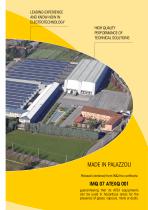
LEADING EXPERIENCE AND KNOW-HOW IN ELECTROTECHNOLOGY HIGH QUALITY PERFORMANCE OF TECHNICAL SOLUTIONS MADE IN PALAZZOLI Palazzoli obtained from IMQ the certificate IMQ 07 ATEXQ 001 guaranteeing that its ATEX equipments can be used in hazardous areas for the presence of gases, vapours, mists or dusts.
Open the catalog to page 3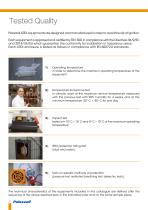
Tested Quality Palazzoli ATEX equipments are designed and manufactured in order to avoid the risk of ignition. Each equipment is approved and certified by TÜV SÜD in compliance with the Directives 94/9/EC and 2014/34/EU which guarantee the conformity for installation in hazardous areas. Each ATEX enclosure is tested as follows in compliance with EN 60079-0 standards: Operating temperature in order to determine the maximum operating temperature of the equipment. Temperature Endurance Test in climatic room at the maximum service temperature measured with the previous test with 90% humidity for...
Open the catalog to page 4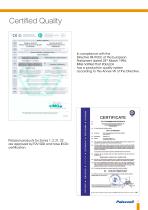
Certified Quality Palazzoli products for Zones 1, 2, 21, 22 are approved by TUV SUD and have lECEx Parliament dated 23rd March 1994, IMQ notified that Palazzoli has a production quality system according to the Annex VII of the Directive. EC-TYPE i^imuncHniinw M u1 Pa 4pk| *plfi~M M PUUM MH P JUOM4I El PP. DPJH kML
Open the catalog to page 5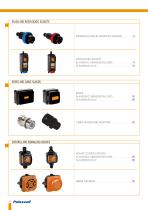
PLUGS AND INTERLOCKED SOCKETs INDUSTRIAL PLUGS in antistatic material INTERLOCKED SOCKETs IN antistatic THERMOSETTING (GRP) IN ALUMINIUM ALLOY BOXES AND CABLE GLANDS BOXES IN antistatic THERMOSETTING (GRP) IN ALUMINIUM ALLOY CABLE GLANDS AND adaptors CONTROL AND SIGNALLING DEVICES ROTARY CONTROL DEVICES IN antistatic THERMOSETTING (GRP) IN ALUMINIUM ALLOY
Open the catalog to page 6
SMALL CONTROL DEVICES SMALL CONTROL DEVICES IN antistatic THERMOSETTING (GRP) IN ALUMINIUM ALLOY oval and round bulkhead lamPS IN ALUMINIUM ALLOY LIGHTING FIXTURES IN STAINLESS STEEL ELECTRICAL INSTALLATIONS IN ATEX LIGHTING DEVICES PALAZZOLI ACADEMY Palazzoli Academy ELECTRICAL INSTALLATIONS IN ATEX
Open the catalog to page 7
CEE-EX Series Zones 2, 21, 22 industrial plugs in antistatic material Conformity to standards ATEX execution ATEX Directives 94/9/EC and 2014/34/EU EN 60079-0:2012 + A11:2013 EN 60079-15:2010 EN 60079-31:2014 Directive 2006/95/EC EN 60309-1:1999 + A1:2007 EN 60309-2:1999 + A1:2007 + A2:2012 II 3G 2D Ex nA IIC T6 Gc Ex tb IIIC T 65 °C Db Body material Surface resistivity Low voltage watertight straight plugs, IEC EN 60309-1 and IEC EN 60309-2 standard, suitable for applications in areas at risk of explosive atmospheres as defined in ATEX Directives 94/9/EC and 2014/34/EU.The body of the plug is...
Open the catalog to page 8
PLUGS AND INTERLOCKED SOCKETS SUITABLE FOR ZONES 2 (GAS) AND 21-22 (DUST) CEE-EX SERIES Plugs with cable gland Rated Rated Voltage Poles h Palazzoli Pack current voltage colour ref. code Q.ty CEE-EX SERIES Plugs with cable gland Rated Rated Voltage Poles h Palazzoli Pack current voltage colour ref. code Q.ty Characteristics: nickel plated pins in one single unit, contact holder insert made of thermosetting
Open the catalog to page 9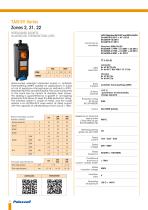
TAIS-EX Series Zones 2, 21, 22 INTERLOCKED SOCKETS IN ANTISTATIC THERMOSETTING (GRP) Conformity to standards ATEX Directives 94/9/EC and 2014/34/EU EN 60079-0:2012 + A11:2013 EN 60079-15:2010 EN 60079-31:2014 Directive 2006/95/EC EN 60309-1:1999 + A1:2007 + A2:2012 EN 60309-2:1999 + A1:2007 + A2:2012 EN 60309-4:2007 + A1:2012 II 3G 2D ATEX execution Wall-mounted watertight interlocked sockets in antistatic thermosetting (GRP) suitable for applications in areas at risk of explosive atmospheres as defined in ATEX Directives 94/9/EC and 2014/34/EU. The cover is attached to the back box by means...
Open the catalog to page 10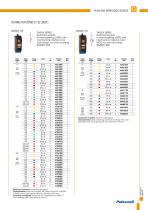
PLUGS AND INTERLOCKED SOCKETs SUITABLE FOR ZONEs 21-22 (DUST) TAIS-EX SERIES Switched sockets in thermosetting (GRP) with mechanical interlock and fuse-holder, for wall mounting 50-60Hz IP66 Voltage colour Palazzoli code 63 entry M40 fuses E33 DIII TAIS-EX SERIES Switched sockets in thermosetting (GRP) with mechanical interlock and MCB, for wall mounting 50-60Hz IP66 Voltage colour Palazzoli code Equipment included: insulated cable gland. Characteristics: lamp indicating presence of voltage. The code 464722EX have cable gland with entry diameter 16-26 mm. Equipment included: insulated cable gland....
Open the catalog to page 11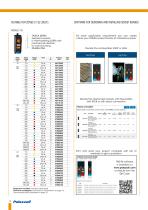
SUITABLE FOR ZONEs 21-22 (DUST) software for DESIGNing AND INSTALLing SOCKET BOARDS MODULE 125 For each application requirement you can create online your TAIS-EX socket boards for hazardous areas. TAIS-EX SERIES Switched sockets in thermosetting (GRP) with mechanical interlock, for wall mounting 50-60Hz IP66 Decide the combustible: DUST or GAS. Voltage colour Palazzoli code Equipment included: insulated cable gland. Technical accessories: enclosures for compositions at page 12. Thermosetting (GRP) backplate at page 12. Decide the interlocked sockets: with fuse-holder, with MCB or with direct...
Open the catalog to page 12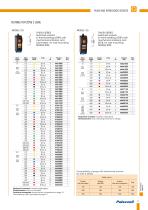
PLUGS AND INTERLOCKED SOCKETs SUITABLE FOR ZONE 2 (GAS) TAIS-EX SERIES Switched sockets in thermosetting (GRP) with mechanical interlock and fuse-holder, for wall mounting 50-60Hz IP66 Voltage colour Palazzoli code Equipment included: insulated cable gland. Characteristics: fuses not included. Technical accessories: enclosures for compositions at page 12. Thermosetting (GRP) backplate at page 12. TAIS-EX SERIES Switched sockets in thermosetting (GRP) with mechanical interlock and MCB, for wall mounting 50-60Hz IP66 Voltage colour Palazzoli code Equipment included: insulated cable gland. Characteristics:...
Open the catalog to page 13All Palazzoli S.p.A. catalogs and technical brochures
 Tunnel 2013
12 Pages
 General Catalogue 2014/2015
466 Pages
 Rino series
8 Pages
 cam-st series
8 Pages
 energybox
16 Pages
 TAIS CUBE
12 Pages
 General Catalog 2011 - 2012
468 Pages
 MARINE selection
34 Pages
 INSTALLATION selection
224 Pages
 ATEX selection
48 Pages
 TopTER
12 Pages
 Company profile
18 Pages
 Book reference
80 Pages
- Single-pole switch
- Cylindrical cap
- Technology switch
- Isolator switch
- Multipole switch
- Electromechanical switch
- Protective cap
- Rotary electric switch
- Fuse box
- Rocker switch
- Multipole disconnect switch
- Electrical cabinet
- Electrical socket
- IP65 switch
- Floor-mounted electrical cabinet
- Plastic electrical enclosure
- Siren without beacon
- Waterproof siren
- Fixed electrical socket
- Electrical plug