
- Catalogs
- Pal system
- PAL_SPME Fibers

PAL_SPME Fibers
PAL_SPME Fibers
Catalog excerpts

Ingenious sample handling
Open the catalog to page 1
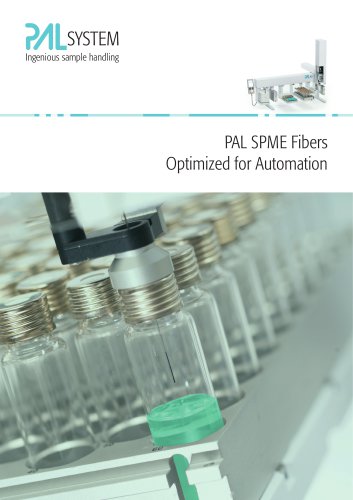
PAL SPME Fiber Since its introduction by Pawliszyn et al. (ref. 1) Solid Phase Micro Extraction (SPME) has seen a tremendous development. SPME is a very effective way of automated sample preparation. It is used for extracting organics from a matrix (solid, liquid or gaseous) into a stationary phase immobilized on a fiber. The analytes are thermally desorbed directly in the injector of a gas chromatograph. Originally mostly used for extracting solvents with excellent sensitivities from aqueous matrices the range of applications today spans from chemical and environmental to medical applications....
Open the catalog to page 2
PAL SPME Fiber Order Information The PAL SPME Fibers are available in order quantities of one, three or five fibers per box. For method development, a set of each fiber type (set of five) is available. Phase Color Code Supelco Color Code PDMS Fiber (Polydimethylsiloxane) - nonpolar 7 µm Green Plain Yellow Plain White Plain Black Plain Polyacrylate Fiber (PA) - polar 85 µm Carbon WR Fiber / PDMS (Carbon Wide Range / PDMS) - bi-polar 95 µm Dark Blue Fiber Collection – Development Kit (1 Fiber of each Fiber Type | Set of 5 ) various Fiber Collection FIB-SEL5-S1 (one of each type) Table 1: PAL SPME...
Open the catalog to page 3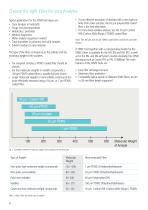
Choose the right Fiber for your Analytes • For an effective extraction of analytes with a very high polarity from polar samples, the 85 μm polyacrylate-coated fiber is the best alternative. • For trace-level volatiles analysis, use the 95 μm Carbon WR (Carbon Wide Range / PDMS) coated fiber. Typical applications for the SPME technique are: • Trace Analysis in foodstuffs • Drugs and pharmaceuticals • Herbicides / pesticides • Medical diagnostics • Water analysis (organics in water) • Trace impurities in polymers and solid samples • Solvent residues in raw materials Note: The 100 µm and 30 µm PDMS-coated...
Open the catalog to page 4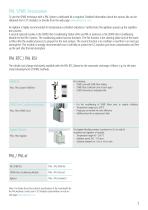
PAL SPME Accessories To use the SPME technique with a PAL System a dedicated kit is required. Detailed information about the various kits can be obtained from CTC Analytics or directly from the web page www.palsystem.com. An Agitator is highly recommended for temperature controlled extractions. Furthermore the agitation speeds up the equilibration process. A second optional module is the SPME Fiber Conditioning Station (PAL and PAL-xt Systems) or the SPME Fiber Conditioning Module for the PAL3 System. The conditioning station has two functions. The first function is the cleaning (bake-out) of...
Open the catalog to page 5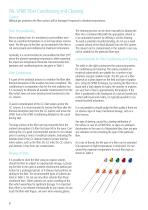
PAL SPME Fiber Conditioning and Cleaning Caution: Without gas protection the fiber surface will be damaged if exposed to elevated temperatures. Fiber Preconditioning Prior to analytical use, it is mandatory to precondition each fiber at a specified temperature in an inert gas phase environment. The life span of the fiber can be extended if the fiber is not unnecessarily preconditioned at maximum temperature. Generally, it is recommended to precondition the fiber 20°C above the planned operating temperature, while respecting the maximum temperature threshold. Recommended temperatures and conditioning...
Open the catalog to page 6
Stationary Maximum Recommended Preconditioning Preconditioning Phase Temp. (°C) Operating Temp. (°C) Time (min.) Fiber Type Temp. (°C) Min. | Max. Min. | Max. Conditioning Conditioning Fiber Rinsing Fiber Rinsing Temp. (°C) Time (min.) Solvent Time (min.) PDMS Fiber (Polydimethylsiloxane) Acrylate Fiber (Polyacrylate) 300 Carbon WR Fiber/ PDMS (Carbon Wide Range / PDMS) EtOH iProp Table 3: Parameters for PAL SPME Fibers. MeOH = Methanol EtOH = Ethanol iProp = Iso-Propanol (2-Propanol) aliphatic HC = aliphatic hydrocarbons (example n-Hexane)
Open the catalog to page 7
For more information on the PAL System visit: PAL is a registered trademark of CTC Analytics AG, Switzerland Part No. PAL Broch-SPME | Rev 1 - March 2015
Open the catalog to page 8All Pal system catalogs and technical brochures
 PAL-xt Systems
10 Pages
 PAL Systems Specifications
8 Pages
 PAL DeCapper Module
2 Pages
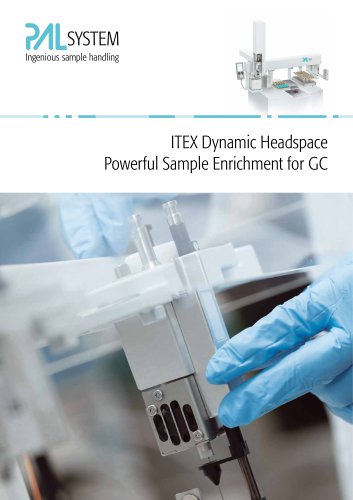
 ITEX Dynamic Headspace
12 Pages
 PAL LSI
8 Pages
 PAL COMBI-xt brochure
20 Pages
 PAL HPLC Accessories catalogue
20 Pages
 PAL DLW
7 Pages
 GC Accessories
14 Pages
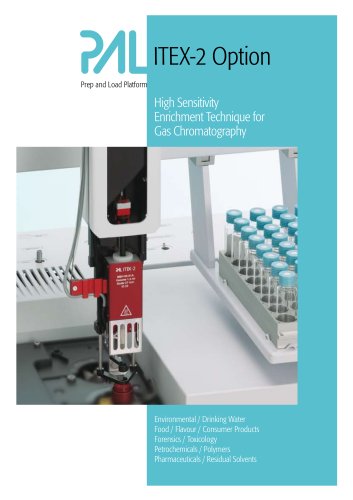 PAL ITEX-2
8 Pages
 PAL RTC
16 Pages


Archived catalogs
 PAL_SPME Arrow
12 Pages
 PAL RTC / RSI
24 Pages
 PAL GC-xt brochure
6 Pages
 PAL DLW brochure
7 Pages
 PAL HPLC-xt brochure
20 Pages
- Dynamic agitator
- Chiller
- Automation software solution
- Management software solution
- Automatic cleaning system
- Process software
- Control software
- Liquid homogenizer
- Industrial software
- Interface software
- Laboratory shaker
- Development software
- Laboratory centrifuge
- Test software
- Vertical centrifuge
- Data acquisition software
- Solvent cleaning system
- Benchtop centrifuge
- Tool changer
- Automatic sampler