
- Catalogs
- Oxford Technical Solutions Ltd.
- Southern Cross University Case Study

- Company
- Products
- Catalogs
- News & Trends
- Exhibitions
Southern Cross University Case Study

Southern Cross University Case Study
Southern Cross University, as part of the Reef Restoration and Adaptation Program (RRAP), aimed to estimate emissions from the Great Barrier Reef under various conditions. This required integrating data from a sonic anemometer and an Inertial Measurement Unit (IMU) to calculate wind speed.
- Compensating for ship movement using IMU data to obtain accurate wind speed measurements.
- Synchronizing data from different sensors to correctly combine datasets.
- Simplifying the data processing workflow.
Airborne Research Australia recommended using the OXTS xNAV650 GNSS/INS. Southern Cross University collaborated with IMS, an Australian OXTS channel partner, to facilitate the commercial process. The xNAV650’s MEMS IMU accurately measured ship motion, and the GNSS/INS was configured to align with the sonic anemometer's location, simplifying data processing. The IMU also output a PPS signal for time synchronization between instruments.
The OXTS technology enabled the team to gather necessary data, allowing accurate modeling of emissions and their impact on the local climate.
- Position accuracy: 0.02 m (RTK/PPK)
- Roll/pitch accuracy: 0.05°
- Heading accuracy: 0.01°
- Data processed using NAVsuite
Liz Deschaseaux from RRAP highlighted the reliability and accuracy of the xNAV650, which significantly improved data collection capabilities.
Catalog excerpts

CASE STUDY Southern Cross University Southern Cross University partners with multiple organisations to embark on a coral reef restoration project using an OXTS GNSS/INS. PROJECT AIM Southern Cross University, a partner in the Reef Restoration and Adaption Program (RRAP), wanted to estimate the emission of specific compounds from the Great Barrier Reef under a variety of conditions. To do this, they needed to combine data from their sonic anemometer (which records three-dimensional wind velocity) with data from an Inertial Measurement Unit (IMU) to calculate wind speed. SUMMARY Company: Southern Cross University Industry: Environmental Science Country: Australia Website: www. scu.edu.au + Use data from an IMU to compensate for the movement of the ship carrying the sonic anemometer in order to get a clear measurement of wind speed. OXTS Hardware: + Synchronise the data from each sensor in order to combine the two datasets correctly. + Configure the system to make the data processing workflow as simple as possible. xNAV650 GNSS/INS OXTS Software: NAVsuite Industrial Measurement
Open the catalog to page 1
The system, using OXTS technology, worked as expected and allowed the team to gather the data they required. Feeding the wind speed data into their models allowed the team to accurately model the emissions under different conditions, and the impact of those emissions on the local climate. THE SOLUTION One of the collaborators on the project, Airborne Research Australia (ARA), suggested that the university use an OXTS xNAV650 GNSS/INS. Southern Cross University contacted Australian OXTS channel partner IMS, who helped them navigate the commercial process. The xNAV650’s MEMS IMU allowed Southern...
Open the catalog to page 2All Oxford Technical Solutions Ltd. catalogs and technical brochures
 Panpro Case Study
2 Pages
 Dronezone SRL Case Study
2 Pages
 Ordnance Survey Case Study
2 Pages
 xRED GNSS/INS
2 Pages
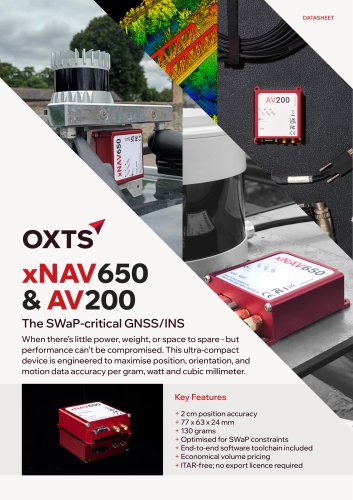 xNAV650 / AV200 GNSS/INS
2 Pages
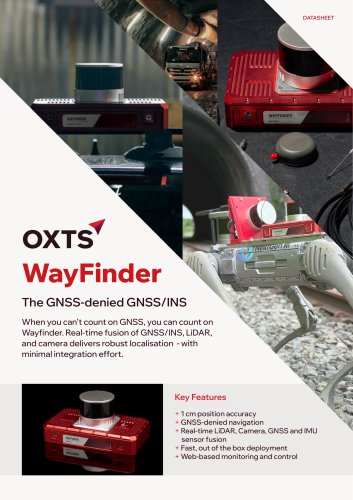 WayFinder Navigation System
2 Pages
 RT3000 v4 DO-160 GNSS/INS
2 Pages
 RT1003 v2 GNSS/INS Datasheet
2 Pages
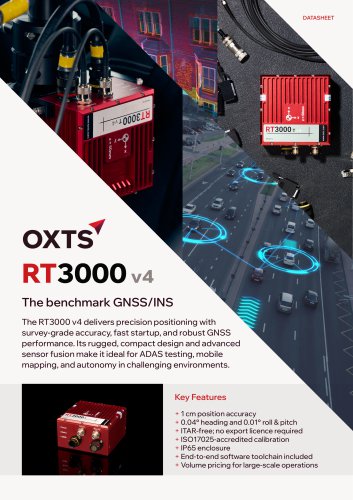 RT3000 v4 GNSS/INS Datasheet
2 Pages
- OXTS inertial navigation system
- OXTS GNSS inertial navigation system
- High-accuracy inertial navigation system
- Lightweight inertial navigation system
- Miniature inertial navigation system
- UAV inertial navigation system
- Inertial navigation system with integrated GPS
- ITAR-free inertial navigation system
- CAN inertial navigation system
- OEM inertial navigation system
- Ethernet inertial navigation system
- Built-in inertial navigation system
- Serial inertial navigation system
- TTL inertial navigation system