
- Catalogs
- Ox Worldwide
- OX WORLDWIDE CATALOG


OX WORLDWIDE CATALOG

OX WORLDWIDE CATALOG
The manual from Ox Worldwide provides comprehensive guidelines on maintenance, checking points, and inspection procedures, ensuring all products are delivered with appropriate instructions.
Each unit features an identity label with model, manufacturer, serial number, SWL (Safe Working Load), year of manufacturing, and CE conformity.
Products are designed and manufactured under strict quality control, with periodic inspections and certifications by Lloyd Register Quality Assurance.
Products come with a certificate of conformity, ensuring compliance with European community safety and health standards.
The company operates an industrial facility in Sant Boi de Llobregat, Barcelona, Spain.
Ox Worldwide specializes in designing and producing handling equipment with high standards of quality and safety, including self-propelled trolleys, spreader beams, lifting beams, C hooks, motorized trolleys, and turning devices.
These trolleys consist of a front rotating traction car and fixed rear trolleys, capable of carrying large loads with polyamide wheels. They are controlled via radio or auxiliary cable control, with a maximum speed of 5m/min. Two ranges are available: OX-ST (three-phase electric) and OX-TBC (electro-hydraulic and battery-powered).
Powered by a three-phase electric supply, these trolleys require an external lifting system to place loads. They are the most economical option, available in capacities from 30t to 200t.
This model operates with either three-phase mains or batteries and includes a hydraulic pump for lifting and wheel rotation. Capacities range from 30t to 150t.
- Self-Propelled Trolleys: Rotate 360 degrees, powered by 380 VAC III 50 Hz or battery modules, featuring chain and pinion drive in every wheel, with remote and auxiliary cord controls. The main hydraulic cylinder can lift loads by 70 mm, and speed is adjustable up to 5 m/min.
- Rotating Trolleys: Designed for loads between 3.2 to 6 tons, rotate 360 degrees, can be combined with manual trolleys, have polyamide wheels, and require the load to cover at least 70% of the support surface.
- Manual Trolleys: Econ-Line trolleys have load capacities of 3000 kg, 6000 kg, and 12000 kg, featuring galvanized pulling bars and robust welding technology. Rollers are made from polyurethane and polyamide, with optional Vulkollan rollers available.
- Customers can customize trolleys with different RAL paint colors, company logos, and modifications such as automatic guidance systems.
- Accessories include transport boxes, polyurethane wheels, and auxiliary battery boxes for extended use.
- All trolleys are equipped with antiskid rubber load pads and are compatible with common transport systems due to their low height of 110 mm.
- Rotating trolleys have central and lateral holes for securing loads and manipulating the trolley when empty.
- For slippery floors, it is recommended to use polyurethane wheels in combination with polyamide wheels for better traction.
- The transported load should be two-thirds of the trolley's capacity to prevent overloading.
The document provides a detailed description of mobile platforms used for transporting heavy loads, such as coil cars and autonomous vehicles, applicable in various industries including heavy industry, automotive, steel mills, and wind power.
- Conventional Movement: Rear-wheel drive with a steering axle and a drive axle.
- Dual Axis Movement: Both axes are directive and motorized simultaneously.
- Omnidirectional Movement: Multi-wheeler type with independent traction and rotation for movement in all directions.
- Hose Reel: Suitable for short or long travel, with options for motorized reels for extended distances.
- Batteries: Sized based on expected usage hours, with options for full shift recharging or flotation charging systems.
- Magnetic Induction: Non-contact power from a buried cable, allowing for complex routing and integration with SCADA systems.
- Speed: Standard speed is 20m/min, adjustable between 10 to 30m/min.
- Capacity: Designed to handle slopes up to 3º, with options for more demanding capacities.
- Control: Includes cable control pendants and radiofrequency joystick controls.
- Safety: Active safety through operator control, with passive safety systems varying by work area. Options for laser detection systems for enhanced safety.
Additional features include lifting, turning, weighing, hydraulic drive, and custom design based on track width. Finite element analysis is available for precise calculations.
These modular beams offer mobility and versatility for lifting heavy loads, with capacities ranging from 9 to 1350 tons. They are designed for easy assembly, reduced transportation costs, and compliance with European safety standards.
Made from structural steel with a zinc phosphate epoxy primer and polyurethane enamel finish. Complies with European machinery and electromagnetic compatibility directives.
DNV-GL quality certification for spreader beams, ensuring adherence to high-quality standards.
The document outlines various models of lifting beams and suspension elements used in crane operations. The lifting speed is specified at 20m/min. The document emphasizes the importance of understanding the crane type and the load's center of gravity when selecting suspension elements.
1. Top Suspension Elements: Used to connect the lifting beam to the crane, recommended for loads with both stable and variable centers of gravity. Options include fixed top suspensions with various configurations to adjust the center of gravity.
2. Bottom Suspension Elements: Can be fixed or adjustable, with options for weldable hooks and multi-eye sheets. They can be duplicated or combined for stability.
1. Standard Beam: Composed of a tube or beam with welded suspension elements. Common configuration includes a simple top eye and two bottom eyes.
2. Adjustable Beam: Features displaceable elements for length regulation. Ensures the center of gravity is centered before lifting.
3. Fixed H Type Beam: H-shaped structure with welded suspension elements. Can be designed to be demountable for transport and storage.
4. Adjustable H Type Beam: Allows regulation in transverse and longitudinal directions. Can be demountable for easier transport.
The document includes tables listing various models, dimensions, weight capacities, and codes for different types of beams and suspension elements. These tables provide detailed specifications for each model, including weight limits and dimensions.
For optimal performance, it is crucial to select the appropriate suspension elements based on the crane type and load characteristics. The document suggests consulting for other models if needed.
The document details various types of lifting beams, including adjustable 'H' beams, rectangular beams, cross beams, swivel spreaders, telescopic beams, and spreader containers. Each type has specific configurations and applications, such as handling 'big-bags' or maritime containers.
These beams are H-shaped with movable suspension elements, adjustable transversely, longitudinally, or both. They are designed for easy transport and storage.
Heavier beams designed for applications requiring more lifting points, with four sides for welding suspension elements.
Ideal for handling 'big-bags', these beams have a welded cross-shaped structure with fixed suspension elements.
These beams can be fixed, adjustable, or telescopic, featuring a motorized rotating crown for stable movement, typically used with two cranes.
Extensible and adjustable, composed of a central tube and lateral tubes for length modification. They require alignment of the center of gravity before lifting.
Designed for the maritime sector, these beams can handle containers from the top using twistlocks or a fixed beam with chains for different container sizes.
- Maximum and minimum dimensions for each beam type.
- Weight Load Limit (WLL) and model codes for identification.
Choose beam types based on specific lifting needs, considering factors like weight, number of lifting points, and application environment.
The document provides detailed information about the various types of beams and accessories manufactured by OX Worldwide, focusing on their Eco-Beams and C & J type hooks. It highlights the specifications, customization options, and compliance with European standards.
- The Eco-Beam is an economical and fast-delivery lifting beam available in capacities from 1 to 10 tons and lengths from 1000 to 4000 mm. It features a fixed structure with a central lifting point and two drop links.
- Materials used include S275 and S355 steel, with options for laser or oxycutting for specific configurations.
- Surface preparation involves sandblasting and epoxy zinc phosphate coating, with additional polyurethane enamel layers.
- Eco-Beams can be quickly assembled from semi-manufactured stock, allowing for rapid customization to meet client needs.
- Accessories can be added to convert fixed beams into adjustable ones, providing flexibility for various lifting requirements.
- Products comply with European directives 2006/42/CE and 2014/30/UE, ensuring safety and electromagnetic compatibility.
- Manufacturing adheres to UNE-EN ISO 12100:2012, UNE-EN 13155:2004+A2:2009, and UNE-EN ISO 3834-2:2006 standards.
- A range of accessories is available, including adjustable lifting points, quick mounting bolts, and custom-made options for specific client needs.
- Custom accessories can include special hooks, legs, and forklift handling attachments.
- Clients are advised to specify any special requirements for color or additional protective coatings during the ordering process.
- For optimal use, select appropriate accessories based on the specific lifting and handling needs.
- Designed for lifting and transporting coils with a self-balanced structure and minimal height loss.
- Options include top fixation elements, polyethylene or polyurethane protections, and additional integrated functions like motorized rotating hooks.
- The document outlines various types of hooks and load handling equipment, including C-type hooks, J hooks, and load rotators.
- Materials used include high-density polyethylene (HDPE) for protection and structural and high-strength steel for construction.
- The equipment is suitable for high-temperature environments and features strong steel structures with integrated torque geared-motors.
- Power supply specifications include 380V 50Hz and 400V 50Hz, with features like anti-slip steel pulleys and minimal height loss.
- Various top fixation elements are available, such as single eye, pin, or 2-leg chain sling.
- Clamp protections can be customized based on the load to manipulate, with options for polyethylene or polyurethane coatings.
- Equipment can be oversized for high temperatures and designed with specific support stands.
- Custom dimensions and designs are available upon request.
- The equipment complies with European directives 2006/42/CE and 2014/30/UE, ensuring safety and electromagnetic compatibility.
- It adheres to standards such as UNE-EN ISO 12100:2012 for machinery safety and UNE-EN 13155:2004+A2:2009 for crane safety.
- J hooks are designed for lifting hollow, circular pieces like steel tubes and wind turbine sections, working in pairs for balanced lifting.
- Load rotators are ideal for heavy materials like glass, steel, and concrete blocks, minimizing risks associated with displaced centers of gravity.
- The equipment is suitable for industrial maintenance and can be used with various lifting accessories like polyester slings and roller chains.
- The document mentions options for radio control systems, adjustable handles, and weighing systems with high accuracy.
- Load sensors and light indicators are integrated for safe load manipulation.
- The equipment is designed for easy access to motors and electrical components, with features like drop-down doors.
The document describes Load Tilters, which are support platforms allowing pieces to be tilted up to 90 degrees, suitable for coils, palletized materials, and prismatic pieces like dies and molds. Special versions can tilt up to 180 degrees for plates or dies.
The chassis is made from mechanical construction steel, finished with sandblasting Sa 2.5 as per ISO 8503-2:2012 standards, and painted with a minimum quality C2, including an epoxy polyurethane primer and two layers of RAL 1028 color.
The equipment complies with European directives 2006/42/EC and 2014/30/EU, and adheres to harmonized standards UNE-EN ISO 12100:2012 for machine safety and UNE-EN ISO 3834-2:2006 for welding quality.
Options include an incorporated weighing system. Tilters can be driven by electric motor-reducer or electro-hydraulic drives, with security locks for the turn. They can accommodate various parts and capacities, with optional mooring systems and motorized elements for size adjustments.
Tilters can be equipped with protections for contact surfaces in materials like Polyamide 6 or Polyurethane. They offer multiple solutions for safe and agile maneuvering, including low platforms or ground-level installations with operator access gateways. Safety can be ensured with conventional fencing, laser perimeter barriers, or a combination of both.
External desks for safe maneuvering and integration of customer safety signals into the safety module are available. The equipment is designed for flexibility and safety in various industrial applications.
Catalog excerpts

GENERAL CATALOGUE CATALOGO GENERAL EQUIPAMIENTO ^ PARA GRAN DES _ . _ _ ___
Open the catalog to page 1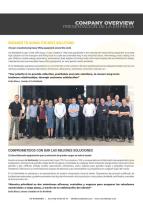
ENGAGED TO GIVING THE BEST SOLUTIONS 25 years manufacturing heavy lifting equipment around the world. Ox Worldwide is part of the CFB Group II was created in 1992 and specialized m the manufacture heavy lifting equipment to provide high solutions fa the transport and lifting loads in a safe and controlled way, in any industrial sector; wind energy, naval, railway, oil & gas. offshae. nuclear energy, automotive, aeronautical, steel, logistics fa heavy loads and small company We are dedicated to design, manufacture and commercialize heavy lifting equipment, fa very specific needs waldwide At Ox...
Open the catalog to page 2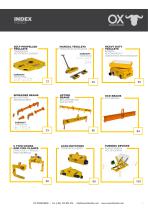
INDEX ÍNDICE SELF-PROPELLED TROLLEYS MANUAL TROLLEYS HEAVY DUTY TROLLEYS TANQUETAS MANUALES TANQUETAS AUTOPROPULSADAS CARROS AUTÓNOMOS Y CONJUNTOS MOTORIZADOS CAPACITY CAPACIDAD CAPACITY CAPACIDAD LIFTING BEAMS SPREADER BEAMS BALANCINES SEPARADORES ECO-BEAMS ECO-BEAMS CAPACITY CAPACIDAD C TYPE HOOKS AND COIL CLAMPS TURNING DEVICES LOAD ROTATORS PLATAFORMAS VOLTEADORAS GIRAPIEZAS AÉREO GANCHOS C Y PINZAS PARA BOBINAS OX WORLDWIDE | tel. (+34) 932 895 474 · [email protected] · www.oxworldwide.com
Open the catalog to page 3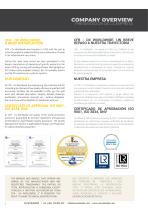
COMPANY OVERVIEW PRESENTACIÓN DE LA EMPRESA CFB - OX WORLDWIDE: A BRIEF INTRODUCTION CFB - OX WORLDWIDE: UN BREVE REPASO A NUESTRA TRAYECTORIA CFB - Ox Worldwide was founded in 1992 with the aim to solve the problems related to lifting and maintenance of loads in the industrial and navy areas. CFB - Ox Worldwide fue creada en 1992 con el objetivo de dar respuesta a las diferentes problemáticas de elevación y manutención de cargas en los sectores industriales y navales. During this wide track record we have specialized in the design, manufacturi nd marketing of specific products in the areas of...
Open the catalog to page 4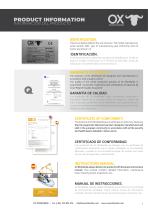
PRODUCT INFORMATION INFORMACIÓN DEL PRODUCTO There’s an identity label on the unit structure. The model, manufacturer, serial number, SWL, year of manufacturing and conformity with CE norms are shown in it. En la estructura de la unidad hay una placa de identificación. En ella se indica el modelo, el fabricante, el nº de serie, el CMU-SWL, el año de fabricación y la conformidad con las normas CE. The products of Ox Worldwide are designed and manufactured in accordance with a quality control. The quality of the whole productive process of Ox Worldwide is guaranteed by periodic inspections and...
Open the catalog to page 5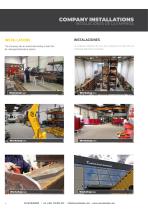
COMPANY INSTALLATIONS The company has an industrial building in Sant Boi de Llobregat (Barcelona, Spain). La empresa dispone de una nave industrial en Sant Boi de Llobregat (Barcelona, España). OX WORLDWIDE | tel. (+34) 932 895 474 · [email protected] · www.oxworldwide.com
Open the catalog to page 6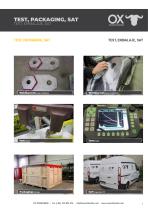
TEST, PACKAGING, SAT TEST, EMBALAJE, SAT Welding testEnsayo soldadura Welding testEnsayo soldardura OX WORLDWIDE | tel. (+34) 932 895 474 · [email protected] · www.oxworldwide.com
Open the catalog to page 7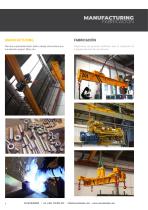
We have a specialized team, able to design and produce any manutention project. tilters, etc. Disponemos de personal cualificado para la realización de cualquier elemento de manutención. OX WORLDWIDE | tel. (+34) 932 895 474 · [email protected] · www.oxworldwide.
Open the catalog to page 8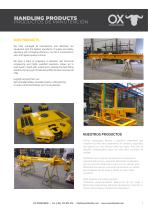
HANDLING PRODUCTS OUR PRODUCTS We have managed to manufacture and distribute our equipment with the highest standards of quality and safety, operating with increasing efficiency. For this it is essential to pass the highest quality controls. We have a team of engineers in elevation and structural engineering and highly qualified operators, allows us to work hand in hand with customers to develop the best lifting solutions for any type of load and proffer the best commercial offer. Highlight among them our: Self-propelled tolleys, Spreader beams, Lifting bemas, C hooks, Motorized trolleys and...
Open the catalog to page 9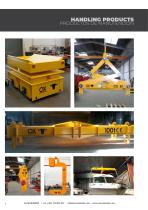
HANDLING PRODUCTS OX WORLDWIDE | tel. (+34) 932 895 474 · [email protected] · www.oxworldwide.com
Open the catalog to page 10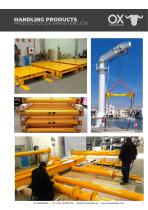
HANDLING PRODUCTS OX WORLDWIDE | tel. (+34) 932 895 474 · [email protected] · www.oxworldwide.com
Open the catalog to page 11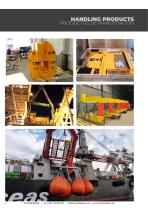
HANDLING PRODUCTS OX WORLDWIDE | tel. (+34) 932 895 474 · [email protected] · www.oxworldwide.com
Open the catalog to page 12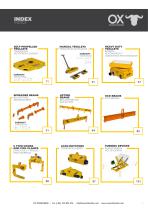
INDEX INDICE ox^rSELF-PROPELLED TROLLEYS TANQUETAS AUTOPROPULSADAS ;ot-2QQt SPREADER BEAMS BALANCINES SEPARADORES 31 MANUAL TROLLEYS TANQUETAS MANUALES LIFTING BEAMS BALANCINES DE ELEVACION HEAVY DUTY TROLLEYS CARROS AUTONOMOS Y CONJUNTOS MOTORIZADOS C TYPE HOOKS AND COIL CLAMPS GANCHOS C Y PINZAS PARA BOBINAS LOAD ROTATORS GIRAPIEZAS AEREO TURNING DEVICES PLATAFORMAS h VOLTEADORAS OX WORLDWIDE | tel. (+34) 932 895 474 • [email protected] • www.oxworldwide.com
Open the catalog to page 13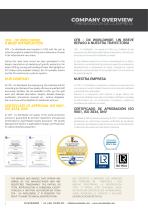
COMPANY OVERVIEW PRESENTACIÓN DE LA EMPRESA CFB - OX WORLDWIDE: A BRIEF INTRODUCTION CFB - OX WORLDWIDE: UN BREVE REPASO A NUESTRA TRAYECTORIA CFB - Ox Worldwide was founded in 1992 with the aim to solve the problems related to lifting and maintenance of loads in the industrial and navy areas. CFB - Ox Worldwide fue creada en 1992 con el objetivo de dar respuesta a las diferentes problemáticas de elevación y manutención de cargas en los sectores industriales y navales. During this wide track record we have specialized in the design, manufacturi nd marketing of specific products in the areas of...
Open the catalog to page 14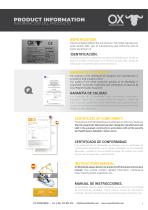
PRODUCT INFORMATION INFORMACIÓN DEL PRODUCTO There’s an identity label on the unit structure. The model, manufacturer, serial number, SWL, year of manufacturing and conformity with CE norms are shown in it. En la estructura de la unidad hay una placa de identificación. En ella se indica el modelo, el fabricante, el nº de serie, el CMU-SWL, el año de fabricación y la conformidad con las normas CE. The products of Ox Worldwide are designed and manufactured in accordance with a quality control. The quality of the whole productive process of Ox Worldwide is guaranteed by periodic inspections and...
Open the catalog to page 15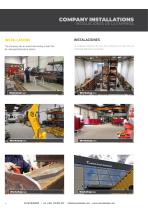
COMPANY INSTALLATIONS The company has an industrial building in Sant Boi de Llobregat (Barcelona, Spain). La empresa dispone de una nave industrial en Sant Boi de Llobregat (Barcelona, España). OX WORLDWIDE | tel. (+34) 932 895 474 · [email protected] · www.oxworldwide.com
Open the catalog to page 16All Ox Worldwide catalogs and technical brochures
 SPREADER BEAMS SB SERIES
33 Pages
 LOAD ROTATORS
4 Pages
 LIFTING BEAMS LB SERIES
24 Pages


- Self propelled trolley
- Lifting hook
- Metal hook
- Heavy load automated guided vehicle
- Electric self propelled trolley
- Safety hook
- Carrier
- Steel hook
- Industrial spreader
- Wheeled carrier
- Heavy load self propelled trolley
- Adjustable spreader
- Fixed spreader
- Electric rotator
- Hydraulic rotator
- Single-girder spreader
- Telescopic spreader beam