- Catalogs
- Otto Ganter GmbH & Co. KG
- Wheels and Casters

Wheels and Casters
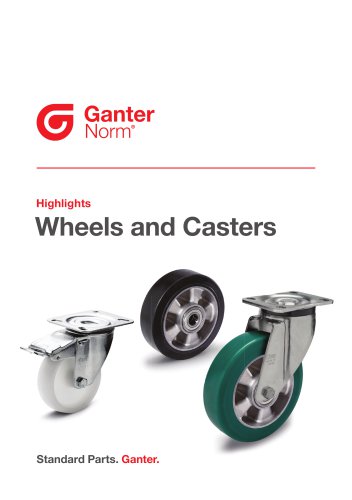
Wheels and Casters
This document provides comprehensive technical information on wheels and casters, detailing their structure, materials, types, and applications. It includes specifications for various wheel models, their applications, and the types of brackets used.
A wheel comprises several components: the contact surface, wheel tread, wheel core, bearing, and hub. The contact surface can be smooth or textured, while the wheel tread, made from materials like rubber or polyurethane, determines the wheel's application. The wheel core connects the tread to the bearing, and bearings and hubs facilitate rotation around a fixed axle.
Wheels are made from materials such as rubber, polyurethane, polyamide, and phenolic resin, each with distinct properties:
- Rubber: High elasticity, low noise, but high resistance and potential abrasion.
- Polyurethane: Low resistance, high elasticity, wear-resistant, and leaves no marks.
- Polyamide: Wear-resistant, low resistance, but can absorb moisture.
- Phenolic Resin: Heat resistant but lower wear resistance.
Brackets connect wheels to carts and come in swivel or rigid types. Swivel brackets allow for maneuverability, while rigid brackets maintain straight movement. Swivel brackets may include total lock brakes to prevent movement.
The document lists various wheel models (e.g., GN 22870, GN 22872) with specifications such as wheel diameter, load capacities, and suitable floor types. It also details the types of bearings used (friction or ball bearings) and the materials for wheel treads and cores.
Wheels are used in industrial and public areas for moving carts and equipment. They are designed to be gentle on floors, overcome obstacles, and provide quiet operation.
Each wheel model includes detailed specifications such as:
- Wheel diameter and dimensions
- Maximum load capacities (ergonomic, static, dynamic)
- Operating temperature ranges
- Material hardness (measured in Shore A or D)
The document provides a guide on how to order wheels, specifying the wheel diameter, bearing type, and model type.
- GN 22880 Wheels: Made with thermoplastic polyurethane tread and polyamide core, suitable for light-duty applications. Operating temperature: -5°C to +40°C.
- GN 22882 Wheels: Feature a polyurethane tread and polyamide core, available with friction or ball bearings. Operating temperature: -15°C to +80°C.
- GN 22884 Wheels: Designed with a polyurethane tread and polyamide core, suitable for medium-duty applications. Operating temperature: -15°C to +70°C.
- GN 22885 Wheels: Include an ESD version with antistatic properties, polyurethane tread, and aluminum core. Operating temperature: -20°C to +80°C.
- GN 22886 Wheels: Feature a polyurethane tread and aluminum core, suitable for medium to heavy-duty applications. Operating temperature: -20°C to +70°C.
- GN 22887 Wheels: Made with a polyurethane tread and cast iron core, designed for heavy-duty applications. Operating temperature: -20°C to +80°C.
- GN 22892 Wheels: Constructed from polyamide, suitable for medium-duty applications. Operating temperature: -30°C to +80°C.
- GN 22868 Pallet Truck Rollers: Feature a polyurethane tread and steel core, designed for heavy load movement. Operating temperature: -20°C to +80°C.
- GN 22870 Light Duty Casters: Made with a rubber tread and polypropylene core, suitable for light-duty applications. Operating temperature: -5°C to +40°C.
Each product is identified by a unique code that specifies the wheel diameter, bearing type, and additional features such as brackets or ESD properties. The document provides a structured format for ordering, ensuring the correct specifications are selected for the intended application.
The document includes references to technical information on operating conditions, plastic characteristics, and other relevant data to ensure proper selection and use of the wheels and casters.
- Low rolling resistance and high elasticity for efficient movement.
- Good wear and tear resistance for durability.
- Options for friction or ball bearings to suit different applications.
- ESD versions available for antistatic requirements.
- Wide range of operating temperatures to accommodate various environments.
The document provides detailed specifications for various types of wheels and casters used in industrial and public areas. Key materials include natural rubber, thermoplastic elastomer, and thermoplastic polyurethane for wheel treads, with cores made from polypropylene, polyamide, or aluminum. Brackets are typically made from zinc-plated steel sheet metal.
Instructions on how to order specific caster models are provided, detailing the necessary parameters such as wheel diameter, bearing type, bracket type, coding, and material.
The document mentions compliance with RoHS standards and provides operating temperature ranges for different caster types, ensuring suitability for various environments.
Different caster models are recommended based on their intended use, such as light duty for indoor areas and medium duty for both indoor and outdoor areas. The document highlights the benefits of low rolling resistance, high elasticity, and protection against floor damage.
Technical details include the hardness of wheel treads, dynamic load capacities, and the presence of features like dual grease-lubricated ball bearings and dust protection rings. Operating conditions and technical information are referenced on specific pages for further details.
Tables provide dimensions and load capacities for various caster types, indicating their suitability for different applications. For example, medium duty casters have dynamic load capacities ranging from 650 N to 5000 N, depending on the wheel diameter and type.
- 4 Rigid Casters, Identical Height: Commonly used in workshops and warehouses, offering good directional stability and cornering but poor maneuverability in tight spaces.
- 4 Swivel Casters, Identical Height: Ideal for supermarkets and logistics centers, providing excellent steering and maneuverability but poor straight travel.
- 1 Swivel Caster, 2 Rigid Casters, Identical Height: Suitable for small carts and light loads, offering cost-effectiveness and maneuverability but poor stability and a tendency to tip over.
- 4 Swivel Casters, 2 Rigid Casters, Identical Height: Used for heavy loads and long equipment, providing good load distribution and steering but at a high cost.
- 4 Rigid Casters, Middle Casters Higher: Used in assembly lines and industrial carts, offering cost-effectiveness and stability but a tendency to tip over.
- 2 Swivel Casters, 2 Rigid Casters, Rigid Casters Higher: Used in workshops and warehouses for long material carts, offering stability and maneuverability but a tendency to tip over.
- Static Load Capacity: Maximum load a stationary wheel or caster can support without permanent deformation.
- Dynamic Load Capacity: Maximum load a wheel or caster can withstand during movement, tested according to ISO 22878 – 22884 standards.
- Recommended Ergonomic Maximum Load: Determined by a pulling or pushing force of 200 N on a four-wheeled cart, equating to 50 N per wheel at a speed of 4 km/h.
- Light Duty Casters: Tested at speeds up to 4 km/h.
- Medium/Heavy Duty Casters: Tested at speeds over 4 km/h, with specific conditions for obstacle height and number.
- Temperature Range: +15 °C to +28 °C.
- Floor Conditions: Hard and horizontal with obstacles.
The required load capacity per wheel is calculated by adding the maximum applied load to the empty weight of the cart and dividing by the number of wheels. For a cart with 4 wheels, the total load capacity should be divided by 3 to account for uneven load distribution.
Catalog excerpts
Standard Parts. Ganter.
Open the catalog to page 1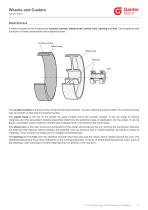
Wheels and Casters General Notes Wheel Structure A wheel consists of the components contact surface, wheel tread, wheel core, bearing and hub. The properties and functions of these components are explained below. The contact surface is the part of the wheel that touches the floor. It is also referred to as the profile. The contact surface may be smooth or textured to increase traction. The wheel tread is the tire of the wheel. Its outer surface forms the contact surface. It can be made of various materials, and the associated material properties determine the potential areas of application for...
Open the catalog to page 3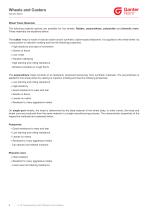
Wheels and Casters General Notes Wheel Tread, Materials The following material options are available for the wheels: Rubber, polyurethane, polyamide and phenolic resin. These materials are explained below. The rubber tread is made of natural rubber and/or synthetic rubber-based elastomer. It is applied to the wheel either via vulcanization or injection molding and has the following properties. + High elasticity and ease of movement + Gentle on floors + Low-noise + Vibration-damping - High starting and rolling resistance - Abrasion possible on rough floors The polyurethane tread consists of an...
Open the catalog to page 4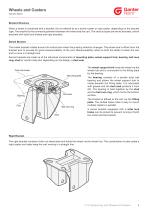
Wheels and Casters General Notes Bracket Structure When a wheel is combined with a bracket, this is referred to as a swivel caster or rigid caster, depending on the bracket type. The bracket is the connecting element between the wheel and the cart. The various types are swivel brackets, swivel brackets with total lock brakes and rigid brackets. Swivel Bracket The sviwel bracket rotates around its vertical axis when the pushing direction changes. The wheel axle is offset from the bracket axis to provide for good maneuverability of the cart. Maneuverability refers to both the ability to steer the...
Open the catalog to page 5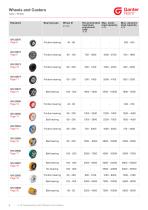
Wheels and Casters Types – Wheels Friction bearing Friction bearing Friction bearing Friction bearing Ball bearing Friction bearing Friction bearing Ball bearing Friction bearing Ball bearing Ball bearing Ball bearing Friction bearing Ball bearing Ball bearing Max. dynamic load capacity in N Bearing type Recommended Max. static load capacity maximum in N ergonomic load in N 3.10 Transporting with Wheels and Casters
Open the catalog to page 6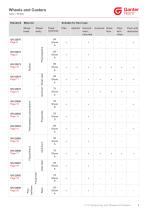
Types - Wheels 3.10 Transporting with Wheels and Casters 5
Open the catalog to page 7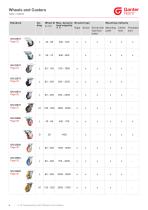
Types - Casters Standard Co- Wheel 0 Max. dynamic ding jn mm load capacity in N Bracket type 3.10 Transporting with Wheels and Casters
Open the catalog to page 8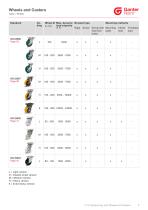
Types - Wheels Standard Co- Wheel 0 Max. dynamic ding jn mm load capacity in N Bracket type L = Light version D = Double wheel version M = Medium version H = Heavy version E = Extra-heavy version 3.10 Transporting with Wheels and Casters
Open the catalog to page 9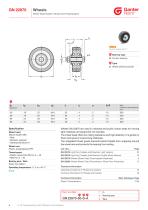
Wheels Wheel Tread Rubber, Wheel Core Polypropylene Bearing type A Wheel without bracket Specification Wheel tread Wheel core Thread guard Bearing pins / Nuts Steel, zinc plated Wheels GN 22870 are used in industrial and public indoor areas for moving light materials and equipment, for example. The wheel tread offers low rolling resistance and high elasticity. It is gentle on floors and good at overcoming obstacles. The integrated thread guard prevents textile threads from wrapping around the wheel axle and protects the bearing from soiling. GN 22870 Light Duty Casters (with Bracket, Light Version)...
Open the catalog to page 10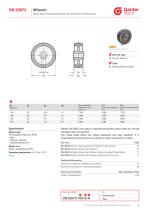
Wheels Wheel Tread Thermoplastic Elastomer, Wheel Core Polypropylene Bearing type A Wheel without bracket Wheel tread Wheel core Wheels GN 22872 are used in industrial and public indoor areas for moving transport carts, for example.The wheel tread offers low rolling resistance and high elasticity. It is characterized by quiet running, is gentle on floors and leaves no marks. see also... Page GN 22872 Medium Duty Casters (with Bracket, Light Version) 24 GN 22873 Wheels (Wheel Tread Rubber) 10 GN 22874 Wheels (Wheel Tread Rubber, Wheel Core Steel Sheet Metal) 11 GN 22875 Wheels (Wheel Tread Rubber,...
Open the catalog to page 11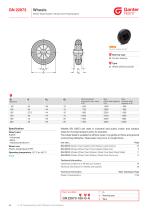
Wheels Wheel Tread Rubber, Wheel Core Polypropylene Bearing type A Wheel without bracket Wheel tread Wheel core Wheels GN 22873 are used in industrial and public indoor and outdoor areas for moving transport carts, for example.The wheel tread is suitable for all floor types. It is gentle on floors and good at overcoming obstacles. Tread wear may occur on rough floors. see also... Page GN 22873 Medium Duty Casters (with Bracket, Light Version) 25 GN 22872 Wheels (Wheel Tread Thermoplastic Elastomer) 9 GN 22874 Wheels (Wheel Tread Rubber, Wheel Core Steel Sheet Metal) 11 GN 22875 Wheels (Wheel...
Open the catalog to page 12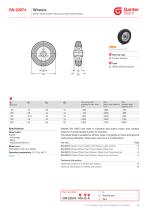
Wheels Wheel Tread Rubber, Wheel Core Steel Sheet Metal Bearing type A Wheel without bracket Specification Wheel tread Wheel core Steel sheet metal, zinc plated Wheels GN 22874 are used in industrial and public indoor and outdoor areas for moving transport carts, for example. The wheel tread is suitable for all floor types. It is gentle on floors and good at overcoming obstacles. Tread wear may occur on rough floors. GN 22874 Medium Duty Casters (with Bracket, Light Version) 26 GN 22872 Wheels (Wheel Tread Thermoplastic Elastomer) 9 GN 22873 Wheels (Wheel Tread Rubber, Wheel Core Polypropylene)...
Open the catalog to page 13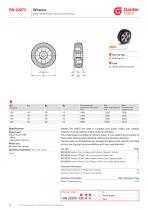
Wheels Wheel Tread Rubber, Wheel Core Aluminum Bearing type A Wheel without bracket Wheel tread Wheel core Aluminum die casting Wheels GN 22875 are used in industrial and public indoor and outdoor areas for moving medium weight carts, for example.The wheel tread is suitable for all floor types. It runs quietly and is gentle on floors while offering good obstacle clearing and vibration damping.The low wear on the ball bearing increases the service life, and the mounting to the inner ring can be accomplished with zero axial backlash. see also... Page GN 22875 Medium Duty Casters (with Bracket,...
Open the catalog to page 14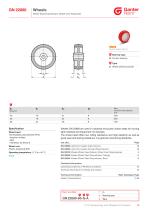
Wheels Wheel Tread Polyurethane, Wheel Core Polyamide Bearing type A Wheel without bracket Wheel tread • Injection molded Wheel core Plastic, polyamide (PA) Wheels GN 22880 are used in industrial and public indoor areas for moving light materials and equipment, for example.The wheel tread offers low rolling resistance and high elasticity as well as good wear and tearing resistance. It is good at overcoming obstacles. see also... Page GN 22880 Light Duty Casters (Light Version) 28 GN 22880 Light Duty Casters (Double Wheel Version) 29 GN 22870 Wheels (Wheel Tread Rubber, Wheel Core Polypropylene)...
Open the catalog to page 15All Otto Ganter GmbH & Co. KG catalogs and technical brochures
 Ganter Catalogue 18.0
2210 Pages
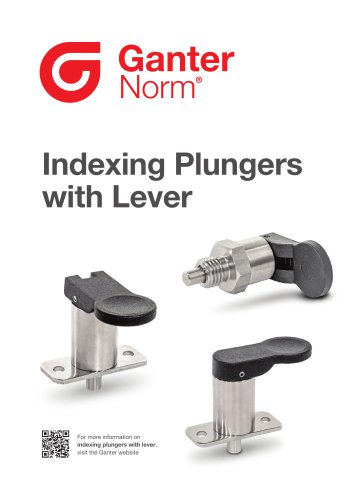 Indexing Plungers GN 823
4 Pages
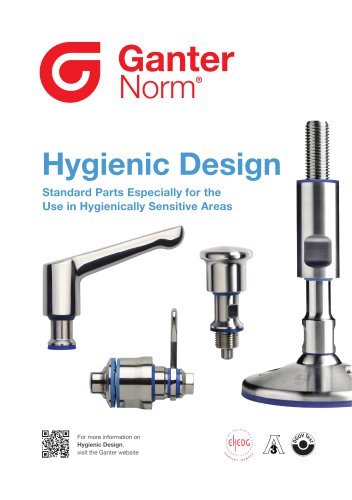 Hygienic Design
52 Pages
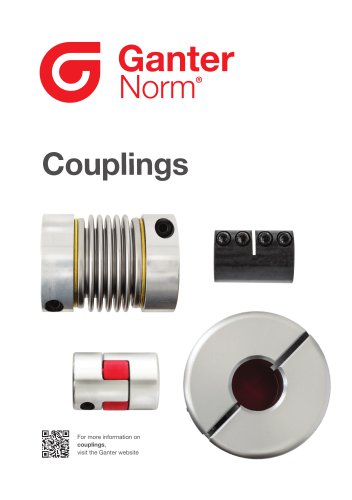 Couplings
36 Pages
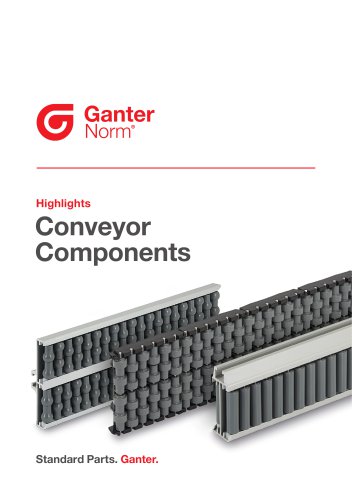 Conveyor Components
44 Pages
 Aluminium Profiles
72 Pages
 Signal Feedback Included
76 Pages
 Telescopic Slides
58 Pages
 Gears and Racks Made of Polyamid
20 Pages
 Quick Release Couplings
8 Pages
 Multiple-joint hinges
48 Pages