
- Catalogs
- Oscilloquartz SA
- OSA 6500B PRC - Primary Reference Clocks

OSA 6500B PRC - Primary Reference Clocks

OSA 6500B PRC - Primary Reference Clocks
The document discusses the OSA 6500B Primary Reference Clock (PRC) by Oscilloquartz, highlighting its role in network synchronization, which is crucial for telecommunications performance. The OSA 6500B is designed to meet and exceed international standards such as G.811, ETSI, and Telcordia, ensuring high precision and reliability.
Specifications
The OSA 6500B features a managed PRC with an interface to SyncView™, multiple Cesium primary references, and integrated GPS for UTC traceability. It offers ± 5x10-12 accuracy, supports single-site or distributed configurations, and provides over 112 outputs. The system includes input qualification with MTIE & TDEV and SSM handling.
Architecture and Functionality
The OSA 6500B is equipped with Cesium and GPS references, a synchronization element, output distribution, alarms, management, and power supplies. It includes the OSA 5548B Stand Alone Synchronisation Element (SASE) for cost-effective management. The system supports up to three Cesium primary references and offers an optional integrated GPS receiver. Reference selection is managed via a priority table, with remote control capabilities.
Output and Interface
The system delivers up to 112 unprotected or 64 protected outputs, expandable with OSA 5530B subracks. It supports various output interfaces, including 2.048 Mbit/s, 2.048 MHz, 1.544 Mbit/s, 5 and 10 MHz. Outputs can be individually squelched, and SSM handling is configurable.
Alarms and Monitoring
The OSA 6500B provides comprehensive alarm reporting and remote monitoring. An alarm panel displays urgent and non-urgent alarms, and a local management port allows system configuration and event monitoring.
Remote Management
An Embedded System Manager (ESM) offers extensive management capabilities, integrating with Oscilloquartz’s SyncView™ and Local Manager. It supports spontaneous alarm reporting, equipment configuration, and real-time MTIE & TDEV calculations.
Decentralized PRC Arrangement
The document emphasizes the benefits of a decentralized PRC arrangement for large or complex networks, enhancing reliability by synchronizing nodes from multiple sources. The OSA 6500B, combined with SyncView™, supports this distributed approach.
Conclusion
The OSA 6500B PRC is a robust solution for network synchronization, offering flexibility, high output capacity, and comprehensive management features. It is suitable for both centralized and decentralized network configurations.
Catalog excerpts
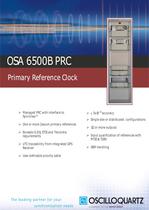
! Managed PRC with interface to SyncView™ ! One or more Cesium primary references ! Exceeds G.811, ETSI and Telcordia requirements ! UTC traceability from integrated GPS Receiver ! User definable priority table ! ± 5x10-12 accuracy ! Single site or distributed configurations ! 112 or more outputs ! Input qualification of references with MTIE & TDEV ! SSM handling OSA 6500B PRC Primary Reference Clock
Open the catalog to page 1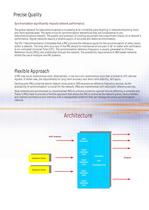
Synchronisation significantly impacts network performance. The global demand for telecommunications is increasing at an incredible pace resulting in networks becoming more and more sophisticated. The same is true for synchronisation elements as they are fundamental to any telecommunications network. The quality and precision of clocking equipment has a significant impact on a network’s performance. Digital networks require a reliable supply of accurate and stable synchronisation. The ITU-T Recommendation G.811 states that a PRC provides the reference signal for the synchronisation of other clocks...
Open the catalog to page 2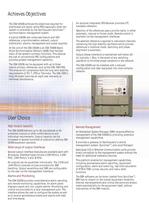
The OSA 6500B achieves the objectives required for distributed and stand-alone PRCs especially when the system is controlled by the Oscilloquartz SyncView™ synchronisation management system. A typical 6500B rack comprises Cesium and GPS references, a synchronisation element, output distribution, alarms, management and power supplies. At the core of the OSA 6500B is an OSA 5548B Stand Alone Synchronisation Element (SASE) that handles many of the system’s primary functions. This reduces the cost of conventional PRC configurations and provides greater management capability. The OSA 6500B can be...
Open the catalog to page 3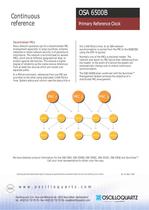
Continuous reference OSA 6500B Primary Reference Clock Decentralised PRCs Many telecom operators opt for a decentralised PRC arrangement especially in large countries, complex networks or where network security is of paramount importance. The network is synchronised by several PRCs, which are at different geographical sites, to protect against site failures. This ensures a higher degree of reliability as the nodes receive references from at least two sources which are routed over separate paths. In a PDH environment, references from one PRC are provided to the other using dedicated 2.048 Mbit/s...
Open the catalog to page 4All Oscilloquartz SA catalogs and technical brochures
 OSA 5405 series
4 Pages
 OSA 5410 series
6 Pages
 OSA 5420 series
6 Pages
 OSASyncViewPlus
2 Pages
 FSPSyncManager
2 Pages
 FSP
FSP2 Pages
 OSA 5051/5052 Dual Switch
2 Pages
 PARAGON-M
4 Pages
 OSA 5331 PTP Grandmaster
2 Pages
 OSA 5335 PTP Grandmaster
2 Pages
 OSA 5410/11 PTP Toolbox
3 Pages
 OSA 5240 GPS
2 Pages
 OSA 3235B Cesium Clock
2 Pages
 OSA 3030B EUDICS
4 Pages
 OSA 3230B Cesium Clock
2 Pages
 OSA 5581C GPS
4 Pages
 OSA 5335 PTP
2 Pages
 OSA 5548C TSG
2 Pages
 OSA 5210 Telecom GNSS Clock
2 Pages
 OSA 5225B Time Node
2 Pages
 3230-metro
2 Pages
 5130
51302 Pages
 5051-5052
2 Pages
 5030
50302 Pages
 5020
50202 Pages
 5225
52252 Pages
 3030
30304 Pages
 3700
37002 Pages
 5330
53302 Pages
 5533C
5533C4 Pages
 5135
51352 Pages
 5548c-tsg
4 Pages
 star3-4
2 Pages
 D5240_01
2 Pages
 D5230
D52302 Pages
 5200b
5200b2 Pages
 3230b
3230b2 Pages
 3230
32302 Pages
 3705
37052 Pages
 5585b
5585b4 Pages
 OSA 5220 NTP Server r2.0
2 Pages
 OSA 4501 OEM GPS Clock
2 Pages
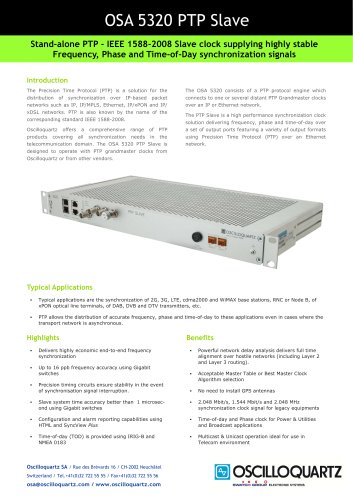 OSA 5320 PTP Slave
2 Pages
 OSA 5533C SDU
4 Pages
 OSA 4500 OEM Clock Series
2 Pages
 OSA 453x GPS/RTM Series
2 Pages


