
- Catalogs
- Oscilloquartz SA
- OSA 5565 STS - Synchronisation Test Set

OSA 5565 STS - Synchronisation Test Set

OSA 5565 STS - Synchronisation Test Set
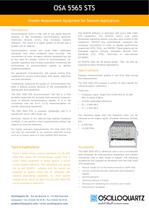
The OSA 5565 STS is a portable synchronization test set designed for telecom applications. It measures synchronization signals with high accuracy and complies with ITU-T O.172 standards. The device is essential for maintaining network efficiency and quality by proactively monitoring synchronization performance.
Typical Applications
The OSA 5565 STS is used to test synchronization outputs from public switch equipment against known references. It helps network operators and equipment manufacturers ensure compliance with industry standards and design objectives.
Main Functions
The device features a high-stability Rubidium oscillator for internal reference and can connect to external references like Cesium clocks for higher precision. It supports various input signals and provides real-time measurement graphs using the WinSTS software.
Specifications
- Internal Reference: Rubidium, 10 MHz frequency, long-term stability of 4x10-11/month.
- External Reference Input: 10 MHz via BNC connector.
- Measurement: Minimum sampling period of 12.5 ms, resolution of 100 ps, and a maximum range of ±100 µs.
- Environment: Operational temperature from 0°C to +45°C, storage temperature from -20°C to +50°C, and humidity below 95% non-condensing.
- Input/Output Signals: Accepts frequencies from 64 kHz to 16.384 MHz and outputs 10 MHz and 2.048 MHz signals.
- Technical: Operates on 115/230 VAC, dimensions of 145x275x400mm, and weighs 7.5 kg.
Accessories
The OSA 5565 STS comes with a passive coupler, various connecting devices, WinSTS software, an operating manual, and an accessory kit.
Software
The WinSTS software calculates and displays performance metrics like MTIE, TDEV, and MADEV. It supports data export and real-time graph display, compatible with Windows 98/NT/2000/XP.
Catalog excerpts
Oscilloquartz SA / Rue des Brévards 16 / CH-2002 Neuchâtel Switzerland / Tel.+41(0)32 722 55 55 / Fax+41(0)32 722 55 56 [email protected] / www.oscilloquartz.com OSA 5565 STS Wander Measurement Equipment for Telecom Applications Introduction Typical Applications Figure 1 below shows a typical application for the OSA 5565 STS, where the synchronization output from a public switch equipment is tested against a known synchronization reference. The calculations are carried out by the WinSTS software and the results are displayed as graphs which can be compared with relevant international standards. For more specific analysis of the result, all data from the OSA 5565 STS can be examined in table form. Synchronization forms a vital part of any digital telecom network. A well maintained synchronization backbone minimises network errors, thus increases network efficiency. The result is a higher quality of service and a greater use of capacity. Synchronization issues are quite often addressed reactively only when problems have occurred. The introduction of more stringent industry standards has led to the need for greater control of synchronization. For network operators this involves proactively monitoring the performance of synchronization signals to identify potential problems. For equipment manufacturers, this means testing their equipment to ensure conformance with design objectives and with standards. Traditionally, assessing the quality of synchronization has been a tedious process because of the unavailability of appropriate test equipment. The OSA 5565 STS Synchronization Test Set is a fully portable equipment for accurate high-resolution measurement of telecom synchronization signals. It is in full compliance with the ITU-T O.172 recommendation for wander measuring equipment. The OSA 5565 STS is compact, lightweight and it is operational 15min. after power up. Moreover, thanks to the internal high stability Rubidium oscillator, it can perform most measurements without the need of an external reference. For higher precision measurements, the OSA 5565 STS can also be connected to an external reference source such as a Cesium clock or a high stability GPS receiver. The WinSTS software is delivered with every OSA 5565 STS equipment. The WinSTS, which runs under Windows® operating system, provides local control of the equipment. WinSTS also automatically computes the necessary calculations in order to display performance graphs like MTIE, TDEV, and MADEV. These graphs can be evaluated against relevant templates derived from standards (ITU, ETSI, Telcordia) or user-defined templates. All WinSTS data can be stored locally. They can also be exported to other Windows applications. Displays measurements graphs in real time (also during the measurement). The OSA 5565 STS accepts a variety of input signals for reference and/or calibration. These are: Frequency input: range from 0.064 MHz to 16.384 MHz in steps of 8kHz 10 MHz (dedicated reference) E1 / 2.048 Mb/s T1 / 1.544 Mb/s The reference signal from the Rubidium clock can be retrieved as an output signal. Available reference formats are: 2.048 MHz 10.000 MHz Main Functions Accessories The OSA 5565 STS is delivered with a set of accessories that enhances its measurement capabilities and enables connection with a wide range of signals. The following accessories are supplied as standards with the OSA 5565 STS equipment: Passive coupler for in-line measurements on traffic links Various connecting devices, attenuator and impedance adapter WinSTS Software Operating Manual in English Accessory kit containing AC cord and a set of fuses Measurement templates
Open the catalog to page 1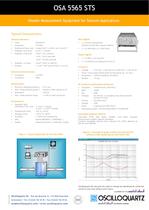
Ed.08 June 0 8/OR IS Oscilloquartz SA / Rue des Brévards 16 / CH-2002 Neuchâtel Switzerland / Tel.+41(0)32 722 55 55 / Fax+41(0)32 722 55 56 [email protected] / www.oscilloquartz.com Oscilloquartz SA reserves the right to change all spec ifications contained herein at any time without prior notice. Wander Measurement Equipment for Telecom Applications OSA 5565 STS Typical Characteristics Internal reference Type : Rubidium Frequency : 10 MHz Reference frequ. adj. : range 5x10⁻⁹ ± 20%, res .1.22x10-12 Stability, long term : 4x10-11 / month Stability, long term : 3x10-11 at 1 second 1x10-11...
Open the catalog to page 2All Oscilloquartz SA catalogs and technical brochures
 OSA 5405 series
4 Pages
 OSA 5410 series
6 Pages
 OSA 5420 series
6 Pages
 OSASyncViewPlus
2 Pages
 FSPSyncManager
2 Pages
 FSP
FSP2 Pages
 OSA 5051/5052 Dual Switch
2 Pages
 PARAGON-M
4 Pages
 OSA 5331 PTP Grandmaster
2 Pages
 OSA 5335 PTP Grandmaster
2 Pages
 OSA 5410/11 PTP Toolbox
3 Pages
 OSA 5240 GPS
2 Pages
 OSA 3235B Cesium Clock
2 Pages
 OSA 3030B EUDICS
4 Pages
 OSA 3230B Cesium Clock
2 Pages
 OSA 5581C GPS
4 Pages
 OSA 5335 PTP
2 Pages
 OSA 5548C TSG
2 Pages
 OSA 5210 Telecom GNSS Clock
2 Pages
 OSA 5225B Time Node
2 Pages
 3230-metro
2 Pages
 5130
51302 Pages
 5051-5052
2 Pages
 5030
50302 Pages
 5020
50202 Pages
 5225
52252 Pages
 3030
30304 Pages
 3700
37002 Pages
 5330
53302 Pages
 5533C
5533C4 Pages
 5135
51352 Pages
 5548c-tsg
4 Pages
 star3-4
2 Pages
 D5240_01
2 Pages
 D5230
D52302 Pages
 5200b
5200b2 Pages
 3230b
3230b2 Pages
 3230
32302 Pages
 3705
37052 Pages
 5585b
5585b4 Pages
 OSA 5220 NTP Server r2.0
2 Pages
 OSA 4501 OEM GPS Clock
2 Pages
 OSA 5320 PTP Slave
2 Pages
 OSA 5533C SDU
4 Pages
 OSA 4500 OEM Clock Series
2 Pages
 OSA 453x GPS/RTM Series
2 Pages


