

3705

3705
The OSA 3705 Passive Hydrogen Maser is a highly stable frequency reference device used primarily in telecommunication systems for synchronization. It offers an alternative to cesium-based references, with a longer expected lifetime of 20 years and low-cost hydrogen refurbishment.
Key Features
- Compliant with G.811/Stratum 1 standards for SDH/SONET synchronization.
- Provides standard outputs of 2.048/5/10/100 MHz and 1 PPS.
- Digital control and monitoring via LCD display and keypad.
- Three-year warranty on the physics package.
Applications
- Telecommunication systems.
- Reference for test equipment.
Principle of Operation
The maser operates by locking a quartz oscillator to the hydrogen atom emission frequency. The system uses a Frequency Locked Loop (FLL) processor to maintain stability and accuracy, converting FM signals into AM signals for precise frequency control.
Specifications
- Initial Frequency: ±2x10-12 (temperature range 5°C to 40°C).
- Accuracy: ±1x10-12 at 22°C ± 2°C.
- Frequency stability ranges from 2x10-12 at 1 second to 2x10-14 at 1 day.
- Long-term stability: ±6x10-14/month for the first 18 months.
- Magnetic sensitivity: < 2x10-14 (1/Oersted).
- Temperature coefficient: < 5x10-14 (1/°C).
Environmental Conditions
- Operational Temperature: +5°C to +40°C.
- Storage Temperature: 0°C to +50°C.
- Humidity: < 80% (max 35°C).
- EMC and Safety: Meets EN50081-1, EN50082-1, EN61010-1 standards.
Output Signals
- 5 MHz / 10 MHz / 100 MHz, 1 Vrms ± 0.2V, 50Ω.
- 2.048 MHz pulse, 2.5Vpp, 75 ohms.
- 1PPS, positive polarity TTL level, 50 ohms.
Phase Noise (at 5 MHz output)
- 10 Hz: -115 dB/Hz.
- 100 Hz: -135 dB/Hz.
- 1000 Hz: -145 dB/Hz.
- 10000 Hz: -150 dB/Hz.
Control and Monitoring
- Digital control and monitoring of all parameters.
- Warm-up time: 8 hours.
Electrical and Mechanical Specifications
- Voltage: 220 VAC (100-240V) / 50-60 Hz and 2x48VDC (36-72V).
- Power consumption: max 80W.
- Dimensions: 203x440x513mm (HxWxD), suitable for 19” rack mounting.
- Weight: 30 kg.
Catalog excerpts
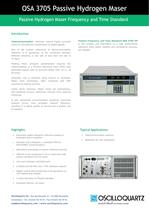
OSA 3705 Passive Hydrogen Maser Passive Hydrogen Maser Frequency and Time Standard Introduction Telecommunication networks require highly accurate Passive Frequency and Time Standard OSA 3705 PH clocks for the effective transmission of digital signals. is the number one alternative to a high performance One of the primary objectives of telecommunication are needed. reference when better stability and competitive accuracy networks is to guarantee, at the connection between different networks, a slip rate of less than one slip in 72 days. Meeting these stringent specifications requires the implementation of a Primary Reference Clock (PRC) that generates signals with an accuracy better than 1E-11, at all times. Generally, this is achieved using Cesium or Hydrogen Maser clock technology, often combined with GPS receivers as backup sources. Unlike off-air receivers, Maser clocks are autonomous, self-contained primary references immune from external influences. A well maintained synchronisation backbone minimises network errors, thus increases network efficiency, resulting in a higher quality of service and a greater use of capacity. Highlights Extremely stable frequency reference based on Hydrogen atom transition. Ultimate G.811/Stratum 1 compliant PRS for SDH/SONET synchronisation. Alternative technology to cesium reference sources. Lifetime is not constraint to 10-12 years like with cesium oscillators but 20 years. Low cost hydrogen refurbishment. 2.048/5/10/100 MHz and 1 PPS standard outputs. Digital control and monitoring of all operations on LCD display and keypad. 3 years warranty on Physics package. Expected lifetime: 20 years. Oscilloquartz SA / Rue des Brévards 16 / CH-2002 Neuchâtel Switzerland / Tel.+41(0)32 722 55 55 / Fax+41(0)32 722 55 56 [email protected] / www.oscilloquartz.com Typical Applications Telecommunication systems Reference for test equipment
Open the catalog to page 1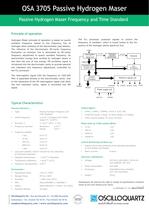
OSA 3705 Passive Hydrogen Maser Passive Hydrogen Maser Frequency and Time Standard Principle of operation Hydrogen Maser principle of operation is based on quartz oscillator frequency locked to the frequency line of hydrogen atom emission of the discriminator (see bellow). The processor produces signals to control the quency of the hydrogen atoms spectrum line. The influence of the discriminator RF-cavity frequency 5 MHz fluctuation on emission line is eliminated by RF-cavity Interrogation signal unit frequency adjustment to quartz oscillator frequency. As discriminator energy level emitted by...
Open the catalog to page 2All Oscilloquartz SA catalogs and technical brochures
 OSA 5405 series
4 Pages
 OSA 5410 series
6 Pages
 OSA 5420 series
6 Pages
 OSASyncViewPlus
2 Pages
 FSPSyncManager
2 Pages
 FSP
FSP2 Pages
 OSA 5051/5052 Dual Switch
2 Pages
 PARAGON-M
4 Pages
 OSA 5331 PTP Grandmaster
2 Pages
 OSA 5335 PTP Grandmaster
2 Pages
 OSA 5410/11 PTP Toolbox
3 Pages
 OSA 5240 GPS
2 Pages
 OSA 3235B Cesium Clock
2 Pages
 OSA 3030B EUDICS
4 Pages
 OSA 3230B Cesium Clock
2 Pages
 OSA 5581C GPS
4 Pages
 OSA 5335 PTP
2 Pages
 OSA 5548C TSG
2 Pages
 OSA 5210 Telecom GNSS Clock
2 Pages
 OSA 5225B Time Node
2 Pages
 3230-metro
2 Pages
 5130
51302 Pages
 5051-5052
2 Pages
 5030
50302 Pages
 5020
50202 Pages
 5225
52252 Pages
 3030
30304 Pages
 3700
37002 Pages
 5330
53302 Pages
 5533C
5533C4 Pages
 5135
51352 Pages
 5548c-tsg
4 Pages
 star3-4
2 Pages
 D5240_01
2 Pages
 D5230
D52302 Pages
 5200b
5200b2 Pages
 3230b
3230b2 Pages
 3230
32302 Pages
 5585b
5585b4 Pages
 OSA 5220 NTP Server r2.0
2 Pages
 OSA 4501 OEM GPS Clock
2 Pages
 OSA 5320 PTP Slave
2 Pages
 OSA 5533C SDU
4 Pages
 OSA 4500 OEM Clock Series
2 Pages
 OSA 453x GPS/RTM Series
2 Pages


