

3030

3030
- Frequency accuracy of 5x10-12 over a wide temperature range.
- Compact design with rugged housing.
- Easy operation via RS232 interface.
- Quick field interchangeability of sub-modules.
The OSA 3030 EUDICS is a digital cesium frequency standard designed for high precision applications such as telecommunications networks, navigation systems, and astrophysics. It offers enhanced integration capabilities and operational features for industrial and professional systems.
- Primary Reference Clock for navigation systems (Loran C, GPS, Galileo, Glonass).
- Broadcasting stations for long and medium wave.
- Localization and large base interferometry.
The device uses a quartz oscillator frequency-locked to the hyperfine resonance of cesium atoms, providing a stable output signal. The system employs a microprocessor-controlled frequency modulation to maintain the lock condition.
- Cesium beam tube under vacuum.
- Control Board: Manages clock functions and alarms.
- RF Synthesizer Board: Synthesizes microwave field for the cesium beam tube.
- General Power Board: Supplies DC voltages and high voltage for the cesium tube.
- Tube Power Board: Powers main tube components.
- Short-term frequency stability and phase noise specifications provided.
- Power supply requirements: 20V to 60V input, with specific consumption rates during warm-up and steady state.
- Operating temperature range: -10°C to 55°C.
- Humidity tolerance up to 95%.
- Dimensions and weight: 187.5x124x366 mm, approximately 10 kg.
- Frequency: 10MHz with accuracy and reproducibility of ±1x10-12.
- Stability measured by Allan deviation over various time intervals.
- Programmable output frequencies: 10MHz, 5MHz, 1MHz.
Catalog excerpts
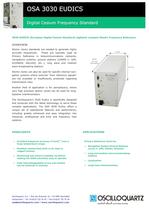
OSA 3030 EUDICS Digital Cesium Frequency Standard 3030 EUDICS (European Digital Cesium Standard) hightech compact Atomic Frequency Reference OVERVIEW Atomic clocks standards are needed to generate highly accurate frequencies. These are typically used as Primary Reference in telecommunications networks, navigations systems, ground stations (LORAN C, GPS, GLONASS, GALILEO, etc…), long wave and medium wave broadcasting stations. Atomic clocks can also be used for specific internal navigation systems where external “time reference signals” are not available or insufficiently protected regarding transmission risks. Another field of application is for astrophysics, where very high precision atomic clocks can be used for longbaseline interferometers. The Oscilloquartz’s 3030 Eudics is specifically designed and produced with the latest technology to serve these complex applications. The OSA 3030 Eudics offers a unique set of operational features and performance, including greatly enhanced and easy integration into industrial, professional and time and frequency host systems. HIGHLIGHTS Excellent frequency accuracy of 5x10-12 over a large temperature range. Smallest volume/foot print in its class in rugged housing Monitoring and control available via RS232 making the 3030 extremely easy to operate. APPLICATIONS Primary Reference Clock for: Navigation System Ground Stations (Loran C, GPS, Galileo, Glonass) Long and medium wave broadcasting stations Localization Field interchangeability of any sub-module can be achieved in minutes. Oscilloquartz S.A. / Rue des Brévards 16 / CH-2002 Neuchâtel Switzerland / Tel.+41(0)32 722 55 55 / Fax+41(0)32 722 55 56 [email protected] / www.oscilloquartz.com Large base Interferometry
Open the catalog to page 1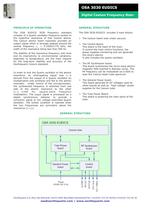
OSA 3030 EUDICS Digital Cesium Frequency Stan- PRINCIPLE OF OPERATION GENERAL STRUCTURE The OSA EUDICS 3030 frequency standard consists of a Quartz oscillator frequency-locked to the hyperfine resonance of free Cesium atoms. The Cesium atomic beam resonator provides an output signal which is strongly peaked around the central frequency = 9.192631770 GHz, the width of the resonance being less than 500 Hz. The OSA 3030 EUDICS includes 5 main blocks: The stability of the resonance frequency with time and its insensitivity to environmental variations, especially to temperature, are the main reasons...
Open the catalog to page 2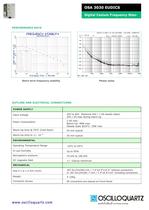
FREQUENCY STABILITY Averaging Time, x, Seconds SWATCH GROUP ELECTRONIC SYSTEMS
Open the catalog to page 3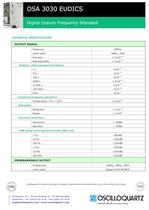
OSA 3030 EUDICS Digital Cesium Frequency Standard TECHNICAL SPECIFICATION OUTPUT SIGNAL Frequency 10MHz Level value 7dBm / 50Ω Accuracy ± 1x10-12 Reproducibility ± 1x10-12 Stability (Allan standard deviation) 1s 2x10-11 10 s 2x10-11 100 s 5x10-12 1000 s 1.5x10⁻¹² 10 000 s 5x10-13 100 000 s 3x10-13 Floor 3x10-13 Fractional frequency deviation Temperature -5°C + 55°C ± 2x10-12 Resolution < 1x10-15 Range ± 1x10⁻⁹ Settability Harmonic distortion Harmonics > 30dBc Spurious > 70dBc SBB phase noise spectral density (BW 1HZ) 1 Hz -90/dBc 10 Hz -120/dBc 100 Hz -135/dBc 1 kHz -145/dBc 10 kHz -145/dBc 100...
Open the catalog to page 4All Oscilloquartz SA catalogs and technical brochures
 OSA 5405 series
4 Pages
 OSA 5410 series
6 Pages
 OSA 5420 series
6 Pages
 OSASyncViewPlus
2 Pages
 FSPSyncManager
2 Pages
 FSP
FSP2 Pages
 OSA 5051/5052 Dual Switch
2 Pages
 PARAGON-M
4 Pages
 OSA 5331 PTP Grandmaster
2 Pages
 OSA 5335 PTP Grandmaster
2 Pages
 OSA 5410/11 PTP Toolbox
3 Pages
 OSA 5240 GPS
2 Pages
 OSA 3235B Cesium Clock
2 Pages
 OSA 3030B EUDICS
4 Pages
 OSA 3230B Cesium Clock
2 Pages
 OSA 5581C GPS
4 Pages
 OSA 5335 PTP
2 Pages
 OSA 5548C TSG
2 Pages
 OSA 5210 Telecom GNSS Clock
2 Pages
 OSA 5225B Time Node
2 Pages
 3230-metro
2 Pages
 5130
51302 Pages
 5051-5052
2 Pages
 5030
50302 Pages
 5020
50202 Pages
 5225
52252 Pages
 3700
37002 Pages
 5330
53302 Pages
 5533C
5533C4 Pages
 5135
51352 Pages
 5548c-tsg
4 Pages
 star3-4
2 Pages
 D5240_01
2 Pages
 D5230
D52302 Pages
 5200b
5200b2 Pages
 3230b
3230b2 Pages
 3230
32302 Pages
 3705
37052 Pages
 5585b
5585b4 Pages
 OSA 5220 NTP Server r2.0
2 Pages
 OSA 4501 OEM GPS Clock
2 Pages
 OSA 5320 PTP Slave
2 Pages
 OSA 5533C SDU
4 Pages
 OSA 4500 OEM Clock Series
2 Pages
 OSA 453x GPS/RTM Series
2 Pages


