
- Catalogs
- Orion Machinery
- Heavy Duty Chiller with Built-In Water Tank

Heavy Duty Chiller with Built-In Water Tank
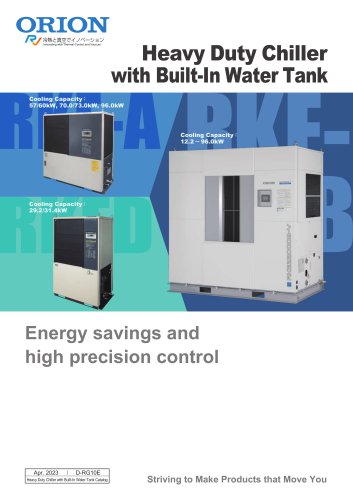
Heavy Duty Chiller with Built-In Water Tank
The RKE-B Series includes air-cooled and water-cooled models with various specifications. The models are equipped with fully sealed rotary or scroll compressors, inverter-driven, and have a cooling capacity ranging from 14.1 kW to 48.0 kW. The operable ambient temperature range is 2 to 45°C, with an accessory available for -20 to 50°C. The power source is three-phase 200V with a tolerance of ±10%.
Signal and communications wiring should be routed through separate access holes from power cables. The control panel features a touch panel for easy operation and monitoring. The system supports linking of multiple units, allowing centralized operation of up to 16 units.
The general tolerance follows JIS B0405(1991)-v standards. The unit includes an earth leakage breaker for safety.
For optimal performance, ensure the required quantity of water as shown in the cooling water flow rate graphs. Use clean water or a 30 to 40% ethylene glycol solution for chilled water, noting a 10% reduction in cooling capacity with the glycol solution.
The cooling capacity varies with water temperature, with detailed graphs provided for different models. The flow rate changes based on inverter frequency, and additives can affect flow rate characteristics.
The intelligent touch panel allows for intuitive operation, with language options in English, Japanese, and Chinese. The system includes a liquid temperature upper/lower limit warning and supports optional equipment like a central chiller controller and snow protection hood.
Various accessories are available, including high flow rate pumps, leakage alarm models, and remote control sets. The ventilation hood supports outdoor installations, and filters are available to prevent clogging in water circuits.
1. Temperature Detection and Alarms: The system allows for abnormal liquid (chilled water) temperature detection with options to enable or disable alarms for relative and absolute values. Alarms are triggered if the temperature exceeds set upper or lower limits, which can be configured via an intelligent touch panel.
2. Time Elapsed Warning: A warning is issued if a pre-set operational time is exceeded, aiding in maintenance management. The time can be set between 1 to 30,000 hours.
3. Communication and Remote Control: USB and RS-422A/485 communications enable remote operation and setting changes. Remote control can be wired with a maximum length of 100 meters, and a Central Chiller Controller can manage multiple units.
4. Signal Output and Alarm Options: The system provides options for operation and alarm signals through no-voltage contacts or voltage output. The relay action for alarms can be set via the touch panel.
5. Settings Lock: Changes to water temperature and other parameters can be locked to prevent unauthorized adjustments.
1. Casters and Coating: Various caster configurations are available, including free-wheeling and fixed options. The external surface is coated with polyester resin for corrosion resistance.
2. Water Temperature Control: Precision control of water temperature is maintained at ±0.1 ˚C, with heating functionality available to raise temperatures during startup.
1. Temperature Range: The system operates with a working liquid temperature range of 3 to 35 ˚C, with options for low and high ambient temperature specifications.
2. Freeze-Prevention and Warm-Up Modes: These modes prevent freezing and maintain water temperature during non-operational periods, configurable via the touch panel.
3. Noise and Weather Protection: Low noise mode reduces fan speed and noise, while snow protection mode and hoods prevent snow accumulation.
1. Pump and Valve Specifications: High flow rate pumps and relief valves are available for pressure protection. Water level alarms and supply port controls ensure consistent operation.
2. Water Filtration: Various water filter assemblies are available with different filtration ratings to maintain water quality.
- Water Quality: The equipment ensures water quality of 10 μS/cm or lower.
- Power Supply: Supports three-phase voltages: 200 V (50/60 Hz), 220 V (60 Hz), 230 V (50 Hz), and higher voltages requiring an external transformer.
- Overload Safety: Includes a built-in multipurpose overload and short circuit protection breaker with current sensitivities of 30 mA and 100 mA.
- Intelligent Touch Panel: Displays time, date, water temperature, and operational parameters. Supports multiple languages including Japanese, English, and Chinese.
- Operation Settings: Allows enabling/disabling operations from the main unit, remote control, or external communications.
- Power Outage Recovery: Offers manual, automatic, or remote operation priority recovery patterns.
- Freeze-Prevention Mode: Operates the discharge pump to prevent freezing during low temperatures.
- Warm Up Mode: Maintains water temperature during non-operation in cold conditions.
- Low Noise Mode: Reduces fan speed and noise.
- Outside Installation: Rated IPX4, requires additional measures for direct sunlight, strong winds, or freezing conditions.
- Snow Protection: Includes modes to prevent snow accumulation and entry into the system.
- Water Filters: Various assemblies available with filtration ratings from 5μm to 100μm.
- Remote Control: Options for wired remote control with varying maximum wiring lengths.
- Alarm and Signal Outputs: Configurable alarm signals and temperature warnings via the touch panel.
- Water Leakage Detection: Built-in leak detector.
- Vibration Reducing Base: Reduces vibration transmission from the chiller.
- Water Tank Alarms: Includes water-level alarms to prevent shortages.
The document outlines specifications for various models of chillers, including RKE3750B-VW-CE, RKE5500B-VW-CE, RKE7500B-VW-CE, RKE11000B-VW-CE, and RKE15000B-VW-CE. These models feature a built-in multi-purpose overload and short circuit protection breaker. The recommended liquid for use is either clean water or a 30 to 40% ethylene glycol solution, with a noted 10% reduction in cooling capacity when using the glycol solution. Deionized water should have an electrical conductivity of at least 1 μS/cm.
For liquid temperature settings of 0 to 3 °C, a 30 to 40% solution of industrial-use ethylene glycol is recommended. The actual cooling water flow rate will depend on the water temperature, and the required quantity of water is shown in accompanying graphs.
The document provides detailed flow rates for different models, with specific flow rates for each model at various water temperatures. For example, the RKE3750B-VW-CE has a flow rate of 43 L/min, while the RKE15000B-VW-CE has a flow rate of 200 L/min.
Cooling capacity is detailed under specific conditions, such as chilled water temperature and cooling water temperature at intake. The document includes graphs illustrating cooling capacity across different models and conditions.
Dimensions for each model are provided, including detailed diagrams showing the layout of components such as the cooling water inlet, outlet, and control panel.
The refrigerant circuit warranty is 2 years from the date of purchase or 10,000 hours of operating time.
The models comply with the RoHS2 Directive [2011/65/EU+(EU)2015/863] and have an IPX4 equivalent rating, indicating splash-proof protection.
Some models include features such as inverter-controlled compressors, built-in discharge pumps, and communication interfaces for temperature control via RS232C or RS422 interfaces.
- Water Filter Assemblies: Three models (A, B, C) with specific part numbers and applicable models. Key specifications include maximum working pressure (0.5 MPa), maximum working temperature (50°C), degree of filtration (100 μm), and initial element pressure loss (0.02 MPa at specified flow rates).
- Deionizer Assemblies: Three models (C, D, E) with specific part numbers and applicable models. Specifications include processing capacity, water quality, working water pressure (0.05 – 0.2 MPa), and working water temperature (5 – 40°C).
- Water Filter Installation: Wall mount type for easy cartridge replacement, with optional stand mount available. Includes ball valves as standard equipment.
- Deionizer Installation: Wall-mounted with optional stand mount. Installation should avoid direct sunlight and areas prone to damage.
- Unloading and Placement: Ensure the installation location is free from combustible materials and provides adequate space for ventilation and maintenance. Specific guidelines for forklift use and securing the unit are provided.
- Enables remote monitoring and operation of equipment using factory's internal network. Features include mail alerts for alarm conditions, CSV-format data logging, and remote operation capabilities.
- Software is only available in Japanese, and operation with non-Japanese systems is not confirmed.
- Ensure water supply and drainage piping is installed reliably to prevent leaks and potential electric shock.
- Maintain specified water pressure limits to avoid equipment damage.
- Follow specific guidelines for piping connections to prevent water leakage.
- Confirm positions of Cooling Water inlet and outlet, marked with stickers.
- Install Cooling Water inlet and outlet valves, safety relief valve, purge/drain valve, and union coupling.
- Ensure cooling water inlet pressure is 0.69 MPa or lower.
- Minimize pipe lengths and avoid vertical and curved piping.
- Use two wrenches for tightening connections.
- Install customer-supplied valves at chilled water ports and a Y-strainer on the intake side.
- Support long horizontal piping to prevent damage.
- Insulate piping and ensure water supply pressure is 0.50 MPa or less.
- Choose power cable based on breaker capacity and ensure proper grounding.
- Route power cord through access hole and secure with cable tie.
- Ensure source voltage is within ±10% of specified voltage and phase unbalance within ±3%.
- Use USB or RS-422A for communications, with specific cable lengths and gauges.
- Remote operation input and signal output specifications provided.
- Ensure duct cross-sectional area is adequate and install fans if necessary.
- Do not obstruct exhaust output within 2 m of the unit.
- Use ground, municipal, or cooling-tower water meeting quality standards.
- Operate with antifreeze rust inhibitor additives cautiously.
- Maintain water pressure at supply port at 0.50 MPa or less.
- Inspect water circuits and clean condenser filter monthly.
Ensure the power cable is secured to prevent contact with hot surfaces, which could cause melting and electrical shorts. The unit should not be operated with an empty water circuit; always fill the water tank and confirm the water level. Avoid performing voltage or insulation resistance tests without consulting a dealer, as these can damage the control board or inverter. Proper grounding is essential, with a ground wire diameter of at least 2 mm². The source voltage should be within ±10% of the specified voltage, and phase unbalance should be within ±3%.
Specifications for remote operation include no-voltage contacts input with a maximum cable length of 20 m and input resistance of 1200 Ω. Signal output specifications include no-voltage relay contact output with specific voltage and current ratings.
When installing ducting, ensure at least 50 cm of space above the product for maintenance. Support hardware should be installed to prevent tipping. Duct cross-sectional area and length should be considered to ensure proper ventilation and prevent overheating.
Water for the condenser can be ground, municipal, or cooling-tower water, meeting specific quality standards to prevent corrosion or scaling. The use of ethylene glycol solutions for freeze prevention is recommended, with specific concentration guidelines. Regular inspection and maintenance of water circuits and filters are advised.
Operate the unit within specified temperature ranges to avoid breakdowns. Frequent starting and stopping should be avoided, with at least 5 minutes between operations. Monthly inspections of water circuits and cleaning of filters are recommended to maintain performance.
The unit operates by circulating liquid through a heat exchanger to maintain a set temperature. Model selection should consider cooling capacity requirements and external heat sources. Calculations for cooling capacity are provided for different scenarios.
Installation and wiring should be performed by qualified personnel. Equipment should be used only for its intended purpose to prevent accidents or breakdowns. ORION provides a network of sales and service support, with a warranty period of 2 years for the refrigerant circuit.
There is a significant concern regarding the accidental release of HFC refrigerants into the atmosphere, contributing to global warming. Compliance with laws and regulations is essential when handling HFCs to ensure safety and environmental protection.
- R134a: GWP 1430
- R404A: GWP 3920
- R407C: GWP 1770
- R410A: GWP 2090
- R32: GWP 675
- Air-Cooled Models: Regular cleaning of the condenser is necessary to prevent dust or dirt accumulation, which can reduce heat exchange efficiency and increase electricity consumption.
- Water-Cooled Models: Ensure water quality to prevent scaling in cooling pipes, which can decrease heat exchange efficiency and performance.
- Regular inspections and maintenance are recommended to maintain optimal equipment performance. Service and inspection fees apply.
- For equipment repair information, consult your dealer. Post-warranty repair charges are the customer's responsibility.
- ORION maintains a stock of replacement parts for 7 years after production ceases.
ORION Machinery supports the Sustainable Development Goals (SDGs).
Catalog excerpts
Heavy Duty Chiller with Built-In Water Tank RKE-A RKED Cooling Capacity: 57/60kW, 70.0/73.0kW, 96.0kW Energy savings and high precision control Heavy Duty Chiller with Built-In Water Tank Catalog Striving to Make Products that Mov
Open the catalog to page 1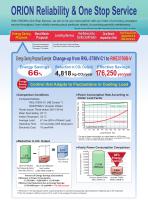
ORION Reliability & One Stop Service With ORION's One Stop Service, we aim to be your best partner with our motto of providing consistent service throughout, from initially hearing about particular details, to providing periodic maintenance. *Specific service offerings may differ depending on the country, region, or model. We have the equipment that meets your needs! See page 11 for details. We offer free loans of demo machinery. Feel free to contact us with any inquiries. Energy Saving Proposal Example: Change-up from RKL-3750V-C1 to RKE3750B-V Energy Savings Energy Saving Points Effective Savings...
Open the catalog to page 2
Global Service Network North America Service Network Europe Service Network East Asia Service Network South America Service Network ASEAN & South Asia Service Network Our service network is developing in Asia, Europe, North America and South America. We make effort to expand the network into the future. East Asia Service Network ORION Machinery (Shanghai) Co., Ltd. (China) Dongguan Orion Machinery Co., Ltd. (China) ORION (HONG KONG) Co., Ltd. (Hong Kong) ORION KOREA Co., Ltd. (South Korea) Taiwan Orion Industry Co., Ltd. (Taiwan) ASEAN Service Training Center ORION Machinery Asia Co., Ltd. (Thailand)...
Open the catalog to page 3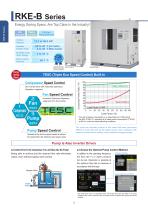
Energy Saving Specs. Are Top Class in the Industry! Air Cooled Water Cooled IPX4 Equiv. Rating Splash-proof Cooling Capacity Operable Ambient Temp. -20 to 45 ˚C [Air Cooled] 2 to 45 ˚C [Water Cooled] Operable Liquid Temp. Range Temp. Control Precision ※ Warranty period of the refrigerant circuitis 2 years from the date of purchase (or 10,000 hours of operating time). Energy Saving Points TESC (Triple Eco Speed Control) Built-In Compressor Speed Control Consumed Power Ratio RKE-B Series RKE-B Series DC Inverter Drive with Automatic Optimized Operation Judgment Automatic Optimized Operation Judgment...
Open the catalog to page 4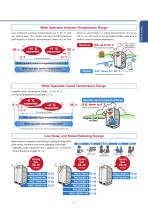
tends to accumulate. In winter temperatures as low as -20 ˚C, you can count on our air cooled models continuing to perform, even in outside installations. Can withstand summer temperatures up to 50 ˚C with our special-spec. Our chillers can also exhibit maximum performance in factory environments where hot air flow With an accessory (sold separately) (Conventional model) Wide operable ambient temperature (Standard model) Wide operable ambient temperature An accessory (sold separately) is needed for high operable ambient temperature. O.K. down to –20 ˚C (Air cooled model) * When setting antifreeze...
Open the catalog to page 5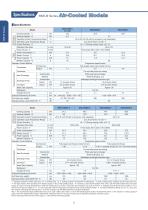
RKE-B Series Power Specifications Performance Specifications Operable Ambient Temperature Range Operable Liquid Temperature Range 3 to 35 (w/ brine: 0 to 35) *7 ±0.1 ˚C (Energy saving mode: ±2.0 ˚C) Operating Flow Rate Equipment Details Compressor speed control Construction Fully sealed rotary type (inverter driven) Fin and tube forced air cooling Construction Heat Exchanger Discharge Pump Fan Motor Plate type heat exchanger Multistage centrifugal immersion type Water Tank Capacity Charged Amount External Dimensions (H×D×W) Unit Mass (dry weight) Operating Noise Level (50/60 Hz) *5 Model Performance...
Open the catalog to page 6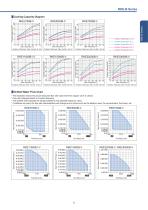
RKE-B Series ■Cooling Capacity Diagram RKE3750B-V Chilled Liquid : Water, Flow Rate : 43 L/min Chilled Liquid : Water, Flow Rate : 140 L/min Chilled Liquid : Water, Flow Rate : 200 L/min Chilled Liquid : Water, Flow Rate : 125 L/min Chilled Liquid : Water, Flow Rate : 125 L/min Chilled Liquid : Water, Flow Rate : 280 L/min Chilled Liquid : Water, Flow Rate : 400 L/min ■Chilled Water Flow Chart * The illustration shows the actual measured flow rate value when the bypass valve is closed. * Flow rate changes based on inverter frequency * The shaded area indicates the range possible for the adjusted...
Open the catalog to page 7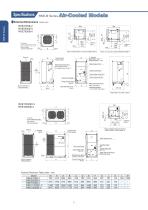
Air-Cooled Models Total 4 Points (Left and right side) Control Panel (Touch panel) Water Circuit Section Detail (RKE5500/7500B-V) Bypass Valve Access Port (Incl. inspection cover) (The bypass valve is built in.) 17.5 Detail of Chilled Water Circuit Parts (RKE3750B-V) 2-12 Hole (Anchor attachment hole) Chilled Water Outlet Rc1 Chilled Water Inlet Rc1 Liquid Level Gauge Wiring Access Hole (φ20.5) Water Tank Drain Rc1/2 Anchor Fastening Fitting Assembly (With 1/2B Valve) *RKE5500/7500B-V Rc 3/4 (With 3/4B valve) Total 4 Points (Left and right side) 4-12 Hole (Anchor attachment hole) Control Panel...
Open the catalog to page 8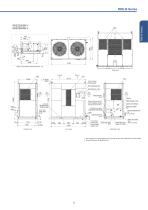
RKE-B Series RKE-B Series Water Circuit Section Detail (Tolerance: ±5) Rear View Exhaust Filter Control Panel (Touch panel) HFC Specifications Label Specifications Label Liquid Level Gauge Over Flow Outlet Rp1 Wiring Access Hole (Upper: Φ50.0, lower: Φ42.0) Drain Pan Drain Hole R1/2 Pressure Equalization Port R4 (Incl. 4B cap) (89) Drain Pan Drain Hole R1/2 Handle Water Supply PJ1/2 Bypass Valve Access Port (Incl. inspection cover) (The bypass valve is built in.) Rectanle Holes Chilled Water Inlet Rc2 8- 14mm Holes (front and rear) Anchor Hardware Installation Hole Chilled Water Outlet Rc2 Middle...
Open the catalog to page 9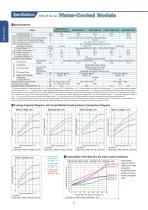
RKE-B Series ■Specifications Model Equipment details Power Specifications Performance Specifications Cooling Capacity *1 Heating Capacity *8 Operable Ambient Temperature Range Cooling Water Temperature Range Operable Liquid Temperature Range Control Precision *4 Operating Flow Rate Power Source *2 Power Consumption *1 Electric Current *1 Power Capacity *3 Breaker Capacity *6 Operation Control Method Construction Compressor Output Condenser Construction Heat Exchanger Material Construction Discharge Pump Output Water Tank Capacity Refrigerant Charged Amount External Dimensions (H×D×W) Unit Mass...
Open the catalog to page 10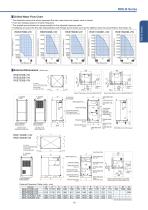
RKE-B Series Flow Rate (L/min) Flow Rate (L/min) Flow Rate(L/min) Cooling Water Inlet Rc1 34 Cooling Water Drain Hole (With plug) RKE3750B-VW : Rp1/4 RKE5500,7500B-VW : Rp3/8 Overflow Outlet Rp1 Water Tank Drain Rc1/2 Chilled Water Inlet Rc1 Drain Pan Drain Port Rc1/2 Chilled Water Outlet Rc1 Cooling Water Outlet Rc1 Wiring Access Hole (φ20.5) Freeze Prevention Valve Bypass Valve Access Port (Incl. inspection cover) (The bypass valve is built in.) Detail of Chilled Water Circuit Parts (RKE5500/7500B-VW) Control Panel (Touch panel) Liquid Level Gauge Anchor Fastening Fitting Assembly Anchor Fastening...
Open the catalog to page 11All Orion Machinery catalogs and technical brochures
 Ceiling-mounted Dehumidifier
8 Pages
 Chiller Product Guide
4 Pages
 INDUSTRIAL DEHUMIDIFIERS
12 Pages
 Chiller Unit without Water Tank
16 Pages
 Dry Vacuum Pump / Blower
52 Pages

- Industrial pump
- Pump with electric motor
- Stationary pump
- Chiller
- Dry pump
- Rugged pump
- Liquid recirculation chiller
- 400 V pump
- Low-noise pump
- Heavy-duty pump
- Air-cooled blast chiller
- 460 V pump
- Forced draft evaporator
- Outdoor recirculation chiller
- Air treatment unit
- Enclosure system
- Free cooling cooler
- Floor-mounted enclosure system
- Cooling unit cooler