
- Catalogs
- Oriental Motor
- Brief Introduction to Stepper Motors


Brief Introduction to Stepper Motors

Brief Introduction to Stepper Motors
This document provides an overview of stepper motors, focusing on their benefits, applications, and technical specifications. It aims to clarify misconceptions about stepper motors compared to servomotors and highlights their advantages in various applications.
Stepper motors are noted for their reliability, ease of use, simple structure, and cost-effectiveness. They offer excellent stopping accuracy, typically ±0.05°, making them ideal for precise positioning applications. They perform well at mid- and low-speeds, generating high torque, which is essential for short-distance positioning.
Stepper motors are used in diverse applications such as factory automation, medical equipment, and precision stages. They are particularly beneficial for short-stroke applications and systems requiring synchronized operation of multiple motors. Their adaptability and open-loop control make them suitable for low-rigidity mechanisms and variable loads.
The document highlights the cost-effectiveness of stepper motors, noting their potential to significantly reduce equipment costs compared to servomotors. The RK Series, for instance, offers a high-efficiency 5-phase stepper motor with a digitally controlled compact driver at a competitive price.
Stepper motors operate by moving in fixed angle units, allowing precise control without encoders or other electrical parts. This simplicity enhances their reliability and reduces maintenance needs. The document also discusses potential cost reductions by optimizing motor selection based on specific application needs.
The brochure encourages engineers to consider stepper motors as a viable alternative to servomotors, especially where cost, precision, and adaptability are critical. It includes a five-minute guide to the basics of stepper motors for newcomers to the technology.
The document discusses using a ball screw mechanism with a servomotor for high stopping accuracy, with a maximum speed of 600 mm/sec and a stroke of 1000 mm. It suggests switching to a belt mechanism to increase speed to 1000–1500 mm/sec and reduce costs, though belts are less rigid and may affect servomotor stability.
1. Switching from a ball screw to a belt mechanism may reduce stopping accuracy, but the intended usage does not require high precision.
2. The lower rigidity of a belt mechanism could affect servomotor stability, but stepper motors, which do not require adjustments, could be a viable alternative.
3. The document suggests exploring other options if they can provide the same output.
Switching from a servomotor to a stepper motor and from a ball screw to a belt mechanism results in significant cost reductions. The estimated cost for a typical servomotor setup is €1,165, while a stepper motor and belt setup costs €674, representing a 42% total cost reduction.
An exchange between Ms. Tell and Mr. Lerner clarifies the differences between stepper motors and servomotors in terms of stopping accuracy and resolution. Both motors have similar stopping accuracy, but stepper motors offer consistent positioning due to their mechanical structure. The discussion also highlights the advantages of the new RK Series stepper motors, which offer high efficiency and reduced power consumption at a lower price.
The document introduces the new 5-phase stepper motor and driver package, emphasizing its high performance and affordability. Oriental Motor offers a diverse lineup of stepper motors, including models with closed-loop control and various electric actuators. The company provides easy selection and quick delivery services.
Catalog excerpts

Discover Your Advantage! Technical Brochure for Engineers Everything You Need to Know About Stepper Motors Outstanding reliability: The stepper motor’s real advantage! The reliability of stepper motors is sometimes underestimated, and most people are surprised to learn that they are in fact just as reliable as servomotors. This brochure introduces the true strengths and advantages of stepper motors. CONTENTS A motor with real benefits Discover Your Advantage! Everything you need to know about stepper motors What is a stepper motor? Five-minute guide to the basics of stepper motors Addressing the cost problem A case in point Is there a way to reduce costs? Discover Your Advantage Which offer better stopping accuracy: stepper motors or servomotors? Pinpoint positioning Stepper Motors Pulse signals are precisely synchronized, and position and speed controlled accurately just by sending pulse signals from controller to driver. Our stepper motors’ low-speed yet high-torque, lowvibration operation makes them ideal for applications that require short-distance, short-time interval positioning. Free brochure:
Open the catalog to page 1
Discover Your Advantage Everything You Need to Know About Stepper Motors There are a lot of people who think servomotors outperform stepper motors – but nothing could be further from the truth. In fact, stepper motors are used in a wide range of devices, from cutting-edge equipment to everyday automatic machinery. So, why should people choose stepper motors? Instead of using technical data, we’ll explain using the perspective of actual users. Illustrated by Yoriyuki Suzuki New 5-phase stepper motor and driver package Our newest model combines a high-efficiency 5-phase stepper motor with a digitally...
Open the catalog to page 2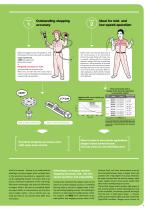
Outstanding stopping accuracy Ideal for mid- and low-speed operation Stepper motor stopping accuracy is the equivalent of ±0.05° when measured in the same units as a ball screw mechanism Stepper motors have especially high torque at mid- and low-speeds, as the representative characteristic graph (below left) makes clear. For example, a product with 85 mm attachment dimensions running at 1000 r/min has rated torque equivalent to a 400 W servomotor. At low speeds it can generate up to more than 5 times the torque. Generating high torque at mid- and low-speed is crucial to short distance positioning....
Open the catalog to page 3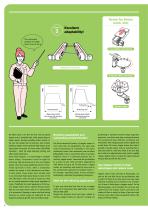
Great for these uses, too! Excellent adaptability! The synchronized operation of multiple motors is easy to set up Low-rigidity mechanisms Substrate conveyor Frequent starts and stops Stepper motor RPM Time Positioning time (Open-loop control) Runs in sync with operation commands the other hand, is not flat. The mid- and low-speed torque curve is relatively high, while torque drops at higher speeds. Besides providing stable rotation at the very low speeds that servomotors have trouble handling, stepper motors generate high-torque at the high-speeds necessary for short-stroke (low-RPM) operation...
Open the catalog to page 4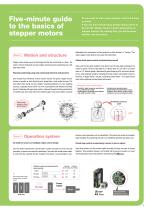
Five-minute guide to the basics of stepper motors Basic 1 Do you want to learn about stepper motors but have no time? If you are one of those busy people without time to go into the details, here is a short explanation of stepper motors. By reading this, you will become familiar with the basics. followability than servomotors and also produces no shaft vibration, or “hunting.” This makes stepper motors ideal for low-tension belt mechanisms. Utilizes both speed control and positioning control Stepper motor rotation moves in fixed angle units like the second hand on a clock. The motor’s internal...
Open the catalog to page 5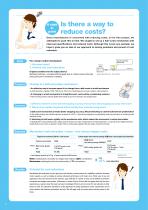
Is there a way to reduce costs? Every manufacturer is concerned with reducing costs, so for this project, we attempted to push this to limit. We sought to set up a ball screw mechanism with improved specifications and reduced costs. Although this is just one example, we hope it gives you an idea of our approach to solving problems and pursuit of cost reduction. For a linear motion mechanism: Increase speed and reduce cost! 1. Increase speed 2. Achieve real cost reductions Original conditions for the subject device Mechanism: ball screw + servomotor with load, speed, lead, etc. criteria as shown...
Open the catalog to page 6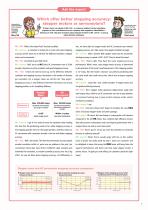
Which offer better stopping accuracy: stepper motors or servomotors? Oriental Motor Customer Support Center employee Oriental Motor Sales Division employee To learn more, we spoke to Ms. Tell – a customer support center employee popular for her contributions to our company info magazine “New Motion.” During our visit, she gave a lecture about stepper motors to Mr. Lerner – a young sales division employee. Ten-year company veteran, Mary Tell Rising star with three years’ experience, Paul Lerner Ms. Tell: What’s the matter Paul? You look troubled. fact, we have data for stepper motor and AC servomotor...
Open the catalog to page 7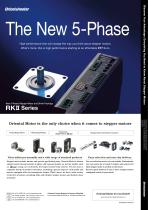
High performance that will change the way you think about stepper motors. What’s more, this is high performance starting at an affordable 377 Euro. New 5-Phase Stepper Motor and Driver Package Closed-loop Stepper Motors Stepper Motors with Electric Actuators Value-added pre-assembly and a wide range of standard products Easy selection and next day delivery Stepper motors make minute and precise positioning easy. Oriental Motor’s diverse stepper motor lineup includes 2-phase and 5-phase models, as well as models such as using our exclusively developed closed-loop control. We also have a complete...
Open the catalog to page 8All Oriental Motor catalogs and technical brochures
 Food Packaging
3 Pages
 Small Robots OVR Series
8 Pages
 CVD Series Multi-Axis Type
8 Pages
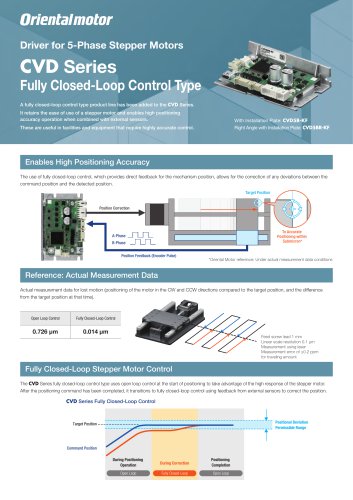 CVD Series Fully Closed-Loop
4 Pages
 Rotary Actuators DGII Series
72 Pages
 Rotary Encoder
4 Pages
 Product Guide
16 Pages
 Brushless Motors BLV-R Series
44 Pages
 Brushless Motors BLE2 Series
32 Pages
 Brushless Motors BMU Series
32 Pages
 Brushless Motors BLH Series
44 Pages
 Robot Controller MRC01
8 Pages
 Axial Flow Fans MD Series
28 Pages
 Axial Flow Fans MU Series
24 Pages
 Asynchronous Motors World K Series
124 Pages
 Linear Actuators DR Series
20 Pages
 AZ Series Mini Drivers
20 Pages
 AZ Series Connector Type
92 Pages
 Electric Gripper EH-Series
24 Pages
 Servo Motors AZX Series
28 Pages
 Torque Motors
8 Pages


- Oriental Motor electric motor
- DC electromotor
- Cylinder
- Synchronous motor
- Industrial robot
- Oriental Motor AC motor
- Multipole motor
- Electric gearmotor
- Angular encoder
- Linear actuator
- Asynchronous motor
- Incremental encoder
- EC motor
- Electromotor for industrial applications
- Three-phase motor
- Articulated robot
- 24 V motor
- 6-axis robot