


Advanced Uses of Oracle Enterprise Manager 12c(White Paper)

Advanced Uses of Oracle Enterprise Manager 12c(White Paper)
Executive Overview
Oracle Enterprise Manager 12c is designed to manage complex IT systems in both private cloud and traditional environments. It provides a comprehensive cloud lifecycle solution, integrated cloud stack management, and business-driven clouds, offering deep insights into applications and business transactions.
Complete Cloud Lifecycle Solution
The software supports all phases of building, managing, and consuming an enterprise cloud, including infrastructure, database, and platform as a service, from a single console.
Integrated Cloud Stack Management
Oracle Enterprise Manager 12c facilitates integrated management of the entire cloud stack, reducing integration costs and complexities.
Business-Driven Clouds
It enables the creation of application-aware clouds with insights into critical business transactions, enhancing business visibility and impact.
Objective of Whitepaper
This whitepaper aims to help IT teams leverage advanced features of Oracle Enterprise Manager 12c beyond basic monitoring, focusing on deep management of applications, databases, middleware, and server hosts.
Introduction
Oracle Enterprise Manager has evolved to support comprehensive management of Oracle applications, databases, middleware, and hardware, as well as non-Oracle environments through plug-ins.
Scalable Architecture Tips
Best practices for production environments include setting up a centralized Oracle Enterprise Manager site with separate components for the repository database, Oracle Management Service (OMS), and the agent, rather than a single-server setup.
Cloud Management
Oracle Enterprise Manager 12c supports planning, setup, deployment, and management of cloud environments, including private clouds with self-service portals and chargeback capabilities.
Security Concerns
Security management is crucial, with features for managing Oracle Secure Backup and implementing backup strategies.
Integrated System Management and Support
Automating patching and integrating with My Oracle Support are key features, enhancing system management efficiency.
Best Practices Using Deployment Procedures
Recommendations include configuring Oracle Active Data Guard and managing heterogeneous environments effectively.
Conclusion
Oracle Enterprise Manager 12c offers extensive capabilities for managing complex IT environments, providing tools for both Oracle and non-Oracle systems, and supporting advanced cloud management strategies.
The document discusses the limitations of placing all Oracle Enterprise Manager components on a single server, emphasizing the need for a distributed architecture to achieve scalability. It highlights the N-tier model introduced with Oracle Enterprise Manager Grid Control 10g, which divides the system into the Repository database, Oracle Management Service (OMS), and Oracle Enterprise Manager agent, allowing for scalability across multiple servers.
For large-scale deployments, the document recommends using multiple load-balanced management servers, potentially with hardware load balancers like F5 Networks’ BIG-IP. This setup aligns with Oracle’s vision of pooling and provisioning resources on demand.
The document advises using Oracle Real Application Clusters (RAC) for hosting the Oracle Enterprise Manager repository to ensure high availability. It also suggests setting up disaster recovery sites using Oracle Active Data Guard and shared storage for management services.
Oracle Enterprise Manager 12c supports various phases of the cloud lifecycle, including planning, setup, deployment, and management. It offers tools like the Consolidation Planner for resource planning and a self-service portal for cloud infrastructure setup.
The document contrasts traditional RMAN backup scripting with the streamlined process offered by Oracle Enterprise Manager 12c, which provides a step-by-step wizard to simplify backup management, reducing the need for manual scripting and minimizing human error.
Oracle Enterprise Manager 12c provides a comprehensive wizard for scheduling various types of backups. Users can adjust settings such as parallelism, compression, and media management. The tool simplifies the use of RMAN backup technology, making it accessible even to novice DBAs. It supports advanced features like block change tracking, introduced in Oracle Database 10g, and integrates the latest RMAN advancements depending on the database version.
Oracle Enterprise Manager 12c allows the execution of custom UNIX shell scripts through its Job System, enabling DBAs to automate and schedule these scripts. The system provides status tracking and notifications for backup success or failure.
Security concerns regarding centralized management are addressed by Oracle Enterprise Manager 12c through the creation of target groups with specific access rights. This ensures that DBAs only access databases within their domain, maintaining strict security protocols.
Oracle Secure Backup offers a secure, integrated tape backup management system, providing faster backups for Oracle Databases and supporting heterogeneous application file systems. It encrypts data before it leaves the database, ensuring security. An Express version is available for free with Oracle Database, albeit without encryption capabilities.
For large databases, Oracle Enterprise Manager 12c supports advanced backup strategies, such as weekly full backups combined with daily incremental backups. This approach facilitates point-in-time recovery and is particularly beneficial for large databases that require efficient backup and recovery processes.
Oracle Enterprise Manager 12c integrates with My Oracle Support to streamline patching and system management. It automates configuration management, patching, and deployment processes, reducing manual errors and improving operational efficiency. The integration provides proactive support advisories and recommendations, enhancing the overall customer experience.
Oracle Enterprise Manager 12c offers powerful deployment procedures for patching, even in environments with restricted internet access. These procedures are based on best practices and allow for advanced features like multiple patch applications and customization of patch flows.
The document outlines the procedure for patching Oracle Databases using Oracle Enterprise Manager 12c. Key steps include upgrading the OPatch utility, staging the patch, initiating a blackout, shutting down the database, applying the patch, executing root scripts, restarting the database, and stopping the blackout. These steps ensure a smooth patching process without triggering unnecessary alerts.
This feature allows for the capture and comparison of metadata definitions across application releases. It supports tracking changes, reverse-engineering database definitions, and propagating schema changes, enhancing database lifecycle management.
Oracle Enterprise Manager 12c facilitates the setup and management of standby databases, including Active Data Guard, which allows for reporting while applying redo information. This reduces production workload and enables database backup on standby systems.
The document describes how Oracle Enterprise Manager 12c manages Oracle Virtual Servers, including monitoring performance, managing configurations, provisioning new VMs, and supporting live migrations. It integrates with Oracle VM and Oracle Virtual Assembly Builder.
Oracle Enterprise Manager 12c provides tools for managing non-Oracle technologies, offering a unified console for monitoring various components across data centers, thus simplifying management in heterogeneous environments.
System administrators can monitor UNIX host performance metrics, including CPU, memory, and disk utilization, through Oracle Enterprise Manager 12c, which provides detailed graphical views and historical data.
The document highlights Oracle Enterprise Manager 12c's capabilities in capturing configuration metrics and ensuring compliance with standards like PCI DSS. It offers a Compliance Dashboard for auditors and regulators to monitor adherence to policies.
IT managers can use Oracle Enterprise Manager 12c to gain a comprehensive view of infrastructure systems, manage SLAs, and automate tasks, reducing reliance on scripts and focusing on high-value projects.
Oracle Enterprise Manager 12c's Topology Viewer aids in root cause analysis by visually identifying issues in complex systems, significantly reducing the time needed for manual checks and improving SLA compliance.
The document concludes with a discussion on managing Oracle Exadata Database Machines using Oracle Enterprise Manager 12c, highlighting its capabilities in monitoring both hardware and software components.
Catalog excerpts
An Oracle White Paper August 2013 Advanced Uses of Oracle Enterprise Manager 12c
Open the catalog to page 1
Advanced Uses of Oracle Enterprise Manager 12c Disclaimer The following is intended to outline our general product direction. It is intended for information purposes only, and may not be incorporated into any contract. It is not a commitment to deliver any material, code, or functionality, and should not be relied upon in making purchasing decisions. The development, release, and timing of any features or functionality described for Oracle’s products remains at the sole discretion of Oracle.
Open the catalog to page 2
Advanced Uses of Oracle Enterprise Manager 12c
Open the catalog to page 3
Advanced Uses of Oracle Enterprise Manager 12c Executive Overview In the modern business environment, many organizations depend on IT to deliver always on systems and mission-critical services. But behind the scenes, IT organizations are coping with more and more complexity than ever before—complexity from growing data volumes, to composite applications, to virtualization and the cloud. Managing all these systems and services 24x7, in a global environment is one monumental challenge and constant battle for IT. However, help is at hand. Today Oracle Enterprise Manager 12c, Oracle’s flagship enterpriseclass...
Open the catalog to page 4
Advanced Uses of Oracle Enterprise Manager 12c the leading providers of business applications and the middleware that many of your custom applications are built on top of, Oracle offers a cloud solution that is optimized for business services. With this in mind, Oracle’s approach starts with management capabilities that are built right into applications and infrastructure. Oracle Enterprise Manager 12c provides an integrated and seamless console that gives IT departments better business visibility and comprehensive insight right across the entire cloud stack. This integration enables IT to gain...
Open the catalog to page 5
Advanced Uses of Oracle Enterprise Manager 12c In the early years of the 21 century, Oracle introduced Oracle Enterprise Manager 10g Grid Control as its flagship Enterprise Management product. Grid Control featured a freshly redesigned interface and architecture, and was primarily intended to assist DBAs with their database management and monitoring tasks. This was achieved through the streamlining and automation of day-to-day DBA activities such as performance diagnosis and tuning, setting up and scheduling RMAN database backups, and setting up and managing Oracle Active Data Guard. Other capabilities...
Open the catalog to page 6
Advanced Uses of Oracle Enterprise Manager 12c transactions on services across a service bus, and can be used to set up the entire infrastructure for the cloud—whether the cloud is infrastructure as a service (IaaS), database as a service (DBaaS), schema as a service (Schema-aaS) or middleware as a service (MWaaS)—the latter three forming Oracle’s offering of platform as a service (PaaS). Oracle Enterprise Manager 12c also enables you to build a private cloud, deliver services in private cloud via its self-service portal, and manage the private cloud, including metering and chargeback. The DBaaS...
Open the catalog to page 7
Advanced Uses of Oracle Enterprise Manager 12c However, while fine for proof of concept purposes, this is the wrong approach for production use. The main working component engine of Oracle Enterprise Manager is the Oracle Management Service (OMS). This is a J2EE application previously deployed on Oracle Application Server, and now on Oracle WebLogic Server. As a result, only limited scalability would be achieved if all Oracle Enterprise Manager components were placed on a single server. Doing this limits use to one Java Machine process with its inherent limits of memory and processor speed. If...
Open the catalog to page 8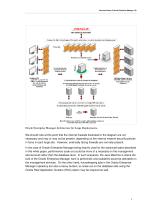
Advanced Uses of Oracle Enterprise Manager 12c Oracle Enterprise Manager Architecture for Large Deployments. We should note at this point that the internal firewalls illustrated in the diagram are not necessary and may or may not be present, depending on the internal network security policies in force in each large site. However, externally facing firewalls are normally present. In the case of Oracle Enterprise Manager being heavily used for the advanced tasks described in this white paper, performance scale-out could be more of a necessity on the management service level rather than the database...
Open the catalog to page 9
Advanced Uses of Oracle Enterprise Manager 12c Load Balancing Oracle Enterprise Manager In the case of a large Oracle Enterprise Manager setup; an example of a large scale Cloud Control deployment would involve thousands of targets across multiple servers and tiers. For this architecture, three or more load balanced management servers should be included. We could use for this purpose as an example; a hardware load balancer—like F5 Networks’ BIG-IP Application Switch Load Balancer. Setting up the Load Balancer in the appropriate way and balancing requests from management servers is further discussed...
Open the catalog to page 10
Advanced Uses of Oracle Enterprise Manager 12c technology. Doing this simplifies the management of the disaster recovery site, because standby OMSs are no longer required to be manually updated following operations such as OMS patch applications, plug-in updates, or upgrades. For further information on these MAA concepts and techniques for Cloud Control, you can refer to Part VII: Configuring Oracle Enterprise Manager for High Availability included in the Oracle Enterprise Manager Cloud Control Administrator's Guide 12c Release 3 (12.1.0.3) from Oracle’s documentation library. You can also refer...
Open the catalog to page 11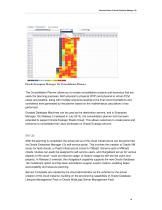
Advanced Uses of Oracle Enterprise Manager 12c Oracle Enterprise Manager 12c Consolidation Planner The Consolidation Planner allows you to create consolidation projects and scenarios that are useful for planning purposes. Both physical to physical (P2P) and physical to virtual (P2V) cases are possible, along with multiple scenarios leading to the final recommendations and confidence level generated by the planner based on the mathematical calculations it has performed. Exadata Database Machines can be used as the destination servers, and in Enterprise Manager 12c Release 3 (released in July 2013),...
Open the catalog to page 12All Oracle catalogs and technical brochures
 Oracle Analytics
4 Pages
 STORAGETEK SL150
5 Pages
 Oracle Server X7-8
6 Pages
 Oracle Server X7-2
6 Pages
 Oracle’s SPARC T7 and M7
6 Pages
 Oracle Solaris 11
3 Pages
 sparc-t5-2-ds-1922871
6 Pages
 ds-timesten-imdb-129255
3 Pages
 osb
osb2 Pages
 oracle-database-editions-wp-12c
19 Pages
 MySQL
MySQL4 Pages
 ORACLE SOLARIS 10
5 Pages
 Oracle Linux (White Paper)
23 Pages
 ORACLE SOLARIS 11.1
4 Pages
 Oracle Fusion Middleware
556 Pages
 pillar-axiom-600
6 Pages
 036083
4 Pages
 DB
DB2 Pages
 erp-cloud
7 Pages
 netra-blade-x3-2b
4 Pages
 etra-sparc-t4-2-ds
4 Pages
 netra-server-x3-2-ds
5 Pages
 m-seriesarchitecture
64 Pages
 sparc-t4-4
4 Pages
 dynamic-tracing
2 Pages
 solaris-zfs
3 Pages
 solaris-10
5 Pages
 Oracle WebCenter
8 Pages
 Sun Server X2-8
5 Pages
 Sun Server X2-4
5 Pages
 Sun Server X3-2L
5 Pages
 Sun Server X3-2
5 Pages
 sun-fire-x2270-
4 Pages
 servers-storage
19 Pages
 sparc-supercluster
6 Pages
 public-sparc-roadmap
4 Pages
 hardware-brochure
8 Pages
 berkeley-db-xml
2 Pages
 berkeley-db
2 Pages
 berkeley-db
2 Pages
 exadata
2 Pages
 database-firewall
2 Pages
 advanced-security
2 Pages
 big-data
16 Pages
 034782
5 Pages
 java-tech-for-embedded
2 Pages
 application-server
18 Pages
 em12c-executive
2 Pages
 dms-11g
4 Pages
 oracle_DATA.pdf
22 Pages


Archived catalogs
 Sun Network 10GbE Switch 72p
4 Pages
 Sun Storage 2500-M2 Array
3 Pages
 Sun Blade 6000
5 Pages
 Sun Blade X6270 M2
4 Pages
 Oracle Learning Management
5 Pages
 Oracle Human Resources
5 Pages




- Oracle management software
- Oracle automation software
- Oracle analysis software
- Oracle process software
- Real-time software
- Windows software
- Computer-aided design software
- Oracle cloud software
- Control software
- Design software solution
- Monitoring software solution
- 3D software solution
- Interface software
- Visualization software solution
- Quality software
- Automated software
- Programming software
- Oracle rack-mount server
- Oracle development software
- Network software