


Weld Contrast Opto solino RTI sensor
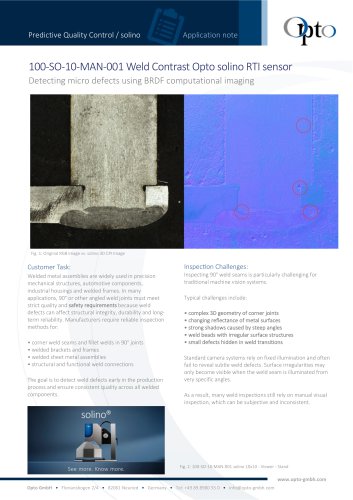
Weld Contrast Opto solino RTI sensor
Welded metal assemblies are crucial in various industries, including precision mechanical structures, automotive components, and industrial housings. Ensuring the quality of 90° or other angled weld joints is essential due to their impact on structural integrity and reliability. Reliable inspection methods are necessary for corner weld seams, welded brackets, sheet metal assemblies, and structural weld connections to detect defects early and maintain consistent quality.
Inspection Challenges
Traditional machine vision systems face challenges in inspecting 90° weld seams due to complex 3D geometry, changing metal surface reflectance, strong shadows, and irregular weld bead structures. These systems often fail to detect subtle defects, leading to reliance on subjective manual inspections.
Technology Principle
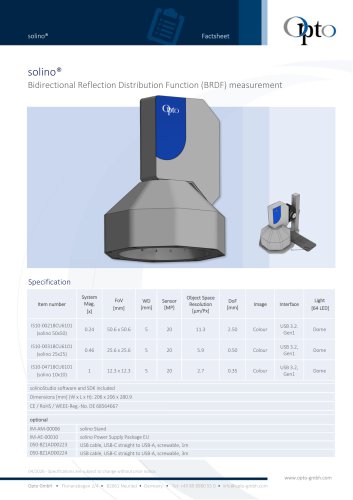
The solino RTI sensor employs BRDF-based computational imaging to detect weld surface structures that conventional imaging misses. It captures 64 images under various illumination directions, reconstructing surface reflectance information. Key features include multi-directional LED illumination, photometric stereo image capture, and computational defect enhancement, creating a stable inspection environment.
Technology Benefits
Solino enhances the visibility of surface anomalies on metallic weld seams, such as cracks, pores, inclusions, undercuts, incomplete fusions, spatter, burrs, and geometry deviations. It is particularly effective on metallic surfaces where traditional vision systems struggle.
Application
The solino 10×10 RTI sensor inspects welded assemblies post-welding or during final quality checks. It enhances contrast to reveal defects in corner weld seams, welded brackets, structural joints, weld bead transitions, and surface finishes.
Solution Architecture
The system includes a solino RTI sensor with 64 LED dome illumination, a high-resolution 20 MP camera, and solinoStudio software for image acquisition and processing. The compact design allows easy integration into automated systems. The workflow involves positioning the component, capturing images, reconstructing weld surface reflectance, and visualizing the structure with solinoStudio.
Conclusion
The solino RTI sensor combines controlled illumination with computational imaging to detect difficult weld surface structures, enabling reliable automated inspection of 90° weld seams. This supports manufacturers in improving weld quality, reducing inspection variability, and ensuring consistent product reliability. Additional image processing and AI options are available upon request.
Catalog excerpts
Predictive Quality Control / solino Application note G^to100-SO-10-MAN-001 Weld Contrast Opto solino RTI sensorDetecting micro defects using BRDF computational imaging Customer Task: Welded metal assemblies are widely used in precision mechanical structures, automotive components, industrial housings and welded frames. In many applications, 90° or other angled weld joints must meet strict quality and safety requirements because weld defects can affect structural integrity, durability and longterm reliability. Manufacturers require reliable inspection methods for: • corner weld seams and fillet welds in 90° joints • welded brackets and frames • welded sheet metal assemblies • structural and functional weld connections The goal is to detect weld defects early in the production process and ensure consistent quality across all welded components. Inspection Challenges: Inspecting 90° weld seams is particularly challenging for traditional machine vision systems. Typical challenges include: • complex 3D geometry of corner joints • changing reflectance of metal surfaces • strong shadows caused by steep angles • weld beads with irregular surface structures • small defects hidden in weld transitions Standard camera systems rely on fixed illumination and often fail to reveal subtle weld defects. Surface irregularities may only become visible when the weld seam is illuminated from very specific angles. As a result, many weld inspections still rely on manual visual inspection, which can be subjective and inconsistent. Fig. 2: 100-SO-10-MAN-001 solino 10x10 - Viewer - Stand Opto GmbH • Floriansbogen 2/4 • 82061 Neuried • Germany • Tel: +49 89 8980 55 0 • [email protected]
Open the catalog to page 1
Technology Principle The solino RTI sensor uses BRDF-based computational imaging to reveal weld surface structures that conventional imaging cannot reliably detect. Within milliseconds the system captures a series of 64 images under multiple illumination directions and reconstructs the surface reflectance information computationally. Key elements include: • 64 multi-directional LED illumination • photometric stereo image capture • reflectance-based surface reconstruction • computational defect enhancement The solino 10×10 RTI sensor can be used to inspect welded assemblies directly after the...
Open the catalog to page 2All OPTO catalogs and technical brochures
 IM•profile M
2 Pages
 Machine Vision Objectives
24 Pages
 Microscope Accessories
28 Pages
 043-112414-C02
2 Pages
 100-CO24-TC
2 Pages
 CylinderInspector 2D
2 Pages
 Focus Drive C, Coarse
2 Pages
 043-603020
2 Pages
 043-112108
2 Pages
 010-310345
1 Page
 100-GS100-02
2 Pages
 100-GS100-01
2 Pages
 Opto Test & Measurement
4 Pages
 Opto Medical & Life Science
4 Pages
 043-21300X
2 Pages
 IP10-06q33CU5101 four pages
4 Pages
 Opto Software
6 Pages
 Imaging Modules
6 Pages
 Trackstand
2 Pages
 043-112414-C01
2 Pages
 100-MS50-GAN
2 Pages
 100-MS50-AN
2 Pages
 100-MS25-GAN
2 Pages
 100-MS25-AN
2 Pages
 045-100130-01
2 Pages
 MMM 4.0
2 Pages
 IC10-05033CU3101 four pages
4 Pages
 IM•linea M
2 Pages
 IM•compact_M
2 Pages
 043-610022
2 Pages
 043-600505
2 Pages
 043-102302-72
2 Pages
 Jointed Coupler
1 Page
 Tilting Table
4 Pages
 Oblique Viewing Module
4 Pages
 Jointed Couplers
4 Pages
 IM MACHINEVISIONMICROSCOPE
6 Pages







- Digital imager
- Visible imager
- CMOS camera module
- Industrial camera module
- OPTO positioning stage
- Full-color camera system
- Monitoring camera system
- OPTO microscope
- Calibration system
- OPTO linear positioning stage
- USB camera module
- Detection camera system
- Monochrome camera module
- OPTO optical microscope
- Image processing camera module
- Inspection system
- GigE Vision camera
- Compact imager
- Inspection imager
- Precision positioning table