


Watch Movement Anomaly Opto solino RTI sensor

Watch Movement Anomaly Opto solino RTI sensor
The document discusses the use of predictive quality control in the production of precision watch movements, which require high-quality standards due to their miniature components and polished metal surfaces. The focus is on detecting surface defects early in the production process to ensure consistent quality.
Inspection Challenges
Inspecting the inner mechanics of watches is challenging for traditional machine vision systems due to highly reflective surfaces, complex geometries, and small components. Standard camera systems often fail to reveal subtle surface irregularities, necessitating manual visual inspections by skilled operators.
Technology Principle
The solino RTI sensor employs BRDF-based computational imaging to reveal surface structures. It captures images under different illumination angles and reconstructs surface reflectance information. Key elements include multi-directional LED illumination, photometric stereo image capture, and computational defect enhancement.
Technology Benefits
The solino system enhances the visibility of surface anomalies on reflective materials, such as scratches, dents, roughness changes, texture deviations, and coating defects. It is particularly effective on polished or decorated metal surfaces.
Application
The solino 10x10 system is used to inspect assembled watch movements, targeting gear wheels, pinions, bridge surfaces, screws, and decorative finishes. It captures surfaces under 64 illumination directions, making small defects visible with high contrast.
Solution Architecture
The inspection system includes the solino RTI sensor, integrated dome illumination with 64 LEDs, a high-resolution 20MP industrial camera, and solinoStudio inspection software. The compact sensor design allows easy integration into production machines.
Conclusion
The solino RTI sensor combines controlled illumination and computational imaging to reveal surface structures difficult to detect with traditional systems. This enables reliable automated inspection of precision watch components, supporting manufacturers in maintaining high-quality standards.
Catalog excerpts

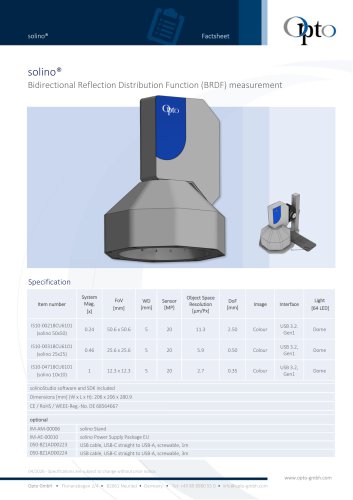
Predictive Quality Control / solino Application note J^)tO100-SO-10-MAN-001 Watch Movement Anomaly Opto solino RTI sensorDetecting micro defects using BRDF computational imaging Customer Task: Precision watch movements contain dozens of miniature components made from highly polished or decorated metal surfaces. They must meet extremely high-quality standards because even the smallest surface defect can affect functionality, reliability, and the perceived value of the final watch. • jewel bearings • decorative finishes The goal is to detect surface defects early in the production process and ensure consistent quality across all assembled movements. Inspection Challenges: Inspecting inner watch mechanics is particularly challenging for traditional machine vision systems. Typical challenges include: • Highly reflective metal surfaces • Complex geometries and small components • Decorative finishes that change appearance with lighting • Micron-scale scratches or dents • Particles or contamination inside the movement Standard camera systems rely on fixed lighting conditions and often fail to reveal subtle surface irregularities. Small defects may only become visible when the surface is tilted under specific lighting angles. As a result, many inspections still rely on manual visual inspection performed by skilled operators. Fig. 2: 100-SO-10-MAN-001 solino 10x10 - Viewer - Stand man Opto GmbH • Floriansbogen 2/4 • 82061 Neuried • Germany Tel: +49 89 8980 55 0 • [email protected]
Open the catalog to page 1
Technology Principle The solino RTI sensor uses BRDF-based computational imaging to reveal surface structures. Within milliseconds the system captures a series of images under different illumination angles and reconstructs the surface reflectance information computationally. solino 10x10 is used to inspect assembled watch movements. Typical inspection targets include: • gear wheels, pinions or bridge surfaces • screws and screw heads • decorative surface finishes • contact surfaces between moving parts • photometric stereo image capture • reflectance-based surface reconstruction • computational...
Open the catalog to page 2All OPTO catalogs and technical brochures
 IM•profile M
2 Pages
 Machine Vision Objectives
24 Pages
 Microscope Accessories
28 Pages
 043-112414-C02
2 Pages
 100-CO24-TC
2 Pages
 CylinderInspector 2D
2 Pages
 Focus Drive C, Coarse
2 Pages
 043-603020
2 Pages
 043-112108
2 Pages
 010-310345
1 Page
 100-GS100-02
2 Pages
 100-GS100-01
2 Pages
 Opto Test & Measurement
4 Pages
 Opto Medical & Life Science
4 Pages
 043-21300X
2 Pages
 IP10-06q33CU5101 four pages
4 Pages
 Opto Software
6 Pages
 Imaging Modules
6 Pages
 Trackstand
2 Pages
 043-112414-C01
2 Pages
 100-MS50-GAN
2 Pages
 100-MS50-AN
2 Pages
 100-MS25-GAN
2 Pages
 100-MS25-AN
2 Pages
 045-100130-01
2 Pages
 MMM 4.0
2 Pages
 IC10-05033CU3101 four pages
4 Pages
 IM•linea M
2 Pages
 IM•compact_M
2 Pages
 043-610022
2 Pages
 043-600505
2 Pages
 043-102302-72
2 Pages
 Jointed Coupler
1 Page
 Tilting Table
4 Pages
 Oblique Viewing Module
4 Pages
 Jointed Couplers
4 Pages
 IM MACHINEVISIONMICROSCOPE
6 Pages








- Digital imager
- Visible imager
- CMOS camera module
- OPTO positioning stage
- Full-color camera system
- Monitoring camera system
- OPTO microscope
- Calibration system
- OPTO linear positioning stage
- USB camera module
- Detection camera system
- Monochrome camera module
- OPTO optical microscope
- Image processing camera module
- GigE Vision camera
- Compact imager
- Inspection imager
- Precision positioning table