


Wafer and PCB control with Opto's 'Machine Vision Microscopes' (4 pages)

Wafer and PCB control with Opto's 'Machine Vision Microscopes' (4 pages)
Opto GmbH provides machine vision microscopes designed for wafer and PCB control, emphasizing the importance of optical inspection in quality control processes. These microscopes are integrated into automated optical inspection (AOI) systems and are suitable for digital manual inspection.
PCB Inspection
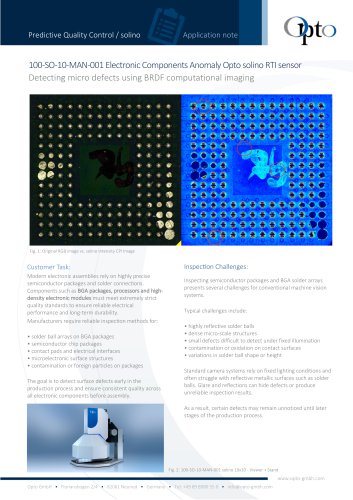
The Opto Imaging Modules are designed for integration into machines or workstations for PCB quality control, rework, failure analysis, and documentation. They feature LED coaxial and ring light illumination for bright and dark field imaging. These modules help identify soldering defects, cracks, short circuits, and other anomalies. They support automated measurements and component identification, enhancing Industry 4.0 compliance.
Software and Usability
The OptoViewer 2.0 software facilitates pixel-to-pixel measurements, annotations, and image storage. The imaging modules are compact, pre-calibrated, and optimized for mobile use, offering high image quality and cost-effective quality control.
Semiconductor Inspection
In semiconductor production, Opto's microscopes assist in detecting defects during wafer processing. They offer resolutions down to 100 nm per pixel, suitable for identifying larger defects. The modules support various illumination techniques, including brightfield, darkfield, and DIC, to enhance contrast and detail visualization.
Integration and Customization
Opto Imaging Modules are easily integrated into AOI machines due to their compact form factor. They offer a balance between price and quality, with reliability in image acquisition. The IM•linea XL modules provide macro and micro imaging capabilities with dual-camera setups, allowing simultaneous overview and detailed imaging.
Conclusion
Opto's machine vision microscopes replace conventional microscopes and optical zoom systems, offering advanced imaging solutions for PCB and semiconductor inspection. The company provides support for image analysis, processing tasks, and custom software development.
Author
Markus Riedi, CEO
Catalog excerpts
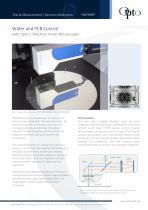
Test & Measurement / Semicon Electronics Wafer and PCB Control with Opto’s ‘Machine Vision Microscopes’ Fig. 1: Imaging Module compact M IC10-05o33MU3101 with 37mm WD . Electronics are an essential part in nearly every device we are using daily. The demand is high, the volumes huge, the size miniaturized, the price normally quite low, but the high throughput inspection needs throughout all the production steps are extremely high and must be fully automated. The optical inspection is – besides the electrical testing – one of the most important technologies in all Quality Control levels. As the Opto Imaging Modules are pure plug & play digital microscopes, they are by nature done for integration into AOI machines and for the need of digital manual inspection. PCB Inspection The new Opto Imaging Modules could be easily integrated in every machine or workstation for accurate printed circuit board (PCB) quality control, rework, failure analysis or documentation process. The time for optical microscopes is over, the operator wants to work purely on a screen and the Quality department wants Industry 4.0 compliance. The new machine vision microscopes have a LED coax- and ring light integrated. Here some more detailed explanation of how our machine vision microscopes (Opto Imaging Modules with microscopic magnification higher than 1x) could assist in optimizing the optical defect screening. Fig. 2: Coaxial LED serves as incident light bright field illumination, the integrated ring light as incident light dark field illumination www.opto-gmbh.com Opto GmbH • Floriansbogen 2/4 • 82061 Neuried • Germany • Tel: +49 89 8980 55 0
Open the catalog to page 1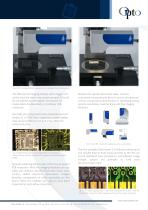
Fig. 3: IM · compact M with coaxial (left) & ring light illumination (right) The IM•linea M Imaging Module with a bigger FoV , or the machine vision microscope compact M could be considered as pure digital microscopes for single-sided, double-sided, or multilayer PCB inspection. Besides this typical microscope tasks, and also automated measurements like pin counts, pin distance control, components identification or identifying wrong polarity assemblies could be done with the Imaging Modules. Normally the components to be inspected are LED diodes, IC`s, FPGA Chips, capacitors, plastic leaded chip...
Open the catalog to page 2
“Time is money”, that’s why the Imaging Modules allow cost-effective QC: • All modules are more compact than regular digital microscopes • Optimized for mobile use • An image in 2 Minutes on a mobile computer • Pre calibrated so immediate measurements are possible • Fatigueless inspection for one or more users on monitor • Highest image quality with huge color repeatability • Less expensive than microscopes with similar optical quality • Robust with integrated LED`s and no moving parts • Perfect mix between working distance, magnification, and size to perform best ergonomics • One unit, all embedded,...
Open the catalog to page 3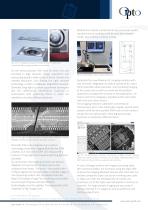
Module by module is produced to the same high quality standard and as nothing could be optically changed inside, also nothing could go wrong. Fig. 12: For imaging transparent samples like photomasks also transmitted light imaging modules are available As the semiconductor AOI must be done fast and normally in high volumes, image acquisition and processing speed is often a critical factor. Besides the needed resolution, also finding the right contrast technology is often a challenge. Brightfield (coaxial), Darkfield (ring-light) or more specialized techniques like DIC (Differential Interference...
Open the catalog to page 4All OPTO catalogs and technical brochures
 IM•profile M
2 Pages
 Machine Vision Objectives
24 Pages
 Microscope Accessories
28 Pages
 043-112414-C02
2 Pages
 100-CO24-TC
2 Pages
 CylinderInspector 2D
2 Pages
 Focus Drive C, Coarse
2 Pages
 043-603020
2 Pages
 043-112108
2 Pages
 010-310345
1 Page
 100-GS100-02
2 Pages
 100-GS100-01
2 Pages
 Opto Test & Measurement
4 Pages
 Opto Medical & Life Science
4 Pages
 043-21300X
2 Pages
 IP10-06q33CU5101 four pages
4 Pages
 Opto Software
6 Pages
 Imaging Modules
6 Pages
 Trackstand
2 Pages
 043-112414-C01
2 Pages
 100-MS50-GAN
2 Pages
 100-MS50-AN
2 Pages
 100-MS25-GAN
2 Pages
 100-MS25-AN
2 Pages
 045-100130-01
2 Pages
 MMM 4.0
2 Pages
 IC10-05033CU3101 four pages
4 Pages
 IM•linea M
2 Pages
 IM•compact_M
2 Pages
 043-610022
2 Pages
 043-600505
2 Pages
 043-102302-72
2 Pages
 Jointed Coupler
1 Page
 Tilting Table
4 Pages
 Oblique Viewing Module
4 Pages
 Jointed Couplers
4 Pages
 IM MACHINEVISIONMICROSCOPE
6 Pages






- Digital imager
- Visible imager
- CMOS camera module
- Industrial camera module
- OPTO positioning stage
- Full-color camera system
- Monitoring camera system
- Calibration system
- OPTO linear positioning stage
- USB camera module
- Detection camera system
- Monochrome camera module
- Image processing camera module
- Inspection system
- GigE Vision camera
- Compact imager
- Inspection imager
- Precision positioning table